
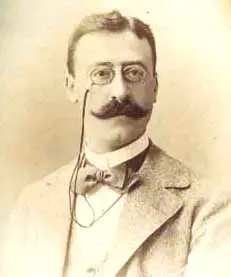
MIESES, JACQUES (Jacob), German-born British chess grandmaster, writer, and journalist. Born on February 27, 1865, in Leipzig, Saxony, to Julius Mieses, a Jewish merchant. Mieses attended the Thomasschule in Leipzig (one of Germany’s oldest schools, once led by Johann Sebastian Bach), graduating cum laude. His father later recalled that the boy excelled at “the serious game of chess, in which he acquired mastery, especially as a blindfold player of the first rank.”
After briefly attending the University of Leipzig, Mieses devoted himself entirely to chess. His first notable success came in 1882, when he won the Berlin championship at 17. Over the following decades, he competed in virtually every major international tournament, including Hastings 1895, Paris 1900, Monte Carlo 1903, and Ostend 1907. Known as “the last Romantic,” he was celebrated for his brilliant attacking style and won more brilliancy prizes than almost any contemporary. His greatest tournament victory was the first Trebitsch Memorial in Vienna in 1907, where he defeated a world-class field that included Duras, Maróczy, Tartakower, Vidmar, and Schlechter.
In 1911, Mieses organized the legendary San Sebastián tournament, establishing the then-revolutionary principle that all participating masters’ travel and living expenses should be covered, a standard that became the norm for international chess events.
Mieses was the doyen of German chess writers, authoring over 76 publications, including tournament books, opening manuals, and the popular instructional work Wie man Schach lernt, wie man Schach spielt. From the 1920s, he also edited many standard chess textbooks. The chess opening 1.d3 bears his name (“Mieses Opening”), and he developed the Mieses Variation of the Scotch Game.
Emigration
With the Nazi rise to power in 1933, Jewish chess players were systematically expelled from the Greater German Chess Federation, barred from official tournaments, and forbidden from publishing. Following Kristallnacht on November 9–10, 1938, the 73-year-old Mieses fled Leipzig with only 15 Reichsmarks in his pocket, leaving behind his apartment at Christianstraße 19. He emigrated to London, where he had relatives, settling at 66 Oakley Square in Camden Town.
An acquaintance who visited him in 1939 found Mieses physically impaired, a consequence of a severe car accident in Kemeri, Latvia, in 1937, and deeply marked by the ordeal of his flight from Germany. Despite these hardships, Mieses took British citizenship and continued playing tournaments, giving simultaneous exhibitions, and writing chess columns throughout the war years.
Late Career in England
Mieses’ achievements after emigration were remarkable. In 1946, at the age of 80, he won the brilliancy prize at Hastings for an attacking combination against the 22-year-old Christoffel, exactly half a century after his first Hastings appearance in 1895. He was the sole surviving participant of that original tournament. In 1949, at age 84, he defeated the 86-year-old Dutch master Dirk van Foreest, remarking afterwards: “Youth has been victorious.”
When FIDE officially awarded the Grandmaster title in 1950, Mieses was among the original 27 recipients and the oldest of them at age 85, thus technically becoming the first British Grandmaster (the first British-born Grandmaster was later Tony Miles).
His professional chess career spanned an unprecedented 64 years (1888–1952), a record never surpassed. His longevity was attributed in part to his commitment to physical fitness. He was known for swimming daily well into old age.
Mieses died on February 23, 1954, in a London nursing home, four days before his 89th birthday.
Sources: D. Hooper and K. Whyld, The Oxford Companion to Chess (1996), 258–59; British Chess Magazine, April 1954 (obituary); J. Geppert, https://www.mieses.info — biographical website with family archive materials, game replays, and historical documents, maintained by the Mieses family.
Encyclopaedia Judaica. © 2007 The Gale Group. All Rights Reserved.
D. Hooper and K. Whyld, The Oxford Companion to Chess (1996), 258–59.
Photo: Public domain, via Wikimedia Commons.