
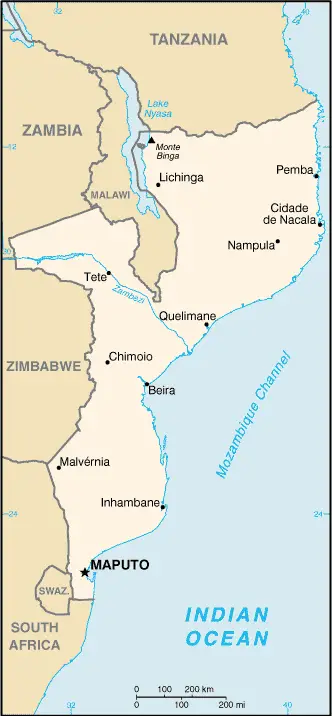
 The Jewish community of Mozambique is more than 125 years old. Throughout its existence, it has been small in number and diverse in origin. Some of the earliest Jews were merchants drawn to the region by the Witwatersrand Gold Rush and Maputo’s importance as an Indian Ocean port. The oldest known grave in the city’s Jewish cemetery dates to 1899. The early Jewish settlers in Maputo - known before independence in 1975 as Lourenço Marques - came from places including Morocco, Lithuania, Britain, and Portugal, often via South Africa. In 1906, they formally organized themselves as Honen Dalim, meaning “He who is charitable to the poor,” but continued to hold services in private homes. The community included both Ashkenazi and Sephardi Jews, who reportedly sometimes feuded over liturgical matters. Community lore records an early Rosh Hashanah service at which an innovative hazzan pleased the entire congregation by alternating between Ashkenazi and Sephardi pronunciation and melodies. During the Second Boer War, Johannesburg Chief Rabbi Joseph Herman Hertz spent several days in Lourenço Marques after being expelled from South Africa because of his pro-British views. Hertz, who later became chief rabbi of the United Kingdom, encouraged the local Jews to build a synagogue. In 1926, the Ashkenazi and Sephardi groups finally constructed a common synagogue. Honen Dalim was officially inaugurated on August 29 of that year. The community was never large enough to support a permanent rabbi, so services and other rituals were led by members - a tradition that continues today. The community grew during World War II, when neutral Portuguese Mozambique became a refuge for Jews escaping Nazi-occupied Europe. At its wartime height, it may have numbered several hundred people. After the war, however, many Jews moved to South Africa in search of greater economic opportunities. By the early 1970s, the community was again in demographic decline. The gabbai sometimes had to recruit visiting South African Jews from Maputo’s tourist hotels to assemble a Friday-night minyan. When Mozambique gained independence from Portugal in 1975, many of the remaining Jews left the country. The new Marxist government restricted organized religion and confiscated the synagogue along with churches and mosques. The building was used as a Red Cross warehouse. The Jewish cemetery, once an urban oasis with an avenue of frangipani and a towering mango tree, fell into disrepair and was badly vandalized. Amid government hostility toward religion and a civil war that lasted from 1977 to 1992, organized Jewish life largely ceased. Some Jews nevertheless maintained a connection to their heritage. Manuela Soeiro and members of her family continued to watch over the synagogue, while Jewish employees of the American Embassy occasionally organized lessons and holiday observances in private homes. In 1989, the synagogue found an unexpected savior in Alkis Macropolous, a non-Jewish Greek businessman. Encouraged by Jewish colleagues in Johannesburg, he helped prevent the building’s demolition. He placed an advertisement in a local newspaper asking the country’s remaining Jews to come forward and reclaim it. The advertisement brought the few remaining Jews back together. Political liberalization around 1990 allowed religious communities to become active again, and small contributions made it possible to begin cleaning and restoring the synagogue. The return of the synagogue to the Jews also led Jews to return to the synagogue. When Samuel Levy arrived in Maputo in 1993, Honen Dalim still lacked a minyan and was not holding regular formal services. On Saturday afternoons, however, Jews and non-Jews gathered in its bare sanctuary to sing folk songs and study Hebrew. Levy later recalled that these simple gatherings were among the deepest forms of prayer he had experienced. Since the synagogue’s recovery, milestone has followed milestone. Passover seders incorporated local ingredients: cashews were used in the charoset, while the exceptionally bitter herb nkakunda served as maror. In 1993, the shofar was blown in Maputo for the first time in at least 15 years. Mozambique and Israel established diplomatic relations that November. Friday-night services became the community’s most unifying ritual. Long gone was the competition between Ashkenazi and Sephardi liturgical styles. The challenge instead was to make services accessible to Portuguese-speaking Mozambicans and English-speaking expatriates and visitors. The result was an idiosyncratic mixture of Portuguese, English, and Hebrew. Non-Mozambican Jews working at embassies, aid organizations, and development agencies became essential to the congregation. Many had not regularly attended synagogue in their home countries. Still, they became deeply involved in Maputo, where they understood that holidays and services would take place only if they organized them. Larry and Diane Herman, Conservative Jews from Detroit who arrived in 1999, assumed important leadership roles. Diane compiled a prayer book containing Hebrew, English, and Portuguese. The couple traveled to Johannesburg to obtain kosher food and hosted Passover seders that sometimes attracted as many as 50 people. The restoration of the Jewish cemetery also became a major communal project. Volunteers removed trash, planted trees, repaired walls, and worked to protect the grounds against vandalism, gradually restoring the cemetery to its former character as a small urban garden. In 2009, Juliana Becker celebrated what was believed to be Mozambique’s first bat mitzvah. A Torah scroll was brought from South Africa, and approximately 125 people attended. The event encouraged Honen Dalim to seek formal government recognition, which it obtained in 2010, establishing the congregation’s legal ownership of the synagogue. During the early 2010s, the deteriorating synagogue underwent extensive repairs. A project initially intended to replace the roof expanded to include the walls and flooring, eventually costing more than $120,000. The money was raised with help from congregants and supporters abroad. Honen Dalim held a rededication ceremony in 2013. Ann Harris, then president of the African Jewish Congress, and Rabbi Moshe Silberhaft presented the congregation with a kosher Sefer Torah. Government officials and representatives of other religions attended. The revival of Mozambique’s Jewish community has been helped considerably by non-Jews. Honen Dalim participates in the Council of Religions in Mozambique alongside Christian, Muslim, and other religious communities. It has welcomed Muslim study groups interested in Jewish practices, while representatives of other faiths regularly attend Jewish memorials and celebrations. Community members generally describe Maputo as tolerant and supportive of Jewish life. Nevertheless, the congregation remains fragile. It consists of only a couple dozen families, and leaders estimate that only about one-third of its members are permanent residents. Attendance at Friday-night services can range from three to 12 people. The community still lacks a permanent rabbi, a mikveh, kosher food infrastructure, or a formal Jewish school. Before the COVID-19 pandemic, Honen Dalim operated a Sunday school with eight children, but the pandemic dealt the community a serious blow. Parents seeking Hebrew instruction or bar and bat mitzvah preparation for their children must depend on a handful of knowledgeable volunteers. Mozambicans interested in conversion face similar obstacles because the necessary rabbinic supervision and facilities are unavailable locally. Rabbi Silberhaft, spiritual leader of the African Jewish Congress, visits and assists with important occasions, but he serves Jewish communities in nine countries. The congregation’s reliance on expatriates also places it in a tenuous position: foreign members often leave after several years when their employment ends. Marcos Vaena, who grew up in a Brazilian Sephardi family with Turkish roots, returned to Maputo in 2024 after previously living there from 2006 to 2010. Finding a diminished community, he began leading Shabbat services several times a month, both to strengthen the congregation and to ensure that his children remained connected to Jewish tradition. Former residents also continue to help from abroad. Larry Herman, now living in Los Angeles, serves as president of the Friends of the Jewish Community of Mozambique and mobilizes international support. Honen Dalim continues to welcome Jewish visitors from Israel, the United States, Europe, and elsewhere. On June 11, 2026, approximately 100 people gathered at Honen Dalim to celebrate the synagogue’s centenary, while about 50 others watched online. The guests included Mozambican President Daniel Chapo, diplomats, government officials, Christian and Muslim leaders, and members of the congregation. Manuela Soeiro, who has been associated with Honen Dalim since the 1940s, also participated. The younger generation is small but present. Children played on the synagogue lawn during the celebration, while younger members joined the prayers. President Chapo praised the enduring place of the Jewish community in Mozambique’s religious, historical, and cultural life. A century after its synagogue opened, Honen Dalim remains Mozambique’s only functioning Jewish congregation. Its future depends on a small group of local Jews, expatriates, distant supporters, visiting rabbis, and non-Jewish friends. Yet it has survived colonialism, war, emigration, nationalization, and physical decay. Its history demonstrates that Jewish knowledge and institutions may lapse, but Jewish identity can endure - and that even a single remaining spark can revive communal life. Sources: Jews of Mozambique. Saudades Photo: CIA Factbook. |