
Contents
Introduction: The Mechanism Behind the Pattern
1. The Refusal to Label Terrorism
2. Selective Language for Israelis
4. Moral Equivalence Between State and Terrorist Actors
5. References to a “Cycle of Violence”
7. Framing the Conflict as Colonial or Apartheid by Default
8. Ignorance of History and of Terrorist Objectives
PART THREE — WHO CONTROLS THE STORY
9. Hamas and Hezbollah Control of Reporting
10. Reliance on Freelancers and Fixers
12. Selective Quotation and Anonymous Sourcing
13. Aiding and Abetting the Enemy
14. Hostile-State Media as Sources
16. Casualty-Driven Framing Without Context
PART FIVE — WHAT IS NEVER SHOWN
19. Unprecedented Measures to Protect Civilians
20. Erasure of October 7 and Rocket Attacks
21. The Presumed Innocence of Civilians
22. Marginalization of Israeli Voices
PART SIX — THE COLLAPSE OF VERIFICATION
24. Believe Terrorists, Not Israel
26. Manipulated Imagery and Pallywood
27. Forensic Theater: Visual Investigations and Borrowed Experts
28. Credulity Toward the Absurd
29. Corrections: Late, Quiet, or Never
PART SEVEN — HOSPITALS, LAW, AND ACCOUNTABILITY
30. The Sanctification of Hospitals
31. Selective Use of International Law
32. Disproportionate Focus on Israeli Accountability
33. Damned If It Does, Damned If It Doesn’t
PART EIGHT — OPINION, IDENTITY, AND THE OLDEST HATRED
34. The Routinization of Criticism
37. Antisemitic Tropes at the Edges of Coverage
CASE STUDIES, CONSEQUENCES, CONCLUSION
Five Institutional Case Studies
Preface: Purpose and Method
“The humbug and hypocrisy of the press begin only when the newspapers pretend to be ‘impartial’ or ‘servants of the public,’” wrote the British journalist Claud Cockburn. “And this becomes dangerous as well as laughable when the public is fool enough to believe it.”[1]
That sentence is the premise of this report. The problem examined here is not that reporters covering Israel hold opinions — every journalist does — but that institutions which market themselves as neutral arbiters have produced three years of coverage whose distortions run consistently in a single direction, while continuing to assure their audiences that nothing has changed.
Since the Hamas massacre of October 7, 2023, the most charitable description of Western media coverage of Israel is that it has been abysmal. Journalistic standards that once governed the profession — verification before publication, skepticism toward interested sources, the obligation to seek comment from the accused, precision in language, the separation of news from advocacy — have been abandoned at remarkable speed, and a longstanding anti-Israel bias in elite newsrooms has reached new lows. The New York Times and the Washington Post, arch competitors in breaking news and shaping opinions, have been engaged in what looks from the outside like a race to see who can lower journalistic standards faster.
How this report is organized
What follows is a taxonomy. Each of the thirty-seven categories below names a distinct technique, defines it, and documents it with dated examples, direct quotations, named reporters, and outlets, and — where they exist — quantitative studies of the coverage. The examples presented here represent a small fraction of the problem. We could have included hundreds and turned the report into a massive tome. Instead, we’ve chosen representative cases and grouped the categories into eight parts. The report begins with words, because every other distortion is ultimately executed at the level of the sentence, and because language is where bias is most visible and most measurable. It then moves roughly from the general to the particular: the frame imposed on the conflict; who controls what reporters can see and what they relay; the treatment of numbers; what is systematically not shown; the collapse of verification; hospitals, the law, and accountability; and opinion, identity, and the oldest hatred.
The categories are not independent. They reinforce one another, and the same episode often illustrates several. The Al-Ahli hospital explosion of October 17, 2023, appears under lack of verification, under believing terrorists over Israel, under headlines, and under the sanctification of hospitals, because it was an instance of all four. Cross-references are given where an example does double duty.
Where an outlet has corrected, retracted, apologized, or lost executives over an episode, that is recorded, because the pattern of correction itself is part of the evidence. In this coverage, corrections arrive late, phrased minimally, and long after the false impression has circled the globe.
A note on what is not claimed
This report does not claim that every journalist covering the war is an antisemite, that Israel’s conduct is beyond criticism, or that Palestinian suffering is fictional. There is real suffering in Gaza, Israel has made real errors, and legitimate criticism of Israeli policy is a normal feature of democratic debate — much of it published in Israel’s own press, which remains the freest in the region.
The claim is narrower and more serious: that the distortions cataloged here are directional, systematic, and self-reinforcing; that they are produced by identifiable practices rather than by chance; and that their cumulative effect has been to make it nearly impossible for an ordinary consumer of Western news to understand what has actually happened and to avoid the conclusion that Israel has engaged in behavior that uniquely warrants global opprobrium.
Introduction: The Mechanism Behind the Pattern
Before cataloging the techniques, it helps to understand the machinery that produces them, because the alternative explanation—that these are ordinary errors, randomly distributed—does not survive contact with the record. Errors distribute randomly. These do not.
“Who does this serve?”
The most penetrating account of the transformation comes from Matti Friedman, who spent nearly six years reporting on Israel for the Associated Press before writing two landmark essays about what he saw from inside. A decade later, he revisited them as the war unfolded and concluded he had understated the problem.
“The most important thing I saw during my time as a correspondent in the American press,” he wrote, “was happening among my colleagues. The practice of journalism — that is, knowledgeable analysis of messy events on Planet Earth — was being replaced by a kind of aggressive activism that left little room for dissent. The new goal was not to describe reality, but to usher readers to the correct political conclusion.”
Starting, Friedman knew the fundamental question a reporter asks: What is going on? By the time he left the AP, he had learned the question had changed: Who does this serve?
“You may think that a news story is meant to serve readers, by conveying reality. I thought so. What I found, however, was that the story was more often meant to serve the ideological allies of the people in the press. If your ideology dictates that Israeli Jews are symbols of racism and colonialism, and Palestinians symbols of third-world innocence, then a story that makes Israelis seem constructive and Palestinians obstructive must be avoided even if it’s true, because it serves the wrong people.”
This explains the specific malpractices he witnessed: staffers ordered not to report Prime Minister Ehud Olmert’s 2008 peace offer, “even though this was clearly a major story”; news from Gaza censored because of Hamas threats to AP staff, without telling readers — and indeed telling them instead that Hamas was becoming more moderate; and the claim that the Palestinian goal was a state alongside Israel “when the Palestinian goal has always been a state that replaces Israel.”
His conclusion is the frame for everything that follows: “People writing letters complaining about press errors and demanding corrections, then and now, miss the point: These aren’t errors. They’re the result of the press doing a different job correctly.”[2]
Why coverage of Israel is structurally biased
Several conditions predate October 7 and shape everything that follows.
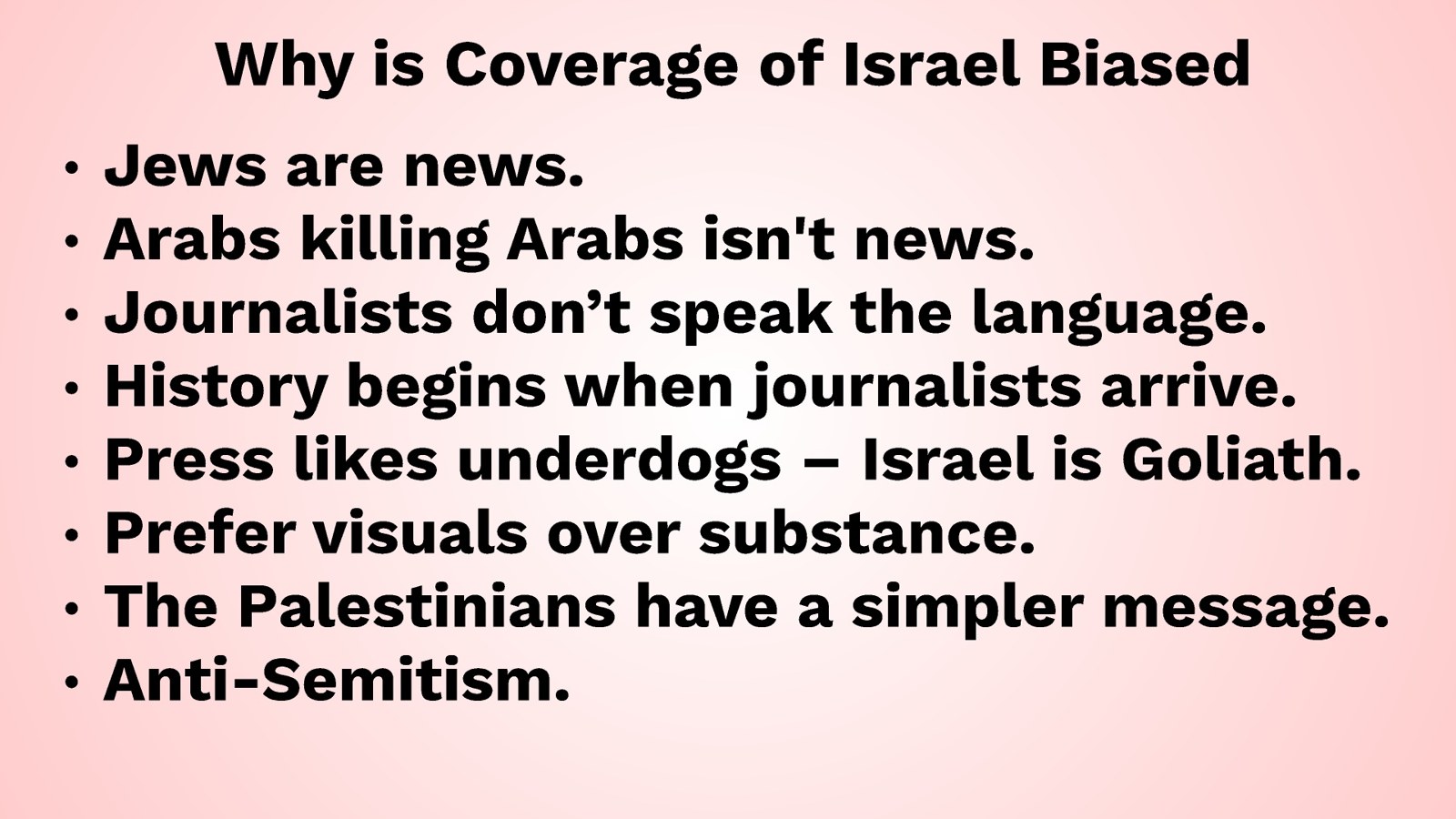
The “Arc of Silence.” The journalistic community considers the Arab/Islamic world the “arc of silence” because the media is strictly controlled by totalitarian governments. Hence, you rarely see reports from Arab capitals. When journalists are allowed to pierce the veil of secrecy, the price of access to dictators and terrorists is often steep. Reporters are sometimes intimidated or blackmailed. They sometimes must agree to put the subject in a positive light, the location of wanted terrorists is concealed, and photographers can only take certain pictures. If journalists play along, their safety is assured; if not, they are on their own.
Journalists usually do not have the freedom to travel where they want in Arab countries: they are escorted so that they only see what the authorities want them to see. Often, if they are allowed to go around on their own, they’re followed. Security agencies warn citizens, sometimes directly and sometimes more subtly, to be careful what they say to visitors. Also, if a journalist displeases the authorities, they might not get back in.
By contrast, Israel has one of the most free-wheeling press corps in the world. Journalists face few limitations within the country, and the foreign press often cribs stories from their Israeli colleagues.
Jews are news; Arabs killing Arabs is not. People are fascinated by the “People of the Book,” who’ve wandered from country to country through the centuries, suffered great persecution, returned to their homeland, built a thriving high-tech society, and fought and repeatedly defeated enemies who had overwhelming numerical superiority. Americans admire the pioneering spirit of Israeli Jews in part because it mirrors the American spirit. The focus on Israel is also a function of the fact that the largest Jewish population in the world is in the United States, and the future of Israel greatly concerns American Jews. Israel also attracts disproportionate attention because of the special relationship it has with the United States and its status as the largest recipient of U.S. aid.
Americans also tend to have higher expectations for the Jews than they do for other peoples. This is in part because of the Jews’ own lofty expectations and goal of being a “light unto the nations.” This seeming compliment to the Jews can also work against them; for when Israelis do something bad, it often attracts disproportionate attention. In contrast, Americans, as a rule, hold Arabs to a different standard. In the news business, man bites dog is newsworthy whereas dog bites man is not. Israeli misbehavior toward Arabs is considered the former; Arabs mistreating Arabs the latter.
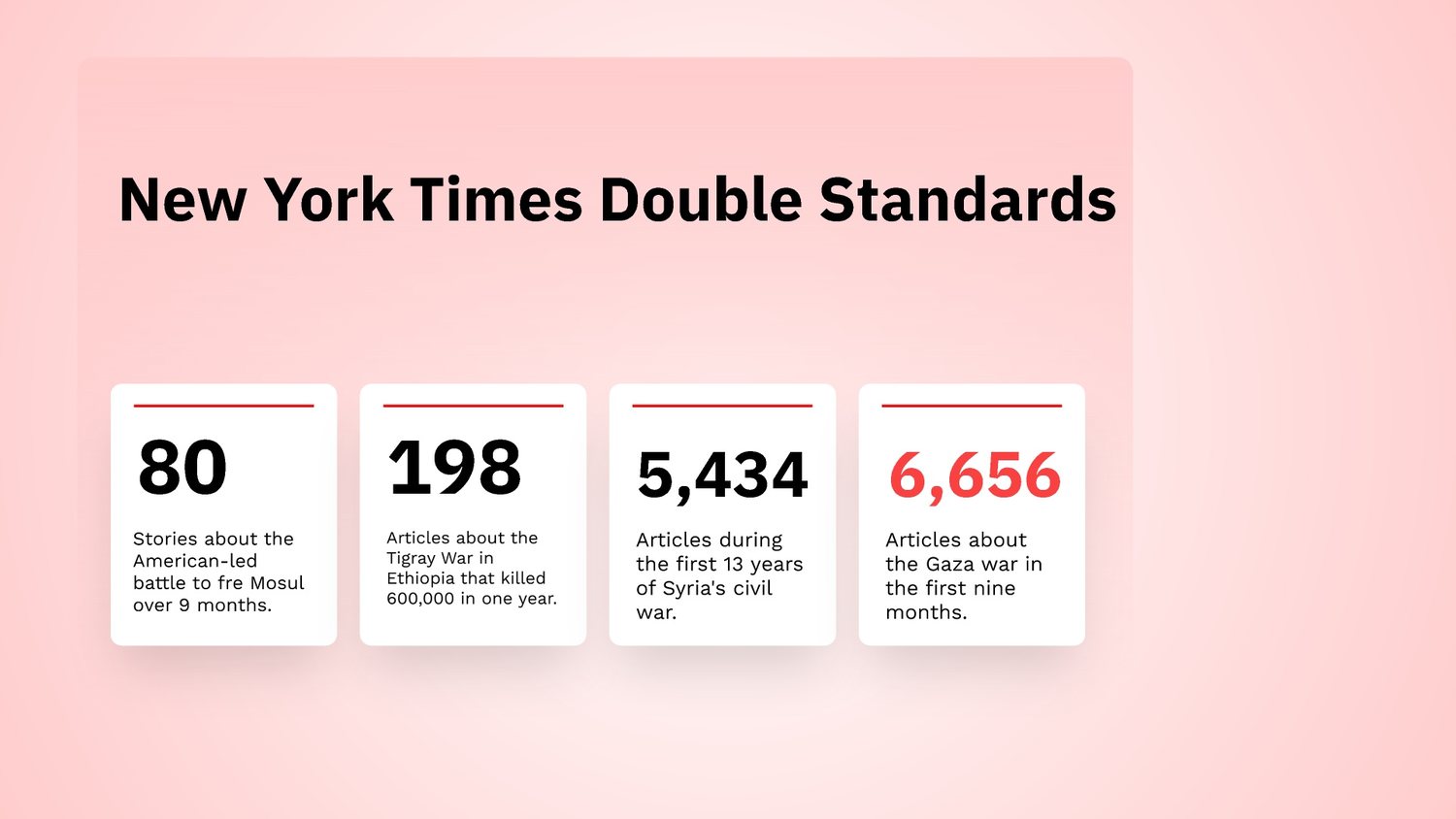
Israel occupies one one-hundredth of one percent of the surface of the world and one fifth of one percent of the landmass of the Arab world and is covered more heavily than any other foreign country. The New York Times published 6,656 articles about the Gaza war in its first nine months. It published 5,434 during the first thirteen years of Syria’s civil war, 198 about the Tigray war in Ethiopia that killed 600,000 people in a single year, and 80 about the nine-month American-led battle to free Mosul.[3]
Anti-Semitism. Some journalists may have prejudices against Jews that inform their coverage. Reporting sometimes reinforces anti-Semitic tropes and conspiracy theories.
Journalists don’t speak the language, and history begins when they arrive. Most reporters parachuted into the region read neither Hebrew nor Arabic and treat the conflict as beginning with their own arrival — a defect examined at length in Category 8. Lacking knowledge of basic history, their reporting can feature glaring errors that shape the consumer’s image of Israel, such as descriptions of Gaza as being occupied before October 7 when Israel had evacuated all soldiers and civilians in the 2005 disengagement.
The press likes underdogs, and Israel is Goliath. Before 1967, Israelis were viewed as “David” against the Arab “Goliath.” That perspective has been inverted. A nuclear-armed democracy is cast as the strong party by default, even though it faces an axis of state and non-state actors openly committed to its elimination. The Palestinians are now portrayed as “David.”
Visuals beat substance, and the Palestinians have the simpler message. Most Israeli casualties occurred on October 7, and many of the images were too graphic to publish. Hamas provided no shortage of photos afterward of suffering, injured, and dead Palestinians. Israel’s defenses protected its population and infrastructure, so fewer dramatic photos were available, whereas the Israel Defense Forces’ destruction of Gaza offered powerful images. And, as Category 18 documents, only one side’s fighters can be photographed.
The Palestinians’ message is also simple and understandable. Every question can be answered in three words: “End the occupation.” Israel’s message tends to be garbled, especially when delivered by gruff Israeli men with heavy accents, and involves lengthy dissertations on the history of the conflict. Public relations cannot compensate for bad policy, and Israel has often chosen to argue history and law where its adversaries argue emotion.
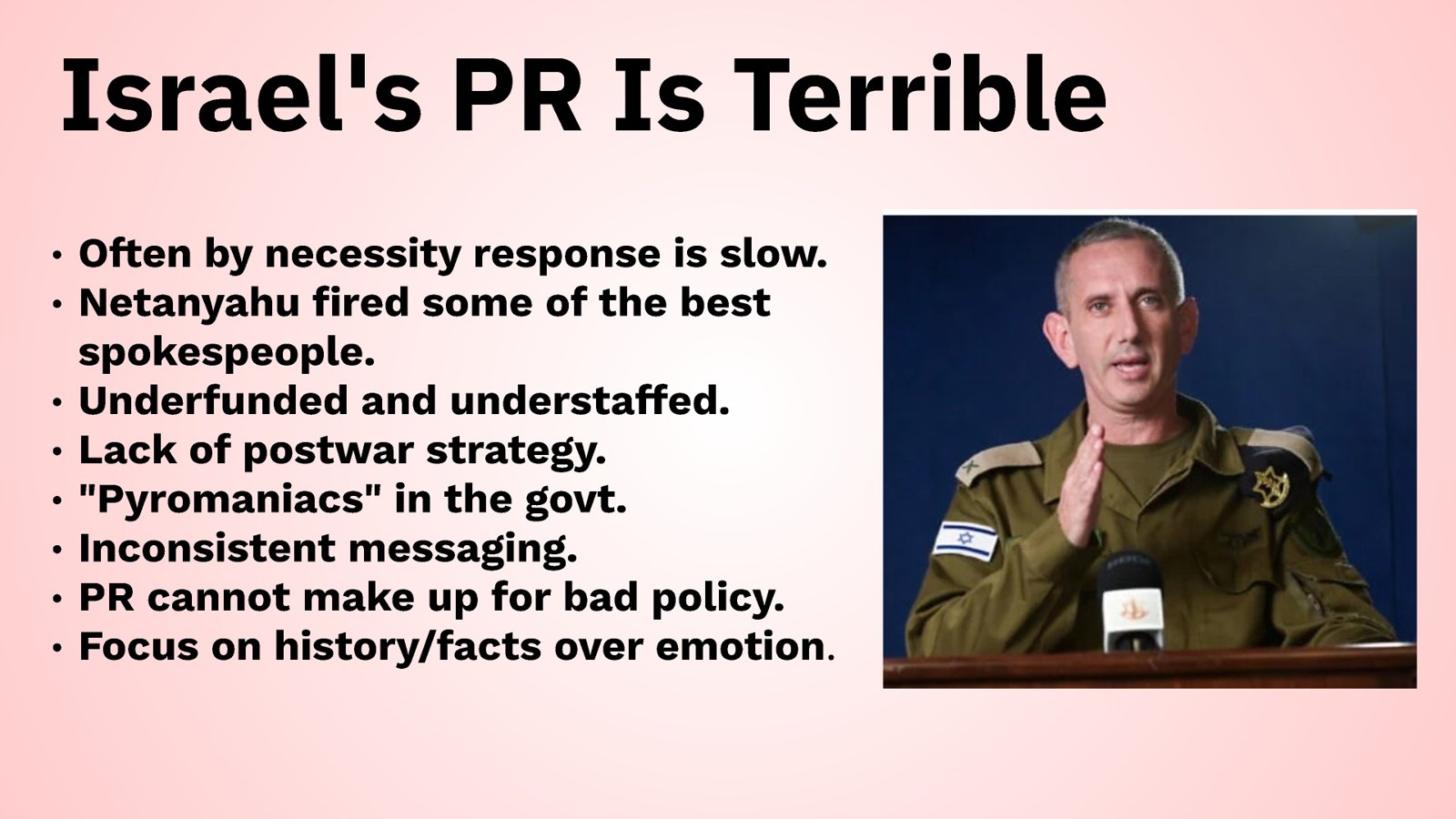
Israel’s own public diplomacy is poor. Terrorists can instantaneously spread lies. Hamas knew from experience that whatever claims it spread would be reported immediately. By contrast, military responses are slow by necessity; it takes time to gather the facts. Moreover, the government’s communications departments have been understaffed and underfunded; talented spokespeople were dismissed for political reasons, the prime minister had no consistent postwar message and has repeatedly allowed officials whose statements damage Israel’s case to speak for it. In past conflicts, Israel’s ambassador to the United States played a leading role in explaining Israeli policy; however, throughout the war in Gaza he was invisible. Benjamin Netanyahu was long regarded as a master of hasbara because of his erudition, but most Americans’ unfavorable opinion of the prime minister likely muted his effectiveness during the war. One of Israel’s best spokespeople, Noa Tishby, was fired before the war for opposing Netanyahu’s judicial reforms, and another effective advocate, Eylon Levy, was fired during the war after several incidents that upset the Foreign Ministry. For most of the war, the principal spokespeople were from the IDF rather than the Foreign Ministry or the Prime Minister’s Office, which effectively explained military operations but could not address the political issues.[4]
The physical conditions of the coverage
Israel restricted independent international media access to Gaza throughout the war, arguing it could not protect journalists in an active combat zone. As Robert Satloff of the Washington Institute noted in the Wall Street Journal, this meant that “for the most part, the Hamas-Israel war went two years without on-the-ground coverage by traditional war correspondents.” Foreign outlets relied instead on local Palestinian stringers, fixers, drivers, and translators — all living under a regime that has controlled “virtually every word written or broadcast in Gaza since 2007.”
A local Palestinian reporter in Gaza working for National Public Radio, often derisively referred to by pro-Israel critics as National Palestinian Radio, was one of the few journalists who stayed throughout the war for a major U.S. platform. Satloff noted that Anas Baba “never focuses on Hamas.” Of the nearly seventy radio segments to which he contributed in a single year, “Mr. Baba didn’t report a single comprehensive story on Hamas. That is, not one thorough report on Hamas’s leadership, decision-making, governance, military operations, or popular support. Not one.” The AP’s stringers were no different: a review of hundreds of its war stories in one year found exactly two deeply reported pieces on Hamas, neither datelined from Gaza.
The explanation is not primarily ideological. “Merely reporting from Hamas-controlled Gaza requires facing Hamas threats, intimidation and extortion,” Satloff wrote. “For some journalists, the solution to survive the Gaza crucible has apparently been to limit their reporting to the slice of the overall story Hamas didn’t mind being told — the hardships of Israeli attacks on the local population — without discussion of Hamas’s role.”
What made this a bias problem rather than merely an access problem is that news organizations rarely disclosed the constraint to their audiences. Readers were given coverage shaped by a terrorist organization’s editorial veto and presented as independent journalism.[5]
The abandonment of objectivity as an ideal
In January 2023 — nine months before October 7 — Leonard Downie Jr., the former executive editor of the Washington Post, published a column in his old paper titled “Newsrooms that move beyond ‘objectivity’ can build trust.” Downie wrote that “increasingly, reporters, editors, and media critics argue that the concept of journalistic objectivity is a distortion of reality,” and admitted that during his own editorship he had not understood the word’s meaning and “didn’t consider it a standard for our newsroom.” The former executive editor of the Associated Press told him the same: objectivity was not a standard for the wire service, because “that standard seems to be White, educated, fairly wealthy.”[6]
New York Times columnist Bret Stephens answered directly: “the standard of objectivity is of immense help to editors trying to keep reporters from putting their own spin on things or excluding people and arguments they dislike from coverage.”[7]
More than 500 journalists, including four from the Times and seven from the Post, had already signed an open letter revealing their bias by declaring that they had “failed our audiences with a narrative that obscures the most fundamental aspects of the story: Israel’s military occupation and its system of apartheid,” and calling on colleagues “to recognize that obfuscating Israel’s oppression of Palestinians fails this industry’s own objectivity standards.” They were not merely concerned with their audience; they also lamented having failed “the Palestinian people” — an unusual constituency for a newsroom to claim.[8]
Marty Baron, another former Post editor, offered the traditional defense: objectivity means “being open-minded, rigorous, comprehensive, thorough, fair, trying to look at the facts as you discover them without being tainted, as much as possible, by your own preconceptions.” Part of fairness, he added, is “not pretending that there is no objective reality.”[9] By the time the war began, the newsroom in which he had worked was operating on a different premise — one in which, as the open letter made explicit, a predetermined conclusion about the conflict was itself the objectivity standard.
Reporters who became activists
Two former senior New York Times figures have described the internal shift.
James Bennet, the paper’s former editorial-page editor, wrote that he “realized how different the new Times had become from the old one that trained me... to a place I barely recognized,” where the problem “has metastasized from liberal bias to illiberal bias... (infected by) pressures of intolerance and tribalism.” Most damning was his account of the deception: “Times readers are being served a very restricted range of views, some of them presented as straight news... And yet the Times insists to the public that nothing has changed. By saying that it still holds itself to the old standard of strictly separating its news and opinion journalists, the paper leads its readers further into the trap of thinking that what they are reading is independent and impartial — and this misleads them.”
Judith Miller, a Pulitzer Prize–winning Times investigative reporter, concurred: the paper had “abandoned its commitment to objective reporting, blurred the boundary between news and opinion... and shifted from being overtly ‘liberal’ to an ‘illiberal’ paper.” Her description of the power inversion is the most concise account of how it happened: “reporters and even interns who once lived in fear of their editors now made their editors fear.”[10]
That inversion had consequences readers could see. When the Times published Jeffrey Gettleman’s two-month investigation into Hamas’s weaponized sexual violence on October 7 — based on more than 150 testimonies and praised internally as a “signature piece” — pro-Hamas staffers opposed its publication, failed to get it shelved, then leaked internal information to a radical anti-Times outlet to attack their own paper’s credibility. The Times formally stood by the investigation while conceding to what one participant called a “newsroom intifada”: it publicly fired and denounced the Israeli reporter hired to work on the story for “liking” a pro-Israel social media post on the day of the massacre; published a follow-up that partially undercut one of the original testimonies without saying so; and abandoned its plan to submit the investigation for a Pulitzer. An internal effort to identify the leakers ended inconclusively after the union filed a grievance.[11]
When the Washington Post ran a Pulitzer Prize-winning cartoonist’s image mocking Hamas’s use of human shields, Zvika Klein noted, “The newsroom revolted. Executive Editor Sally Buzbee apologized. Opinion Editor David Shipley called it ‘divisive.’”[12]
With that machinery described, the categories follow.
PART ONE — WORDS
Every category documented in this report is ultimately executed at the sentence level, which is why the taxonomy begins here. What follows are the three places where the choice is made in the smallest available unit — the noun assigned to a killer, the verb assigned to Israel, and the twelve words a reader sees before deciding whether to read further.
1. The Refusal to Label Terrorism
The technique. Organizations designated as terrorist by the United States, the European Union, the United Kingdom, and Canada are described in the press’s own voice as “militants,” “fighters,” “gunmen,” “armed groups,” or “the armed wing” — while the word “terrorist,” which the same outlets apply without hesitation to the Islamic State, al-Qaeda, and al-Shabab, is either withheld entirely or attributed to Israel as a claim rather than a fact.
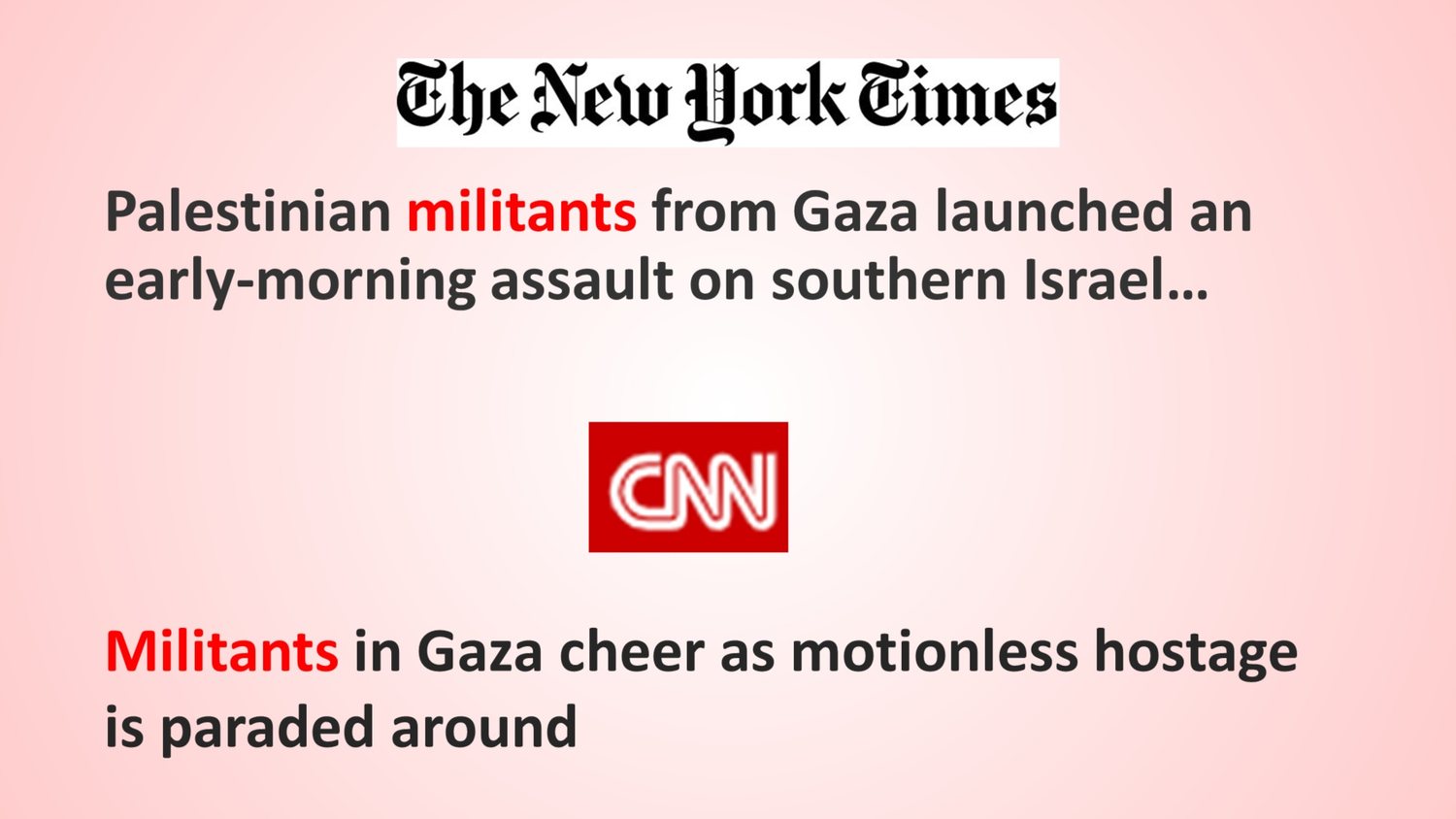
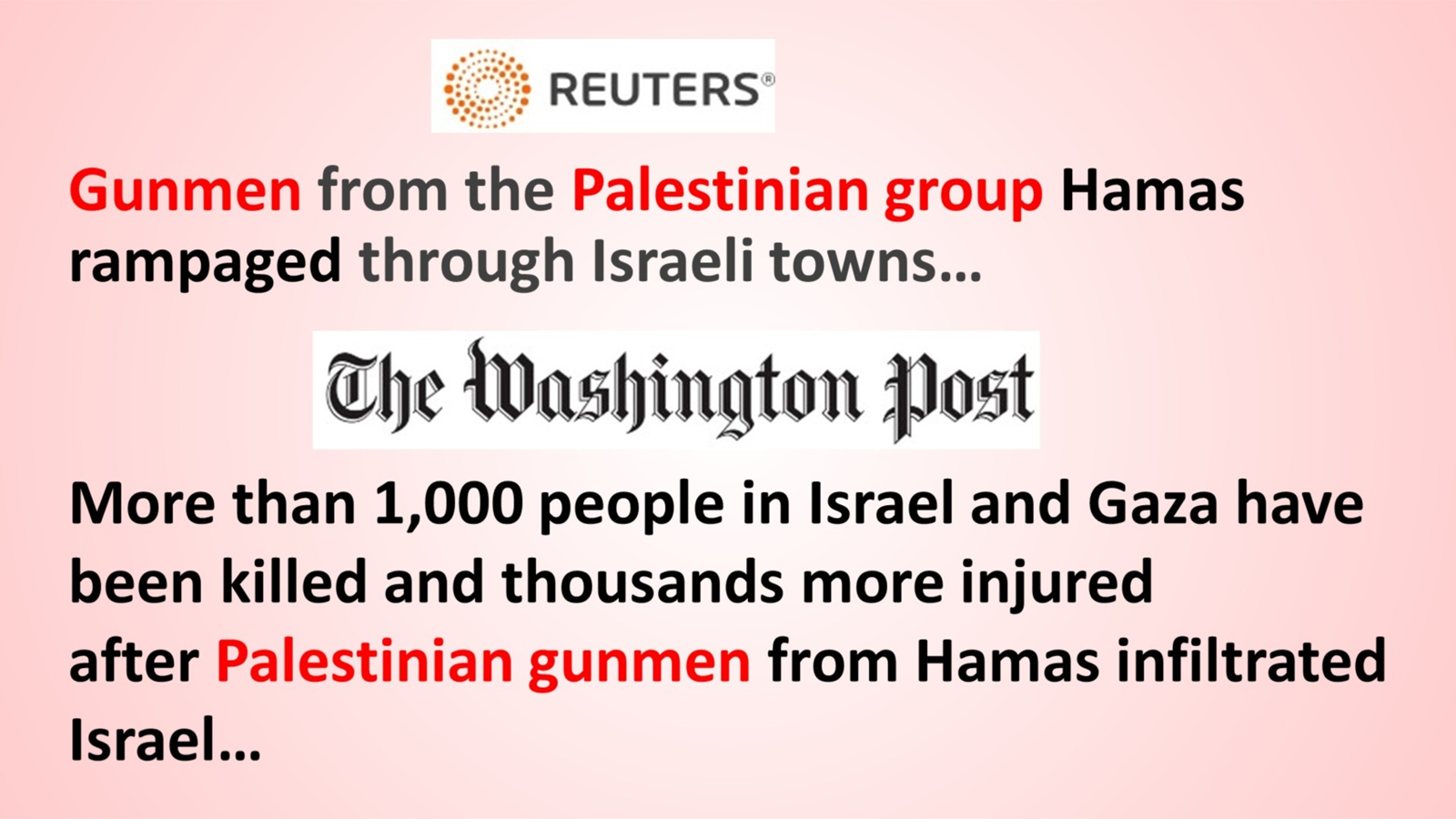
The astonishing lack of clarity and honesty was evident in the coverage of the massacre on October 7 and its immediate aftermath. The New York Times and CNN referred to the perpetrators as “militants,” while Reuters and the Washington Post described them as “gunmen.”
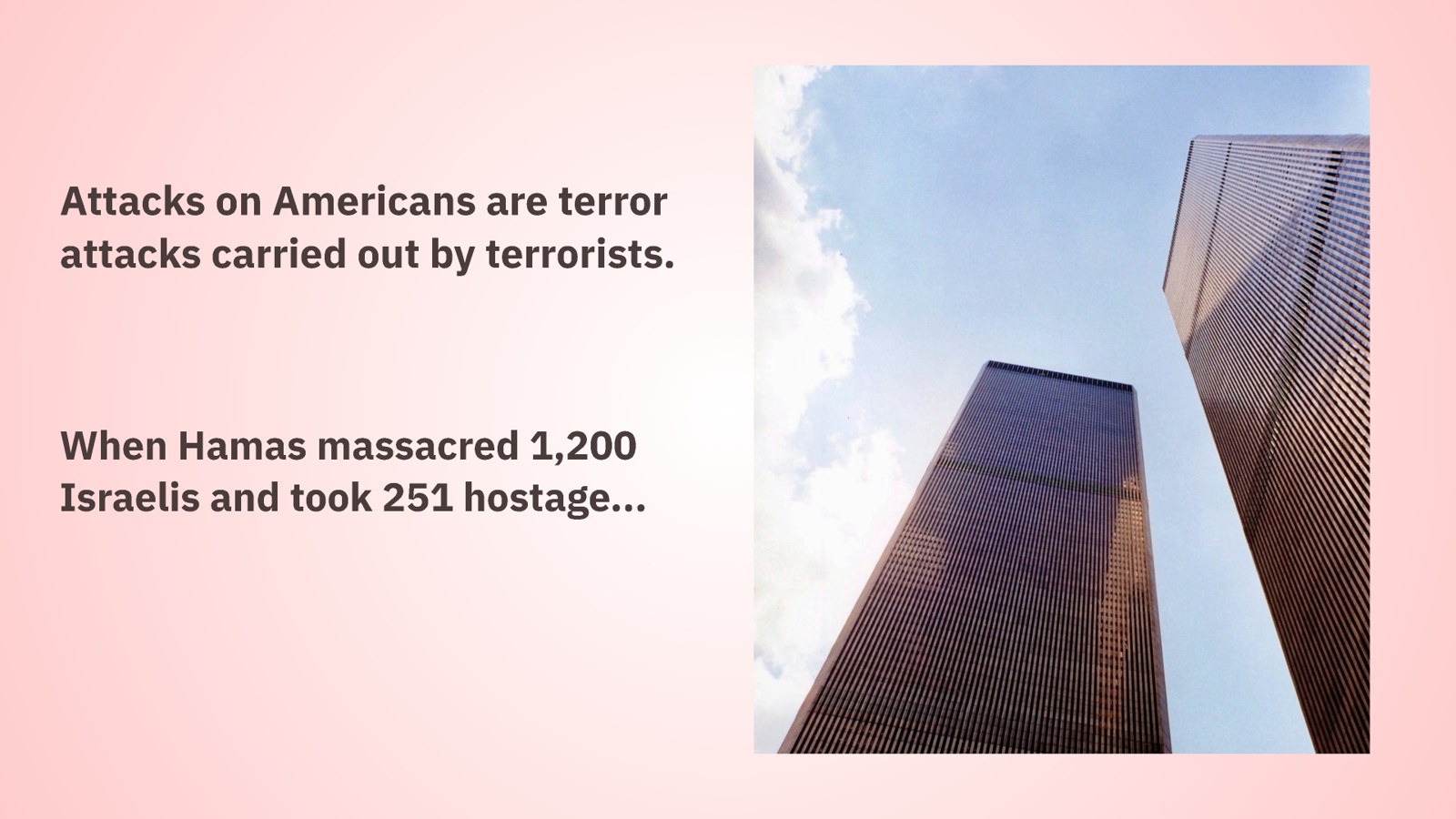
After a terrorist attack that was also described with euphemisms, Cliford May pointed out the absurdity: “No newspaper would write, ‘Militants struck the World Trade Center yesterday,’ or say, ‘They may think of themselves as freedom fighters, and who are we to judge, we’re news people.’”[13]
In a memo to the New York Times foreign desk in 2005, then Jerusalem bureau chief James Bennet criticized his paper’s reluctance to use the word “terrorism.” He said, “The calculated bombing of students in a university cafeteria, or of families gathered in an ice cream parlor, cries out to be called what it is....I wanted to avoid the political meaning that comes with ‘terrorism,’ but I couldn’t pretend that the word had no usage at all in plain English.” Bennet acknowledged that not using the term was “a political act in itself.”[14]
This is not the accumulated instinct of individual reporters. It is written policy.
The style guides
The Associated Press stylebook entry is explicit: “militant, militants — AP uses this term to describe Hamas, Hezbollah, and other armed non-state actors. Terms such as fighters, attackers or combatants are also acceptable depending on the context. Do not use the term soldiers or resistance with reference to such groups outside of direct quotations.” The AP reiterated the guidance in its style note for the Iran war.[15]
The BBC’s guidelines stipulate that groups such as Hezbollah be called “militants” rather than terrorists, and that journalists “not use the term ‘terrorist’ without attribution,” preferring less “emotive” terms such as “gunmen” and “militants.” In BBC reports on Israeli operations against Hezbollah, the group has been described as a “militia” or as an organization “considered” to be terrorist.
John Simpson, the BBC’s world affairs editor, defended the policy in his own byline: “We regularly point out that the British and other governments have condemned Hamas as a terrorist organization, but that’s their business... The key point is that we don’t say it in our voice. Our business is to present our audiences with the facts and let them make up their own minds.”
The Campaign Against Anti-Semitism replied that “in the wake of the barbaric October 7 attacks, when Hamas murdered over 1,200 Israelis and took some 250 hostage, the BBC showed an unbelievable level of resistance to calling Hamas what it is — a terrorist organization. Similarly, Hezbollah is a proscribed anti-Semitic genocidal terror group, and it began attacking Israel from across the border in Lebanon on October 8 with no respite... Using any other descriptor risks legitimizing or downplaying the actions and rhetoric of this and other terror groups.” CAMERA Arabic made the narrower point that the BBC might at least “cover Hezbollah in accordance with the UK’s own foreign policy, namely its designation as a terrorist organization” — that is, that the corporation’s neutrality runs against its own government’s legal determination in one direction only.[16]
Marty Baron, the Washington Post’s longtime executive editor, gave the philosophy its most candid statement when asked directly whether Hamas should be called a terrorist organization. The Post’s policy, he said, is to “talk about acts of terrorism rather than characterizing individuals,” and “we did tend to use the word ‘militants.’ I mean, Hamas is the government in Gaza.”[17]
The last clause is the tell. Governance is treated as conferring a status that supersedes the conduct — a standard that, applied consistently, would have required a different vocabulary for the Taliban and for the Islamic State in Raqqa.
Counting the euphemisms
This issue is not new. For example, a few months before the Hamas attack, the New York Times covered an Israeli operation to arrest members of the Lions’ Den — the group responsible for a wave of shooting attacks on Israelis —under the misleading headline “At Least 10 Palestinians Killed During Israeli Raid in West Bank,” a construction that implies an attack on innocents. Inside the story, the terrorists were called:
• “planning imminent assaults”
• “fighters”
• “armed Palestinian groups”
• “gunmen”
• “militant groups”
• “mass shooting...by the Palestinian in East Jerusalem”
• “armed resistance”
• “suspects”
• “armed people”
• “Palestinians”
• “dissidents”
Eleven euphemisms; zero uses of “terror,” “terrorism,” or “terrorist.” The story reported that sixty Palestinians had been killed in the “occupied West Bank;” readers had to reach paragraph twelve to learn that eleven Israelis had been “killed by Palestinians,” and paragraph eighteen to learn that at least six of the ten dead Palestinians were associated with the Lions’ Den, the Aqsa Martyrs’ Brigades, or Islamic Jihad — all three of which claimed them as members.[18]
The Washington Post’s version of the same story was headlined “At least 11 Palestinians killed, 100 wounded in Israeli raid in the West Bank.” Its first paragraph described “the deadliest such raid in years,” which “left Nablus’s Old City riddled with bullets and was another escalation in counterterrorism tactics by Israel under its new far-right government” — the sole reference to terror in the piece, and one that attaches the concept to Israel’s response rather than to the attacks that prompted it. Its euphemisms: “spate of deadly Palestinian attacks,” “Palestinian armed groups,” “militants,” “fighters,” “hot spots for militancy against Israel,” “operative,” “Islamic Jihad, which rejects politics in favor of violent resistance to Israel,” and “lone-wolf Palestinian attacker.” Fourteen paragraphs elapsed before the Israelis killed in “attacks” by Palestinians were mentioned.[19]
The euphemisms were used repeatedly after October 7.
For example, a September 2024 Washington Post headline said, “Israeli airstrike kills top militant” (the online version used a different headline: “Israel kills senior Hezbollah commander in strike on Beirut suburb”). The target was Ibrahim Aqil and other Hezbollah terrorists who were referred to as “operatives.” Aqil was wanted by the United States for his role in the bombing of the U.S. Embassy in Beirut in 1983 that killed 63 people. The State Department was offering a reward of up to $7 million for the man who was a “Specially Designated Terrorist.” The Post referred to him as a “prominent Hezbollah official” even as the “militant group” called him a “great martyr” and “one of the great jihadist leaders.”[20]
The control case establishes that the vocabulary exists and is available. The Times’ report on an American operation in 2023 was headlined “Senior ISIS Leader in Somalia Killed in U.S. Special Operations Raid.” There, the dead man was “one of the terrorist group’s top financial operatives;” al-Shabab was “the terrorist group linked to Al Qaeda;” the Islamic State was “a terrorist organization;” and one author’s biographical line noted that he covers “terrorism.” Same paper, same year, same kind of raid, opposite lexicon.
From euphemism to whitewash
BBC Arabic went past euphemism into active sanitization. Reporting on the assassination of Hamas military chief Mohammed Deif, the channel described three decades of suicide bombings as “military operations”: “For approximately 30 years, [Deif] took part in several military operations against Israel, starting from kidnapping soldiers and rocket attacks, passing through military operations and culminating in the October 7th, 2023, attack.” A caption stated that “Deif planned a series of military operations against Israel which caused the kidnapping and killing of dozens of soldiers in the 1990s.”
CAMERA established the facts the phrasing erased. The death toll in the attacks Deif planned was 93, of whom 80 were civilians aged 13 to 83. Thirteen were soldiers or security personnel. “Downplaying Palestinian groups’ responsibility for targeting innocent civilians as mere ‘accusations,’” CAMERA noted, “has been a BBC Arabic habit for years. Even when the Palestinian groups themselves boast about similar murders, BBC Arabic reporters would often use their own voice to falsely describe them as ‘military operations’ carried out against ‘soldiers’ or ‘gunmen.’”
The BBC’s defense was that its coverage “made clear throughout” that Deif was a U.S. and EU–designated Specially Designated Global Terrorist and that it had “quoted the Israeli military describing Deif as a terrorist” — which is to say that it had attributed the characterization to interested parties while declining to make it itself.[21]
When CAMERA appealed a BBC Arabic profile of Deif that referred only to “accusations” that he had killed civilians, the corporation’s Executive Complaints Unit dismissed the appeal, ruling that there was no expectation a short profile video would “go into detail about all aspects of his activities.”[22]
NPR’s September 2024 coverage of the operation when Israel detonated Hezbollah pagers supplied a compact version of the same technique. The report told listeners that Israel’s “attack raises fears of an escalation” and that “Hezbollah militants have been engaged in 11 months of cross-border fighting with Israel” — a phrasing that converts a year of unprovoked bombardment of northern Israel into mutual “fighting” — and described Hezbollah as a “Lebanese armed group” without noting its U.S. terrorist designation. A follow-up segment failed to mention the twelve Druze children killed at Majdal Shams by a Hezbollah rocket and led its audio with a sympathetic account of a funeral for “a dozen people” killed in the pager operation, without specifying whether the dead were Hezbollah members.[23]
Glorification and Justification
Where the language is not sanitizing terrorists, it is at times celebrating them or rationalizing their behavior.
After Israel killed Hassan Nasrallah, the host of NPR’s Weekend Edition asked her guest: “So what kind of response do you expect from Hezbollah to the killing of Nasrallah, this towering figure and leader?”
Aviya Kushner, who heard it while driving, wrote in the Forward: “I nearly swerved into the next lane. Towering figure? Leader? Well, maybe to the Supreme Leader of Iran.” She recounted what the phrase omitted: Hezbollah’s 1983–84 suicide truck bombings that killed nearly 300 Americans and Lebanese; the 1985 hijacking of TWA Flight 847, in which, as the FBI recorded, “the terrorists had tied passengers up and were beating them, threatening to kill them”; the kidnapping of three Israeli soldiers in 2000; Hezbollah’s intervention to save Bashar al-Assad; and the rockets that displaced 60,000 Israelis from their homes. “There were a few words missing from Rascoe’s description of Nasrallah. ‘Terrorist’ was one. And what about ‘murderer of Americans?’ Since when does that make someone a ‘towering figure?’”
Kushner noted that the White House had no such difficulty: President Biden’s statement said, “Hassan Nasrallah and the terrorist group he led, Hezbollah, were responsible for killing hundreds of Americans over a four-decade reign of terror.”
Her broader diagnosis names the asymmetry precisely: “Hezbollah is part of the trend that erases the word ‘terrorist’ in the name of objectivity. This is also why we rarely hear what Hamas members actually believe in. While what Project 2025 has to say is something journalists feel comfortable quoting, and every statement by far-right Israeli leaders is amplified, actual Hezbollah statements — and Hamas charters — get far less play.”[24]
The obituaries confirmed it. The New York Times described Nasrallah as “beloved” and a “powerful orator” who supposedly championed equality among Muslims, Christians, and Jews. The Associated Press called him “charismatic and shrewd,” an astute strategist “idolized by his Lebanese Shiite followers and respected by millions across the Arab and Islamic world.” Col. Richard Kemp, former commander of British forces in Afghanistan, supplied the precedent: “All this is reminiscent of the Washington Post’s infamous 2019 headline that described Islamic State leader Abu Bakr Al-Baghdadi as an ‘austere religious scholar’ after he was killed during a raid by U.S. special forces.”
Kemp also recorded the consequence he has observed directly: “These distortions don’t just influence the activists who have taken to our streets and have been intimidating pro-Israel students on university campuses. I have spoken to political leaders and government officials calling for an arms embargo on Israel whose evidence is exclusively from what they have seen in the progressive media.” He noted that the Guardian concluded its obituary by branding Nasrallah a “political leader” rather than an arch-terrorist — a man whose actual program was “the destruction of Israel, the ejection of the U.S. from the Middle East and the fight for supremacy of Shia over Sunni Islam, at the behest of his masters in Tehran.” The Guardian was nonetheless the only outlet whose obituary mentioned Hezbollah’s murder of Argentinian Jews, and it recorded that Nasrallah “praised Holocaust deniers and in 2001 reportedly called Jews ‘miserly and cowardly.’”[25]
The Wall Street Journal referred to Hamas’s political chief Ismail Haniyeh in a headline as the organization’s “leading pragmatist” — a designation for the man who directed the political wing of the movement that carried out October 7.
The refusal extends to attacks on Jews outside Israel. When a synagogue was attacked, the coverage declined to use the word “terror” at all — a pattern documented across the American press and not confined to the Middle East beat.[26]
The Washington Post supplied its own contribution when Yahya Sinwar was killed, with a reporter’s commentary treating the architect of October 7 as a figure of tragic stature rather than as the commander of a massacre.[27]
Foreign Press Association head Ian Williams equated Hamas to U.S. political parties and questioned the terror group’s designation, saying, “We don’t kill journalists for being Republicans or Democrats or Labour Party. Hamas is a political organization, as well as a terrorist organization, perhaps.”[28] The Anti-Defamation League condemned Williams’ “outrageous” statement as the “dangerous normalization” of Hamas’ activities that “has no place in journalism.”[29]
BBC Arabic supplied the outer bound. It covered a Hamas attack under the headline “The Qassam Brigades announce...” — allowing the terrorist organization’s own military communiqué to function as the news frame — and, in another report, described Israelis killed and wounded in an attack in language that named the victims by nationality and the perpetrators not at all.[30]
The consequence for the reader
Th Vocabulary shapes what the reader can conclude. If Hamas is a “militant group” and the IDF is a military, the two are formally symmetrical actors and the conflict is a war between comparable parties — which is the premise of Category 4. If Hamas is a terrorist organization that deliberately targets civilians and embeds among its own, the conflict is asymmetrical in a way that changes every subsequent moral judgment. The style guides do not merely describe; they decide.
2. Selective Language for Israelis
The technique. The converse of Category 1. The vocabulary withheld from terrorists is applied without hesitation to Israel — verbs of aggression, adjectives of extremism, and constructions that assign agency to Israelis and remove it from everyone else.
Loaded verbs
The Washington Post described the Israeli prime minister’s address to the United Nations as “swaggering and bellicose” — adjectives reserved almost exclusively for the Jewish state among the democracies whose leaders address that body.[31] A day later, the Post reported that Israel was “pounding” Lebanon.[32] Another Post story said Israel was engaged in a “ferocious air campaign.”[33]
When Israeli forces conducted a counterterror raid in the West Bank in which, as the story’s opening paragraph acknowledged, “militants” were killed, the Times headlined it “Destructive Israeli Raid in West Bank Kills 5, Palestinians Say” — “destructive,” not “defensive,” not “counterterror”; and the death toll sourced to “Palestinians” even as the same paper reproduced Gaza Health Ministry figures in its own voice.[34]
The New York Times editorial board set the register at the top of the institution. “This war on its current course is leading to the wholesale killing of Palestinians,” it wrote in February 2024. “Allowing this conflict to continue unchecked is no longer acceptable.” In April 2024: “The suffering of civilians in Gaza — tens of thousands dead many of them children; hundreds of thousands homeless, many at risk of starvation — has become more than a growing number of Americans can abide. Confronted with that suffering, the United States cannot remain beholden to an Israeli leader fixated on his own survival and the approval of the zealots he harbors.”[35] The editorials treated Hamas’s continuing threat as incidental and stripped the war of its essential context: it began with Hamas’s October 7 massacre and continued because the terrorist organization still held hostages and remained committed to Israel’s destruction.
“Zealots” and “extremists” are applied to the elected officials of a democracy at war in a way they are not applied to the elected officials of other democracies at war. And the demand that the United States cease being “beholden” to a democratically chosen prime minister is a formulation that would not survive substitution of any other allied government’s name.
The passive voice and its distribution
The pattern is most visible where the stakes are smallest, because that is where no editorial argument can have taken place.
When Israel rescued the Bedouin hostage Qaid Farhan al-Qadi, the Times noted that “at least 17 Bedouins died in Hamas’s surprise Oct. 7 attacks” — died, not were murdered. The same article observed that Israeli rescue operations “have often killed scores of Palestinians,” and, of an operation in which nothing of the kind had occurred, wrote: “It was not immediately clear whether the operation to free Mr. al-Qadi had resulted in any deaths.” A rescue is reported through the frame of the deaths it might hypothetically have caused.[36]
When CAMERA forced a correction to a 2026 op-ed claiming that over 1,000 Palestinians had been killed since the ceasefire without noting that many were terrorists, the Times issued the correction — but declined even then to call them terrorists, or combatants, or fighters. It described them as “people other than civilians.”[37]
And in October 2025 CNN’s chief international anchor Christiane Amanpour, who has a long history of anti-Israel commentary, claimed Hamas had “probably” treated Israeli hostages better than many Gazans. Facing a backlash, she subsequently apologized for what she conceded was an “insensitive” remark about the Israeli hostages — a lapse notable less for itself than for the fact that the equivalent slip in the other direction is not one the network has had occasion to apologize for.[38]
The Washington Post’s “captives” episode of November 2023 is the compact case. Over one weekend the paper ran headlines characterizing as “captives” the Palestinian prisoners being released by Israel in the negotiated exchange for hostages taken on October 7. Jonathan Greenblatt of the ADL said: “Describing children and elderly people kidnapped from their homes as ‘captives’ is an editorial choice... Describing inmates who committed crimes as ‘captives’ is explicit, indefensible bias.” Robert Satloff of the Washington Institute criticized the front-page version for “equat[ing] Israeli hostages and Palestinian security prisoners as ‘captives.’” He condemned it as “the latest in a series of unprofessional editorial decisions” by a newspaper whose war coverage he had previously characterized as “tendentious” and “one-sided.”[39]
A single word — chosen twice, on a weekend, by different desks — performed the entire moral equivalence of Category 4 without an argument being made.
3. Headlines
The technique. Most readers read only the headline. Where the headline’s frame diverges from the article’s own contents, the divergence is the story — and it is not random.
The scale of the problem
The New York Times covered the war with 6,696 headlines between October 7, 2023 and October 10, 2025 — approximately 7 percent of everything the paper headlined in that period. Of those, 1,305 (19.5 percent) dealt with death and killing. Of those, 709 dealt with Palestinian casualties, and 653 with Palestinians in Gaza specifically. Gilboa and Sigan analyzed all 653.[40]
Who the dead were. Of 653 headlines, 231 (35 percent) stated that the casualties were civilians. A further 322 did not specify who the dead were. Together, 553 headlines — 85 percent of all Gaza casualty headlines over two years — told the reader that the dead were civilians or simply “Palestinians.”
Where the fighters went. Of the 653, exactly 100 referenced Hamas members. But 86 percent of those hundred concerned the killing of a named leader — Arouri, Deif, Sinwar, Haniyeh — with each elimination generating many headlines; Sinwar’s killing alone produced 31. Subtracting those, 14 headlines in two years referred to Hamas fighters killed on the battlefield: 2 percent of all headlines about Palestinian casualties. Half of those fourteen framed the deaths as contested Israeli claims (Category 17).
Whose numbers were doubted. The cumulative casualty total (10,000, 25,000, 30,000, and so on) appeared in 11 headlines and subheadlines. None distinguished combatants from civilians or noted that the figure includes Hamas fighters, casualties of failed rocket launches, and victims of Hamas’s internal executions. None of the eleven raised any reservation about the source. One noted the total was probably higher than reported. The single reservation that did appear was attributed to President Biden and appeared only after reporting on the missile that struck Al-Ahli. Against this: the IDF’s assessment of the number of terrorists killed appeared in one headline in two years — and the Times questioned its reliability in the headline itself.
That is the whole structure in one data set. The enemy’s numbers, unqualified, eleven times; Israel’s numbers, once, with a caveat attached.
The distortions*
Three headline failures documented elsewhere in this report belong here as a class.
Al-Ahli. “Israeli Strike Kills Hundreds in Hospital, Palestinians Say” — five errors in one headline, printed at the top of the front page, with the denial run beneath it in smaller type when it came. The internal review conceded that the paper’s “presentation of the news — in the headline, news alert and social media channels — relied too heavily on claims by Hamas.” The change came after President Biden called the headline “irresponsible” (Category 23).
Majdal Shams. “Israel-Hezbollah exchange of fire kills three militants, wounds 11 in Israeli-controlled Golan Heights” — the AP’s headline for the murder of twelve Druze children on a soccer field. The dead were not militants; there was no exchange; and “Israeli-controlled Golan Heights” recast the killing of children as a dispute over sovereignty. The AP’s tweet of the story drew 1.5 million views before correction (Category 4).[41]
The Gaza casualty headline of December 22, 2023. A Times international-edition headline on Gaza fatalities was corrected the following day — the correction acknowledging what the headline had asserted without qualification.
The twins. “Baby twins killed in Gaza as father registered births” ran across British outlets before the account collapsed; the amended headline read “Father says baby twins killed...” — the attribution added only after the fact, and after the original had traveled.[42]
Anonymous deaths. “Destructive Israeli Raid in West Bank Kills 5, Palestinians Say” — whose opening paragraph reports that “militants” were among the dead.[43]
Burying the lede. “At Least 10 Palestinians Killed During Israeli Raid in West Bank” — whose paragraph eighteen reports that at least six of the ten were claimed by three separate terrorist organizations. The reference was moved to the second paragraph when it was updated several hours later.[44]
Headlines that omit critical information
The most instructive category is the headline the article itself refutes.
“Israel expands strikes in Syria” — a Washington Post front-page headline of December 11, 2024, for a story about the destruction of the fallen Assad regime’s chemical weapons and naval assets to prevent their capture.
An old joke circulating among Israelis captures what readers have learned to expect:
An Israeli visiting the Bronx Zoo sees a child fall into the lion enclosure, leaps in, and drives the lion off with a punch to the nose. A New York Times reporter watching the whole thing promises him the front page and asks where he’s from and what he does. “I’m from Israel; I serve in the IDF.” The next morning’s headline: “ISRAELI SOLDIER ASSAULTS AFRICAN IMMIGRANT AND STEALS HIS LUNCH.”
The joke is not that the facts were invented. Every fact in the imagined headline is true. That is the point.
PART TWO — THE FRAME
4. Moral Equivalence Between State and Terrorist Actors
The technique. Israel and its enemies are presented as comparable “sides” — two parties to a quarrel, each with grievances, each inflicting harm — collapsing the legal and moral distinction between a sovereign democracy defending its citizens and designated terrorist organizations whose declared purpose is that state’s destruction and whose method is the deliberate killing of civilians.
“Exchange of fire”
The purest example came on July 27, 2024, when a Hezbollah rocket struck a soccer field in the Druze town of Majdal Shams in the Golan Heights, killing twelve children and teenagers. The Associated Press led with: “Israel-Hezbollah exchange of fire kills three militants, wounds 11 in Israeli-controlled Golan Heights.” The New York Times: “Fears of Escalation After Rocket From Lebanon Hits Soccer Field.” The Washington Post: “Attacks in Gaza and Golan Heights kill more than 40, many of them children” — merging an Israeli operation and a Hezbollah massacre into one undifferentiated body count. The Wall Street Journal: “Deadly Strike on Soccer Field Raises Risk of Escalation Between Israel and Hezbollah.” CNN and the BBC hedged the perpetrator with attribution.[45]
The Post carried a photograph of mourners at the funeral of eleven-year-old Alma Ayman Fakhr al-Din — one of the twelve children killed by the Hezbollah rocket — directly beneath the large-type headline “Israel hits its targets in Lebanon.” The layout invited every reader to conclude Israel had killed the child in the photograph. The paper was widely mocked for it.[46]
The vocabulary of symmetry
Equivalence is carried by small words. Reuters on October 7: “Gunmen from the Palestinian group Hamas rampaged through Israeli towns.” The Washington Post the same week: “More than 1,000 people in Israel and Gaza have been killed and thousands more injured after Palestinian gunmen from Hamas infiltrated Israel” — a single sentence merging the murdered and their murderers into one casualty pool.
Hostages and convicted prisoners
Moral equivalence reached its most concrete form in coverage of the November 2023 hostage exchange, when the Washington Post headlined both groups “captives” — the Israeli children, women, and elderly kidnapped from their homes on October 7, and the Palestinian prisoners convicted in Israeli courts of violent crimes.
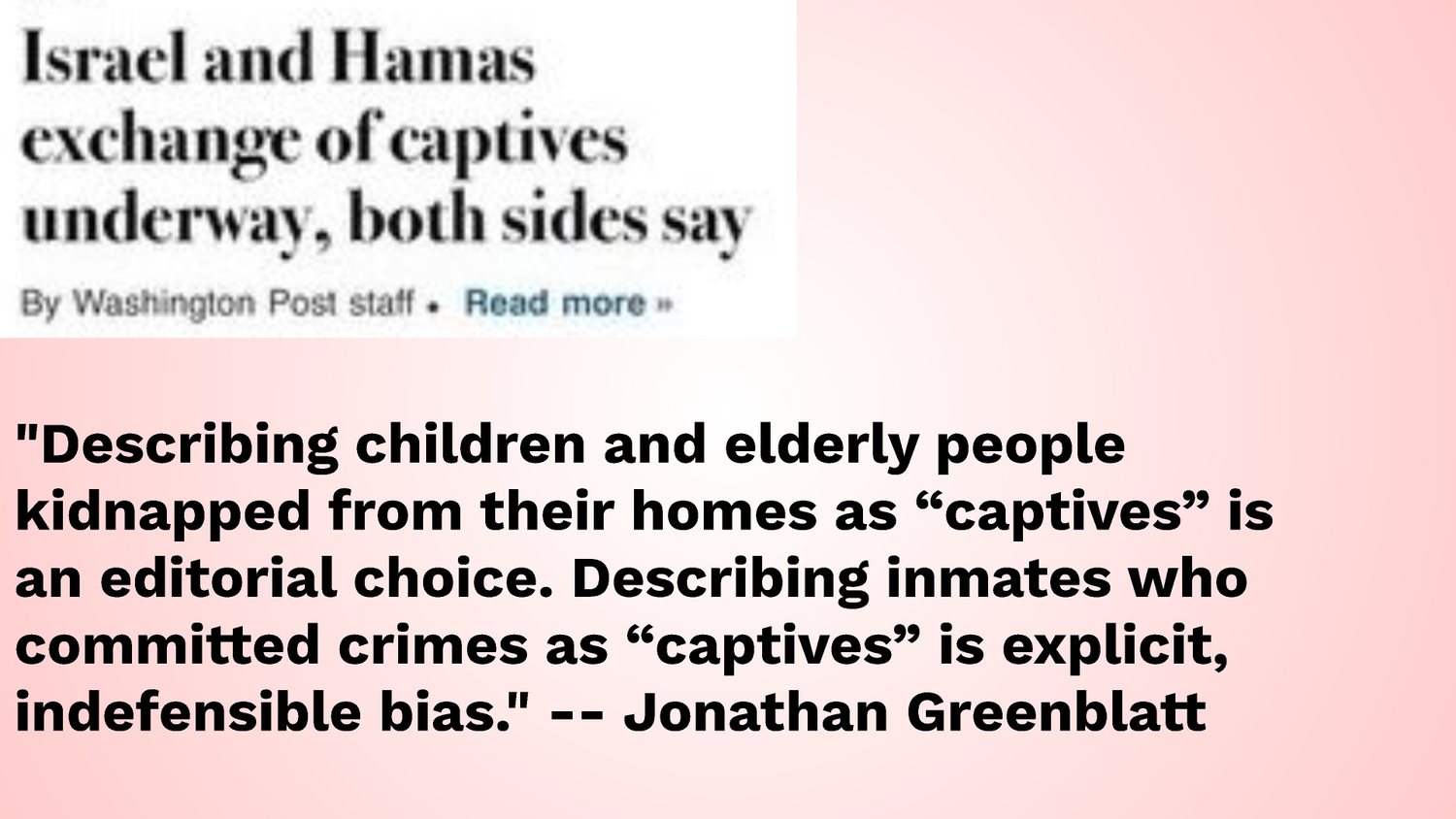
Bloomberg produced its own variant, describing the deal as an exchange of hostages for Palestinian “political prisoners.”[47]
The Post also chose to frame the war as the “Israel-Gaza war” rather than Israel’s war against Hamas — a nomenclature that makes a population, rather than a terrorist organization, Israel’s adversary.[48]
The most grotesque instance came in the Post’s own reporting on hostages released in October 2023: Yocheved Lifshitz and Nurit Cooper, Israeli women in their 70s and 80s, were released October 23, for what Hamas called “crushing humanitarian reasons.” Even while noting their husbands remained in captivity, the paper relayed a terrorist organization’s characterization of its treatment of elderly women it captured as humanitarian without a syllable of skepticism.[49]
5. References to a “Cycle of Violence”
The technique. An ongoing war is presented as a self-perpetuating weather system with no author — and, in its sharper form, Israel is accused of manufacturing the terrorism it fights, a charge never leveled at the United States for fighting its own enemies.
Coverage of Israel’s Lebanon campaign routinely quoted anonymous senior State Department officials — the press’s preferred authority in this conflict — accusing Israel of “perpetuating a cycle of violence.” The framing required omitting that Hezbollah attacked Israel unprovoked on October 8, 2023, in an act of aggression it chose, and continued firing more than 9,000 rockets across the border over ten months, displacing some 60,000 Israelis.
Reporting on the origins of the northern front compounded the distortion. Articles routinely described Hezbollah’s attacks as being launched “in solidarity with Hamas,” effectively adopting the terrorist group’s own justification as explanatory context. That framing obscured the fact that Hezbollah had long called for Israel’s destruction and was reportedly preparing an October 7-style assault of its own. More fundamentally, “solidarity” with Hamas hardly mitigates Hezbollah’s responsibility for opening another front; expressing solidarity with a massacre by attacking another country is not an extenuating circumstance for initiating hostilities. Stories about Israel killing Hezbollah’s leaders rarely mentioned that Hezbollah has killed more Americans than any terrorist organization other than al-Qaeda on 9/11.
The same anonymous officials were quoted making the recruitment argument: that Israel’s actions were “simply creating a ball to the recruitment of more terrorists.” The obvious question was never asked. The United States has killed ISIS and al-Qaeda fighters for two decades; no correspondent suggests in the paper’s own voice that American operations manufacture terrorists faster than they eliminate them, and no anonymous official would be quoted saying so without challenge. As one summary of the asymmetry puts it: when Israel strikes, it is accused of creating more terrorists, but no one says the U.S. creates more terrorists by killing ISIS or al-Qaeda fighters.
The arithmetic of the northern front was arranged the same way. When the Washington Post quantified it, the numbers were presented to Israel’s disadvantage: “From the beginning of the conflict through Sept. 21, Hezbollah conducted at least 1,758 air or drone attacks against Israel, according to data compiled by ACLED... In the same period, Israel carried nearly 9,000 airstrikes.” The reader is invited to infer disproportion. The article did not explain that the ratio compares a terror militia firing unguided rockets at population centers with an air force conducting precision strikes on military targets — a comparison in which a higher number of Israeli sorties is evidence of discrimination, not indiscriminateness.[50]
The deeper inversion is that describing Israel’s actions as “retaliation” rather than self-defense, and accusing it of perpetuating a cycle, is like comparing an arsonist with a firefighter.
6. False Analogies
The technique. Israel’s conduct is measured against historical episodes chosen for their moral charge rather than their military comparability — most often the Second World War — while the comparisons that would contextualize its conduct are never made.
The comparisons that were made
In November 2023, six weeks into the war, the New York Times published a long article by Lauren Leatherby claiming the rate at which Israel was killing civilians in Gaza was almost unprecedented in this century, exceeding Russia’s war in Ukraine, with no reference to the source of the comparison. The claim was false — Russia killed more civilians in Mariupol alone than Hamas claimed for the entire Gaza war, a fact the Times had itself reported. The paper erased the offending paragraph from its website without disclosing the error or the correction; syndicated versions, including in the Irish Times, still carry it.[51]
In December 2023, the Times international edition ran the headline “Gaza Deaths Surpass Any Arab Loss in Wars in Past 40 Years.” Wars in Syria, Lebanon, Iraq, and Yemen have each killed hundreds of thousands — at least tenfold higher. Six days later, after being mocked online, the paper corrected: the total was “the heaviest loss on the Arab side in any war with Israel in 40 years, not in any war involving Arab countries in that time frame.”[52]
On December 23, 2023, the Washington Post published a visual analysis arguing Israel’s campaign was among the “most destructive wars” of the century, outpacing Aleppo and Raqqa. The professional response was withering. Chuck Pfarrer, a former Navy SEAL Team Six squadron leader: “To compare Gaza to the deliberate, nationwide destruction of Ukraine is not just a stretch, it’s idiotic. WaPo also ignores a glaring fact: Hamas deliberately co-locates military assets with civilian infrastructure, with a special proclivity for embedding command and control networks in and under hospitals. Ukraine does not, yet more than a THOUSAND Ukrainian hospitals and clinics have been targeted and destroyed... Russia has engaged in a 670-day-long campaign of murder against UKR civilians. There is no comparison.”[53]
Malcolm Nance, a former Navy counterterrorism intelligence expert who had fought in Ukraine, added the on-the-ground correction: “I’ve been to Dresden and 95 percent of that city was rebuilt. I’ve also seen Mariupol. I fought in Ukraine. I’ve been through a hundred little villages that were leveled.” His methodological objection is the essential one: “I cannot start off with a bias and make the data fit it because it looks bad. There’s a big difference between looking bad and being bad.”[54]
David Adesnik of the Foundation for Defense of Democracies faulted the piece for “a profoundly misleading comparison of IDF tactics with those of Assad and Putin, who deliberately targeted hospitals as a means of sowing terror.” Furthermore, he noted how the Post demonstrated that Israel did not act indiscriminately; rather, it showed the precision of Israeli targeting, hitting in the vicinity of hospitals without striking the hospitals.[55]
When NPR described the Israeli air campaign in Lebanon as “one of the most intense aerial bombardments in modern history,” Aviya Kushner asked the obvious question: “Would that include World War II, Vietnam, or maybe, what Putin did in Mariupol?”[56]
The comparison that is never made
The analogy the press will not draw is the one that contextualizes Israel’s conduct: the record of Western democracies fighting existential wars.
David Mikics made it in Tablet, responding to The New Yorker’s insistence that Israeli operations are equivalent to Nazism: “Hundreds of thousands of German and Japanese children were burned to death by Allied bombers. Before and after D-Day alone, America and Great Britain killed an estimated 50,000 French civilians. Were those Allied actions the equivalent of Nazism? One could argue — idiotically, but according to some internally consistent logic — that they were. But Gessen doesn’t bother to do so. Apparently, only Israeli actions can be equivalent to Nazism. Why is that?”[57]
The same asymmetry appears in the Mosul comparison. American and allied forces destroyed much of a city of nearly two million to remove ISIS, killing thousands of civilians, over nine months. No serious outlet described that campaign as genocide, and none built a running casualty ticker supplied by ISIS.
7. Framing the Conflict as Colonial or Apartheid by Default
The technique. An activist framework — Israel as a settler-colonial enterprise and apartheid state — is adopted as unexamined background rather than as a contested claim, detaching the conflict from regional geopolitics, Iranian sponsorship, and Islamist ideology, and reducing a security dilemma to identity politics. Because it operates as a premise rather than argument, it pre-judges outcomes before any fact is reported.
The Network Contagion Research Institute studied the vocabulary’s function directly and found that “apartheid,” “colonialism,” and “settler” operate as weaponized conflict language — generating demonizing rhetoric that persists long after any specific military event ends, creating a double standard in how Israel is viewed relative to other actors.[58]
The framework entered newsrooms as an explicit demand. The open letter signed by more than 500 journalists did not ask for more context or better sourcing; it asked colleagues to adopt a conclusion.[59]
At Condé Nast it became an internal battle. The company’s Content Integrity Group, which fact-checks most non–New Yorker titles, objected to Teen Vogue’s use of “apartheid” and “genocide” in Gaza articles and at points held up pieces because the language was too biased against Israel. A Hollywood public relations president wrote privately that “Jewish representation has been wiped out completely by Teen Vogue in terms of its coverage.” Condé Nast’s first head of diversity stepped down in June 2024 after Jewish employees — who had proposed a Jewish employee resource group — filed a formal complaint. An anonymous internal tip line established in 2020 came to be used to level anti-Semitism allegations against staff who expressed sympathy for Palestinians. Semafor identified the fault line: “a rift between the nonwhite staffers who have expressed support for Palestinians or advocated editorially for more critical coverage of Israel and the white Jewish staffers who’ve objected.”[60]
Reading lists and platforms
On October 10, 2023 — three days after the massacre — Financial Times editors published a list of suggested reading to understand October 7, including books by anti-Zionist writers Rashid Khalidi, Nathan Thrall, and Joe Sacco. Two days earlier, its editorial on the still-unfolding massacre had opted for “violence begets violence” and the assertion that “the region can only secure peace if the decades-old Palestinian demand for a viable state is addressed with serious intent” — ignoring the consequences of Israel’s 2005 Gaza withdrawal and history of peace offers.
The FT’s U.S. editor wrote on October 11 that “Benjamin Netanyahu’s Israel has starved non-violent Palestinian alternatives” and that the violence resulted from Israeli leaders “depriv[ing] Palestinians of hope.” An Egyptian FT contributor justified the massacre in an October 7 retweet before publishing an op-ed accusing Israel of using the attacks as a pretext to empty Gaza. Another contributor, a distinguished fellow at Columbia’s Institute of Global Politics, described the pogrom of October 7 as an “operation” and “incursion” and three days later argued that “at its core, the current conflict is about the longest occupation in modern history.”
Adam Levick, CAMERA’s UK Media Research Manager, observed: the FT’s early coverage “is another illustration of the moral corruption within too many Western media institutions, particularly in their insistence on framing the pathologies of anti-Western extremists as legitimate grievances.”[61]
The academy’s framework, adopted wholesale
In February 2024 the Times published an essay on Israel, Gaza, and “decolonization.”[62] In April 2026, it gave its op-ed page to Ussama Makdisi, who, after October 7, shared an article titled “I Could Have Been One of Those Who Broke Through the Siege on October 7” — a statement raised at congressional hearings on campus anti-Semitism, where a member asked UC Berkeley’s chancellor: “Why would you give a position to someone who said Oct. 7 was justified?” In a 2023 podcast, Makdisi declared flatly, “Colonial Zionism has to end,” and dismissed Israel as an “ethnoreligious settler-colonial state [born] entirely of Western imperialism.” In the New Left Review, he has written that “fighting anti-Semitism often implies erasing Palestine.”
Reporter Steven Emerson’s distinction is the operative one: “there is a categorical difference between a critic of Israeli policy and a man who has declared that Zionism itself — the foundational ideology of a living democracy of nine million people — ‘has to end.’” His test: “The Times would not publish an op-ed on racial justice by a man who had publicly expressed solidarity with those who bombed a Black church.”[63]
Laundering the campus movement
The framework’s most consequential domestic application was the Times’ coverage of campus protests, which converted a movement that openly celebrated mass murder into a free-expression story.
Gilead Ini documented the technique in an October 2025 feature headlined “What Happened to Campus Activism Against the War in Gaza?” Readers were told of demonstrators “arrested,” “suppressed,” and targeted by “crackdowns” pushed by a “Republican-controlled” congressional committee. Congressional criticism that protests were “tinged with anti-Semitism” was immediately rebutted. All three commentators quoted defended the activists.
What the article omitted, by the Times’ own prior reporting, is what the movement said. Columbia University Apartheid Divest — which the Times has itself described as the “main protest movement” at the “epicenter” of campus activism — called October 7 one of the “greatest moments of Palestinian resistance,” a “crowning achievement,” and “the very essence of what it is to resist.” Its member groups declared on October 9, 2023, that they stood “in full solidarity” with the attack. CUAD amplified a post reading “Let repression breed more resistance... All Zionist... infrastructure are legitimate targets,” punctuated with the inverted red triangle Hamas uses to mark military targets, and announced that “violence is the only path forward” in support of a student leader who had said “Zionists don’t deserve to live” and “be grateful that I’m not just going out and murdering Zionists.”
The dilution is measurable: committee members had spoken of a “pervasive rot of anti-Semitism” and campuses “upended by an epidemic of hate, violence and harassment targeting Jewish students.” The Times rendered this as “tinged with.” CAIR, one of three groups quoted in the activists’ defense, was introduced only as “a Muslim civil rights group,” without noting its history of anti-Semitism or that its executive director expressed “happiness” about October 7.
A companion feature recast activists as victims of a “climate of fear,” refusing to say that many were disciplined for behavior rather than speech: masked protesters storming a Modern Israeli History class distributing flyers reading “Burn Zionism to the ground”; students barricading a campus building then demanding “humanitarian aid” when police intervened; Jewish students barricading themselves inside a library while protesters screamed outside; NYU students hurling chairs, bottles, and metal barricades at officers. The Times called this “civil disobedience,” explained that masks were worn to “avoid harming their future job prospects,” and conceded only that some organizers “seemed indifferent to complaints from Jewish students that some chants and other acts felt antisemitic.” Its chosen defender was a professor at Northwestern’s Qatar campus — Qatar being both Hamas’s chief sponsor and among the largest foreign funders of American universities, a fact left unmentioned.[64]
8. Ignorance of History and of Terrorist Objectives
The technique. Reporters covering the region know little of its history and act as though it began the day they arrived — so basic factual claims are stated incorrectly, and the belligerents’ stated objectives go unreported.
History that begins on arrival
The most common instance is the description of Gaza as “occupied” after Israel’s complete disengagement in 2005 — the removal of every settlement, every soldier, and the exhumation of Jewish cemeteries — and the treatment of the blockade imposed after Hamas’s violent 2007 seizure of power as though it had no cause. The Egyptian half of that blockade is rarely mentioned.
On the evening of October 7th, while Hamas terrorists were still in Israeli territory, the Guardian’s Jerusalem correspondent Bethan McKernan tweeted, “Until this morning, tearing down the walls that have hemmed in Gaza’s 2.3m people for 16 years was unthinkable. Whatever else happens now, this is a clear sign that the siege, and 56-year-old occupation, are not sustainable projects.”[65] The comment ignored Israel’s 2005 withdrawal from Gaza and the fact that Egypt also controls a border crossing—facts that complicate the portrayal of Gaza’s borders as solely an Israeli blockade.
A September 2025 Times article on displaced Gazans rendered 1948 this way: survivors “say that hundreds of thousands of Palestinians were told at the time that they would be allowed to return to their villages.” The passive construction conceals that their own leaders told them so. The same article appended “according to the Israeli government” to the toll of the October 7 massacre.[66]
Gessen’s account of 1948 in The New Yorker — “Hundreds of thousands of Palestinians fled the fighting. Those who did not were driven out of their villages by Israeli forces” — is contradicted by Historian Benny Morris’s research establishing that the Haganah expelled roughly 2 percent, that the overwhelming majority fled a combat zone, and that large numbers remained and became Israeli citizens, now 21 percent of the population, some of whom Hamas murdered on October 7.[67]
The Wall Street Journal inaccurately claimed[68] that the 2007 Israeli-Egyptian blockade ended all Gazan employment in Israel and was designed to impoverish innocent Palestinians purposefully. Cross-border employment, however, was ongoing: nearly 18,000 residents of the Gaza Strip possessed active permits to work in Israel right up until the October 7 attacks.[69]
Objectives that are never quoted
The corollary is that the belligerents’ own stated aims disappear. The Hamas Covenant declares that “our struggle against the Jews is very great and very serious,” that the movement “strives to raise the banner of Allah over every inch of Palestine,” and that “there is no solution for the Palestine question except through Jihad.” Hassan Nasrallah said of Jews: “If they all gather in Israel, it will save us the trouble of going after them worldwide.”[70] Iran’s Supreme Leader Ayatollah Khamenei said, “Israel’s annihilation is the only real cure.”[71]
These are not obscure documents. They are the founding texts and public statements of the parties to the war, and they are almost absent from the coverage. The BBC’s Executive Complaints Unit formalized the omission, ruling that it was “not directly relevant” to mention Hamas’s founding charter calling for Israel’s eradication in articles explaining the group’s ideology and the October 7 attack.[72]
On October 7, the Wall Street Journal misleadingly wrote that Hamas was “dedicated to the creation of an independent Palestinian state” and had “signaled it is willing to accept a two-state solution based on borders that existed before 1967.”[73] The Charter, however, makes clear its goal is the destruction of Israel, and Hamas statements referring to two-state solutions were in the context of a stage toward that ultimate objective.
Blaming the victim
On October 8, the Financial Times published an editorial ignoring the disengagement and suggesting the Hamas massacre was a result of Israel’s failure to meet Palestinian demands for independence. The paper also seemed to suggest Israel should not respond because “violence begets violence.”[74]
Three days later, the paper’s U.S. editor Edward Luce blamed Israel for the attack, writing that the horrific killings “should come as no surprise” because “Benjamin Netanyahu’s Israel has starved non-violent Palestinian alternatives” and “deprived Palestinians of hope for the future and peaceful outlets to express their frustrations.”[75] A similar argument was made in FT by contributor Kim Ghattas, who insisted, “the current conflict is about the longest occupation in modern history, one that leaves the Palestinians dispossessed.”[76]
“No, it’s about the lethal anti-Semitism of a movement whose objective is the annihilation of the Jewish state,” argued Adam Levick. “The FT’s early coverage of Oct. 7th is another illustration of the moral corruption within too many Western media institutions, particularly in their insistence on framing the pathologies of anti-Western extremists as legitimate grievances.”[77]
PART THREE — WHO CONTROLS THE STORY
9. Hamas and Hezbollah Control of Reporting
The technique. Reporters in Gaza and Lebanon were permitted to show only what the terrorist organizations allowed them to show — and the same regimes limited what aid workers, doctors, NGO staff, and UN personnel could say. Western outlets published the resulting product as independent journalism without disclosing the constraint.
This is the most important fact about the coverage, and the one least often stated.
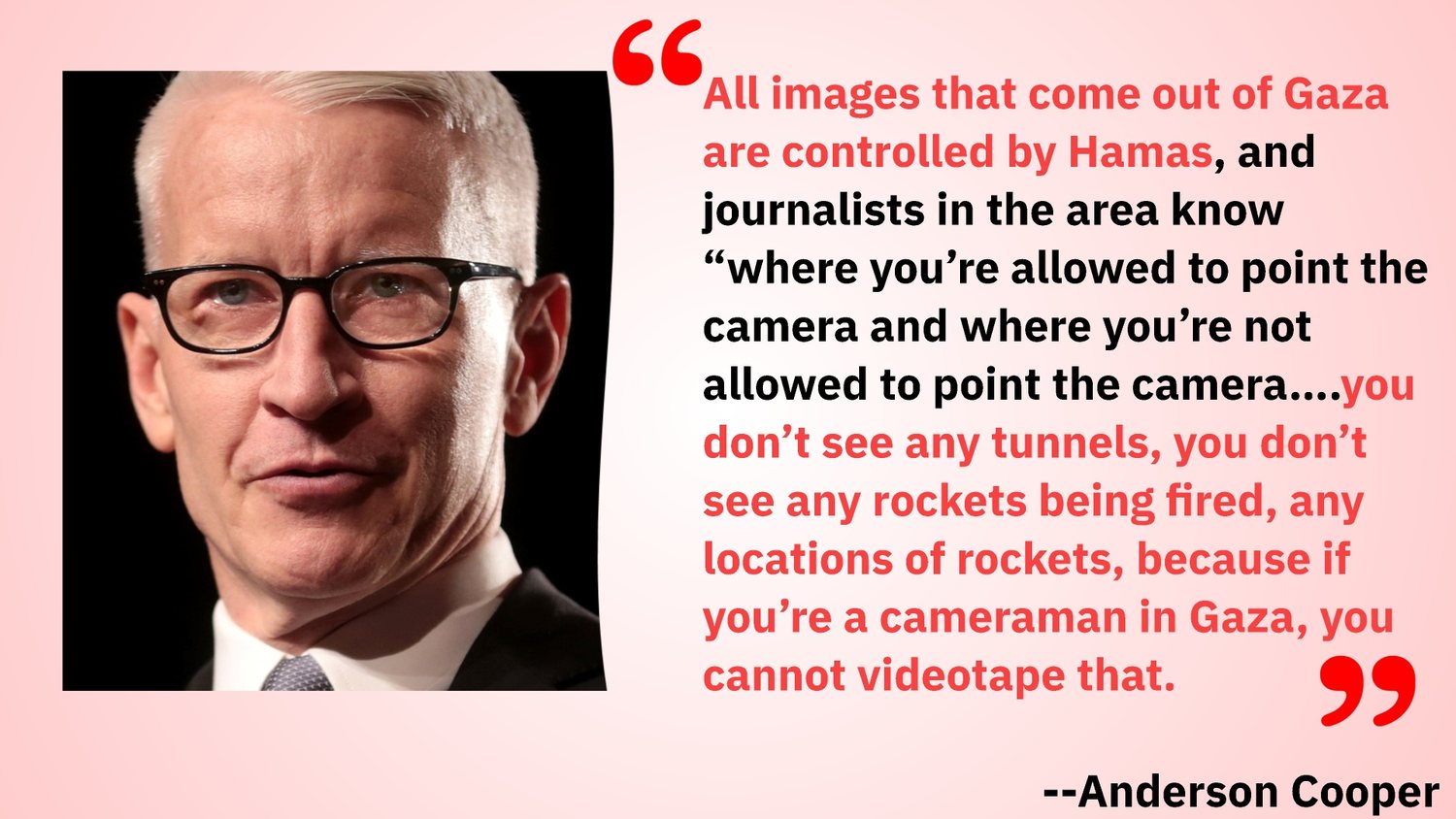
Anderson Cooper of CNN described the system plainly: “All images that come out of Gaza are controlled by Hamas,” and journalists in the area know “where you’re allowed to point the camera and where you’re not allowed to point the camera.... you don’t see any tunnels, you don’t see any rockets being fired, any locations of rockets, because if you’re a cameraman in Gaza, you cannot videotape that.”[78]
Friedman, writing from inside the Associated Press bureau, supplied the operational detail: “The AP staff in Gaza City would witness a rocket launch right beside their office...[and] wouldn’t report it.... Hamas fighters would burst into the AP’s Gaza bureau and threaten the staff — and the AP wouldn’t report it. Cameramen waiting outside Shifa Hospital would film the arrival of civilian casualties and then, at a signal from an official, turn off their cameras when wounded and dead fighters came in, helping Hamas maintain the illusion that only civilians were dying.”[79]
Read carefully; that last sentence describes something graver than self-censorship. It describes Western news organizations participating, by omission, in the construction of a false casualty picture that then became the moral basis for international pressure on Israel.The same control extended to the professionals whose testimony the press treated as independent corroboration. Hospital administrators and NGO staff in Gaza operate under threat of reprisal from the armed groups that govern them, which produces a culture of silence about terrorist use of medical and humanitarian infrastructure. When a Western outlet quotes “a hospital director” or “aid workers on the ground,” it is quoting people who are not free to describe what they have seen. In some cases, the sources were later learned to have affiliations with Hamas.
Media reports did not acknowledge the constraints on their sources. Journalists also failed to do in-depth research to supplement, refute, or correct the information they were being given. For example, journalists could have easily located the PBS documentary filmed in 2006 that showed Hamas fighters in the Shifa Hospital.[80] A 2009 PBS report quoted a doctor who said he believed Hamas officials had taken refuge in the basement or an underground area beneath Al-Shifa Hospital after Israeli forces destroyed their previous hideouts. Speaking anonymously, the doctor said he believed Hamas knew its presence at the hospital was putting civilians at risk.[81]
Reporters could also have found guidelines published by the Hamas interior ministry in 2014 instructing the civilian population on how to behave toward the press. The guidelines included:
Anyone killed or martyred is to be called a civilian from Gaza or Palestine before we talk about his status in jihad or his military rank. Don’t forget to always add “innocent civilian” or “innocent citizen” in your description of those killed in Israeli attacks on Gaza.
Begin [your reports of] news of resistance actions with the phrase “In response to the cruel Israeli attack,” and conclude with the phrase, “This many people have been martyred since Israel launched its aggression against Gaza.” Be sure to always perpetuate the principle of “the role of the occupation is attack, and we in Palestine are fulfilling [the role of] the reaction.”
Avoid publishing pictures of rockets fired into Israel from [Gaza] city centers. This [would] provide a pretext for attacking residential areas in the Gaza Strip. Do not publish or share photos or video clips showing rocket launching sites or the movement of resistance [forces] in Gaza.[82]
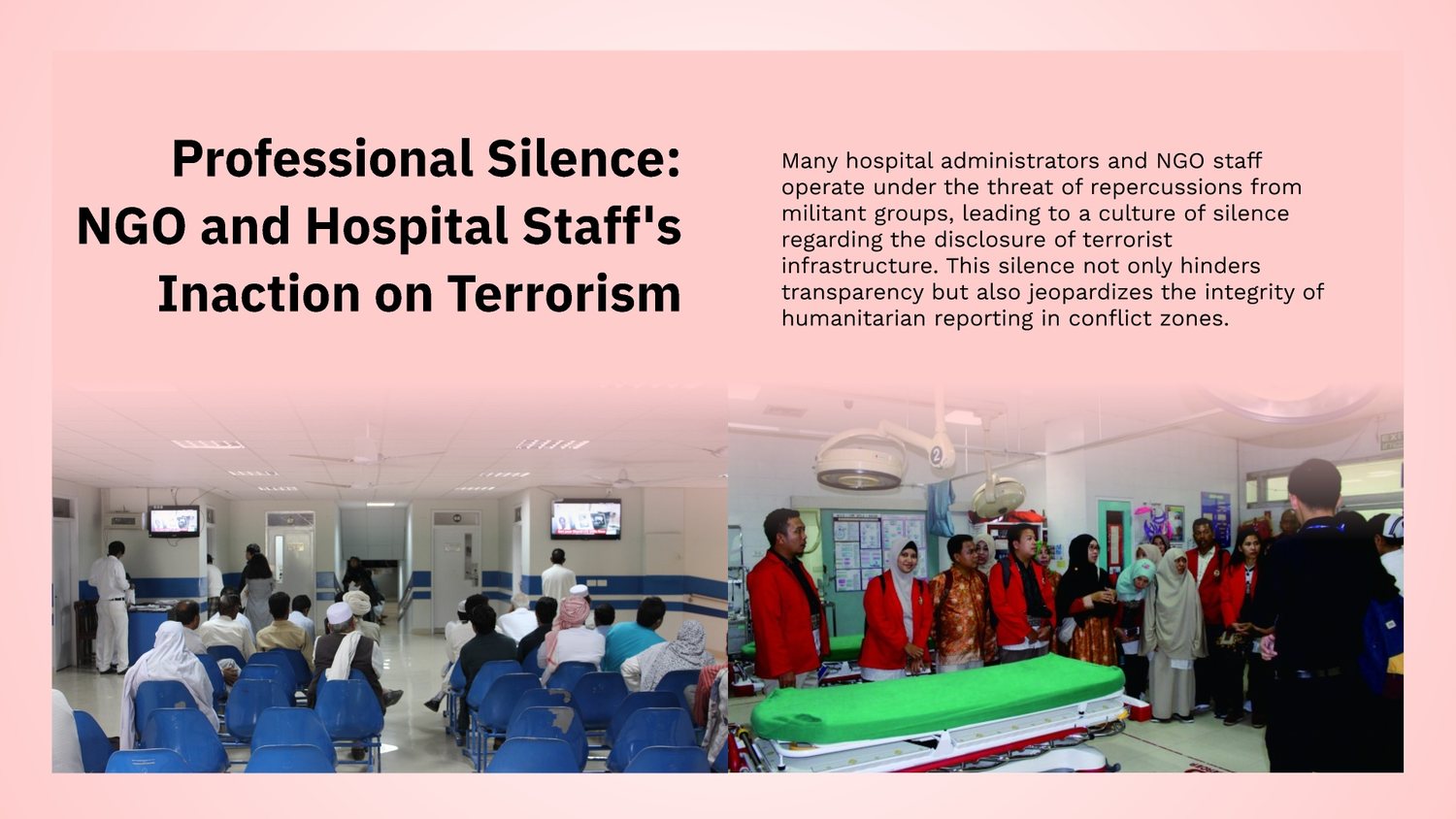
Professional silence: hospital and NGO staff operate under threat of reprisal.
Marvin Kalb documented the identical system in Lebanon a generation earlier, and the continuity is the point: “Cameramen didn’t need permission to film devastation, but they were warned against taking pictures of Hezbollah terrorists. The rarest picture of all was that of a Hezbollah guerilla. It was as if ghosts were fighting the war on the Hezbollah side.”[83]
Robert Satloff’s warning about what happens when access finally opens is worth recording, because the natural assumption is that more journalists means better information: “Even with the best intentions and oversight from headquarters, this will be a bonanza for Hamas’s well-oiled media operation, which has controlled virtually every word written or broadcast in Gaza since 2007.
The suppression was not limited to wartime. As Khaled Abu Toameh documented, the Palestinian Journalists Syndicate had recorded 500 violations against journalists by Hamas since its 2007 takeover; its chairman called the arrests of hundreds “a dangerous indicator of an ISIS-like mindset that does not believe in freedom of the media,” and noted the true number “exceeds what has been documented, because some of them fear for their lives and the lives of their children if they speak out.”
The named cases are numerous: Hani al-Agha, held in poor conditions despite deteriorating health after spinal surgery; Mohammed al-Louh, arrested from his home with no stated charges; Hamza Hammad, seized in a raid by men who did not identify themselves; Ahmed Saeed, arrested after reporting that Hamas bore responsibility for young Gazans drowning at sea while fleeing; Hani Abu Rizeq, arrested after reporting on a Gaza resident whose home was destroyed by Hamas police when he refused to sell it to a Hamas-linked businessman; Taghreed Abu Dhareefa, arrested for “communicating with” the Palestinian Authority; Hajar Harb, an investigative reporter jailed for six months for reporting corruption in Hamas ministries.
“Some foreign journalists were aware that their Palestinian colleagues were facing a brutal campaign of intimidation by Hamas but chose to look the other way,” Abu Toameh wrote. “Many foreign journalists only want stories that reflect negatively on Israel.”[84]
Gazans themselves described the enforcement mechanism to the Center for Peace Communications and The Free Press: “Al-Jazeera’s correspondents locate people for Hamas. They direct Hamas gunmen to arrest independent journalists and break their limbs.”[85]
Ahmad Sharawi of the Foundation for Defense of Democracies traced the architecture of that control. In 2013, Hamas’s Interior Ministry convened Gazan journalists and social-media activists for a workshop on how to report from Gaza, attended by the movement’s military spokesman, Abu Ubayda; participants were told the press mattered as much as the fighters. The warnings came with enforcement. In 2016, Hamas arrested al-Monitor reporter Mohammed Othman for exposing medical errors in Gaza’s hospitals and then barred him from them; in 2019, it detained twelve journalists for covering protests its rule. During the war, in at least three cases, Gazan reporters said Hamas fighters beat or threatened them after they aired residents blaming Hamas for the destruction and ordered them to stop reporting local discontent. Documents that later came to light showed Hamas instructing Al Jazeera in 2022 on how to cover a failed rocket launch that killed Palestinian civilians, and in 2023, how to set up a secure communications line with the network.[86]
The consequence for Western audiences is the point. Outlets depended on local journalists while largely missing that criticism of Hamas was unlikely ever to reach a camera. By the time the material arrived in foreign newsrooms, the coercion that shaped it had become invisible.
10. Reliance on Freelancers and Fixers
The technique. Denied access, Western outlets relied on local stringers, freelancers, and fixers whose work was published without meaningful vetting — including many with documented ties to terrorist organizations, some of whom continued to be used after those ties were exposed.
The structural problem is inseparable from Category 9: a fixer who arranges interviews, translates, and navigates a war zone determines what the visiting correspondent sees, and in Gaza that fixer answers to Hamas.
The vetting failures are documented and specific.
Hassan Eslaiah, a photographer who worked for CNN, the Associated Press, and Reuters, uploaded video apparently shot from the back of a motorcycle crossing from Gaza into Israel on October 7, with a hand clutching a grenade visible in frame. His posts that day called the attack “beautiful,” the perpetrators “warriors,” and mocked Israelis hiding in a dumpster. Researchers found a 2020 selfie on his own account showing Yahya Sinwar kissing him on the cheek. CAMERA had informed the AP of his Hamas ties in 2018; the agency continued to employ him.
Ashraf Amra and Mohammed Fayq Abu Mostafa, whose photographs were published by AP and Reuters, held an Instagram Live broadcast after returning to Gaza, displaying gruesome footage while grinning and laughing. “We were there two hours ago, since the beginning,” Abu Mostafa said — contradicting Reuters’ claim that its photographers were active only “two hours after Hamas fired rockets... and more than 45 minutes after Israel said gunmen had crossed the border.” They urged Gazans to join in: “Whoever can go — go... It is a one-time event that will not happen again.” Amra had received an award and a kiss from Ismail Haniyeh.[87]
Soliman Hijjy, a Gazan photojournalist, was fired by the New York Times in 2022 for posting antisemitic material on social media — then rehired after October 7, contributing to thirteen war articles including the false Al-Ahli report. His contributions ceased only after the New York Post exposed the rehiring. Times readers were never told his background.[88]
Yousef Masoud, a Times freelance photographer, was defended by the paper against allegations concerning October 7. The Times stated that editors “determined that the first photo he transmitted to the AP... was taken more than 90 minutes after the attack began,” and that Masoud said he was woken at home “shortly after 5:30 A.M.” Hamas began launching rockets at 6:30 a.m., not 5:30; the paper issued a correction phrased as a typo. AP metadata showed the photograph was created at 6:41 a.m. — eleven minutes after the attack began, not ninety.[89]
The Wall Street Journal’s contributor roster showed the same pattern. HonestReporting documented Fatima AbdulKarim, Ramallah-based and affiliated with the Journal before the war, with a history of posts accusing Israel of “apartheid” and “ethnic cleansing” and reliance on sources including Defense for Children International–Palestine, a PFLP front. In August 2024, it uncovered the social media history of Journal contributor Abeer Ayyoub, who celebrated October 7, spread false claims about a kidnapped Israeli general, and commented “Eat shit” in Arabic on Elon Musk’s message of sympathy with Israel.[90]
The BBC’s Arabic service institutionalized the problem. Internal research showed that Samer Elzaenen, who had posted that Jews should be burned “as Hitler did,” appeared 244 times between November 2023 and April 2025, consistently introduced as a journalist. Ahmed Qannan, who described a gunman who killed four civilians and a police officer as a “hero,” appeared 217 times. Ahmed Alagha, who described Israelis as less than human and Jews as “devils,” appeared 522 times across BBC Arabic television, radio, and Gaza Today. In public statements, the corporation downplay them as “eyewitness accounts” and said, “these are not BBC members of staff or part of the BBC’s reporting team.”[91]
In September 2026, Motaz Azaiza—named one of TIME’s 100 most influential people of 2024 and GQ Middle East’s Man of the Year—described a Hamas-administered group, known as Category 11, through which Gaza’s journalists coordinated their activities. His account prompted Sharawi to raise a question foreign news organizations should have been asking since October 7, 2023: How many American and international media outlets rely on fixers connected to this network to arrange interviews and translate Arabic-language conversations? Sharawi called for a long-overdue audit of these relationships. To date, no major news organization has officially announced one.[92]
11. Compromised “Journalists”
The technique. The count of “journalists killed” became a moral indictment of Israel while resting on a category error: a substantial share of those counted were operatives of terrorist organizations, and the organizations doing the counting apply a standard to Israel that they do not apply to anyone else.
The Washington Post’s Ishaan Tharoor devoted a column to “Israel’s unprecedented slaughter of journalists in Gaza,” reporting the Committee to Protect Journalists’ (CPJ) tally of at least 189 Palestinian journalists and media workers “killed by Israel in Gaza” and noting that the figure “is far larger than the toll from two decades of war in Afghanistan, a decade of war in Ukraine, and the wars in Vietnam and Korea.”[93]
The academic underpinning was an April 2025 Watson Institute report at Brown University by Nick Turse, News Graveyards. Salo Aizenberg’s examination found it collapses on inspection:
• The chart contradicts the claim. Adding the figures from Turse’s own cited sources yields 293 journalists killed in the listed prior wars against 232 claimed for Gaza.
• Syria is omitted. The study notes that 717 journalists and media workers — the same category used for Gaza — were killed in the Syrian civil war, three times the Gaza figure, and leaves it off the chart.
• Iraq is omitted on an invented rule. A footnote records 285 killed in the Iraq War, excluded because the deaths span 2003 to 2025 — though about 70 percent occurred in the first five years.
• The Gaza number is inflated by source-shopping. For prior wars, Turse relies on CPJ. For Gaza, he abandons CPJ — whose complete count through the study’s end date is 165 — in favor of an Al Jazeera investigation listing 222, then adds ten more from CPJ for later months.
• The World War II baseline is absurd. Turse’s figure of 67 comes from a database covering only Allied news agencies. It excludes Soviet, German, Japanese, and Polish correspondents. A Russian nonprofit held a 2025 memorial for 1,500 Soviet journalists killed at the front; a University of Illinois database lists 64 Polish journalists by name, and another source offers biographies of 576 Polish writers and journalists who died between 1939 and 1945; a Yad Vashem search for journalists killed in the Holocaust returns 1,425 names.
• Categories are not comparable. Prior-war data counted accredited reporters and photographers; Gaza figures include drivers, fixers, and translators.
• Combatant status is ignored. CPJ’s own database includes Hamda Al-Yaziji, listed as working for “Hamas-owned” Al-Quds Radio. A review of the first eighteen Gaza journalist fatalities in CPJ’s list found only ten were considered to have been on journalistic duty when killed.[94]
Israel’s Meir Amit Intelligence and Terrorism Information Center produced a different count, examining each of 266 names. At least 157 — about 60 percent — were operatives of or affiliated with terrorist organizations: 104 identified with Hamas, of whom at least 47 were members and/or military operatives; 45 with Palestinian Islamic Jihad, of whom at least 18 were members and/or military operatives; two of Fatah’s al-Aqsa Martyrs Brigades; two of the PFLP; one of the DFLP; one of the Popular Resistance Committees.
Its central finding: “many had double roles, they were both military operatives and media personnel. That was particularly obvious in the cooperation between Hamas and Qatar’s Al Jazeera network. Loyalty to a media outlet and a terrorist organization not only undermines trust in media personnel and the credibility of their reporting but alters the status of journalists under international law and places them in danger, since military forces find it difficult to distinguish between journalists and military operatives.”[95]
Anas al-Sharif, the Al Jazeera correspondent killed in August 2025, is the emblematic case. Both CNN and the BBC confirmed he had previously served as a Hamas propaganda operative. In October 2024, the IDF released captured personnel files, salary records, and documents establishing that six Al Jazeera employees were active Hamas and PIJ operatives, identifying al-Sharif as commander of a Hamas rocket-launching squad and a member of the Nukhba force that spearheaded October 7, on Hamas’s payroll. Al Jazeera rejected the evidence and kept employing them. Another so-called journalist, Abdallah Aljamal, held Israeli hostages in his home.
Avi Mayer’s argument about CPJ’s inconsistency is the sharpest available. Sergeant Lior-Shlomo Ziv, a twenty-year-old IDF military photographer, was killed documenting counterterror activity in Rafah in April 2003; CPJ lists 42 journalists killed that year, and Ziv is not among them. Major Megan McClung, a U.S. Marine Corps public affairs officer, was killed by an IED in Ramadi in December 2006 while accompanying Newsweek journalists; CPJ lists 57 killed in 2006, and she is not among them. “While it might seem obvious that uniformed military personnel would not be considered journalists, CPJ seems all too willing to grant ununiformed terrorist operatives who perform equivalent military functions for their respective militant groups that very title, artificially inflating the number of journalists killed and undermining the contributions of actual media professionals.”
Mayer opened his essay with Marie Colvin, who in September 1999 refused to leave a UN compound in Dili, East Timor, where 1,500 civilians sheltered from Indonesian-backed militias, reporting the siege until international pressure secured their evacuation. “I just couldn’t leave,” she said later. “It was morally wrong, the idea that we would walk out, say goodbye, and all those people knew they were going to be killed.” Against that standard, he set individuals identified as journalists in Gaza who “have not only failed to intervene when harm was imminent — they have actively participated in inciting, perpetrating, amplifying, and celebrating that harm.”
He is careful to concede the legitimate criticism: “Israel’s approach to the international media throughout this war — including its ill-considered and continuously detrimental decision not to permit foreign journalists to enter Gaza freely — has been imperfect at best.”[96]
The casualty lists themselves were never audited by the outlets that cited them. In May 2024, Jewish Insider reviewed the CPJs’ roster of 100 Palestinian journalists killed and found that 33 had worked for Hamas-affiliated media and two more for Palestinian Islamic Jihad outlets; thirteen had been employed by Al-Aqsa TV, which the U.S. Treasury designated a terrorist entity in 2010. Reporters Without Borders’ named cases included the director of the Hamas outlet Quds News and a director at Al-Aqsa TV, without noting either affiliation. Both groups say they count only those killed in connection with their work, yet their lists included people killed at home with their families. CPJ said it includes Gazans by default until it has definite information that they were not working. The RSF USA director acknowledged a different standard for Gazans, who he said could fairly be assumed to be working from their homes. CPJ, meanwhile, had removed two Israeli journalists killed at the Nova festival because they were attending rather than reporting.[97]
The Washington Post and the New York Times reported the rising journalist toll without mentioning any of these affiliations.
The pattern recurred in Lebanon. On March 28, 2026, Israel struck a vehicle on the Jezzine highway, killing Ali Shoeib — a journalist for the Hezbollah-affiliated al-Manar whom Israel identified as a Hezbollah intelligence operative — along with Fatima Ftouni and her brother Mohammed. Headlines led with “three journalists killed;” press groups called it a war crime. David Collier, working from open sources, found within hours what the outlets had not sought: Fatima Ftouni had posted celebrations of terror attacks, including of the January 2023 murder of seven Jews outside a Jerusalem synagogue — “Photos of the Israeli dead... 8 killed... A beautiful night in Jerusalem” — and her brother had posted images of himself in military dress beside Hezbollah flags with a Hezbollah fighter killed in clashes with Israeli forces.
More than two years after October 7, the head of the Palestinian Journalists’ Syndicate explained how Hamas silences reporters in Gaza through summonses, interrogations, threats, beatings, arrests, publication bans, interference with content, and surveillance. His deputy acknowledged that most journalists in Gaza now censor themselves. CPJ said such abuses are vastly underreported because victims are afraid to speak out. Journalist Khaled Abu Toameh pointed out that no international protests were mounted to protest Hamas’s crackdown on journalists. [98]
CPJ revised its criteria for inclusion on the list. Previously, it did not regard membership in a military media unit as evidence of participation in combat. Under the revised policy, it excludes anyone who was an active member of a state military or an armed organization’s military wing.
Subsequently, CPJ has removed names from its database as more evidence of “journalists’” terror connections emerged. In June 2026, for example, it removed 20 names, some of whom were referenced in obituaries published by Hamas and Islamic Jihad. The Meir Amit Center found 23 more cases.[99]
Motaz Azaiza explained in a September 2026 podcast that all Gaza journalists were in a WhatsApp group whose icon is the Hamas flag. He said one of the Hamas media directors based at the Rafah crossing ran it.
Azaiza described a Hamas-controlled group of reporters that managed the narrative from Gaza, whose administrator he identified as the media director of the Rafah crossing, and said that when someone voiced dissent, many journalists simply lowered the camera. He also acknowledged that he filmed Israeli hostages being beaten in a Gaza street on October 7 and never published the footage.[100]
“It is one thing to argue that Israel has not publicly provided evidence,” Collier wrote. “It is quite another to promote a story presenting those killed as journalists, cast doubt on Israel’s account, and ignore publicly available material that suggests those claims may have merit. That is no longer journalism. It is advocacy that chooses to ignore inconvenient facts.”[101]
Reporters Sans Frontières (Reporters Without Borders - RSF) has also kept a tally of media workers killed in the war. RSF was often cited by the media in articles accusing Israel of targeting journalists. Like CPJ, it has revised its list as it received evidence of ties to terror groups. In August 2026, it removed two terrorists from its list. Of the 67 remaining journalists in RSF’s database, at least 19 had ties to terrorism, according to HonestReporting. Terrorist organizations issued martyr notices for three of them. Obituaries and other open-source information linked another three to participation in hostilities. Four worked for outlets affiliated with terrorist groups, the IDF alleged that eight were terrorists, and one worked for a news outlet whose terrorist affiliation is disputed.[102]
The IDF announced on October 1, 2026, that, after extensive research, it had determined that 170 Gazans killed during the war and presented as journalists or media workers had been members of terror groups. According to the military, 118 had been active in Hamas’s military wing, 49 in Palestinian Islamic Jihad, two in the Popular Resistance Committees, and one in the Mujahideen Brigades, and 17 had taken part in the October 7, 2023, invasion of Israel. Some on the list had also worked for international outlets, including Reuters, CNN, the BBC, AFP, AP, Le Monde, and ABC Australia. The IDF published the names on a dedicated website, listing each person’s role along with civil and military ID numbers, and said it was releasing verified evidence, including visual material and terror-group documents, some found in the field, showing their affiliations and roles. The military also accused international media of repeatedly charging Israel with deliberately harming journalists “without presenting verified findings.”[103]
12. Selective Quotation and Anonymous Sourcing
The technique. Reporters select sources whose answers they can predict — Arabists, former officials, aligned academics, and NGO staff — and grant anonymity that shields not only identity but agenda.
Coverage of the war relied heavily on former State Department officials, the media’s go-to authorities whose views reporters often know in advance and whose assessments conveniently reinforce the prevailing narrative. Many are Arabists with longstanding criticisms of Israel, veterans of opposing administrations, or disgruntled former officials with their own grievances. Yet they rarely disclose their ideological predispositions, political loyalties, or personal agendas. Readers are also not reminded of the failures of the policies these same officials helped formulate and implement. Instead, they are presented as disinterested experts whose judgments carry the weight of authority without the burden of accountability.
Anonymous “senior State Department officials” supplied the war’s most tendentious formulations: that Israel was perpetuating a cycle of violence; that Israeli operations were manufacturing terrorists. Anonymity here does not protect a whistleblower from retaliation — the standard justification — it protects an official from having his record and his agenda weighed by the reader.
The New York Times’ December 2024 investigation “Israel Loosened Its Rules to Bomb Hamas Fighters, Killing Many More Civilians” was the technique at full scale. As Ruthie Blum observed, the article was “marked by as many bylines as anonymous sources.” Its central claim rested on a “senior military officer” saying the army “believed that Israel faced an existential threat” — a nameless source required to establish that Israel felt endangered on October 7. The reporters assured readers they had reviewed “dozens of military records.” They interviewed “more than 100 soldiers and officials,” most of whom could not be identified because of the subject’s “sensitivity.” The piece’s one named Gazan voice was the brother of a senior commander in a militia allied with Hamas that joined the October 7 attack.
The article’s framing inverted its own subject: it used the IDF’s self-imposed “purity of arms” doctrine — a stricter code than that of any other military — as the standard by which to condemn Israel. Col. Richard Kemp, former commander of British forces in Afghanistan, called the piece “slanted”: “In my experience of observing the IDF in action, they scrupulously stick to the laws of war in their targeting policies and actions... I know that no other army has had such sophisticated or effective means of mitigating harm to civilians.”[104]
NGOs as neutral experts
Human Rights Watch and Amnesty International — organizations that have established themselves as systematic critics of Israel — are presented as neutral watchdogs. These groups “claim to promote values that are seen as universally good – peace, human rights, justice, coexistence,” which gives them a “halo effect.” They are “automatically perceived as credible and constructive forces, immune from investigation and criticism.” Hence, the media and others regurgitate their findings uncritically.
“The ‘halo effect,’ NGO Monitor argues, “provides anti-Israel political advocacy NGOs with a façade, allowing them to hide their political warfare agendas behind the rhetoric of ‘human rights’ and ‘international law.’”[105]
HRW’s own founder, Robert Bernstein, publicly condemned the organization in 2009 for its disproportionate fixation on the Jewish state and for aiding “those who wish to turn Israel into a pariah state.”[106]
Human Rights Watch and Amnesty International both issued reports accusing Israel of genocide, allegations that received widespread media coverage. Although some outlets included Israel’s denials, few subjected the organizations’ evidence, methodology, or conclusions to meaningful independent scrutiny, largely presenting their accusations as authoritative findings.
A senior HRW editor who spent nearly 14 years overseeing the organization’s global research resigned in November 2023 citing anti-Israel bias; in a public letter to 600 staff, Danielle Haas wrote that “HRW’s initial reactions to the Hamas attacks failed to condemn outright the murder, torture, and kidnapping of Israeli men, women, and children. They included the ‘context’ of ‘apartheid’ and ‘occupation’ before blood was even dry on bedroom walls,” and that “years of institutional creep culminated in organizational responses that shattered professionalism, abandoned principles of accuracy and fairness, and surrendered its duty to stand for the human rights of all.”[107]
The Post’s expert selection produced one especially embarrassing case. In an early piece arguing Israel’s campaign was historically unprecedented, Louisa Loveluck cited Marc Garlasco, identified as “a military adviser at the Dutch organization PAX for Peace” and a former war-crimes investigator, who claimed, “the highest number of bombs and other munitions dropped in one year during the war in Afghanistan was just over 7,423.” CAMERA established that this was the highest single-year figure since 2006 and excluded 2001–2006 — during which the U.S. Air Force dropped 17,500 bombs in the first 76 days alone. The Post corrected. What it never disclosed was that Garlasco had been suspended by Human Rights Watch in 2009 for collecting Nazi memorabilia, having written online under the handle “Flak 88” that “the leather SS jacket makes my blood go cold it is so COOL!” The Post’s defense was that Garlasco is widely cited by other outlets.[108]
UNRWA presents the same problem in acute form. Before the war, the agency had stationed over a third of its global employees in Gaza; its staff was subsequently documented participating in the October 7 attack and holding Israeli hostages in their homes. It remained a routine and unqualified source.
13. Aiding and Abetting the Enemy
The technique. Outlets published operational information of direct military value to Israel’s enemies — most conspicuously satellite imagery and detailed mapping of Israeli troop movements — a practice they do not apply to American, British, or even Russian forces in the field.
The New York Times published:
• “A Detailed Satellite View of Israel’s Invasion” (October 31, 2023)
• “Satellite imagery shows Israel’s advance into central Gaza” (December 26, 2023)
• “A Satellite View of Israel’s New Front in Gaza” (May 8, 2024)
• “Satellite Images Show Israeli Military Buildup Around Gaza City” (September 16, 2025)
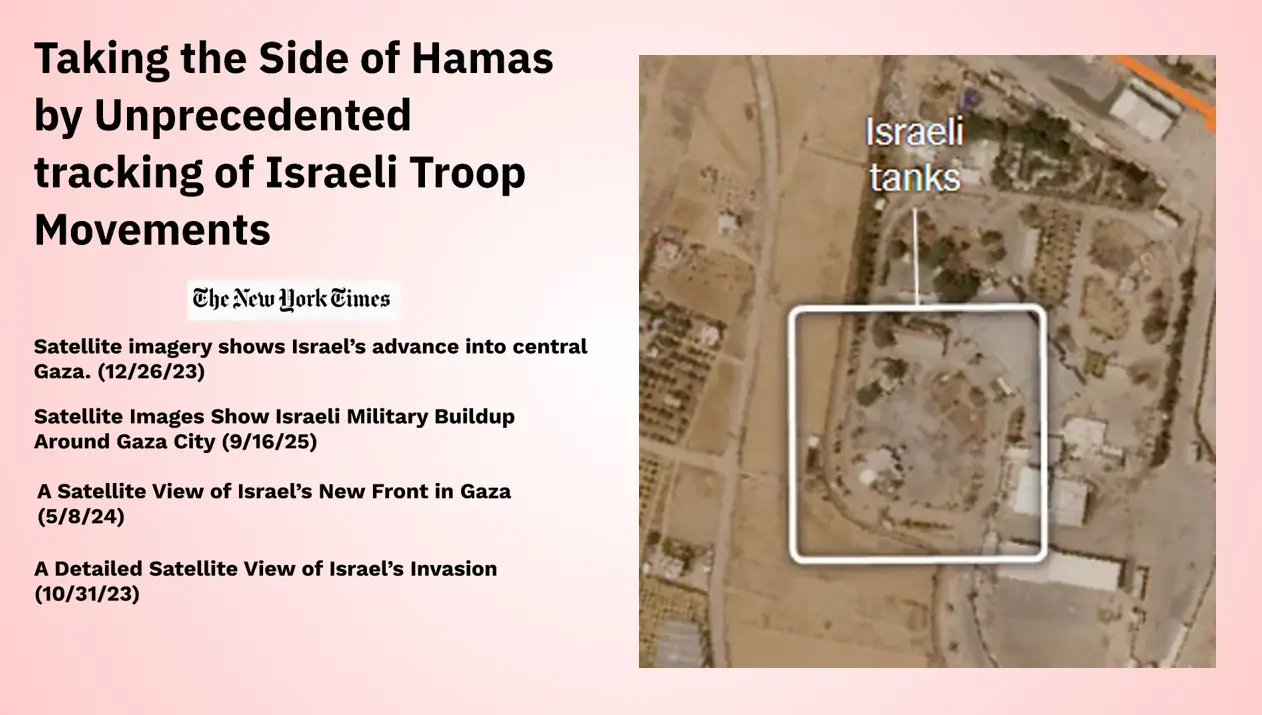
The Lebanon coverage went further, mapping the towns Israel had ordered evacuated, the closed military zones where “Israel has amassed troops and equipment on its side of the border,” the specific locations where Hezbollah reported clashes, and the terrain analysis — “southern Lebanon is a rugged area, filled with steep valleys in which defenders can ambush an invading army.” In December 2024, the paper produced “Maps: See Israel’s Moves in Syria Since al-Assad Was Toppled.”[109]
Two things distinguish this from ordinary war reporting. The first is selectivity: the Times did not publish satellite reconstructions of American force concentrations during the Mosul or Raqqa campaigns, Turkish deployments in northern Syria, or Russians in Ukraine. The second is that the information has no informational value to the reader that would justify the operational value to the adversary. A reader in Ohio does not need to know where an Israeli division is staging; Hezbollah’s targeting cell does.
The asymmetry compounds a pattern documented in Category 18: enormous forensic effort is expended on making Israeli military activity visible, and none on making the enemy’s visible. Over more than a year of Hezbollah bombardment, no major outlet produced a single comparable photographic investigation of a Hezbollah launch site — despite having reporters on the ground in Lebanon the entire time.
14. Hostile-State Media as Sources
The technique. Outlets owned or directed by states and movements at war with Israel are quoted as news organizations, often under euphemisms such as “semi-official” or simply by name, without telling readers who controls them. Their claims enter Western coverage with the credibility of the outlet that relays them, not the one that produced them.
“Semi-official”
The New York Times routinely reports what “Iran’s semi-official - news agency” says about ceasefire proposals, strikes, and prisoners. Tasnim is owned and operated by the Islamic Revolutionary Guard Corps; the U.S. Treasury has placed it on the Specially Designated Nationals list, and the European Union sanctioned it for publishing forced confessions and circulating photographs of protesters so that readers would help identify them. Nothing about it is semi-official.[110]
The Jewish Chronicle recalled the precedent. On September 1, 1939, the Times led with a report, attributed to a “semi-official news agency,” that Polish guerrillas had attacked a German radio station at Gleiwitz. There was no such thing as a semi-official agency in Nazi Germany; the attack was a staged provocation using murdered concentration camp prisoners, and the Times’ relay of it helped supply the pretext for the invasion of Poland. The correspondent, Otto Tolischus, won the 1940 Pulitzer Prize for his Berlin dispatches. The paper’s Berlin bureau chief through the 1930s, Guido Enderis, was recorded in a Nazi Foreign Office memorandum as having shown “proved friendliness to Germany.”[111]
Al Jazeera and AJ+ as news
Qatar hosted Hamas’s leaders living outside Gaza. According to Khaled Abu Toameh, “the only Palestinian journalists who were free to operate in the Gaza Strip for nearly the past two decades were those working for Qatar’s Al-Jazeera.”[112] Unsurprisingly, documents recovered in Gaza showed Hamas directing its coverage (Category 9).79 Its output is nonetheless cited, embedded, and recirculated as reporting. In September 2026, AJ+ broadcast a segment in which Bisan Owda, standing in a tent camp, attributed Gaza’s summer heat to Israeli bombing that she said had reduced the amount of oxygen in the region. The August highs she cited, 89 to 91 degrees Fahrenheit, were within the range of the previous four years, including 2023, and typical of a Miami summer.[113]
The consequence for the reader
A reader informed that a claim comes from “Iranian state media” or “Hamas’s television channel” can weigh it. A reader told it comes from a “semi-official news agency” or a named network with no description cannot. The omission transfers credibility from the relaying outlet to the propagandist, which is precisely the service asymmetric-war propaganda requires of its Western intermediaries.
PART FOUR — THE NUMBERS
15. The Casualty Scoreboard
The technique. Palestinian casualty figures are repeated constantly and juxtaposed with the smaller number of Israeli dead, as though the conflict were a sporting event in which the side with more corpses wins — a metric that penalizes Israel for protecting its citizens and rewards Hamas for exposing its own.
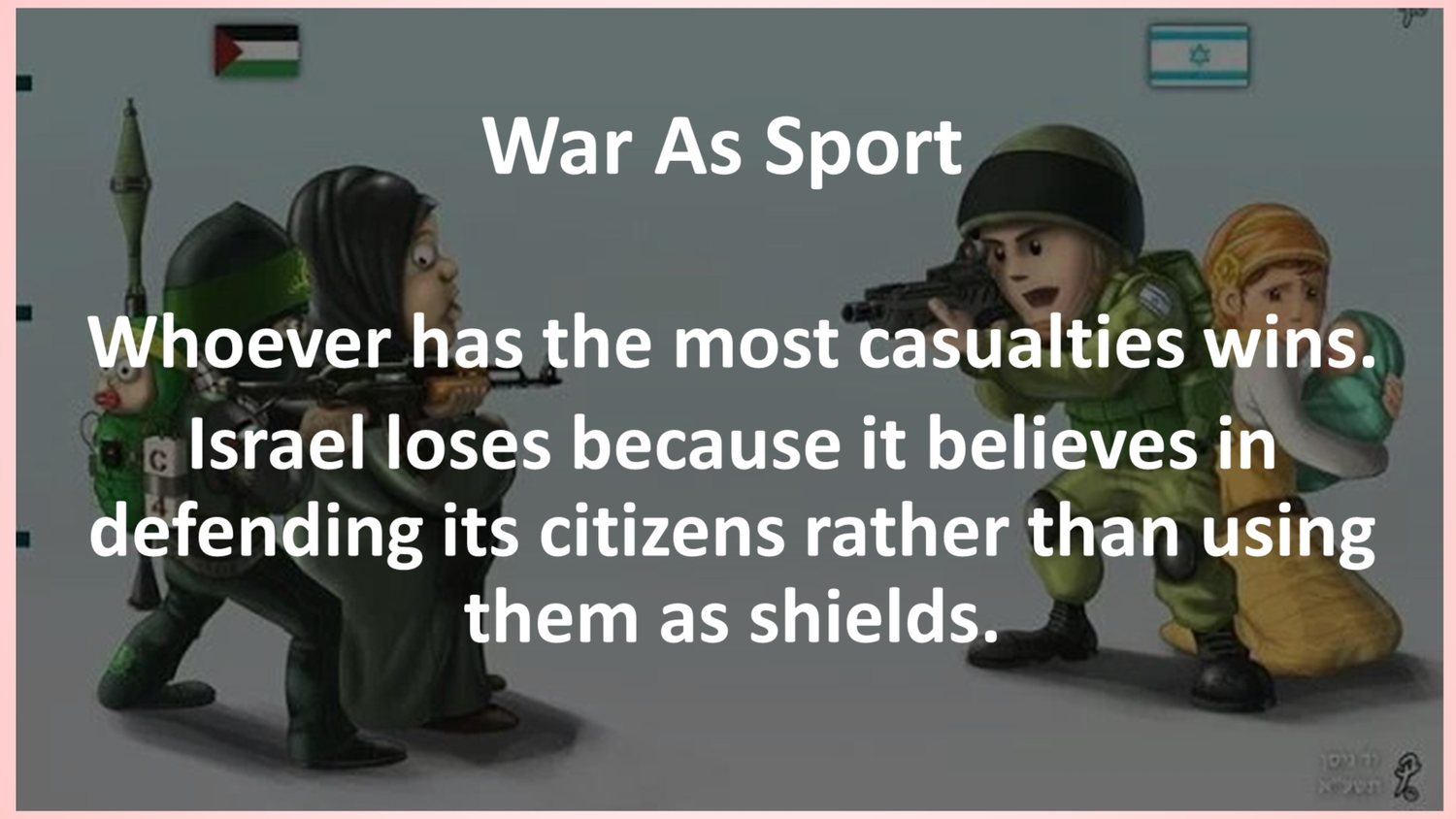
The press’s framing let it publish Hamas’s figures daily while appearing scrupulous. The Washington Post version: “The bombardment left more than [number] Palestinians dead, according to the Gaza Health Ministry, which does not distinguish between civilians and combatants but says the majority of those killed in the war are women and children.”
The sentence is a dodge in three parts. “Does not distinguish between civilians and combatants” implies an administrative limitation rather than a deliberate strategy — when the refusal to distinguish is the entire point of the count. The ministry’s assertion that most of the dead are women and children is relayed without evidence and without noting the incentive to make that claim. And the formulation substitutes for the sentence a reader actually needs: a substantial share of these dead are terrorists, and Israel has published its estimates of how many.
Gilboa and Sigan found that the New York Times consistently amplified casualty figures from Hamas-run authorities while downplaying critical flaws in the data and marginalizing counter-evidence. When the Gaza Health Ministry acknowledged that roughly one-third of its reported deaths came from unverified media sources or unclear individuals rather than medical facilities, The Times initially ignored the admission, later framing the issue merely as a routine shift in UN sourcing without questioning the credibility of the underlying Hamas data. Throughout eight months of coverage and across 27 opinion pieces on the topic, the publication regularly printed these figures without noting that Hamas failed to separate civilian deaths from combatants, thereby inflating the perceived civilian toll. Furthermore, while Israeli officials routinely provided estimates indicating that at least one-third of the dead were active combatants, The Times almost entirely omitted these figures, mentioning them only once early in the war and once more in a single, vague headline.[114]
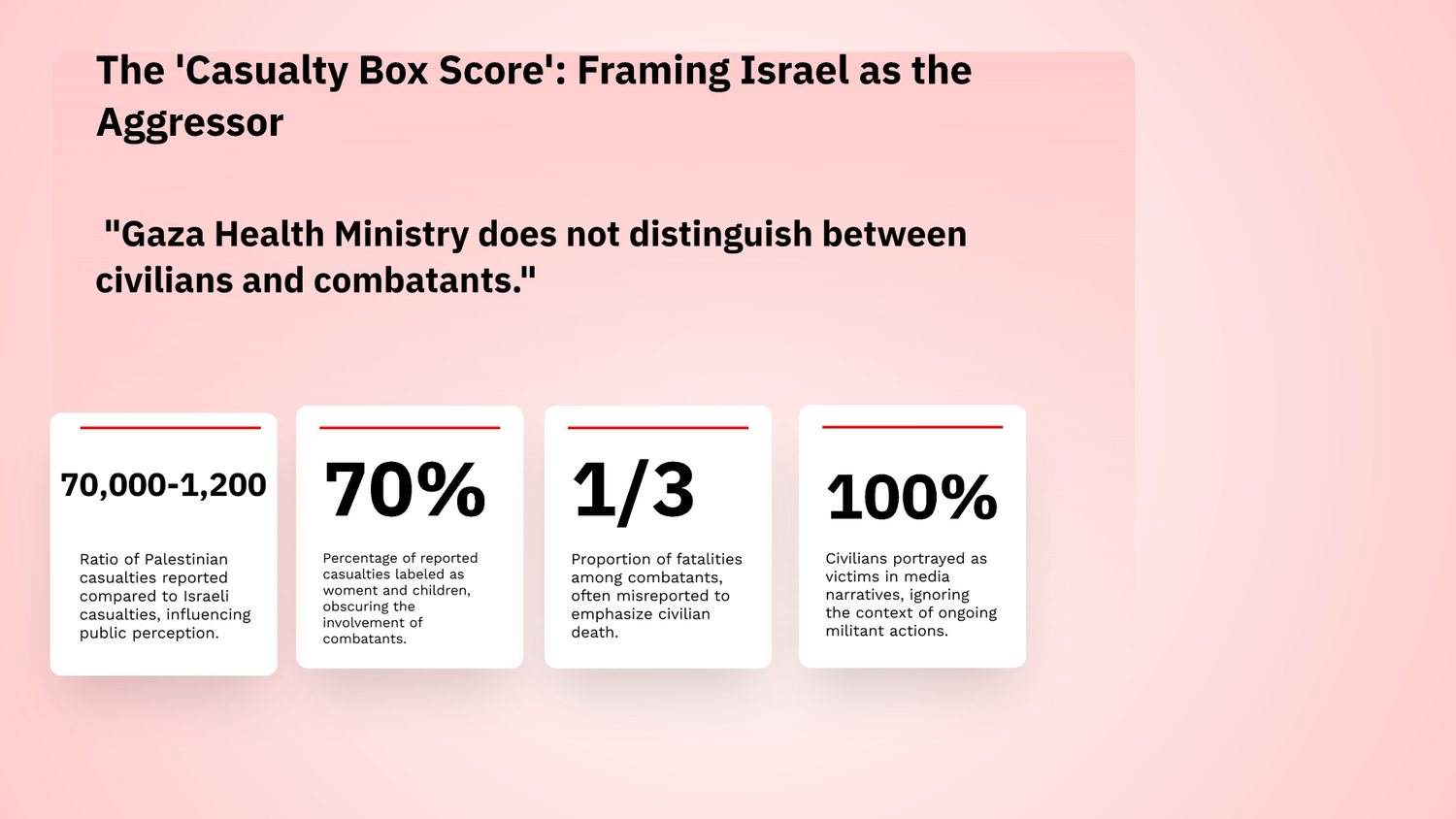
Andrew Fox, a former British Army officer, offered the most useful critique — including a self-criticism of Israel’s defenders: “Here is my one regret from the last two years of commentary. We let ourselves get sucked into arguing the running death toll coming out of Hamas’s Health Ministry in Gaza... We allowed Hamas’s daily ticker to become the global yardstick for morality in this conflict.”
On why immediate numbers are always wrong, Fox explained: “immediate casualty numbers after explosions are guaranteed to be wrong. These are not fog-of-war errors from Hamas; they are straight-up lies. The Al-Ahli explosion is a case study. Within minutes, the ‘500 dead’ claim circled the world. Subsequent assessments from Western intelligence agencies put the likely death toll in the low hundreds, yet the first number did its work; it framed the narrative for days.”
And on what the scoreboard displaced: “the ‘numbers game,’ the breathless, running tally, turns a legal and moral analysis into a horse race graphic. It incentivizes speed over verification, from a single unverified source with a clear propaganda motive, and it collapses complex questions into a single, unreliable metric... A cumulative body count, especially one compiled in real-time under combat conditions, can neither prove compliance nor establish violations.”
Fox also made the comparison that exposes the scoreboard as unique to this conflict: Afghanistan’s war killed roughly 176,000 people through direct violence by 2021; Iraq’s direct-war deaths from 2003 to 2021 total 275,000 to 306,000. “Those wars are debated on strategy, aims, and legality, not by a daily, decontextualized ticker. Nobody alleges those wars were genocides.” In Sudan today, where the UN-backed IPC has formally identified famine and up to a million people could die, “there are no mass marches in Western capitals keyed to that potential number and no live tickers on cable news.”
According to Fox, Gaza became a unique focal point in media coverage because Hamas strategically fed the media economy a continuous stream of casualty numbers that major news outlets routinely adopted as baseline facts. This strategy succeeded because Israel’s critics transformed the raw casualty toll into their primary argument—treating higher numbers as automatic proof of guilt—while pro-Israel advocates unwittingly validated Hamas’s “death ticker” by engaging in debates over the classification, ratios, and accuracy of those very figures instead of rejecting the premise.[115]
West Point’s John Spencer put the professional judgment plainly: “I have never seen a battle or war where casualty numbers can be known immediately after a strike. Not in hours, not in minutes. Also never seen a war where mainstream media will immediately run numbers from local sources (aka Hamas) while saying they can’t verify the military statements. Despite the repeated examples of local sources (Hamas) providing wild numbers (Al-Ahli) or claiming no combatants were killed (hostage rescue). In an age where mainstream media is struggling for credibility and survival you would think they would not repeatedly keep doing this in pursuit of sensationalism.”[116]
16. Casualty-Driven Framing Without Context
The technique. The numbers are reported without differentiation between civilians and combatants, without disclosure of the source’s nature, without acknowledgment of that source’s incentive to inflate, and without the operational context that would explain how the deaths occurred — including Israel’s own published combatant estimates.
Anatomy of a single article
Miriam Berger’s August 15, 2024, Washington Post story, “More than 40,000 killed in Israel’s war in Gaza, Health Ministry says,” repays close reading because every technique appears in one place.
The precision asymmetry. The ministry’s figure is rendered exactly — “40,005 killed” — and the injured exactly — “At least 92,401.” Israeli casualties in the same article are estimates: Hamas killed “about 1,200 people” and took “around 250 others”; “more than 300 Israeli soldiers have also died in combat.” The real figures were available and specific: 1,200 murdered, 251 taken hostage, 330 soldiers killed as of publication. The side whose figures come from a terrorist ministry gets five significant digits; the side with a free press and a public casualty registry gets rounded approximations.
The verification asymmetry. When the article reaches the IDF’s statement that 17,000 combatants had been “eliminated,” it adds that the spokesman “did not say how the military arrived at that estimate” and that “the Israeli military did not provide evidence.” No comparable sentence appears anywhere about the ministry’s methodology.
The uncorrected authority. The article rests the ministry’s credibility on a December 2023 letter in The Lancet asserting that “the Gaza MoH has historically reported accurate mortality data” and that the authors “found no evidence of inflated rates.”[117] By August 2024, later studies had shown the figures were statistically anomalous, and the ministry itself had admitted roughly a third of its reported casualties came not from hospital records but from “media sources” or “unclear individuals.” None of this appeared.
The missing arithmetic. The same paper had reported in July 2024 that the IDF said about 14,000 militants had been “eliminated or apprehended” — framed as “meaning combatants potentially make up less than half of those killed.” The framing treats a roughly 1:1.5 combatant-to-civilian ratio as an indictment. It is extraordinary. John Spencer has documented that “the UN, EU, and other sources estimate that civilians usually account for 80% to 90% of casualties, or a 1:9 ratio (to combatants) in modern war,” while Israel achieved “a ratio of roughly 1 combatant to 1.5 civilians.” The Times, Gilboa and Sigan found, systematically omitted Spencer’s analysis, though it treats him as a credible source and has quoted him on other warfare topics.
The balance of sources. The article quotes Michael Spagat of the University of London, Emily Tripp of Airwars, and the ministry itself — all to argue the true toll is probably higher. It quotes no analyst arguing the opposite, though several had published by then.[118]
Ignoring Israeli data
The IDF provided the press with information that 20,000–25,000 of the casualties reported by Hamas were terrorists — a figure that would dramatically change the narrative and put the civilian-to-combatant ratio in perspective against other wars. It was rarely reported. Lilac Sigan’s headline study found that across two years and 653 New York Times headlines dealing with Palestinian casualties in Gaza, the IDF’s assessment of terrorists killed appeared in exactly one headline — and the Times questioned its reliability.[119]
What the data showed
The Henry Jackson Society’s December 2024 report concluded that “the fatality figures released by Gaza’s ministry of health are riddled with statistical anomalies and methodological flaws. Men have been repeatedly misclassified as women, adults have been recorded as children, and deaths unrelated to Israel Defense Forces action — such as natural deaths or fatalities from misfired rockets — have been included.”
Its media findings, from 1,378 articles reviewed:
• 98 percent cited fatality figures from Hamas-controlled sources without critical scrutiny.
• 5 percent cited Israeli sources — and of those, 50 percent questioned their credibility.
• 19 percent treated Hamas-controlled figures as fact without attribution.
• Fewer than 2 percent acknowledged the statistics are unverifiable or contested.
• Just 16 percent mentioned the figures fail to distinguish combatants from civilians.
• Only 3 percent included the number of combatants in reported totals.[120]
A separate analysis by Fifty Global of 1,378 articles found CNN, the BBC, the Times, the Post, the Guardian, the AP, Reuters, and the ABC based 96 percent of casualty information on Hamas sources and 4 percent on Israeli ones.[121]
Other studies reached the ministry’s own doorstep. One found “statistically impossible results that cast serious doubt on all other aspects of the Gazan death counts.” Another documented that from early November 2023, as northern hospitals shut down, the ministry introduced “a new, undefined methodology for counting fatalities: media reports,” which came to “account for the majority of fatalities.” A third concluded the daily figures were “poorly fabricated” because they “increase with almost metronomical linearity.”[122]
Even the United Nations revised. Having reported for months — along with the BBC and others — that 70 percent of those killed were women and children, the UN reduced the figure to 52 percent. An internal BBC review warned the corporation had for too long given “unjustifiable weight” to the 70 percent claim, “even though concerns about its credibility were well known.”[123]
The view from the U.S. embassy
Jack Lew, the departing American ambassador to Israel, described the dynamic from inside the policy apparatus: “Some of the best-resourced news channels and outlets in the world are being relentlessly credulous of Hamas claims. Now, some of those claims may be true, but many of them are unverifiable... The data being put out by the Palestinian ministries is challenged. It’s not clear and certainly doesn’t separate between fighters and civilians.”
On how falsehoods survive correction, Lew noted: “People tend to focus the day something happens. The media that is presenting a pro-Hamas perspective is out instantaneously telling a story. It tells a story that is, over time, shown not to be completely accurate. ‘Thirty-five children were killed.’ Well, it wasn’t 35 children. It was many fewer. The children who were killed turned out to have been the children of Hamas fighters. Not in every case, but we try to keep that information flowing, but the press moves on, the world moves on. And in policy circles, you can keep people focused saying it’s bad, but it wasn’t quite what it sounded like. In the world’s eye, the first story out there is the one that creates an impression.”
And on the structural asymmetry: “Hamas puts out a report without accurate data that defines a story. Israel is trying to figure out what happened and be totally accurate. And by the time they put out their data, I can send it to official Washington, but the world never knows it’s there.”[124]
PART FIVE — WHAT IS NEVER SHOWN
17. Fighting Ghosts
The technique. In two years of war, the press produced essentially no photographs or videos of Hamas or Hezbollah fighters in the act of firing rockets, launching missiles, or shooting at soldiers. The result is that audiences saw a one-sided bombardment of civilians by the Israeli military — fighting no one.
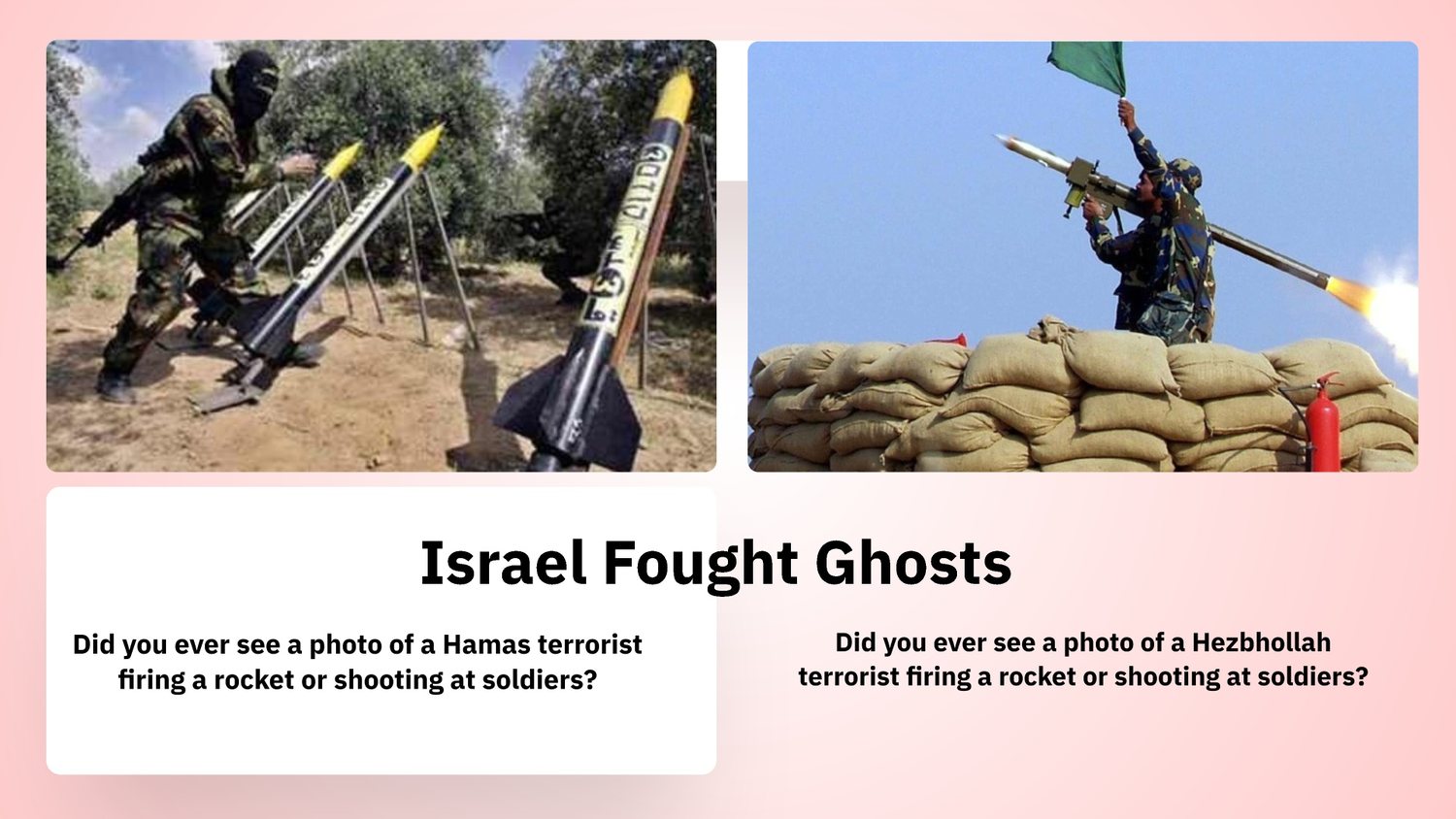
The question is worth stating as bluntly as the manuscript does: Did you ever see a photograph of a Hamas terrorist firing a rocket or shooting at soldiers? Did you ever see a photograph of a Hezbollah terrorist doing so?
Almost no one has. This is not because the images do not exist — the terrorists film themselves constantly, and did so on October 7 — but because the images Western outlets could obtain were controlled by the parties described in Category 9.
Marvin Kalb documented the identical phenomenon in Lebanon in 2006, and the continuity across two decades establishes that this is a system rather than an accident.[125]
Friedman described the mechanism that produces the absence — AP staff watching a rocket launch from beside their own office and not reporting it; camera operators switching off at a signal when wounded fighters arrived at Shifa.[126] Cooper stated it as a rule of the trade: “you don’t see any tunnels, you don’t see any rockets being fired, any locations of rockets, because if you’re a cameraman in Gaza, you cannot videotape that.”[127]
The numbers behind the absence
Edieal Pinker’s analysis of 1,559 New York Times news articles from the war’s first eight months quantifies what the missing imagery produced in prose. Only 10 percent of the articles most directly about the fighting mentioned the death of Hamas fighters. Across the 244-day sample, 182 days mentioned no Hamas casualties at all, and ten stretches of a week or longer mentioned none. During that same period, the Armed Conflict Location & Event Data project recorded 414 armed clashes between the IDF and Hamas or PIJ.
Pinker’s summary is the definitive sentence on this category: “From the New York Times perspective, Israeli soldiers are mainly fighting civilians or shadows.”[128]
Lilac Sigan’s study of every Times headline across two full years of war reaches the same place from the other direction. Of 653 headlines dealing with Palestinian casualties in Gaza, 100 referenced Hamas members — but 86 percent of those concerned the killing of a named leader (Arouri, Deif, Sinwar, Haniyeh) rather than fighters killed in battle. Sinwar’s death alone generated 31 headlines. Excluding the four named leaders, fourteen headlines in two years referred to Hamas fighters killed on the battlefield: 2 percent of all Palestinian casualty headlines. And half of those fourteen presented the information as an Israeli claim whose credibility should be doubted. Seven headlines out of 653 constituted clear reporting that combatants had died in combat.[129]
The visual double standard
The absence is thrown into relief by the extraordinary resources deployed to visualize Israeli military action.
When Israel struck al-Mawasi in September 2024, the Times consulted three weapons experts — Chris Cobb-Smith of Chiron Resources, Trevor Ball, a former U.S. Army explosive ordnance disposal technician, and Patrick Senft of Armament Research Services — to establish from crater dimensions and a fragment of a SPICE-2000 guidance kit that 2,000-pound bombs had likely been used, and gave prominent space to the judgment that using such a munition in a designated “safe zone” was “disproportionate.” In November 2024 the Post obtained an AP photograph of a bomb striking a Beirut building and again went to three weapons researchers to identify a 2,000-pound bomb with a U.S.-made JDAM guidance kit.[130]
In 2023 the Post built a 3D model from a collection of videos of a Nablus raid to suggest Israeli soldiers had intentionally shot unarmed Palestinians. The reconstruction acknowledged gunfire but insisted that a person visible holding what appears to be a gun and running toward civilians was unarmed and did not fire. It showed IDF vehicles driving down the street unmolested, though readily available footage exists of Palestinians pelting those vehicles with rocks.[131]
No comparable forensic reconstruction was ever built of a Hamas rocket launch, of the Nova festival, of Be’eri, or of a Hezbollah firing position — despite a year of Hezbollah bombardment during which the press had reporters on the ground in Lebanon throughout. Nor did coverage note that Hezbollah stopped publishing its casualty figures as its losses mounted, exactly as it had in previous wars, or ask what that concealment implied about the figures being reported.
The one substantial Times description of how Hamas fights is the exception that measures the rule. In July 2024 the paper wrote that Hamas fighters “hide under residential neighborhoods, storing their weapons in miles of tunnels and in houses, mosques, sofas — even a child’s bedroom — blurring the boundary between civilians and combatants”; that “they emerge from hiding in plainclothes, sometimes wearing sandals or tracksuits before firing on Israeli troops”; and that “they rig abandoned homes with explosives and tripwires, sometimes luring Israeli soldiers to enter the booby-trapped buildings by scattering signs of a Hamas presence.” The word “terrorist” does not appear, and none of it was ever carried into the paper’s casualty framing.[132]
18. Omission of Facts
The technique. Facts that would explain the situation the press is describing are simply left out — most consequentially the agreement that confined the Gazan population inside the war zone, which created both the humanitarian catastrophe and the public relations catastrophe that followed.
The Biden–Sisi understanding
Uniquely among modern conflicts, the civilian population of the battlefield was, with rare exceptions, and the payment of bribes, not permitted to leave. Egypt sealed the Rafah crossing and accepted no refugees; the Biden administration, rather than pressing Cairo to open, it made a deal opposing the movement of Gazans into Egypt.[133] Lebanese civilians, by contrast, were able to flee to Syria during Israel’s northern campaign and did.
Almost every downstream element of the coverage flows from that omitted fact. The shrinking “humanitarian zones,” the repeated evacuations, the images of families moving with what they could carry, the shelter shortage, the famine reporting — all of it is reported as though the enclosure were a law of nature, or an Israeli policy, rather than a decision made in Washington and Cairo.
The Wall Street Journal’s editorial page was among the very few to name it: “Not one of the groups yelling genocide calls on Egypt to let women and children escape to safety by opening its border with Gaza. Uniquely in this conflict, they insist that civilians be penned in the war zone. They do so because they know there isn’t an Israeli genocide but rather unintended civilian casualties, which can be used against Israel.”[134]
The double standard on population movement was made explicit later. When President Trump and Prime Minister Netanyahu proposed voluntary relocation of Palestinians out of Gaza, the Times news columns condemned it as “a violation of international law” that “would surely require many thousands of U.S. troops and possibly trigger more violent conflict,” and as “outrageous — and not at all presidential.”[135] When a Times feature profiled a London-based Arab spending more than $250,000 trying to get his relatives out of Gaza, the identical objective was rendered sympathetically: “More than anything, Saleh was focused on figuring out how to help his family escape.”[136]
Other structural omissions
Rocket misfires. Israel estimated that roughly 12 percent of Palestinian rockets malfunctioned and landed inside Gaza — at least 550 misfired projectiles before October 2023 had ended, and over a thousand by mid-November.[137] Every one is a Palestinian casualty event attributed by the ministry to Israel. The press has rarely reported this as a component of the toll.
Hamas ordering civilians to stay. On August 30, 2025, the Post ran a front-page story with two nearly full inside pages, “A Heavy Choice in Gaza City: Flee or Stay?” In thirty-two paragraphs, the eighth disclosed that “the Hamas-run Interior Ministry has urged residents ‘not to yield to the occupation’s threats and intimidation’ and remain in their homes as long as possible.”[138] The single most important fact about why civilians remained in a combat zone was buried a quarter of the way into a story framed as an Israeli-imposed dilemma.
The Wall Street Journal wrote on November 1, 2023, “many Gazans have been unable to flee due to ongoing Israeli airstrikes.” As Chaim Lax noted, this implied that “Israel was solely responsible for putting local Palestinians in harm’s way” while omitting that “many Palestinians were also being prevented from venturing south due to Hamas attacks on those who were trying to flee northern Gaza.” Another Journal article,[139] mentioned the closing of the Rafah crossing after Israeli forces entered the city but omitted the fact that Egypt, not Israel, was responsible for its closure.[140]
Aid theft. When Secretary of State Blinken pressed Israel on conditions in northern Gaza, the Washington Post waited until the seventeenth paragraph to disclose the State Department’s own briefing that about 50 percent of aid entering through Kerem Shalom was being stolen.[141]
Aid volume. In August 2025 the Times asserted on its front page that Israel “has blocked most food and other aid from entering the Gaza Strip” since the war began.[142] The UN’s own crossings data shows that from January through September 2023 an average of 2,285 truckloads of food per month entered Gaza — about 1,142 tons per day — while 17,665 truckloads entered between October 21, 2023, and May 7, 2024, about 1,332 tons per day. COGAT’s data portal records 1.5 million tons of food aid entering since October 7, averaging 2,245 tons per day, and 3,886 tons per day between August 1 and August 22, 2025. More food per day entered Gaza during the war than before it. The newspaper was made aware and declined to correct.[143]
Comparative silence. A Post front page announced, “Israel expands strikes in Syria;” paragraph 21 of 24 mentioned that the United States had struck 75 Islamic State targets in Syria the same week.
Ceasefire violations. After a ceasefire broke down, the Wall Street Journal headlined its article “Israel Resumes Combat Operations in Gaza as Ceasefire Stalls.”[144] Lax noted the article ignored Hamas’s resumption of rocket fire that preceded Israel’s resumption of military operations.[145]
Doctors Without Borders. A January 2026 Times feature on MSF clinics closing in Gaza advanced three claims — that MSF is indispensable, that Israel’s new NGO registration rules are politically motivated, and that concerns about MSF’s terrorist links are marginal. It omitted that MSF operates five of roughly 220 medical facilities in Gaza; that reports by NGO Monitor and the Israeli government document a pattern of MSF staff with terror ties alongside lax vetting; that an MSF doctor was the primary “eyewitness” for the false Al-Ahli accusation, debunked by the Times itself and never retracted by MSF; that former MSF secretary-general Alain Destexhe has accused the organization of systematic bias in favor of Hamas; and that NGOs in Gaza including MSF provided staff information to Hamas authorities for years while objecting to Israeli vetting on privacy grounds. The article relied almost entirely on site visits arranged in cooperation with MSF, then used those impressions to dismiss Israeli claims — circular logic that, as CAMERA observed, “would not pass muster in coverage of a corporation, a university, or a political campaign.”[146]
19. Unprecedented Measures to Protect Civilians
The technique. The extraordinary and in some respects historically unique steps the IDF took to reduce civilian casualties received almost no coverage, with the result that the resulting casualty figures were presented to audiences with no benchmark against which to judge them.
The measures are documented and were available to any reporter who asked: warnings by leaflet, telephone call, and text message; “roof-knocking” — dropping non-explosive ordnance on a building to warn occupants before a strike; the designation of humanitarian zones and evacuation corridors; daily tactical pauses; the use of small-warhead precision munitions to take out individual rooms; and the aborting of strikes when civilians appeared.
Col. Richard Kemp, former commander of British forces in Afghanistan, who has observed the IDF in the field: “In my experience of observing the IDF in action, they scrupulously stick to the laws of war in their targeting policies and actions. Of course, errors will be made and lessons learnt and procedures modified accordingly... and I know that no other army has had such sophisticated or effective means of mitigating harm to civilians.”[147] Malcolm Nance, describing what distinguishes the destruction in Gaza from the villages he saw in Ukraine, pointed to “the widespread IDF policy of ‘roof-knocking’ where ordnance is dropped on a building to warn civilians to leave the premises ahead of an impending strike.”[148]
John Spencer, who has embedded with the IDF in Gaza four times, has repeatedly stated that “Israel has taken more measures to avoid needless civilian harm than virtually any other nation that’s fought an urban war.”[149]
The Washington Post’s own December 2023 destruction analysis contained the evidence and drew the opposite conclusion. As David Adesnik observed: “The Post’s own evidence demonstrates Israel’s commitment to avoid striking hospitals except in cases of dire urgency. In a graphic entitled, ‘Hospitals with damaged structures within 180m,’ the Post illustrates how frequently Israel struck targets in the vicinity of hospitals. Yet the extraordinary thing about each of these maps is their demonstration that the IDF can and will strike targets near hospitals without ever striking the hospitals themselves.”[150]
The starkest omission concerns aid. COGAT reports over 1.7 million tons of food aid delivered to Gaza during the war — a fact almost entirely absent from coverage that simultaneously reported famine. The question of what other army at war has fed its enemy’s population on that scale, while that enemy diverted the aid to fund itself, was not asked.
Andrew Fox, a former British Army officer who has tracked the operational record, made the same point about what the coverage leaves out of the comparison: the measures Israel adopted — roof-knocking, leaflet drops, individual telephone warnings, evacuation corridors, daily humanitarian pauses — have no precedent in the campaigns against which Israel is judged, and the outlets that judge it have not asked whether their own countries’ forces would adopt them.[151]
20. Erasure of October 7 and Rocket Attacks
The technique. As the war extended, coverage detached Israeli operations from the events that precipitated them. October 7 receded from ongoing trauma into historical background; rocket fire from Gaza and Lebanon was normalized or unreported; and the displacement and trauma of Israeli civilians received almost no attention. The cumulative impression is that Israeli military action is gratuitous rather than reactive.
Quantifying the erasure
Pinker’s study identified a “dominant narrative” — Hamas attacked on October 7, killing 1,200 Israelis, and Israel’s response has killed a rising number of Palestinians, with no mention of Israeli deaths after October 7 and no explicit mention of Hamas fighter deaths. Some 969 articles, 70 percent of those that described the war at all, were consistent with it. Within that group, 237 articles omitted the Hamas attack entirely, against 38 that omitted Israeli violence. Only 42 percent mentioned the Israeli hostages — despite the hostages being the basis of every negotiation to halt the fighting.
Between October 8, 2023, and June 7, 2024, the IDF lost 364 soldiers; several thousand were wounded, many severely; 31 Israeli civilians were killed, in 116 incidents killing or wounding civilians out of 1,603 recorded attacks. Yet:
• Only 11 percent of articles most directly about the fighting mentioned Israeli military casualties after October 7.
• There were 128 days on which at least one IDF soldier was killed, with only two stretches of a week or more without a death. In the Times’ coverage, there were 74 days with any mention of post–October 7 Israeli casualties, and nine stretches of a week or longer with no mention at all.
• A Times reader would never go more than five days without an article containing a personal story of Palestinian or Lebanese suffering.
Pinker’s observation: “it creates the appearance of a hierarchy of human life that is perhaps linked to degree of victimhood.” Israelis murdered on October 7 appear in 57 percent of ground-coverage articles; soldiers, being less like victims, far less; and once the counteroffensive began, even Israeli civilians were treated as less victim-like.
He documented how thin the coverage was. On May 5, 2024, Hamas fired rockets at the Kerem Shalom crossing, killing four Israeli soldiers, and Israel closed the crossing — reducing aid channels. From May 5 to June 7, there were seventeen Times articles mentioning Israeli military deaths; twelve mentioned only Kerem Shalom. During that same period, Israeli soldiers were killed in combat on sixteen days, thirty-eight in total.[152]
The erasure reached its logical end in September 2026. A New York Times article by Isabel Kershner on the Israeli reaction to NAZA, a documentary about Palestinian civilian deaths, told readers that Israelis “still largely view themselves as the victims of Oct. 7” — as though the murder of some 1,200 people and the abduction of about 250 were a matter of Israeli perception. After the line drew wide criticism, the paper removed it and appended an editors’ note attributing it to an “editing error” that “inadvertently suggested” victimhood was a perception.[153]
This was just one of four Times articles about the film that Adam Levick argues is part of the “genre of pseudo-investigatory propaganda films alleging atrocities by the Israel Defense Forces in Gaza.”[154] The first was a review of the film by Manohla Dargis.[155] Seth Mandel noted in Commentary that “by the time Dargis’s gushing review ran on September 30, the film’s methodological problems had been revealed and some of its claims debunked. And so the effect of reading a starry-eyed love letter to a sloppy piece of agitprop is disconcerting: How could reviewers not even include all the new information, even if just mentioning it briefly?”[156]
Rather than publish any of the analysis of experts,[157] the Times published an op-ed by columnist Michelle Goldberg who suggested Israeli reactions were a result of “a taboo being smashed, of Israel being confronted with something it desperately doesn’t want to see.”[158] To further emphasize NAZA’s message, it published a second op-ed written by a Gazan who reinforced the demonization of Israel.[159]
The rockets that vanished
Pinker’s most granular finding shows how a nominally “covered” topic can be functionally erased.
Only 21 percent of ground-coverage articles mentioned any Palestinian violence after October 7 — and his criterion was deliberately lax, counting any mention regardless of detail or prominence.
To test what the laxness concealed, he examined October 8 to November 2, 2023. In that period, there were seventeen days with thirty-one incidents of Hamas rocket fire causing injuries to Israeli civilians. The Times mentioned Palestinian violence on twelve days, with twenty individual mentions — apparently comparable coverage.
But of those twenty, only four days included any mention of Israeli casualties, and only one concerned civilians injured by rocket fire. Of the sixteen articles mentioning Hamas or PIJ rocket fire, eleven mentioned it only in the context of the debate over Al-Ahli — that is, the rockets appeared chiefly as an element of a controversy about whether Israel was to blame for something it had not done. Of the remaining five, four appeared between October 8 and 16 and mentioned no Israeli casualties at all. From October 17 through November 2, there was a single mention of rocket attacks unrelated to the Al-Ahli debate — during seventeen days in which thirteen separate incidents caused Israeli civilian injuries.
His side-by-side comparison of Times language against ACLED incident records is the study’s most damning artifact:
• October 8: Hamas barrages hit Sderot injuring two and striking at least six buildings; barrages hit Ashkelon severely injuring a woman and lightly injuring five others, damaging four buildings including a hospital. The Times: nothing.
• October 9: Missiles hit Sderot, Ashdod, Yavne, Abu Ghosh (killing an Arab Israeli civilian), and Ashkelon. The Times, in a 6,828-word dispatch: Israeli troops were “ducking under rocket fire.”
• October 10: Rockets killed two foreign workers near Magen and injured four near Talme Eliyyahu. The Times, in a 6,072-word article: Palestinian fighters “continued to fire rockets into Israel, targeting central cities like Tel Aviv and driving Israelis into basements and underground shelters.”
• October 11: Barrages hit Sderot and Ashkelon, injuring at least twelve; roughly 900 rockets had been fired at Ashkelon since October 7, at least 126 landing inside the city. The Times, in a 9,218-word piece: reporters “heard booms of rocket and mortar fire from Gaza.”
• October 12: A rocket killed one person and injured six in Sderot; two injured in Bet Shemesh. Nothing.
• October 14: A mortar injured five civilians at Kibbutz Nirim; an anti-tank missile injured five more near Magen; a missile injured two at a diving club in Nahariya. Nothing.
As Pinker noted, “there does not appear to be a space constraint that prevented mentioning the Israeli casualties.” He also found six incidents of Hezbollah fire injuring Israeli civilians in the same period, none of which the Times reported — despite publishing twenty-five articles mentioning the northern violence.
“According to the Israeli government”
The final stage of erasure converts the massacre itself into a contested claim. A September 2025 Times article: “Hamas waged its surprise attack on Israel, storming across the border on Oct. 7, killing about 1,200 people — most of them civilians, according to the Israeli government — and seizing about 250 others as hostages.”
The attribution places the best-documented atrocity of the twenty-first century — filmed by its perpetrators on their own body cameras — in the same evidentiary category as a disputed operational claim.
Seth Frantzman captured the temporal erasure: framing the conflict as “two years since Israel launched its war” is like saying, in December 1943, that it had been two years since the United States launched its war on Japan.[160]
Rape denial
The most disturbing erasure concerns Hamas’s sexual violence — first minimized, then inverted.
UN Under-Secretary-General Pramila Patten concluded that “there are reasonable grounds to believe that conflict-related sexual violence — including rape and gang rape — occurred across multiple locations of Israel and the Gaza periphery during the attacks on 7 October 2023.” Sheryl Sandberg’s documentary Screams Before Silence assembled extensive testimony, including taped admissions by captured Nukhba fighters. The Times ignored the documentary in its news reports.
Meanwhile, the New Yorker’s principal voice on Gaza wrote that “Israeli propagandists had promoted terrifying fictions,” “promoting stories of sexual violence — horrific, crazed, grotesque sexual violence,” offering as counterweight videos of Israeli “soldiers playing with women’s lingerie found in homes in Gaza” — which, as David Mikics observed, is “surely the moral equivalent of cutting off women’s breasts and shooting women in the head while raping them.” Mikics named the standard being applied: this was “whataboutism that the New Yorker would surely never tolerate in its pages if any other group of women on the planet claimed to have been sexually harassed on a college campus, let alone subjected to premeditated mass rape as a weapon of war.”[161]
The Guardian’s One Day in October review
In October 2024, the Guardian reviewed Channel 4’s documentary One Day in October, which used CCTV and GoPro footage to depict the massacre at Kibbutz Be’eri, where more than 100 Israelis were killed and 32 taken hostage.
The reviewer criticized the film for failing to contextualize the killers: “If you want to understand why Hamas murdered civilians, though, One Day in October won’t help.” He lamented that “all our sympathies are with relatable Israelis... By contrast, Hamas terrorists are a generalized menace on CCTV, their motives beyond One Day in October’s remit,” and — while awarding four stars — faulted the documentary for depicting Gazans as “testosterone-crazed Hamas killers” and “shameless civilian looters.”
Dave Rich of the Community Security Trust asked whether there was “something wrong with sympathizing with an Israeli child cowering in fear rather than the terrorists coming to kill her.” The Guardian removed the review, conceding that “the unacceptable terms in which it went on to criticize the documentary were inconsistent with our editorial standards. This was a collective failure of process.”[162]
21. The Presumed Innocence of Civilians
The technique. Gaza’s civilian population is treated as uniformly passive and uninvolved — erasing the part ordinary civilians played on October 7, in holding and abusing hostages, and in the staged spectacles surrounding the releases.
The evidentiary record is not ambiguous. Thousands of Gazans who were not part of the Hamas shock force, crossed into Israel on October 7 — looting, abducting, and participating in the killing. Hostages were held in the private homes of teachers, journalists, and other professionals. The so-called journalist Abdallah Aljamal held Israeli hostages in his house.
The crowds are documented. “The sight of hundreds of Palestinians delirious with joy and shouting ‘God is Great’ as Hamas paraded hostages like trophies through the streets of Gaza, propagandizing their humiliation by publishing it online didn’t exactly diminish the fear amongst Israelis that some Palestinians were no longer part of the family of humanity. How else to interpret the half-naked broken body of 22-year-old Shani Louk being spat on by the mob? Or, hostage Yarden Roman-Gat, 36, surrounded by Gazan men, taunting her as a ‘Jewish female dog’? Or the crowd that greeted Moran Yani as her abductors brought her into Gaza: ‘It was like a bull being entered into a huge arena. Everybody’s happy — the children, the women, the men. It was tons of people.’”[163]
Israel publicly offered $5 million for information leading to the return of a hostage. In a territory of roughly two million people, where hostages were held in refugee camps, UN facilities, the main al-Shifa hospital, and private homes — seen by many — not one person came forward. In the single recorded case of a hostage escaping a tunnel, local residents caught him and delivered him back; they knew exactly to whom he should be returned.[164]
None of this makes Gazan civilians legitimate targets, and nothing in this category should be read to suggest it does. The point is narrower and journalistic: coverage that treats an entire population as having no agency whatever — no role on October 7, no view of Hamas, no participation in the hostage system — is not neutral reporting. It is a choice, and it is the choice that makes the Category 15 casualty scoreboard read the way it does.
The same erasure operates in the coverage of the releases. Hamas staged the handovers as propaganda spectacles, with armed men, crowds, and choreographed humiliation, and released hostages were harassed. The staging was generally reported as a ceremony rather than as what it was.
22. Marginalization of Israeli Voices
The technique. Israeli perspectives — of civilians, survivors, displaced communities, and the agencies with direct knowledge of events — are quoted less often, treated more skeptically, and framed as “official narrative,” while Palestinian and NGO claims are received as personal testimony.
The measurement
Pinker’s data quantify the empathy gap. Across 1,559 Times articles:
• 57.5 percent of ground-coverage articles mention Palestinian suffering; more than 36 percent include a personal account of a Gazan’s struggles. Out of 244 days, only 84 had no such personal account — two out of every three days.
• 17 percent contain personal stories of October 7 victims.
• Fewer than 4 percent contain an account of an Israeli’s struggles after October 7.
• Across the entire corpus, only 52 articles out of 1,559 make any reference to Israeli suffering among the population who are not direct victims of October 7.
Pinker enumerates what those 52 articles were not covering: reservists called up for hundreds of days; thousands of wounded, many severely; widows and orphans created by combat deaths; the disruption to the economy; the 60,000 displaced from the north; the families of hostages. “Is there a correct number of mentions? I cannot say. But 4% is very low.”[165]
He observed that “Reporting on Israeli suffering through personal accounts of non-October 7 victims is very limited, while reporting of Palestinian personal accounts of suffering is very frequent…Outside of the direct Israeli victims of October 7 there is relatively little sympathy for Israelis or recognition of the costs of the war to Israel, whereas great responsibility is placed upon Israel for the suffering of the Palestinians and the situation in the region.”
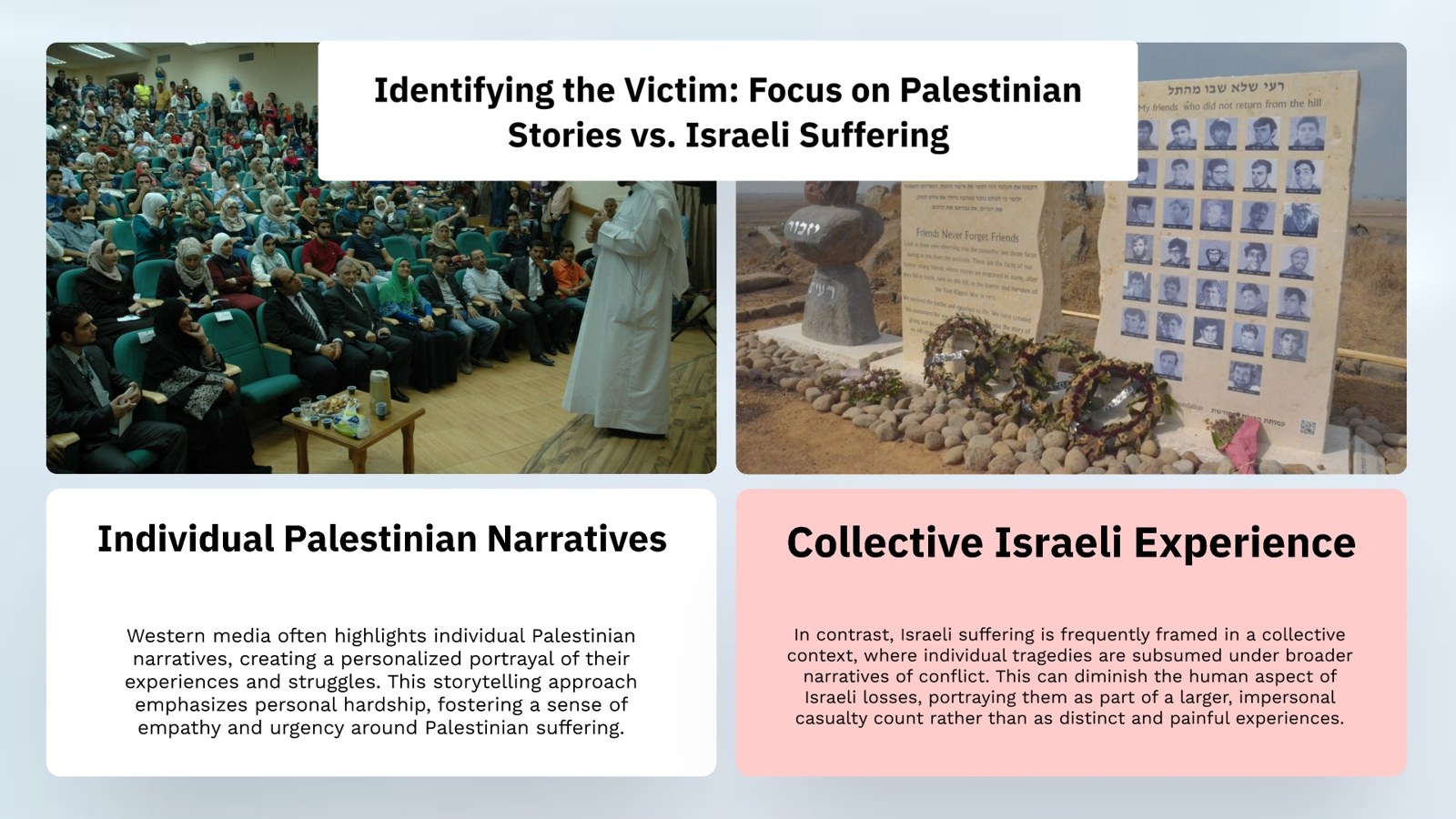
Canada’s public broadcaster produced a starker version. A study of more than 2,700 CBC articles between October 2023 and June 2025 by HR Canada found “a consistent pattern of narrative imbalance that privileges Palestinian perspectives, while systematically minimizing or abstracting Israeli and Jewish experiences.” The CBC was more than thirteen times as likely to humanize Palestinians by identifying them by name, role, or personal experience as it was to do the same for Israelis. Fewer than 1 percent of its portrayals of Israelis included such details. Coverage of Israeli civilian suffering dropped sharply after December 2023 and then “fell to nearly zero.” A B’nai Brith Canada study found 55 percent of CBC coverage between October 2024, and April 2025 was pro-Palestinian, 38 percent balanced, and 6 percent favorable to Israel. The study also found CBC coverage “repeatedly elevated visibility of anti-Zionist Jewish organizations that represent a minority of the Jewish community, granting them disproportionate coverage and implicit authority.”[166]
The right of reply, waived
The most concrete form of marginalization is failing to ask Israel for comment at all. The case study is the Washington Post’s November 17, 2023, front-page article, “Israel’s war with Hamas separates Palestinian babies from their mothers.”
The article claimed that expiring transit permits forced Palestinian mothers with complicated pregnancies to leave newborns behind in Israeli and West Bank hospitals, and that the war prevented reunification. It relied on largely anonymous hospital administrators, with a single named Palestinian source, and declined to name the hospitals because “staff members fear reprisals from Israeli authorities” — a fear presented as reason not to approach those authorities for comment.
Robert Satloff did what the three Post reporters had not: he asked. Over three weeks, he put the claims to COGAT, the Israeli Ministry of Health, and the Israeli embassy. What he learned:
• The procedure for exceptional medical care runs through the Palestinian Authority, which passes requests to Israel. Patients are never charged, and payment disputes never impede access.
• Permits are renewed electronically online. “In all cases like these,” a senior Health Ministry official said, “permits are extended automatically on a weekly basis, with no requirement to return to Gaza.” The Post’s claim that a mother “must return to Gaza and start the process again” was false.
• Separations, when they occur, are typically the mother’s own choice: “Mothers who do return to Gaza in peacetime do so generally to care for additional children left at home.”
• In the one named case, the mother “returned to Gaza of her own choice prior to the Hamas attacks of October 7th,” was in contact with the hospital and Israeli authorities, and Israel had offered to return the infants via Rafah — an offer she declined because she could not care for them in wartime Gaza.
Satloff’s summary: the Post “took an essentially good news story about babies being cared for during wartime and turned it into an attack on Israel, based largely on unnamed sources without making any effort to check the claims with the relevant Israeli government agencies.”[167]
Weeks later the Post issued an editor’s note: “The Post neglected to seek comment from Israeli officials for this article, an omission that fell short of The Post’s standards for fairness,” with a substantive correction acknowledging that “it was not always necessary for mothers to return to Gaza.” Asked whether it had introduced new processes to ensure balance, the Post declined to comment.[168]
As is always the case, however, the damage to Israel’s image was already done.
Israeli statements as “claims”
Ambassador Lew: “I frequently see language like ‘the Palestinian Health Authority reports and the IDF claims’....the language it’s used with has to reflect its infirmity as an objective source. I think ‘claims’ is a little bit arch for a trusted ally. You could say they ‘say.’”[169]
The Post took the construction to its end in a 2025 story on UN access, reporting that “Israel claims, without evidence,” that Hamas compromises the UN system in Gaza — after UNRWA employees had been documented participating on October 7 and holding hostages.[170]
The most striking instance concerns eyewitness reporting. In October 2024, the Times accompanied the IDF into southern Lebanon. Reporters saw, with their own eyes, two tunnel shafts leading to a network of hideouts and weapons stores at least one story deep, within 200 yards of a UN peacekeeper base; an anti-tank missile launcher and firing apertures allowing Hezbollah to shoot into Israel from underground; roughly 100 sites within a single square kilometer used for tunnel shafts, weapons caches, internet cables, water stores, thermal scopes, blood bags, and medical kits marked “Made in Iran”; and, on a tree stump in a forest clearing, a small swastika.
The account nonetheless stated that “the New York Times could not independently verify the details provided by Israeli officials on Sunday about the whereabouts and extent of the stores of weapons that were uncovered, or the level of Hezbollah’s preparations for an invasion of Israel” — in the paragraph immediately preceding its own description of what its reporters had seen.[171]
PART SIX — THE COLLAPSE OF VERIFICATION
23. Lack of Verification
The technique. Outlets publish claims they acknowledge they cannot verify—often at maximum speed and prominence—then, when caught in an error, correct quietly days later, after the narrative has set. The same organizations apply an entirely different standard to material that would damage other subjects.
The archetype: Al-Ahli
“Hamas have a long track record of lying,” Andrew Fox noted. “They have been caught faking numbers killed in Israeli strikes time, and time, and time again. The pattern is the same: hide in civilian location > draw air strike > immediately release grossly inflated fatality numbers.”[172]
The Al-Ahli Hospital story was a case study of the success of the Hamas strategy.
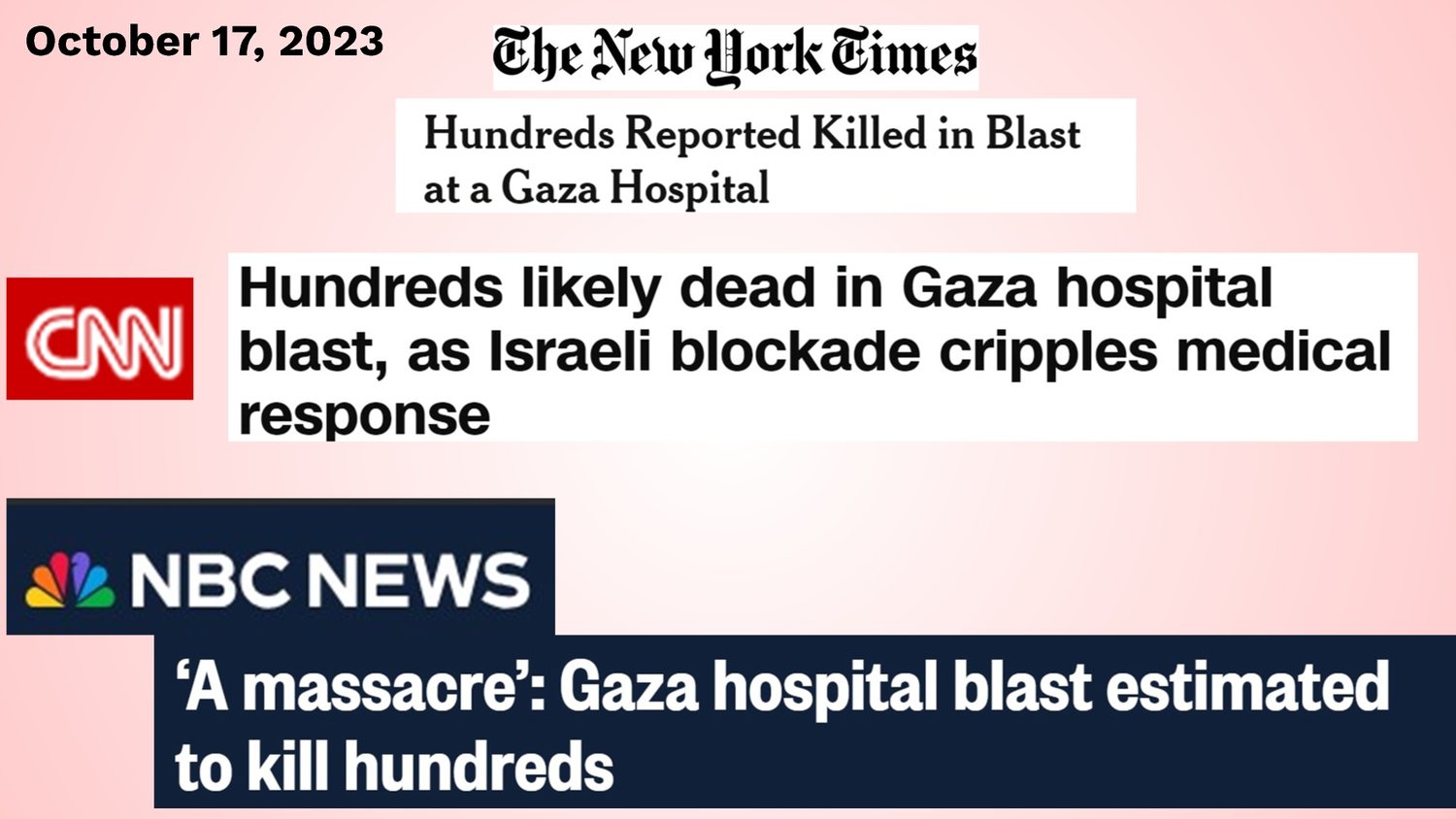
On October 17, 2023, ten days into the war, the New York Times published as its lead website headline: “Israeli airstrike killed 500 at a Gaza hospital, Palestinians say.” CNN: “Hundreds likely dead in Gaza hospital blast, as Israeli blockade cripples medical response.” NBC News: “‘A massacre’: Gaza hospital blast estimated to kill hundreds.” The Wall Street Journal: “Israeli airstrike on Gaza hospital kills more than 500, Palestinian officials say.”[173]
Gilboa and Sigan counted five errors in the Times headline alone: it was a failed rocket, not an Israeli bomb; fired by Palestinian Islamic Jihad, not the Israeli Air Force; it fell in the parking lot, not on the hospital; it killed 50 to 100 people, not 500; and the source was the Hamas-controlled Ministry of Health, not “Palestinians.”
The consequences were immediate and geopolitical: riots across the Middle East, and King Abdullah of Jordan’s cancellation of a summit in Amman with President Biden, President Sisi, and Mahmoud Abbas.
Israel denied the report within hours and produced a recorded intercept of PIJ operatives discussing the failed launch. The Times placed the denial in a smaller headline beneath the original — cueing readers that the first was more reliable.
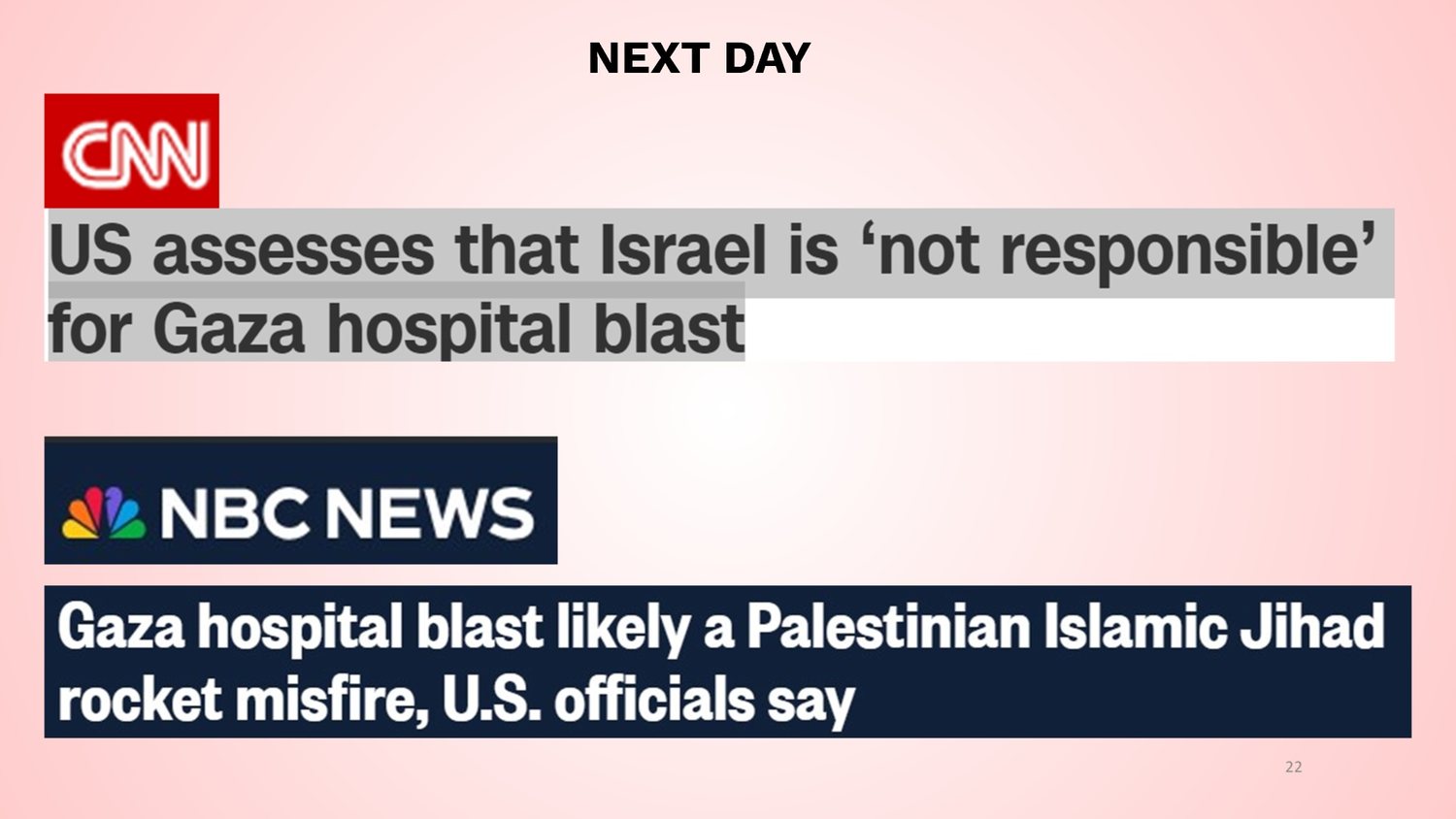
Three days later, long after other outlets had issued corrections, the Times published a correction concerning a video: “The hospital itself was not ruined; its parking lot was damaged most heavily in the blast.” It did not identify PIJ as the cause, Hamas as the source, or the true casualty count.
Five days after the incident — and only after President Biden called the headline “irresponsible” and “raged against the Times in a private White House meeting” — the paper published an editor’s note conceding that “the early versions of the coverage — and the prominence it received in a headline, news alert and social media channels — relied too heavily on claims by Hamas, and did not make clear that those claims could not immediately be verified.”
The Washington Post’s version led: “A strike on a hospital in Gaza City on Tuesday left hundreds dead, Palestinian authorities said.” The National Review and others were reporting Israeli evidence against Hamas’s claim by mid-afternoon; nevertheless, the Post tweeted a video that evening that it described as showing what “Palestinian authorities say was an Israeli strike.” A Post spokesperson defended the coverage, saying its alert did not attribute the blast to an Israeli airstrike. The National Review conceded that point but noted that the headline still described a “strike on [a] Gaza hospital” and relayed the Palestinian claim of hundreds killed. Two days after the Post reported “at least 500” casualties, AFP cited a senior European intelligence official putting the toll at no more than 50.[174]
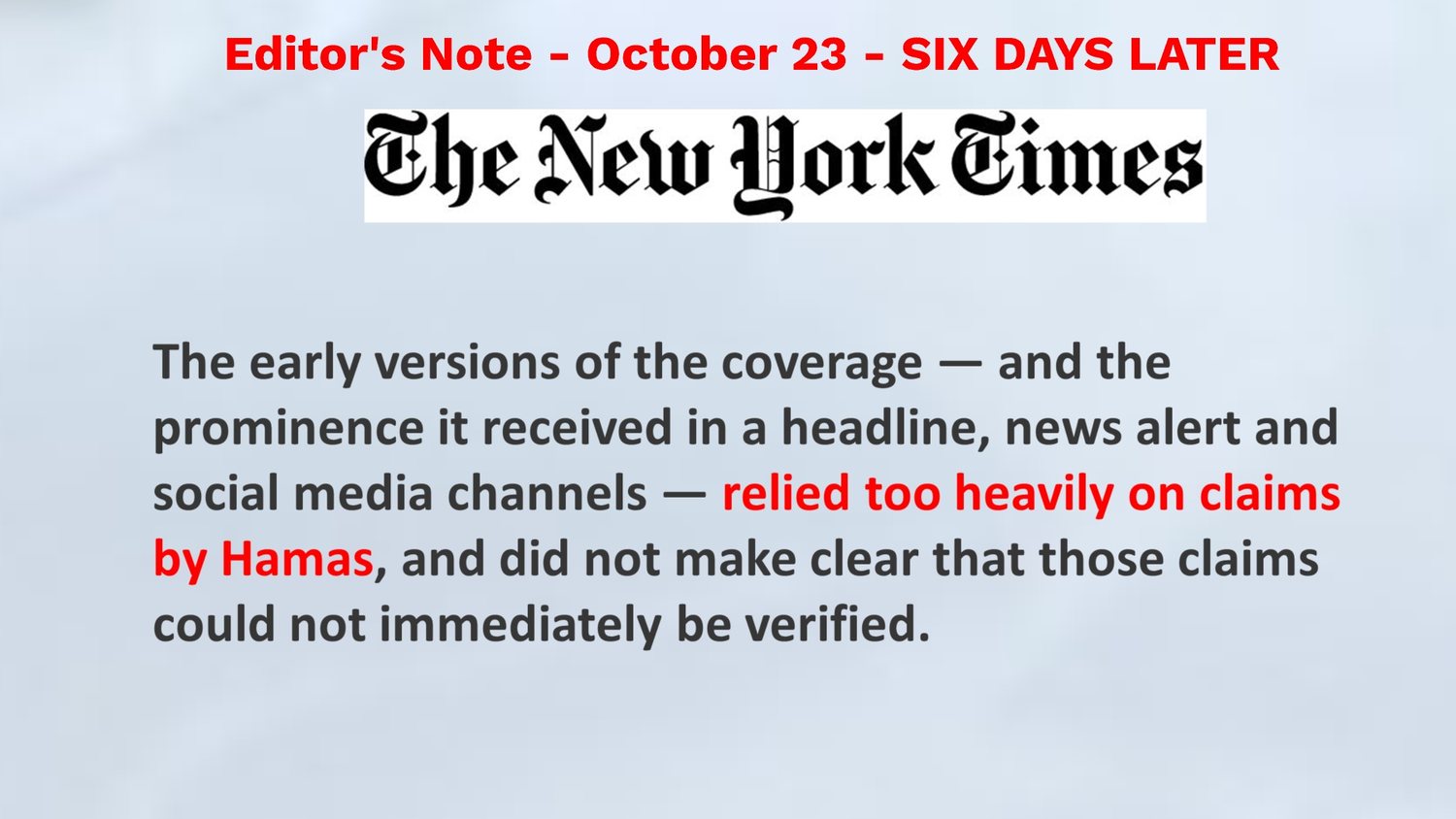
The BBC’s correspondent, live from Gaza, told viewers, “it is hard to see what else this could be, really, given the size of the explosion, other than an Israeli airstrike or several airstrikes.” When the BBC apologized days later, it still failed to make clear that the evidence showed conclusively that the explosion was not an Israeli attack.[175]
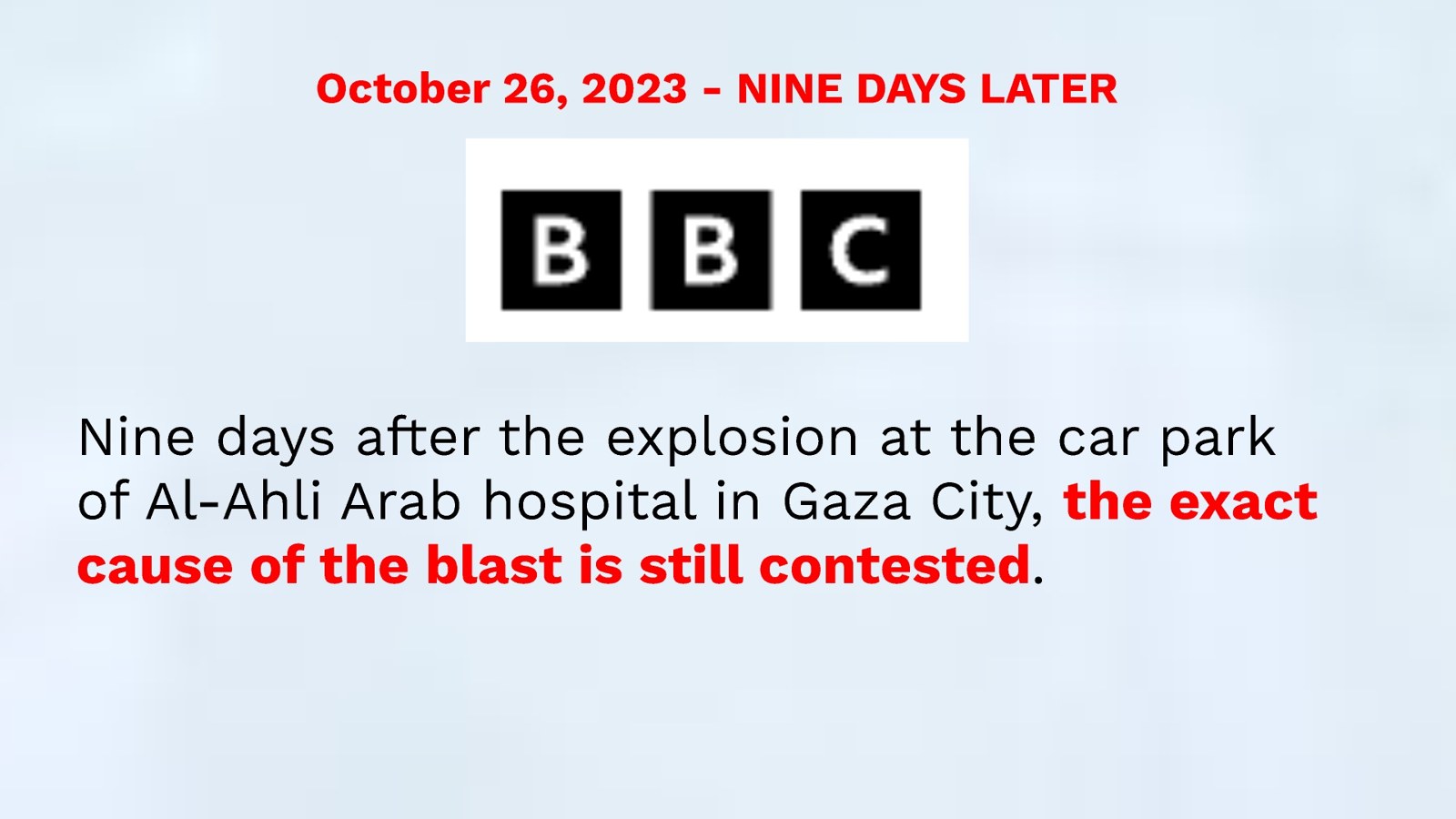
Nine days after the explosion, the BBC was still telling audiences that “the exact cause of the blast is still contested.”
Charlotte Klein subsequently exposed the New York Times’ internal Slack channel #israel-briefings, revealing that the paper’s international editor had objected in real time that the headline “goes way too far,” and that two junior editors thought it better “to hedge it” — but a senior news editor insisted. The international editor tried again: “we can’t just hang the attribution of something so big on one source without having tried to verify it and then slap it across the top... Putting the attribution at the end doesn’t give us cover, if we’ve been burned and we’re wrong.” The phrase stayed at the top of the homepage for hours.
.
Alyson Cowan, a Times writer and editor for more than twenty-five years, wrote that the paper had been “propping up propaganda” and “kept smears online for six days, unfixed, un-apologized for, unexamined and largely uncorrected, notwithstanding the white flag of an Editor’s Note that was finally posted.”[176]
The double standard, stated by the Times itself
The clearest measure of how unusual this behavior has come from the same newspaper’s treatment of a domestic story. Reporting on references to Donald Trump in the Epstein files, the Times told readers: “The emails did not include any corroborating evidence, and the New York Times is not describing the details of the unverified claims.”[177]
That is precisely the standard that was not applied to a claim that produced riots across the Middle East and the cancellation of a presidential summit.
The pattern repeats
August 2024 — the BBC baby twins. The BBC published “Baby twins killed in Gaza as father registered births,” reported from London by a journalist who based the account entirely on an AP story filed by reporters in Gaza and Cairo. The report stated flatly that “the Israeli air strike also killed his wife and the twins’ grandmother,” and noted that “the BBC has asked the Israeli army for comment on the strike and is waiting for a response” — publishing first and asking later. CAMERA UK and the Times of Israel both received the IDF’s response on August 14: “the details of the incident as published are not currently known to the IDF.”
On August 16, the BBC amended its headline to “Father says baby twins killed by Israeli strike in Gaza” and qualified the opening with “reportedly.” The updated version still claimed the BBC was “waiting for a response” two days after others had received one. Because the BBC website has no dedicated corrections page, readers who saw the original on August 13, 14, 15, or the morning of the 16th had no way of learning it had changed.
CAMERA set the failure against the BBC’s own marketing. Two years earlier, the corporation’s CEO of News had described the “thoughtful work that goes into verifying, fact-checking and sourcing our journalism,” adding that editorial guidelines ensure “we forensically check and verify facts, double and triple source information, and track down first-hand eyewitnesses. And that as we pursue the truth, we do so with impartiality and with accuracy. This is our promise.”[178]
2025 — the boy who was not killed. Anthony Aguilar, a former Gaza Humanitarian Foundation contractor and retired Green Beret, told a series of outlets that he had watched Israeli soldiers gun down an eight-year-old Gazan boy, “Amir,” outside an aid site: “Shot to the torso, a shot to the leg — dead.”
The story was carried by MSNBC, Al Jazeera, the BBC, PBS NewsHour, Mother Jones, Democracy Now, Responsible Statecraft, Zeteo, and the Tucker Carlson Network. As Noah Rothman noted, none of them “lent any credence to GHF’s [Gaza Humanitarian Foundation] account of Aguilar’s erratic behavior, his dismissal for cause, and the former contractor’s promise to get revenge on his former employer. The stories he told were just too juicy to check.”[179]
They were also inconsistent. Aguilar placed the shooting at three different distribution sites in three retellings. Body-camera footage obtained by the Daily Wire from a contractor standing beside him showed the boy walking up, kissing the cameraman’s hand, turning to Aguilar to ask for help persuading the crowd to let them take food, and then walking away — with Aguilar himself saying on his own video, “This little young man here, obviously pretty young, he has food. Go home, go home, okay? Thank you.” Pressed, Aguilar retreated: “I saw Amir’s body on the ground... It has always been my position that he, and others, were dead. The body wasn’t moving... I, nor anyone, could verify that he was dead.”
The boy — Abdul Rahim Muhammad Hamden, known as Abboud — was alive. His stepmother said he had not gone missing until July 28, the same day Aguilar first told the story publicly on a podcast whose stated mission is criticizing the Israeli government; he had left to stay with his birth mother. GHF located him and confirmed his identity with facial recognition against the body-cam images. He and his mother were extracted from Gaza — a precaution, GHF’s spokesman explained, because the publicity “placed the child and his family squarely in the crosshairs of Hamas... If the boy was proven alive, it would unravel their propaganda.” MSNBC, Zeteo, and the Tucker Carlson Network did not respond to requests for comment.[180]
Verification abandoned as policy
At its extreme, the practice becomes explicit. The Washington Post published the Hamas government media office’s claim that Israel had “stolen vital organs” from returned bodies, noting only that “the claims could not be independently verified” — the sole qualifier attached to a blood libel that virtually every other reputable outlet declined to print.[181]
The 14,000 babies
The compact case of the whole category is the claim made by a UN official in May 2024 and repeated across the global press within hours, that 14,000 babies in Gaza would die within forty-eight hours. No such thing happened, and no such thing was asserted in the underlying report. CAMERA traced the chain: an official misstated an IPC projection covering a full year of at-risk cases; the wires ran the number; and the correction, when it came, reached a fraction of the original audience. The episode is a controlled experiment in what the verification process costs when it is skipped, because the claim was falsifiable within two days by the simple passage of time.[182]
24. Believe Terrorists, Not Israel
The technique. Claims by Hamas and Hezbollah are reported as fact or lightly attributed; Israeli statements are wrapped in doubt even when accompanied by documentation — and terrorist denials are given equal or superior standing to verified intelligence.
The Incompetent IDF
To accept the Hamas casualty figures requires belief that the IDF is the most incompetent army in history because it failed to kill any terrorists. Even as Israel documented individual Hamas and PIJ members who were eliminated, the press continued to accept the narrative that only innocents were killed.
The IDF stated on July 16, 2024, that about 14,000 militants had been “eliminated or apprehended.” The IDF spokesperson subsequently updated that figure to 17,000, meaning combatants made up less than half of the “official” figure of 40,005 killed to that point. The Washington Post expressed doubt because the military did not say how it arrived at its estimate.[183] Subsequent reports by the media on casualties rarely, if ever, mentioned the IDF figures.
The Druze village
On July 27, 2024, a Hezbollah rocket killed twelve Druze children on a soccer field in Majdal Shams. The U.S. administration verified Hezbollah’s responsibility. News outlets nevertheless rushed to print the denial:
• The New York Times: “Israel blamed Hezbollah... Hezbollah has denied it was responsible.”
• The Washington Post: “Israel blamed Hezbollah for the strike in the Israeli-controlled Golan Heights, but Hezbollah rushed to deny any role.”
• The BBC: “Israel says the Lebanon-based Hezbollah militant group was behind the attack, though the group has denied this.”
• NPR made the same equivocation and mentioned Hezbollah only halfway through an article that led with Gaza.[184]
Israeli evidence, doubted
Sigan found that Times rarely quoted Israeli sources, and it cast doubt on them in one of every four cases where it did. Its main source in Gaza, which is run by Hamas, it never questioned at all.[185]
When Israeli forces entered al-Shifa in November 2023 and displayed captured weapons, ammunition, protective vests, and Hamas uniforms found behind MRI machines, the Times stated it “was unable to verify the provenance of the weapons and equipment in the images or assess the claim of the command center’s existence” — an implication that the IDF had planted them to mislead journalists. Only later in the piece did readers learn that National Security Council spokesman John Kirby had said the United States had its own intelligence supporting Israel’s assertion.[186]
In late December 2024, when the IDF released a filmed interrogation in which a Kamal Adwan Hospital worker described Hamas, Islamic Jihad, and other operatives using the hospital for weapons transfers, patrols, and as an observation post, the Times cautioned that it “was not able to independently verify the claims made in the video, or to determine the circumstances under which the detainee made the admission” — and pivoted immediately to allegations of Israeli abuse of detainees.[187]
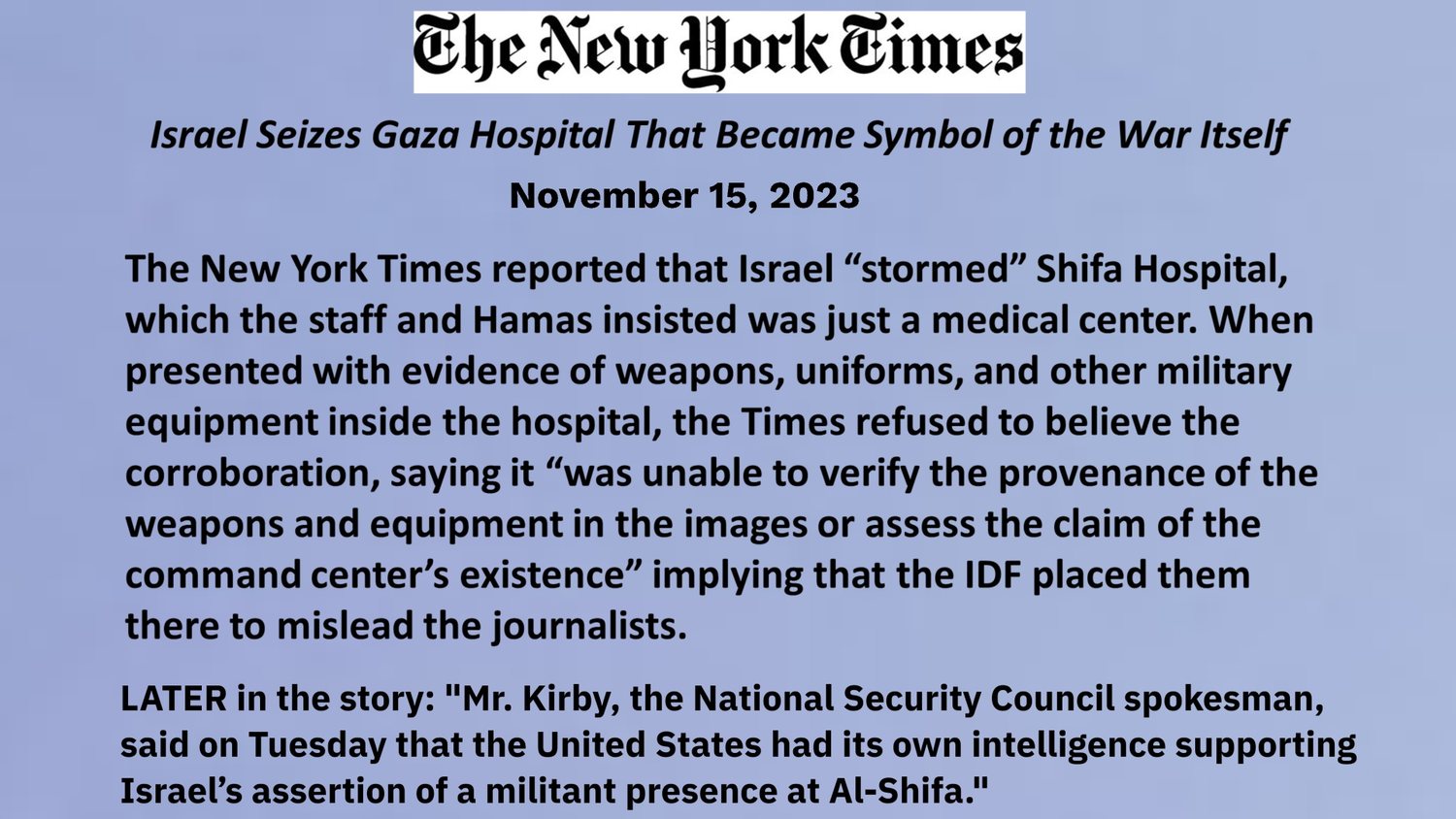
On March 28, 2026, an Israeli strike on the Jezzine highway in southern Lebanon killed Ali Shoeib, Fatima Ftouni and her brother Mohammed Ftouni. Within hours, headlines worldwide announced, “three journalists killed,” and press groups called it a “war crime.” Israel said Shoeib, who worked for Hezbollah’s outlet Al-Manar, was an intelligence operative who helped expose Israeli troop positions, and Israeli media pointed to Hezbollah links in the Ftouni family. Most coverage pushed that account aside or left it out. Al-Manar’s description of its own staff was taken at face value, and Israel’s assessment was treated as presumptively false. Skepticism is a journalistic virtue, but applied in only one direction is a conclusion reached in advance.
Checking would not have been hard. Fatima Ftouni’s public social media celebrated terrorist attacks on Israelis. After seven people were murdered outside a Jerusalem synagogue in 2023, she called it “a beautiful night in Jerusalem.” Her brother Mohammed’s Facebook page showed him in military-style clothing, posing beside Hezbollah flags with Mohamed Ali Boutam, a Hezbollah fighter killed fighting Israel in May 2024. None of this proves an operational role. It does support the links Israel described, and any reporter could have found it in minutes. Newsrooms that pride themselves on verification don’t apply it when the story points away from Israel.
As David Collier put it, “This creates a clear divide. On one side are Israeli intelligence assessments, based on sustained operations against Hezbollah’s leadership and infrastructure. On the other is a media ecosystem that has, time and again, repeated claims originating from within terrorist propaganda networks with limited scrutiny.”[188]
The asymmetry as policy
Ambassador Lew, again, on the vocabulary: “the Palestinian Health Authority reports and the IDF claims.”[189]
The press also repeated, without independent examination, terrorist claims that Israel targets schools, hospitals, and mosques — the substance of Categories 25 and 30 — and did so while declining to report the Israeli evidence that those sites were in military use.
Repeatedly, the media treated the claims of a terrorist organization as more credible than those of a liberal democracy.
25. Illogical Reporting
The technique. Reports contain internal contradictions that no editor appears to have noticed: firefights occur at hospitals where the press insists no fighters were present; casualty accounts include no combatants in battles the same account describes; and reports present conflicting claims as facts without acknowledging that they contradict one another.
The clearest example concerns the hospitals. Coverage denied that Hamas used al-Shifa and Kamal Adwan as military facilities — and simultaneously reported extended gun battles in and around those hospitals. As Ambassador Lew described Kamal Adwan: “It has not been the resistance of a few isolated fighters. It has been a fierce battle. It was clear that there were significant Hamas fighters embedded there, with various kinds of assets, both in terms of communication and fighting.”[190] Somebody was shooting, but the coverage never said who, or how a hospital containing no combatants produced a fierce battle.
A second contradiction: Hamas at one point forbade a hospital to accept fuel deliveries from Israel. The prohibition is inexplicable unless Hamas exercised authority inside the hospital — which is precisely what the coverage denied.
A third: reports of Israeli strikes producing casualty figures that include no combatants whatsoever, in engagements the same reports describe as clashes with fighters. Hostage rescue operations were reported as killing “scores of Palestinians” with no verification of the casualties or acknowledgment that the guards holding the hostages were among the dead.
A fourth, structural: the press relied on medical personnel in Gaza as independent witnesses while acknowledging elsewhere that Hamas controls the territory absolutely. Any doctor or administrator who contradicted the Hamas line would not remain in place—a point that applies equally to the foreign medical volunteers whose testimony was treated as disinterested, since they would not have been admitted if they were likely to say anything inconvenient.
The al-Shifa case produced the most direct contradiction. The Washington Post argued in December 2023 that “the evidence presented by the Israeli government falls short of showing that Hamas had been using the hospital as a command and control center,” and that there was no evidence Hamas used the tunnel network beneath it.[191]
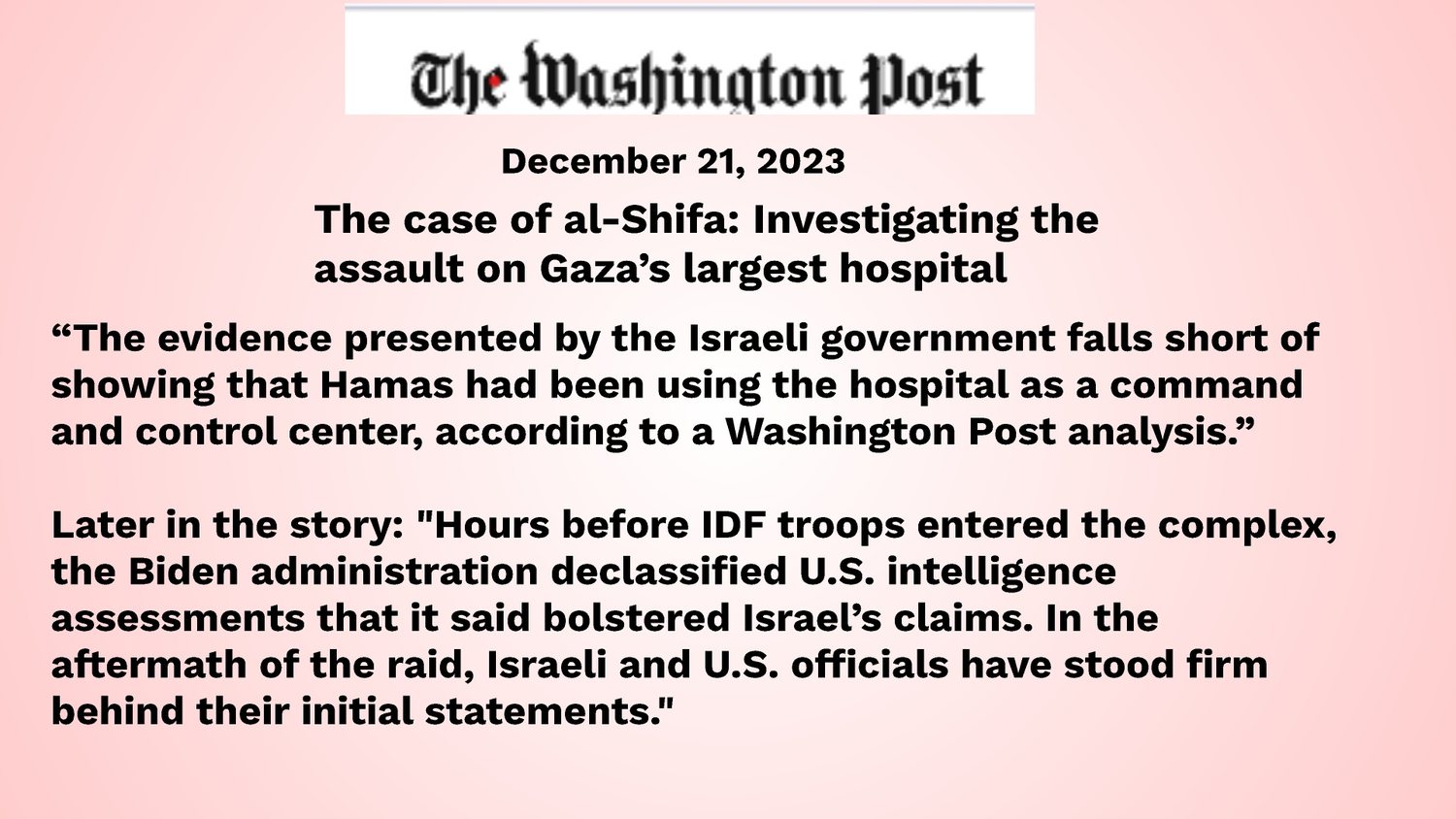
The Post’s own archive contradicted it. A 2014 article by William Booth — the paper’s London bureau chief at the time of the war — had described al-Shifa as the “de facto headquarters for Hamas leaders, who can be seen in the hallways and offices.”[192] Asked about the contradiction, a Post spokeswoman said the 2014 article “did not assert in any way that the hospital was a military headquarters or a command-and-control center.”[193]
Neither the Times nor the Journal joined the Post in that conclusion; neither did the Biden administration, which stated it had “information that continues to support our conclusion that Hamas and Palestinian Islamic Jihad used the al-Shifa Hospital complex and sites beneath it to house command infrastructure, exercise certain command and control activities, store some weapons, and hold at least a few hostages.” Two weeks later, U.S. intelligence officials offered fresh detail bolstering the assessment.[194]
Had journalists done their research, they would have discovered ample evidence of Shifa’s use by Hamas. In 2014, for example, Tablet noted, “The idea that one of Hamas’ main command bunkers is located beneath Shifa Hospital in Gaza City is one of the worst-kept secrets of the Gaza war.” In addition to Booth, a 2006 PBS documentary showed gunmen roaming the halls of the hospital and demanding services. A 2009 PBS report quoted a doctor who said he believed Hamas officials had taken refuge in the basement or an underground area beneath Al-Shifa Hospital. Unmentioned in stories after October 7 was the reason Israel knew Hamas used the hospital: the Israelis “built a secure underground operating room and tunnel network beneath Shifa hospital” in 1983 when the Strip was under their control.[195]
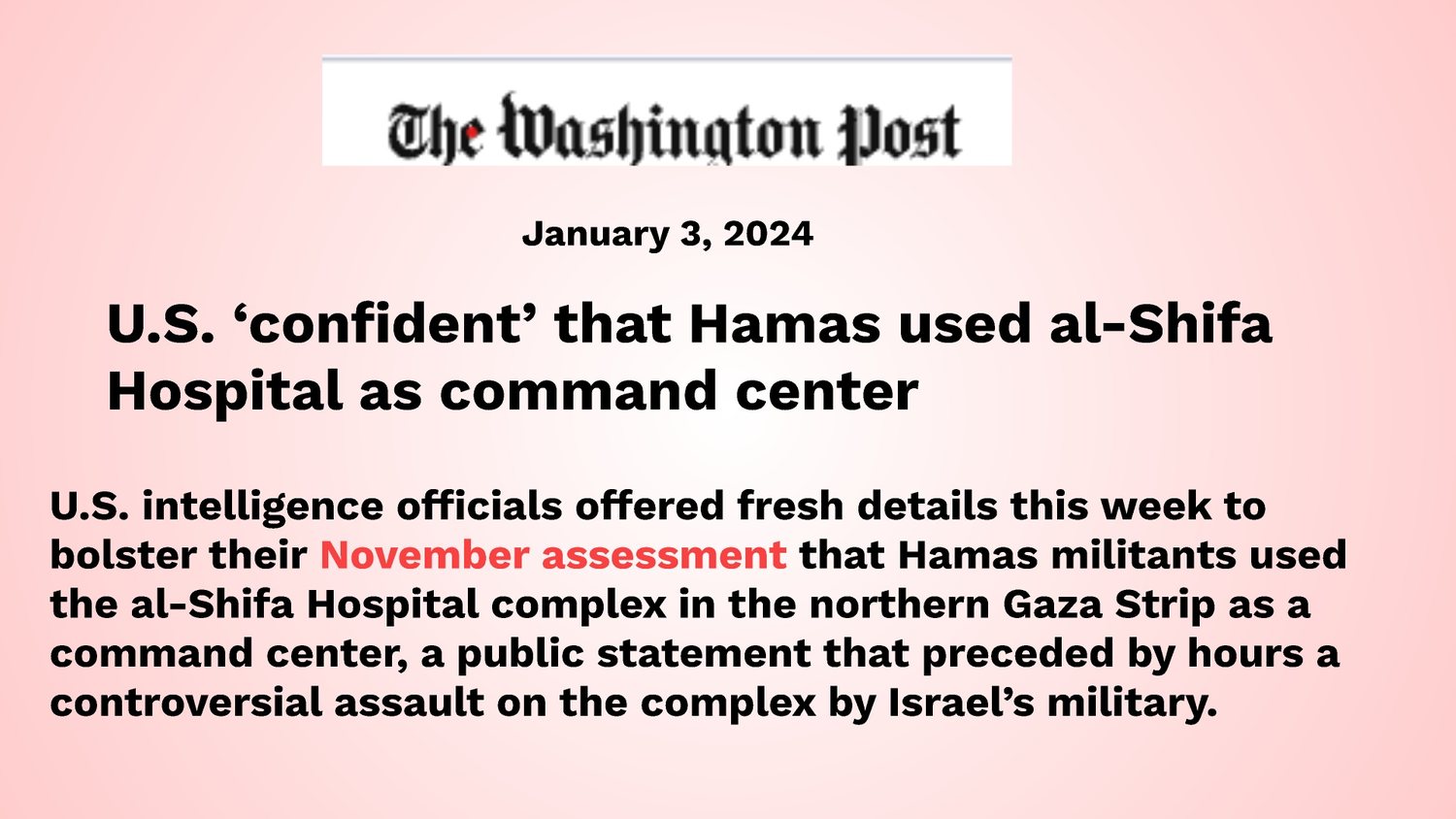
26. Manipulated Imagery and Pallywood
The technique. Staged, miscaptioned, recycled, and decontextualized images are published as documentary evidence — and the corrections, when they come, never reach the audience the image reached.
Images from other wars
The simplest form is the photograph that is not what it is said to be. One widely circulated image presented as a child killed by Israelis in Gaza was, in fact, a child killed in the Syrian civil war.
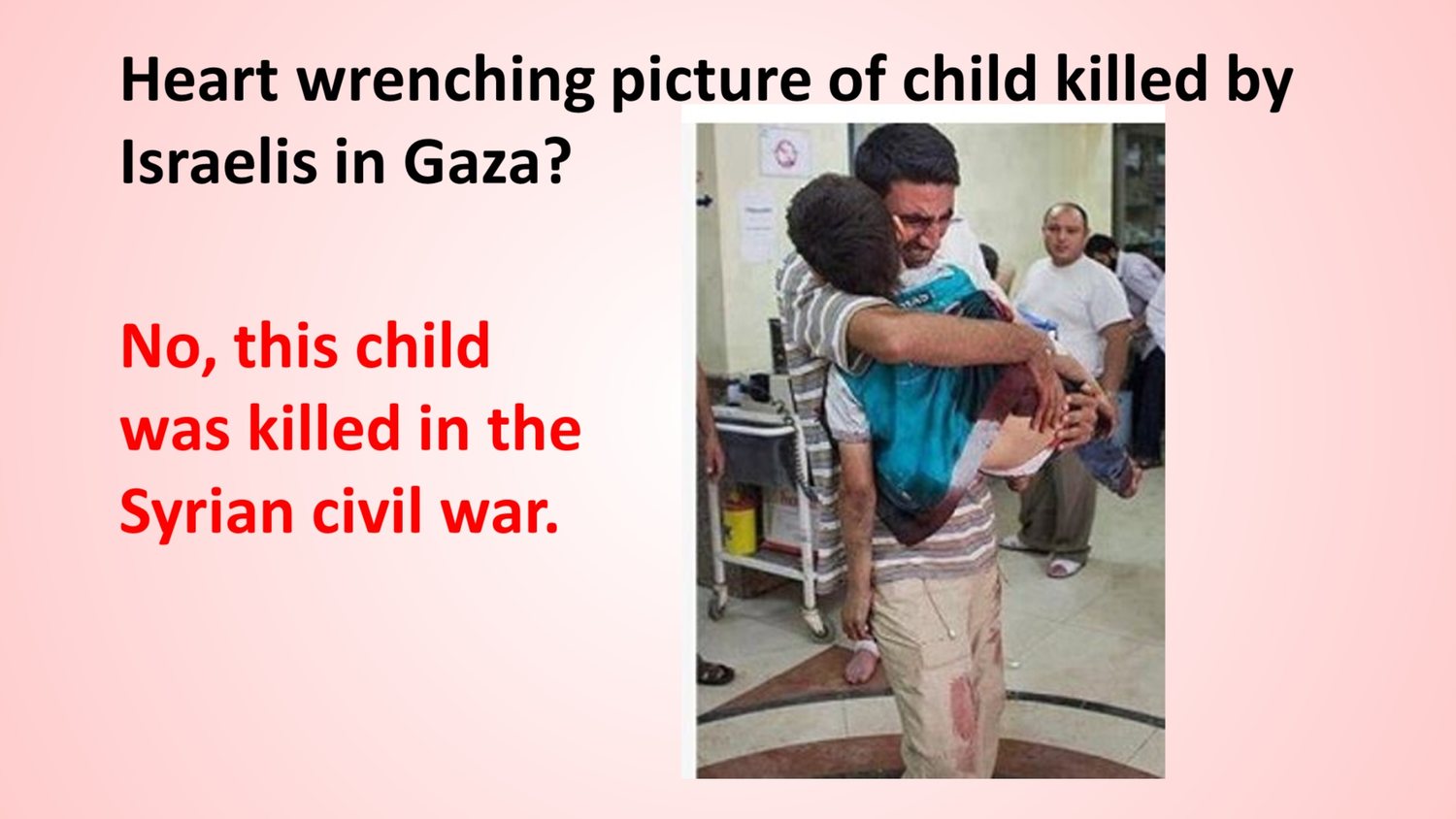
The Network Contagion Research Institute documented the Washington Post, illustrating an article arguing that a “worst-case scenario is finally unfolding” in Gaza with a photograph taken a year earlier; the paper corrected it to note the June 2024 date. NCRI’s broader finding: “These stories were not just shaped by omission: They were laundered from unverified or partisan Arabic- and Turkish-language sources, while being presented as credible journalism to Western audiences. The resulting journalistic products resemble propaganda more than neutral reporting.”[196]
The starvation campaign
The most consequential instance was the summer 2025 starvation imagery.
On July 24, 2025, the New York Times ran “Gazans Are Dying of Starvation,” illustrated online with a video showing Gazans being fed. The front page of the paper edition featured a photograph above the fold of Mohammed Zakaria al-Mutawaq, an eighteen-month-old, captioned as a child who “was born healthy but was recently diagnosed with severe malnutrition.”[197]
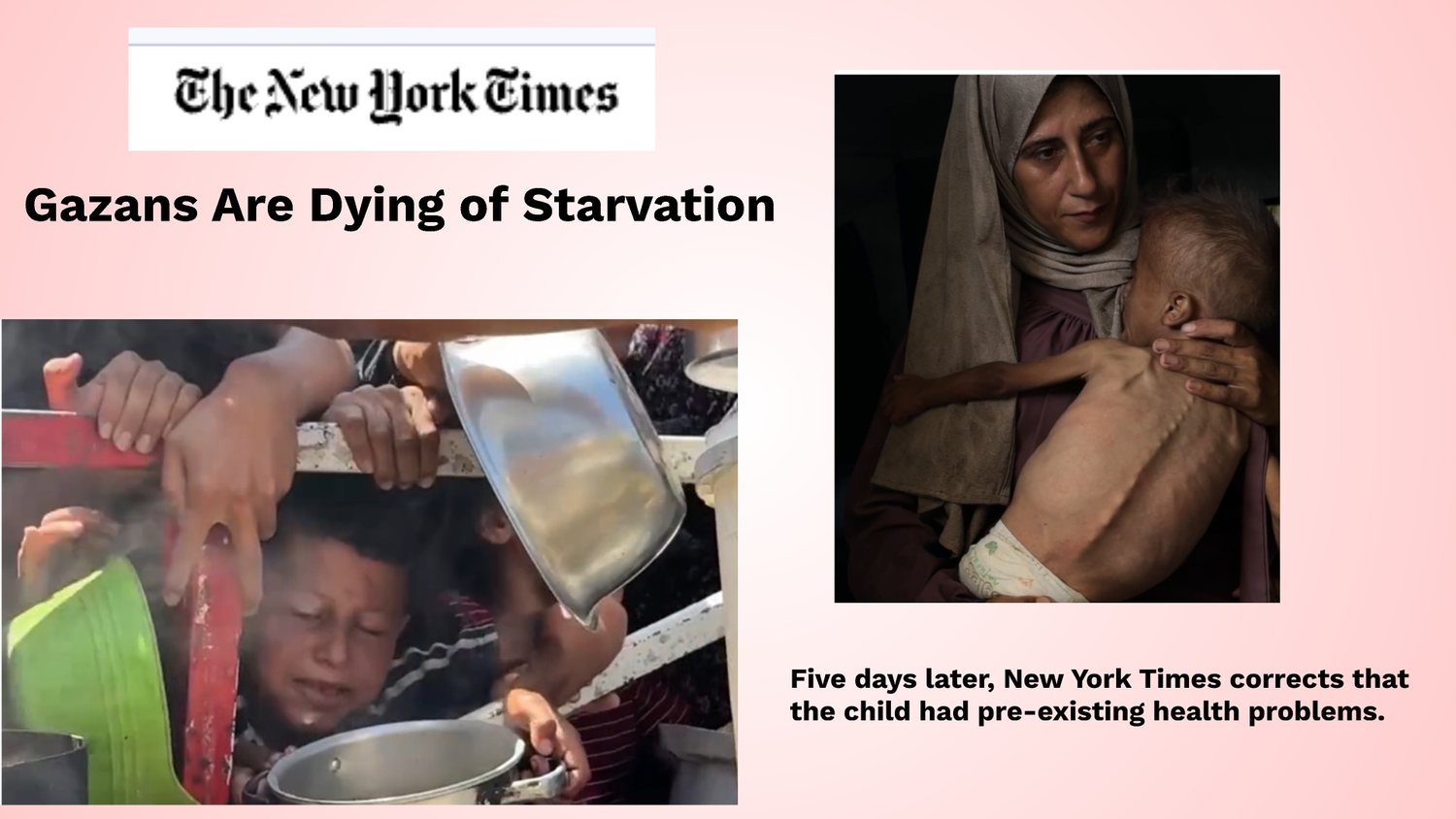
The front page, and the correction five days later.
Four days later, the Times appended an editors’ note conceding the child had underlying conditions affecting his brain and muscle development and quietly deleted the mother’s quotation that he had been “born a healthy child.” It did not mention the boy’s brother, who appears healthy in the background of another photo published online.[198]
Internal Slack messages obtained by Semafor showed the paper’s most senior editors had considered a different photograph — of Youssef Matar, a child with cerebral palsy — and rejected it precisely because of the medical complication. Managing editor Marc Lacey: “Do we want to use a photo that will be the subject of debate when there is presumably no shortage of images of children who were not malnourished before the war and currently are?” Executive editor Joe Kahn: “The story isn’t framed around people with special needs and the lead art really should not do that, either.” They chose al-Mutawaq instead. The Israeli Consulate General’s response: “it is unfortunate that the international media repeatedly falls for Hamas propaganda. First they publish, then they verify, if at all.”[199]
A Free Press investigation by Olivia Reingold and Tanya Lukyanova found at least a dozen other viral starvation images lacking crucial context, published by CNN, NPR, the Guardian, the BBC, Reuters, Al Jazeera, the Los Angeles Times, the Telegraph, CBC, the Financial Times, Middle East Eye, and UNICEF:
• Maryam Dawas, 9, in a UNICEF fundraising ad captioned “All children under five in the Gaza Strip are at risk of acute malnutrition” — whose own mother said on video: “I suspect that Maryam has another problem besides malnutrition... a condition that no one understands here in Gaza.” The Los Angeles Times nevertheless stated without attribution that “hospital tests revealed no underlying medical condition.”
• Youssef Matar, whose image illustrated the Guardian’s newsletter under “Famine Under Way in Gaza.” Reuters’ original caption had included the words “who suffers from cerebral palsy;” the Guardian deleted them.
• Hamza Mishmish, 25, illustrating NPR’s “People Are Dying of Malnutrition in Gaza” — who has had cerebral palsy since birth, per a woman who cared for him, speaking on video published by the Palestinian Authority’s own news agency.
• Najwa Hussein Hajjaj, 6, in CNN’s “Starvation in Gaza” gallery — who suffers, per her father, from an esophageal condition causing “constant vomiting” that “has accompanied her throughout her life.”
• Mosab al-Debs, 14, in the same CNN story — who had sustained a traumatic head injury the previous May, with part of his skull removed. His image also ran on Reuters, Al Jazeera, and the BBC.
• Atef Abu Khater, 17, opening the Times story as a boy “who was healthy before Gaza was gripped by war” — whose father had told Al Jazeera Mubasher days earlier of a “mysterious illness”: “We did every possible test, but to no avail.”
• Abdullah Abu Zarqa, 4, circulated by Hamas-affiliated accounts — whose father said his son had suffered joint pain since age two and that doctors “suspected he might have rickets.” Israeli records showed a 2023 diagnosis of “Rickets, active.”
• Karam Khaled al-Jamal, 27, whose death Al Jazeera attributed to famine — who had suffered muscular atrophy and partial paralysis since childhood, per Turkey’s own state news agency.
• Osama al-Raqab, 5, whose photos ran in the Guardian, CBC, Al Jazeera, and the Financial Times — and who has cystic fibrosis, a fact available in English-language reporting including an AP story.
The investigation’s most damning line concerns the effort required: “Uncovering this missing context didn’t require in-depth, on-the-ground reporting — or months of investigative work. It took minutes, and required nothing more than a computer with a stable internet connection. We simply ran the story subjects’ names through Google Translate to get the Arabic spelling, then searched those names in Arabic-language media.”
The responses are as revealing as the omissions. CNN said it would add “additional details to these photo captions” but not issue a correction. The Guardian invited the reporters to file a complaint with its readers’ editor. NPR, the Los Angeles Times, and Al Jazeera did not respond. The Times said it was “confident” in its reporting and cited “an official report” listing severe malnutrition as cause of death — declining to say whether that report was stamped by the Hamas-controlled Ministry of Health.
The Free Press was careful about the underlying reality, and any honest treatment should be, too: there is hunger in Gaza. The WHO reported 63 deaths from malnutrition in one month, including 25 children. But as Hebrew University economist Yannay Spitzer, who tracked Gaza food prices, put it: “If a situation like that lasts more than a few days, a lot of people will go hungry but not starve to death en masse. That’s the beginning of a process, which the media portrayed as already at the catastrophic end stage... But it never happened.” He added that prices remained “15 times higher than peacetime” but far below their summer peak: “It’s very different from these Ethiopian-like famine pictures that readers in the West were led to believe in.”[200]
The BBC admitted in August 2025 that a Gazan woman it reported died of malnutrition was being treated for cancer: “We were not initially aware that Marah Abu Zuhri was being treated for leukemia.” Sir Michael Ellis, a former attorney general, responded that the BBC’s “persistent bias against Israel is dangerous, both to the cause of peace in the Middle East and more immediately to the Jewish community in the UK, which has seen unprecedented spikes in anti-Semitism thanks in part to shocking misinformation like this.”[201]
Volume and selection as manipulation
Photographic bias also operates through sheer quantity. Phyllis Chesler cataloged the December 22, 2024, New York Times Magazine, whose cover featured a Pietà-like image of a Gazan mother holding her son, in black and white, titled “Escape From Gaza.” Inside were twenty-two additional pages of photographs, with captions that damn Israel and never mention that Gazan civilians were deliberately placed in harm’s way by Hamas.
The same day’s separate “Year in Pictures” section ran ten more Gaza photographs across thirty-six pages, including a two-page spread of two wounded Gazan children and a woman who lost an eye, and a two-page color spread of a pro-Gaza encampment at UCLA. A half-page photo of Beirut was captioned: “The Ras-el-Nabaa neighborhood after Israeli airstrikes killed at least 22 people and injured over 100” — with no indication of why Israel struck. There was one small photograph of an Israeli mother mourning her son, “one of six hostages whose bodies were found in Gaza by the Israeli army” — a caption that does not say how the bodies came to be there, who took them, when, or why. It was placed directly opposite the Beirut photo.
Chesler’s count across three sections of a single edition: thirty-two pro-Palestine photographs and one sympathetic but context-free photograph of a mourning Israeli family. The “Year in Pictures” section contained three photographs of Ukraine and nothing from the Congo, Sudan, Kenya, Iran, or Afghanistan — and nothing from the “Jew hunt” in Amsterdam.[202]
The New York Times highlighted the work of Pulitzer Prize-winning photographer Saher Alghorra in a 12-photo spread.[203] Only one of them showed Hamas terrorists: masked men in Hamas headbands carrying what were believed to be the remains of a hostage, in a scene that appeared staged. The other photographs showed Palestinian prisoners returning after Israel released them, along with a range of images of death and destruction. None showed terrorists conducting attacks, weapons caches, tunnels, or anything else suggesting that the Palestinian suffering on display was a result of Hamas’s actions. Journalist Ashley Rindsberg noted that her portfolio also included “included the now-infamous front-page image of an emaciated child captioned as a victim of Israeli-induced starvation. The child had cerebral palsy.”[204]
State-manufactured material entering the stream
Much of what flooded social media, and then mainstream reporting, was manufactured by state actors. Research and intelligence reports published between 2023 and 2025 documented how Iran, Russia, and China exploited the Israel–Hamas war through state-linked media and social media campaigns, amplifying anti-Israel narratives, spreading disinformation, and seeking to deepen political divisions in the United States and abroad. Tactics included staged and edited video and AI-generated fake audio laid over real news footage.[205] The cybersecurity firm Cyabra found that in the early weeks, roughly one in four accounts posting about the war on major platforms appeared to be fake or inauthentic.[206] Research by Humanz found pro-Palestinian tags on Instagram and TikTok reaching approximately 110 billion posts against 7.4 billion for pro-Israeli tags — nearly 15 to 1.[207] The ISD documented a 50-fold increase in anti-Semitic comments on conflict-related YouTube videos.[208]
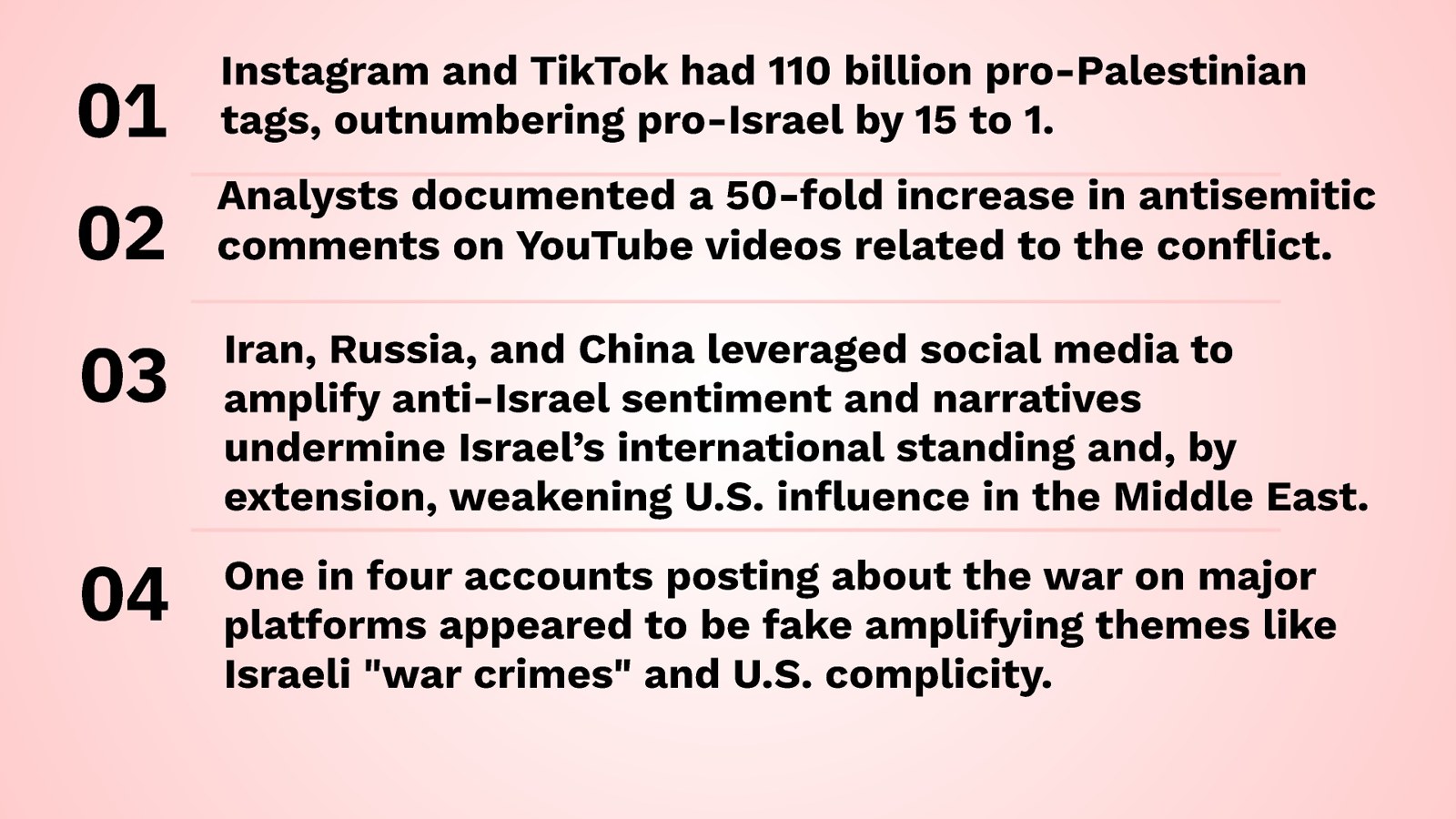
None of this excuses professional newsrooms. It explains the environment in which their credulity did maximum damage: when a professional outlet relays unverified material from that ecosystem, it launders it.
27. Forensic Theater: Visual Investigations and Borrowed Experts
The technique. Satellite imagery, crater measurements, munitions identification, and artificial-intelligence analysis are presented as objective proof, while the premises are chosen by reporters and “independent experts” whose affiliations and records are not disclosed. The apparatus of forensics lends scientific authority to conclusions that the method cannot support.
The wrong bomb
On December 21, 2023, the New York Times used artificial intelligence to find craters roughly forty feet across, which it said were typically made only by 2,000-pound bombs, and presented them as evidence of Israel’s use of one of the most destructive munitions in Western arsenals. Lenny Ben-David, a former deputy chief of staff at Israel’s Washington embassy, pointed out that the analysis assumed the Mark-84, a general-purpose bomb that explodes on impact, rather than the BLU-109 bunker buster, which penetrates many meters before detonating and leaves a crater when the tunnel beneath it collapses. The Wall Street Journal had reported U.S. transfers of BLU-109s. CNN, following the Times, attributed high casualties to 2,000-pound bombs and their fragmentation radius, yet its own fine-print caption conceded that the large craters it measured were consistent with underground explosions; several of its mapped craters lay in open fields in a linear pattern consistent with a tunnel.
CNN also reported that nearly half of Israel’s munitions were unguided “dumb bombs.” John Spencer noted that an unguided bomb is not by definition indiscriminate or imprecise; the thousands of JDAM guidance kits supplied to Israel convert such bombs into precision weapons.[209]
Conclusions in search of data
The Washington Post’s December 2023 visual analysis ranked the Gaza campaign among the century’s “most destructive wars,” outpacing Aleppo and Raqqa. Veterans who had seen Mariupol and Dresden called the comparison unserious, and David Adesnik of the Foundation for Defense of Democracies noted that the Post’s own maps of strikes near hospitals showed the opposite of its thesis: the IDF repeatedly struck targets near hospitals without striking the hospitals. The same Post team concluded that Israel had not shown al-Shifa was a Hamas command center, a conclusion neither the Times, the Journal, nor the Biden administration shared (Category 30).[210]
The experts
All three outlets relied on former government, UN, and Human Rights Watch analysts, several known for hostility to Israel. CNN quoted Marc Garlasco, who said the density of bombing had not been seen since Vietnam, without disclosing that he had been HRW’s senior military analyst during its campaigns against Israel or that HRW had suspended him in 2009 over his collecting of Nazi memorabilia. The Post cited him as a military adviser to a Dutch NGO; his Afghanistan comparison was wrong, and the paper later corrected it.[211] Evan Hill, who oversaw the Post’s “most destructive” analysis and had worked for Al Jazeera and Human Rights Watch, had produced a 2021 Times investigation dismissing Israeli statements about a Hamas tunnel under a collapsed building because Israel provided “no evidence” — the formula he returned to in 2023.[212]
The effect is a closed loop: the conclusion determines which experts are called, the experts’ affiliations go unmentioned, and the graphics make the result look like measurement.
28. Credulity Toward the Absurd
The technique. Claims that would be rejected on their face about any other country are repeated, amplified, or treated as open questions when made about Israel. The appetite for stories of Israeli malevolence far outstrips any impulse toward diligence.
The source-free statistic
In August 2026, the Financial Times reported that Gaza has “the highest rate of child amputees per capita in the world,” attributing the claim to the United Nations. CAMERA traced it and found no source. The UN cited the International Rescue Committee, whose press release offered no data; the phrasing went back to an October 2024 statement by OCHA’s Lisa Doughten that Gaza was home to the largest cohort of child amputees in modern history, which in turn closely resembled an unsourced remark by the British-Palestinian surgeon Ghassan Abu Sittah in the New Yorker in March 2024. The claim then appeared in The Lancet and on Save the Children’s website, again unsourced. CAMERA could find no comparative study of child amputees in conflict zones of any kind. The Financial Times did not respond to question.[213]
Numbers without limit
UN Special Rapporteur Francesca Albanese suggested the Gaza death toll should be thought of as about 680,000, including 380,000 infants under five — more children under five than the Palestinian Central Bureau of Statistics estimates lived in Gaza — and later conceded she had used the figure provocatively and that such numbers are highly disputed.[214] Martin Griffiths, the UN humanitarian chief, called the situation the “worst ever,” worse than the Khmer Rouge, less than a month after Israeli ground forces entered Gaza.[215] UN Women put female deaths above 38,000, far above even the Hamas ministry’s count.[216]
The menagerie
Viral videos of Gazans crawling through snowbanks — on the Mediterranean coast — circulated widely before being exposed as fabrications. Claims of Israeli organ harvesting, poisoned candy, deliberate HIV infection, and a wartime bestiary of spy dolphins, vultures, sharks, and attack rats found audiences, and the trained-dog rape allegation reached the New York Times opinion page (Category 37). The question such stories never prompt is why an enemy so cunning and so malevolent has not already ended the war.
The lesson of this category is not that every outlet printed every absurdity. It is that the threshold of plausibility applied to Israel is so low that the absurd is repeatedly let through, and that each item, once debunked, leaves behind a residue the correction never remove.
29. Corrections: Late, Quiet, or Never
The technique. Errors damaging to Israel are corrected slowly, minimally, and out of sight — by an editor’s note days later, by the silent deletion of a paragraph, by rephrasing that preserves the original impression — or not at all. The false version travels; the correction does not. Because the errors run overwhelmingly in one direction, the correction record is itself evidence of bias.
The count
Gilboa and Sigan counted 72 errors the New York Times acknowledged in its war coverage between October 2023 and June 2024, each identified by outside critics rather than the paper. The Florida shareholder suit cataloged how they were managed. The Al-Ahli headline contained five separate errors; the first correction addressed only a mischaracterized video, and the full editors’ note conceding the paper had relied too heavily on Hamas came six days later, after the U.S. government had attributed the blast to a Palestinian rocket. The December 22, 2023, headline claiming Gaza deaths exceeded “any Arab loss in wars in past 40 years” stood for six days. A November 2023 claim about the rate of civilian deaths was quietly erased without disclosure. A January 2024 article describing two men as journalists whom the Israeli military identified as Hamas and Islamic Jihad operatives was never corrected, and the description was repeated in three more articles. A December 2023 article calling the IDF “Israeli occupation forces” was silently changed.[217]
The editing errors
In a single week in September 2026, the Times acknowledged two “editing errors” on Israel stories: a photo caption that put the weight of bombs supplied to Israel at 40,000 pounds rather than 2,000 — a twentyfold overstatement — and the line suggesting that Israelis only “view themselves” as victims of October 7 (Category 20).[218] The same week it described a man killed in a drone strike, Sharif Labad, as a civil defense rescue worker, without noting that the IDF had identified him as a member of the Nukhba force that invaded Israel on October 7; that story was not updated.[219] Neither editing error was caught before publication; the second was corrected after a post by Eitan Fischberger drew some 1.5 million views.[220]
The correction that repeats the error
Even compelled corrections can preserve the distortion. When CAMERA forced a correction to a 2026 op-ed claiming more than 1,000 Palestinians had been killed since the ceasefire, the Times declined to call any of them terrorists or combatants and described them as “people other than civilians” (Category 2).[221] When the paper finally removed the claim that Mohammed al-Mutawaq was “born healthy,” it added an editors’ note four days later but left the photograph’s impact intact; the image was part of the portfolio that won its photographer a 2026 Pulitzer Prize.[222]
The Times abolished its public editor in 2017, arguing that readers on social media would collectively serve as the watchdog. They have. But a system in which outsiders find errors, correct them only under public pressure, and never trace them to the editors who made them is not a correction system. It is damage control.
PART SEVEN — HOSPITALS, LAW, AND ACCOUNTABILITY
30. The Sanctification of Hospitals
The technique. Hospitals are treated as categorically immune rather than as protected sites that lose protection when used for military purposes — and the press implied throughout that no terrorists were present at them, ignoring evidence of tunnels, arsenals, command posts, hostages held on site, and hospital staff who were themselves members of terrorist organizations.
The legal position is not obscure. Under the law of armed conflict, medical facilities are protected — and lose that protection when used to commit acts harmful to the enemy. The party that so uses them bears responsibility for the consequences. Readers of the war coverage would not know this rule exists.
What was found
The evidentiary record accumulated steadily and was reported grudgingly or not at all.
At al-Shifa, Israeli forces documented weapons caches, ammunition, protective vests, and Hamas uniforms behind MRI machines, and tunnel infrastructure beneath the complex. U.S. intelligence assessed publicly, before the raid, that Hamas and PIJ used the complex “to house command infrastructure, exercise certain command and control activities, store some weapons, and hold at least a few hostages,” and offered fresh corroborating detail in January 2024.[223]
At Kamal Adwan, the IDF released a filmed interrogation in which a hospital employee described operatives from Hamas, Islamic Jihad, and other groups using the facility for weapons transfers and distribution, patrols, and as an observation post, precisely because they considered it a haven that could not be targeted.[224]
In December 2025, David Collier published geolocated footage and timestamps establishing that al-Shifa served as a distribution hub for Israeli hostages on the morning of October 7 — a stolen IDF jeep carrying at least six hostages from the Nahal Oz base arriving at 10:53 a.m., a black Jeep Wrangler carrying the hostage Naama Levy moving on a parallel route, multiple stolen military vehicles converging within minutes surrounded by armed men and celebrating crowds. Journalists were present; cameras were rolling; live reporting from the complex continued throughout the morning. Photographs of the very jeep that carried the Nahal Oz hostages — identifiable by three distinctive bullet holes in the driver’s-side window — were posted at 11:31 a.m. under the caption “continuous transfer of wounded Palestinians to the Shifa Medical Complex.” Not a single journalist present reported the arrival of Israeli hostages at the hospital.[225]
The staff
The most direct evidence of military use is the identity of the people running the facilities.
Hussam Abu Safiya, director of Kamal Adwan Hospital and a celebrated figure in Western coverage of Israeli raids, published two opinion pieces in the New York Times condemning Israel’s campaign — in October 2023 and December 2024. Neither disclosed that he holds the rank of colonel in Hamas’s Military Medical Services, as a resurfaced decade-old photograph of him in Hamas uniform alongside senior officers later confirmed.
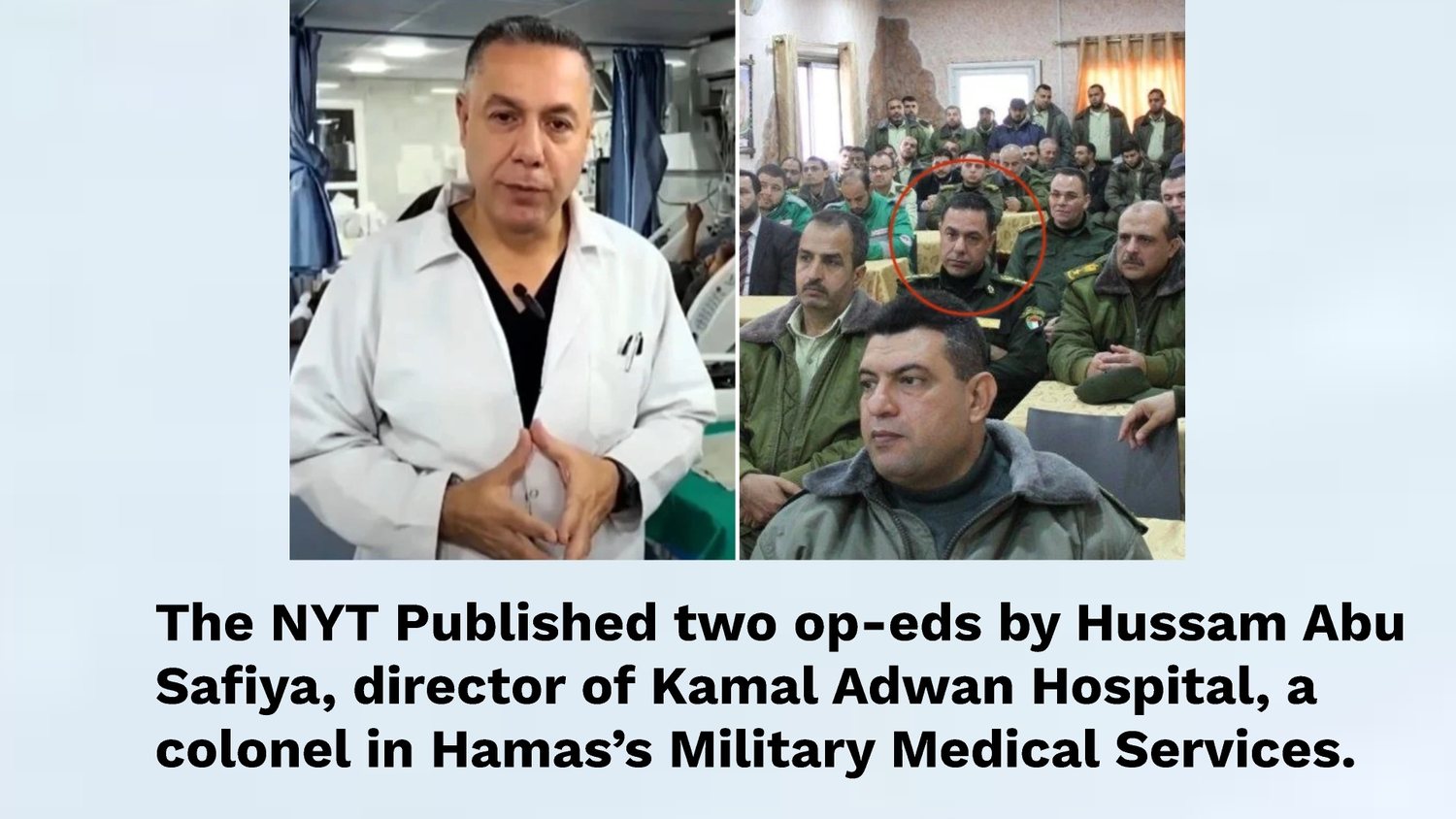
A previous director of the same hospital, Ahmed Kahlot — a lieutenant colonel in Hamas since 2010 — stated under interrogation that the facility had been turned into a military installation under Hamas control, that it had at one point housed a kidnapped soldier, and that some sixteen members of its medical staff were al-Qassam Brigades operatives.[226]
The tunnels beneath
The Washington Post’s own October 2024 investigation established the scale of what the hospital coverage treated as an Israeli allegation: Hamas “built an underground war machine to ensure its own survival,” a network of hundreds of miles of tunnels running beneath civilian infrastructure and constructed with materials imported for reconstruction.[227] The same paper’s hospital reporting continued to present the presence of that infrastructure beneath medical facilities as a contested Israeli claim.
The coverage
Against this, the press maintained the presumption of purity. The Times framed the al-Shifa operation as a test Israel might fail: “Should the Israelis in the end be unable to come up with compelling evidence that the hospital was used to house troops, store weapons and command fighters, they may find that the time left to achieve their stated goal — removing Hamas from power — has been curtailed.” When the military displayed the evidence, the paper said it “was unable to verify the provenance.”[228]
The Post went further, concluding in December 2023 that the Israeli evidence “falls short,” ignoring its own 2014 reporting had described al-Shifa as the “de facto headquarters for Hamas leaders.”[229]
The BBC made matters worse. Jeremy Bowen, its international editor, implied that the Kalashnikov rifles found in the hospital’s basements might belong to hospital security rather than Hamas, remarking, “Wherever you go in the Middle East, you see an awful lot of Kalashnikovs.” Earlier, the BBC had reported that IDF troops entered al-Shifa “targeting medical teams and Arabic speakers,” a willful or careless misreading of an IDF statement that the troops were “accompanied by Arabic speakers and medical teams” to assist patients. In that case, the BBC did broadcast an adequate apology.[230]
An internal BBC report separately flagged an article headlined “Gaza medics tell BBC that Israeli troops beat and humiliated them after hospital raid,” warning that the piece did not make clear the circumstances under which hospitals lose protection and did not cover the evidence Israel had uncovered of Hamas operating there.[231]
31. Selective Use of International Law
The technique. Legal vocabulary is deployed as a set of moral verdicts rather than a body of rules: proportionality is invoked without military necessity; the requirement of distinction is demanded only of the party that observes it; and courts’ preliminary procedural rulings are reported as findings of guilt.
Proportionality, misunderstood
In common usage, “proportionality” has come to mean rough parity of casualties. In the law of armed conflict, it means something else: that expected incidental harm to civilians must not be excessive in relation to the concrete and direct military advantage anticipated from a specific attack. It is a prospective, per-strike judgment, not a retrospective scoreboard.
Coverage inverted this consistently. Every increase in the toll was reported as prima facie evidence of disproportion, with no assessment of the military advantage sought in any particular strike. Andrew Fox: “International humanitarian law asks something different and more exacting: did the attacker distinguish between combatants and civilians? Were feasible precautions taken? Was the expected collateral harm not excessive in relation to the concrete and direct military advantage anticipated? These are the only metrics of proportionality.” Even the ratio favored by Israel’s defenders is beside the point: “Not even the much-vaunted ‘combatant-to-civilian ratio’ decides the question.”[232]
“There’s never been a war in the history of war… where any nation has been asked, but what’s your civilian to combat ratio? Because that’s not how war works, just not how the law of war works,” John Spencer noted.[233]
The corollary the coverage seldom mentions is that embedding military assets in civilian areas is itself a war crime, and one that shifts legal responsibility for the resulting deaths.
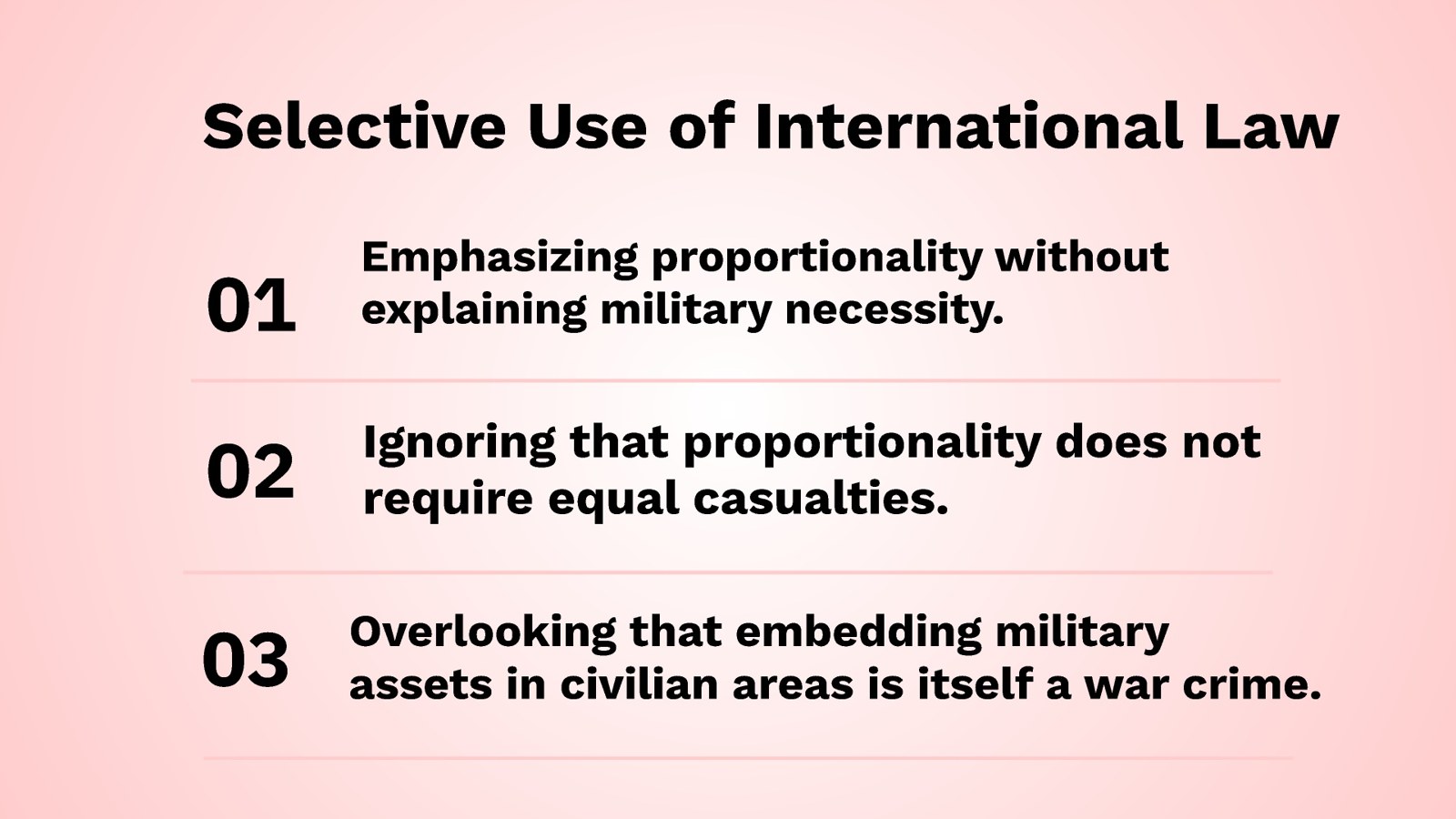
The pager operation as test case
The Hezbollah pager and walkie-talkie operation of September 2024 posed an unusually clean legal question, because the devices had been distributed by Hezbollah, on an individual basis, to its own commanders and fighters.
The Times opinion page published Michael Walzer — author of Just and Unjust Wars — under the headline “Israel’s Pager Bombs Have No Place in a Just War.” Walzer conceded the devices “most probably were being used by Hezbollah operatives for military purposes” and that this “might make them a legitimate target,” but argued the attacks “came when the operatives were not operating; they had not been mobilized and they were not militarily engaged.”
The argument fails on its own terms. Lawful combatants may be attacked at any time during an armed conflict, whether or not engaged at that moment; soldiers may be struck while relaxing on base. The question is status, not momentary activity. Walzer’s framework imagines a Hezbollah call-up procedure in which a terrorist is a civilian until summoned. More fundamentally, Hezbollah is an unlawful combatant force: it wears no uniform, carries arms covertly, and does not observe the laws of war. Israel is not obliged to determine when an unlawful combatant is “involved in military action;” the entire premise of the group’s method is to make that determination impossible.[234]
The rebuttal appeared, tellingly, in the Washington Post’s opinion section, where Peter Berkowitz of the Hoover Institution walked through the three principles the operation satisfied — necessity (“a direct and efficient way of accomplishing the legitimate war aims of destroying the militia’s equipment and removing its fighters from combat”), distinction (“Hezbollah purchased the pagers and walkie-talkies for their commanders and fighters”), and proportionality (“Israel’s targeting of Hezbollah fighters by igniting their communications devices minimized collateral damage to a remarkable degree”).
Berkowitz also named the deeper problem: the error “perpetuates the ugly practice of maintaining one body of the laws of war for the rest of the world while creating separate laws that criminalize Israel’s right to defend itself.” He noted that Hezbollah’s ten months of attacks — most striking civilian areas, driving 60,000 Israelis from their homes — “constitute straightforward violations of the laws of war,” a fact that received a small fraction of the legal attention devoted to the pagers.[235]
Misreporting the courts
The most damaging legal distortion was the reporting of the International Court of Justice’s interim order of January 26, 2024.
The BBC and much of the world’s press reported that the ICJ had found a “plausible case of genocide” or a “plausible risk of genocide.” Joan Donoghue — the court’s own former president — told the BBC’s HardTalk that the media had widely misinterpreted the ruling and that it was not correct to say the court had found a plausible case of genocide.
An internal BBC report flagged “numerous instances” of the phrase across BBC television and radio reports, analysis, and live two-ways, including by International Editor Jeremy Bowen and on Newsnight, and concluded there were too many instances “to be listed in full.” The internal review’s summary: “It is very clear and explicitly states that the court is not making any determination on the merits of South Africa’s case. The ICJ said it was only assessing whether what South Africa had alleged was potentially covered by the genocide convention.” The order runs to twenty-six pages in non-technical language. As the reviewer asked: “Had no BBC reporter troubled themselves to read it?” The BBC took months to clarify.[236]
The underlying case rested for its evidence of genocidal intent on statements by Israeli leaders — and, as Gilboa and Sigan documented, the key quotations were false. Defense Minister Yoav Gallant, speaking in Hebrew days after the massacre, said: “Gaza will not return to what it was before. There will be no Hamas. We will eliminate it all.” The Times omitted the reference to Hamas, transforming the meaning. Netanyahu’s statement contained a biblical quotation — “a straightforward reference to a surprise attack on the innocent” — misattributed to a different biblical story with an entirely different meaning, though the correct reference appears explicitly in the official translation of his speech.
Times columnist Megan Stack built two op-eds on the falsified Gallant quote. Michelle Goldberg’s January 5, 2024, column claimed Netanyahu “said this week that the government is considering a scenario of surrender and deportation of residents of the Gaza Strip”; the Times’ January 23 correction acknowledged the quotation “had been taken out of context.[237] Referring to Hamas leadership, he said the Israeli government is considering a ‘scenario of surrender and deportation.’ The quotation did not refer to all Gaza residents.” Netanyahu’s misattributed biblical quotation was never corrected.
Redefining terms to fit the verdict
A distinct pattern is the alteration of definitions to produce a desired finding — and the failure to report the alteration.
The Integrated Food Security Phase Classification projected in March 2024 that famine was imminent in northern Gaza, walked that back in June when the evidence did not support it, then reversed again in August 2025, declaring famine in Gaza Governorate. As the Washington Free Beacon reported, the IPC had quietly changed its methodology in Gaza: shifting from a comprehensive weight-and-height assessment to the cruder measure of arm circumference and halving the famine threshold from 30 percent of children registering as malnourished to 15 percent.[238]
Amnesty International likewise revised the definition of genocidal intent in reaching its finding against Israel, and the body billed by the press as “the world’s leading genocide scholars’ association” followed suit. As Noah Rothman observed, that organization’s prestige was roughly commensurate with its $30-to-$125 membership fee — the only barrier to entry beyond the application — and only a fraction of its members participated in the resolution, with the usual channels for dissent closed off.[239]
Inventing law outright
On October 31, 2024, an Associated Press article stated that “international law gives Palestinian refugees and their descendants the right to return to their homes.” There is no such right. UN General Assembly Resolution 194 is non-binding and its operative language — refugees “should be permitted” to return — denotes a recommendation accompanied by the requirement that they be willing to “live at peace with their neighbors.” After CAMERA’s Israel office documented the error, the AP removed the claim, and several dozen secondary outlets corrected in turn.[240]
32. Disproportionate Focus on Israeli Accountability
The technique. Israel is subjected to continuous, resourced, institutionally serious scrutiny for alleged war crimes, use of force, and compliance with international law. The documented violations of Hamas and Hezbollah — human shields, tunnels under hospitals, hostage-taking, recruitment of minors, summary executions of Palestinians — receive no comparable sustained investigation.
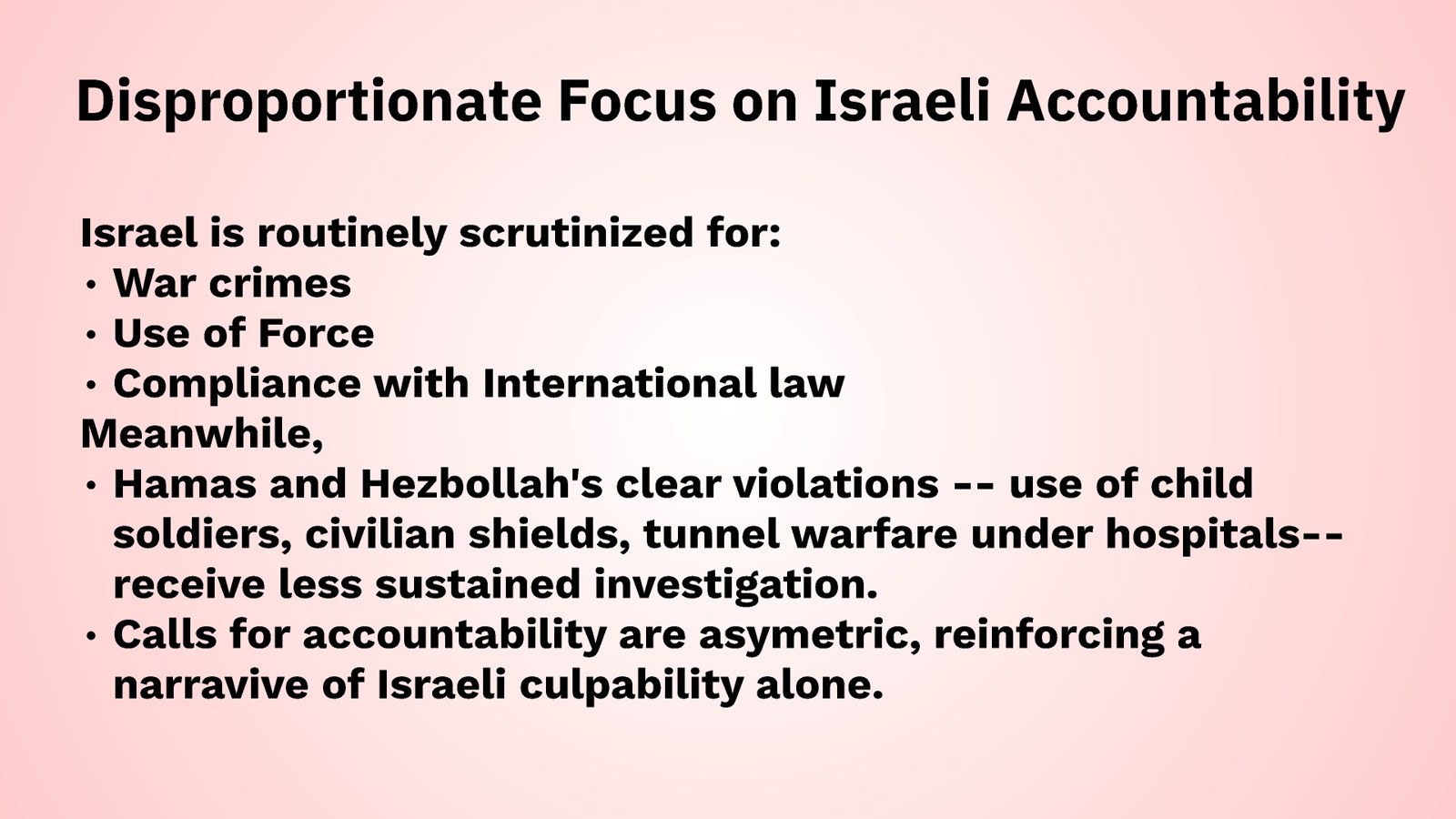
Israeli journalist Amit Segal recounted how he was asked by a New York Times journalist why the Israeli media has only covered 20% of the suffering in Gaza. He replied that he was okay with the Israeli press covering only 20% of the suffering in Gaza, since the New York Times covered 200% of it.[241]
The quantitative record
A client asked Asserson Law Offices to evaluate whether the BBC was in breach of its duties of accuracy and impartiality in its coverage of the Israel-Hamas War. Trevor Asserson subsequently analyzed nine million words of output and hundreds of hours of flagship broadcasts across the first four months of the war, with roughly twenty lawyers and twenty data scientists, it found the BBC associated:
• Israel with war crimes 121 times; Hamas 30 times
• Israel with genocide 283 times; Hamas 19 times
• Israel with breaching international law 167 times; Hamas 27 times
It identified 1,553 breaches of the BBC’s own editorial guidelines; found the BBC more likely to describe Hamas in relation to its “health ministry” than as a proscribed terrorist organization; found more than 90 percent of BBC Arabic’s video and web output exhibited pro-Palestinian bias, including during the massacre itself; and found that in a sample of BBC Arabic output, 27 percent of Arabic-speaking interviewees were connected to terrorist groups or had posted antisemitic rhetoric.[242]
Danny Cohen, former director of BBC Television: “Israel being accused of war crimes in the BBC’s reporting six times more often than Hamas, despite the killings on Oct 7 being documented in video footage that the terrorists filmed themselves. Other than as a result of deep-rooted bias, how is it possible that the BBC’s emphasis on ‘war crimes’ is so consistently directed towards Israel?”[243]
The accountability that never came
Former Secretary of State Blinken observed to the Times itself in January 2025: “One of the things that I found a little astounding throughout is that for all of the understandable criticism of the way Israel has conducted itself in Gaza, you hear virtually nothing from anyone since October 7 about Hamas. Why there hasn’t been a unanimous chorus around the world for Hamas to put down its weapons, to give up the hostages, to surrender — I don’t know what the answer is to that. Israel, on various occasions, has offered safe passage to Hamas’s leadership and fighters out of Gaza. Where is the world?”[244]
The asymmetry extended to Hamas’s treatment of Palestinians. Its two-decade campaign against Palestinian journalists generated no global campaigns (Category 9). Its summary executions of Gazans, its diversion of aid, its use of the population as a shield, and its refusal to build shelters for anyone but its own fighters were reported episodically at best and never as sustained investigations.
33. Damned If It Does, Damned If It Doesn’t
The technique. Israel is condemned when civilians are killed and condemned for the measures it takes to prevent civilians from being killed — a structure in which no course of action is available that the coverage will treat as legitimate.
When Israel struck without warning, it was accused of indiscriminate bombardment. When it issued evacuation warnings, the warnings themselves became the offense: Palestinians were described as forced into “never-ending searches for shelter,” and the designation of humanitarian zones was reported as the progressive shrinking of the space in which Gazans were permitted to exist. The alternative — remaining in an active combat zone — was not presented.
The same structure governed the aid coverage. Israel was condemned for restricting aid; when aid entered at rates exceeding prewar levels (Category 18), the coverage did not adjust, and when the aid was stolen by Hamas, the theft was buried (Category 18) or omitted. Israel was condemned for the conditions in Gaza while the Biden-al-Sisi agreement that prevented Gazans from leaving went unmentioned.
The most compact illustration is the al-Mawasi coverage. Israel designated a humanitarian zone and directed civilians to it; when it struck a target inside that zone, the Times’ quoted expert judged that “the use of a munition in a densely populated area, and one designated as a ‘safe zone’” was “disproportionate.”[245] The designation of the zone, undertaken to protect civilians, became an aggravating factor in the indictment.
Douglas Feith identified the strategic consequence: media outlets “claiming to be sympathetic to the Palestinians” are “actually rewarding a Hamas strategy that’s catastrophic for the Palestinians... rewarding this perverse determination by Hamas to maximize Palestinian civilian casualties so as to win condemnation of Israel.”[246]
PART EIGHT — OPINION, IDENTITY, AND THE OLDEST HATRED
The last four categories concern what happens when the accumulated distortions of the preceding thirty stop being individual choices and become an atmosphere: criticism that no longer needs an occasion, identity deployed to license conclusions, a legal term of art converted into a slogan, and — at the outer edge, in the most respected publications in the English-speaking world — the reappearance of tropes that predate the State of Israel by centuries.
34. The Routinization of Criticism
The technique. Condemnation of Israel ceases to be a response to particular events and becomes the standing condition of the coverage — a background hum that requires no occasion, admits no good news, and shapes the daily editorial product regardless of what has happened.
What the front page looks like on an ordinary weekend
The measure of routinization is not any single article. It is the aggregate on a day when nothing in particular occurred.
Over one weekend in June 2026, the New York Times homepage featured a package of headlines including: “Pentagon Sees Growing Espionage Threat from Israel,” “Israeli Strike Kills 3 Lebanese Soldiers, Days After Truce Was Signed,” and “Infant Killed as Israeli Military Fires on Car in West Bank, Palestinian Officials Say.” That weekend came less than a month after the Kristof column (Category 37). It coincided with a “visual investigations” piece by a former freelance contributor to Al Jazeera, who had come to the Times from Airwars, asserting that Israel was violating international law by using white phosphorus over civilian areas of Lebanon. On the following? Monday, the paper published a 6,000-word project that, as Ira Stoll put it, “lumps together all the lurid tropes about Israel and Jews — starving Gazans, bombing hospitals, killing children, profiteering, and destroying Arab villages in 1948.”[247]
No single item in that package is indefensible on its own. The aggregate is the finding. Stoll’s summary: “rather than retreating or pausing after the Kristof dog-rape article, which generated a legal threat from Prime Minister Netanyahu and a formal condemnation from the Conference of Presidents of Major American Jewish Organizations, the Times is pushing ahead with similar content.”
The economics of the routine
Stoll also documented the mechanism that sustains it. The 6,000-word project carried a small-type disclosure that it “was produced in partnership with the Pulitzer Center” and “with the support of the Pulitzer Center.” Nowhere did the Times tell readers what the Pulitzer Center is or who funds it. Stoll’s structural point is the important one: the news business has been financially difficult, and outlets have taken to underwriting news and editorial content with foundation money, and some of those foundations, notably Open Society and Rockefeller, have historically funded organizations critical of Israel. Readers are left “slogging through content that might not have cleared the hurdle for publication or justified the editorial resources without the donor subsidy” — content whose subject matter is selected, in part, by donors with a declared position on the subject.[248]
The proportion
The routinization is visible in the ratio of attention documented at the outset of this report: a country comprising one one-hundredth of one percent of the world’s surface receiving more coverage than any other foreign story; 6,696 war headlines in two years; 27,205 mentions of “Israel” against 8,499 of “Hamas” in the Times’ war coverage.
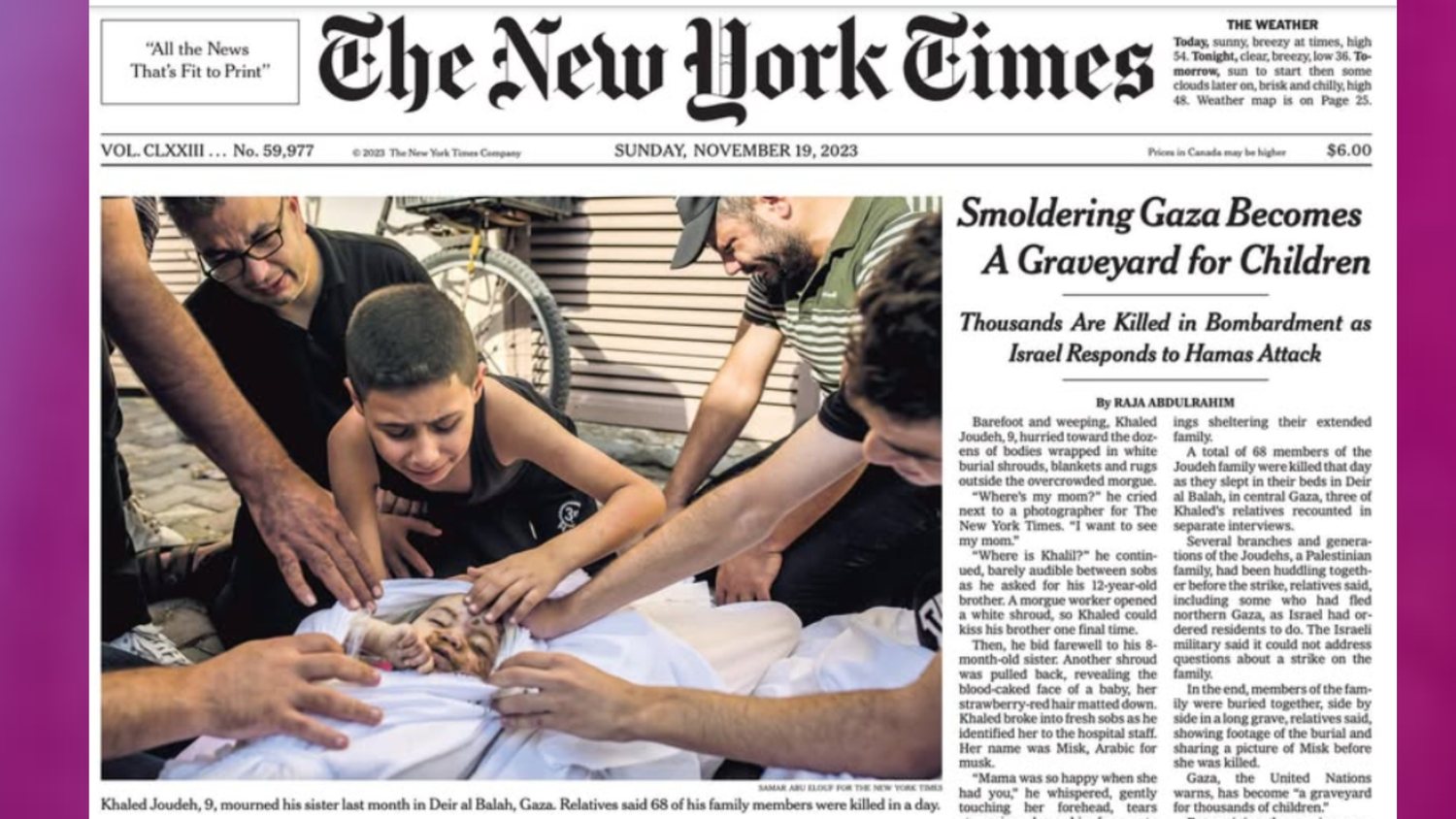
Fox puts the coverage in perspective by comparing Gaza with other recent conflicts. Direct violence in the Afghanistan war killed about 176,000 people by 2021, and direct war deaths in Iraq between 2003 and 2021 numbered between 275,000 and 306,000. Those wars, he notes, are argued over in terms of strategy, goals, and legality, not tracked through a running casualty count without context, and no one accuses the countries that fought them of genocide. He makes the same point about Sudan. There, the IPC has officially declared famine and warned that as many as a million people could die, yet Western capitals see no mass protests over that figure and cable news shows no live death tally.[249]
The distinguishing feature of the Gaza coverage is not its volume alone but its permanence: a story that continues to generate front-page condemnation on days when its own reporters have nothing new to report.
35. “As-a-Jews”
The technique. Jewish identity is deployed as a credential rather than described as a viewpoint. Outlets present unrepresentative anti-Zionist Jews as the Jewish voice on Israel — often without disclosing their organizational affiliations — thereby immunizing the resulting coverage against the charge of bias and, at the same time, misinforming readers about what most Jews think.
New York Times opinion writers
Journalists have long said that “dog bites man” isn’t news, and by the same logic a Jew writing in support of Israel rarely makes headlines. It’s no surprise, then, that the media go looking for Jews who criticize the Jewish state. The New York Times is notorious for publishing op-eds by Jews hostile to Israel, and it features a stable of Jewish columnists and contributors who, with the notable exception of Bret Stephens, regularly take aim at it. Leading the pack is Thomas Friedman, whose faith in an elusive two-state solution colors nearly everything he writes about the region; he disapproves of any Israeli policy he sees as standing in its way. His attacks on Benjamin Netanyahu have been so relentless that he might as well hang a sign on his office door reading “I hate Bibi.” Alongside Friedman, Michelle Goldberg, M. Gessen, and Peter Beinart routinely pile on.
One example of the Times’ approach was to find a Jew to criticize one of Israel’s most successful intelligence coups – the exploding pagers held by Hezbollah terrorists – as a “war crime.” As noted earlier (Category 31), Michael Walzer couldn’t help contradicting himself because his argument made no sense. That was of no concern to Times editors.
The Code Switch episode
On October 15, 2025, NPR’s Code Switch aired a forty-five-minute program titled “What does Israel mean to American Jews?”
It did not answer the question it posed. As HonestReporting documented, the episode was not a survey of the relationship between American Jews and Israel “from staunch Zionists to anti-Zionists.” It was a platform for voices within the Jewish community that are either sharply critical of Israeli actions or opposed to the existence of the Jewish state. Much of the content was lifted verbatim from an April 2024 Code Switch episode that had at least been honestly titled — “As American Jews speak out on Israel, some see rifts in their communities” — and had not claimed to describe American Jewry as a whole.
The tone was set early. Co-host Leah Donnella told her colleague that in the days following October 7, all her interviewees were “devastated” by what Israel was doing in Gaza and felt somewhat “implicated” in it. October 7 itself is mentioned in the episode but never explained as a large-scale massacre of Israelis by a terrorist organization.
That every interviewee’s response to the massacre was to deepen their criticism of Israel is a measure of how unrepresentative the sample was. The dominant response within American Jewry in those days was, by the available research, “horror, shock, and disbelief.”
The second half of the episode was given to Marjorie Feld, a professor introduced as the author of a book on the history of anti-Zionism in the American Jewish community — an academic providing scholarly context for the views expressed in the first half. Donnella mentioned in passing that Feld is “openly critical of Israel.” Listeners were not told that Feld serves on the Academic Advisory Council of Jewish Voice for Peace, an organization the ADL describes as a “radical anti-Israel and anti-Zionist activist group.”[250]
This is the disclosure failure of Category 12 applied to identity: an advocate presented as a scholar, with the affiliation that would have allowed the listener to weigh her testimony withheld. It also explains what her “academic contextualization” omitted — the two-thousand-year connection between Diaspora Jewry and the Land of Israel, erased in favor of a framing in which Palestinian Arabs are the land’s native population and Jews arrived from elsewhere.
NPR’s own published standards require accuracy, fairness, and completeness, and require that views be “rigorously challenged.” None of the episode’s opinions were challenged; no opposing viewpoint was presented; the story of American Jewry and Israel was not told comprehensively.[251]
What the surveys show
The available polling was easy to consult. Even as some American Jews grew more critical of Israel’s conduct over two years of war, the majority continued to report an emotional connection to Israel. This connection strengthens with degree of communal involvement. A program purporting to describe “what Israel means to American Jews” that omits the majority position is not a study of a community; it is a selection from it.[252]
Why the device works
The “as-a-Jew” credential performs a specific function in the coverage: it converts a contested political claim into a testimony that cannot be challenged without appearing to challenge the speaker’s identity. When The New Yorker assigned Masha Gessen to write that Gaza is a Nazi ghetto being liquidated (Category 37), the assignment carried an implicit warrant. When the Times’ opinion editors defended the Kristof column, the defense included that “a number of other readers, including some who said they’re Jewish, wrote that they were grateful the column had run.”[253]
The device is also, in the aggregate, self-reinforcing. Category 34’s routinization determines which Jewish voices are newsworthy; those voices then authenticate the routine.
36. The Genocide Charge
The technique. A legal term with a specific definition — acts committed with intent to destroy, in whole or in part, a national, ethnical, racial, or religious group — is deployed as a description, repeated until it functions as a premise, and then reported as an open question or a fact according to convenience.
Misreading the Genocide Convention.
The volume
The Asserson Report’s figures, cited above, are the hard number, and they point in one direction: on every measure, from war crimes to genocide, the BBC tied Israel to the gravest charges far more often than it did Hamas.[254]
The charge was not limited to quoting others. Danny Cohen, the former director of BBC Television, put the question the number raises: “Other than as a result of deep-rooted bias, how is it possible that the BBC’s emphasis on ‘war crimes’ is so consistently directed towards Israel?”[255]
A verdict before the evidence
The charge preceded the facts it purports to describe. On October 10, 2023 — three days after the massacre and before Israel had begun any ground operation — the Critical Race and Ethnic Studies department at UC Santa Cruz announced it would close in protest of Israel’s “genocidal attack on Gaza.” Days later, the Stockton University professor Raz Segal called the war “a textbook case of genocide.” Israel’s ground invasion did not begin until October 27. Both were widely quoted in the coverage that followed as expert judgments rather than as positions adopted before there was anything to judge.[256]
The ICJ ruling that was not what was reported
The single most consequential distortion in this category was the reporting of the International Court of Justice’s interim order of January 26, 2024.
The BBC widely reported that the court had found a “plausible case” of genocide. As former ICJ president Joan Donoghue later said on the BBC’s own HardTalk, it had found no such thing. The BBC’s internal review found the error so pervasive, including in Jeremy Bowen’s reporting and on Newsnight, that it couldn’t list every instance. It noted that the 26-page order says explicitly that the court was not ruling on the merits, and it asked: “Had no BBC reporter troubled themselves to read it?”[257] The BBC still took months to issue a clarification.
The evidence that was false
South Africa’s filing — which the White House called “meritless, counterproductive, and completely without any basis in fact whatsoever” — rested for its evidence of genocidal intent on statements by Israeli leaders. The key quotations were false, and the press falsified them.
Columnist Megan Stack based two Times op-eds on the doctored Gallant quote.[258] Her columns repeated the pattern described above: she read Israeli leaders’ words as proof of revenge and genocidal intent, and she put in Netanyahu’s mouth a biblical call to kill men, women and infants that he never made. Goldberg’s January 5 column likewise had Netanyahu considering the “surrender and deportation” of Gaza’s residents.[259]
The Times’ January 23 correction, printed after the ICJ hearings, acknowledged that the quotation “had been taken out of context.” The corrections came only because the errors were exposed externally. Netanyahu’s misattributed biblical quotation was never corrected. Screenshots of the misquotations continue to circulate.
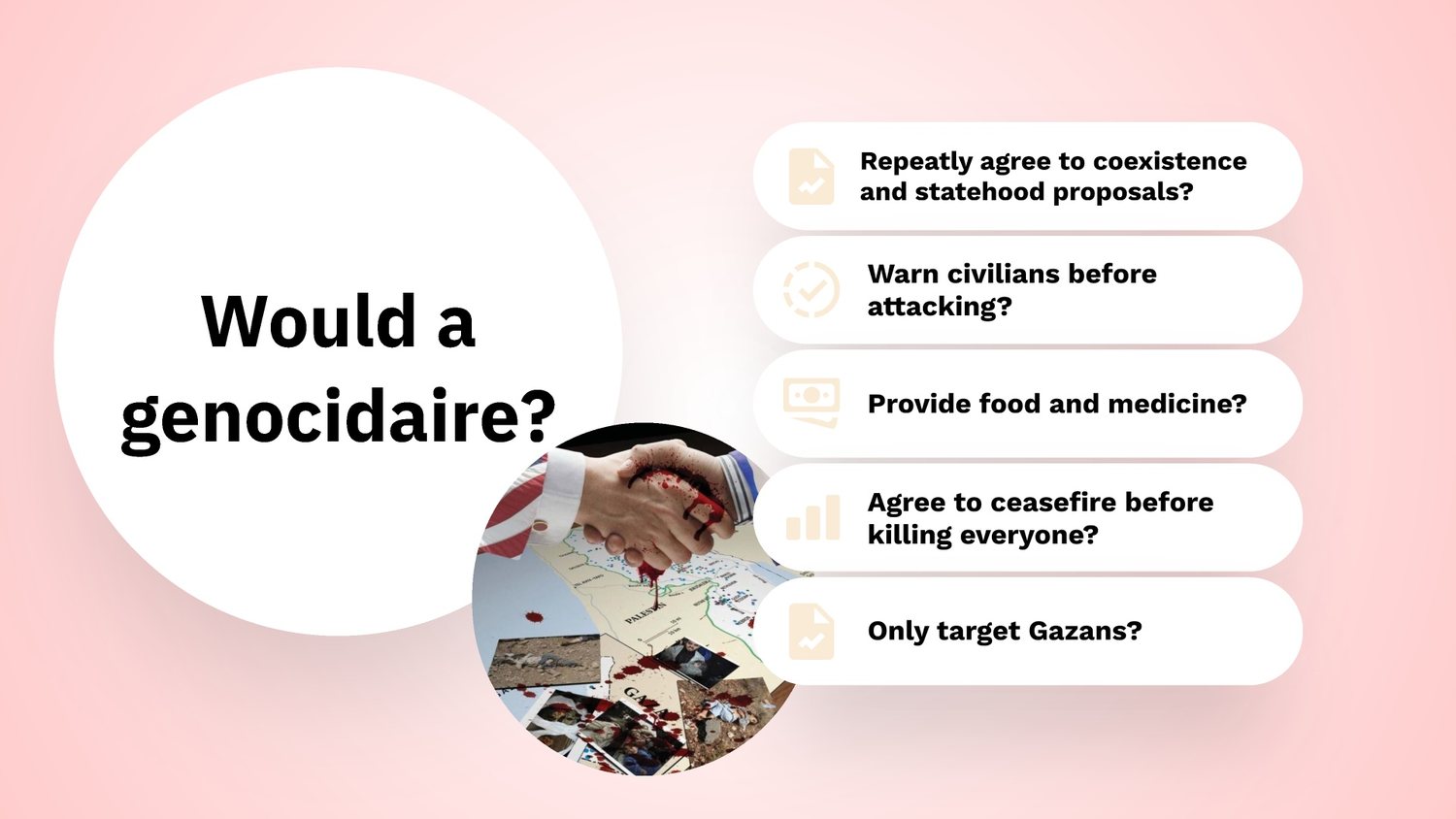
Redefining the terms to reach the verdict
When the existing definitions didn’t produce the finding journalists wanted, they altered the definitions—and the changes went almost entirely unreported.
As noted, the IPC’s famine calls swung with its methods rather than the evidence: it warned of imminent famine in March 2024, backed off in June, and declared famine in August 2025, after it had quietly switched to a cruder measure (arm circumference) and halved the child-malnutrition threshold from 30 to 15 percent.[260]
Amnesty International revised the definition of genocidal intent in reaching its finding against Israel. The organization billed by the press as “the world’s leading genocide scholars’ association” followed. As Noah Rothman observed, that body’s prestige was roughly commensurate with its $30-to-$125 membership fee — the only barrier to entry beyond an application — and only a fraction of its members participated in the resolution, with the usual channels for dissent closed.[261]
Eugene Kontorovich, who directs George Mason University’s Center for the Middle East and International Law, drew the inference that the collapse of the famine claims invites: it “tends to suggest that much of the information coming from Gaza, in general, is false. It lends further credence to the proposition that information coming out of Gaza is coordinated propaganda.” On whether contrary evidence would alter the ICC’s course: “If this did not lead the ICC prosecutor to change course, nothing will.”[262]
The demographic fact the charge cannot accommodate
The absurdity of the allegation is evident from the facts: Since Israel captured the disputed territories in 1967, the Palestinian population there has grown exponentially. The Arab population in Israel has also grown and now constitutes 2.1 percent of the population. Even if one accepted the Hamas casualty figures, roughly 98 percent of the Gaza population was alive when the ceasefire was declared, which undercuts the claim of genocide. Further, if the intent was genocide, why would a genocidaire repeatedly agree to peace agreements with its enemy, warn civilians before attacking, or provide food and medicine? And if the intent was genocide of Palestinians, why weren’t they being killed en masse in the West Bank or Israel?
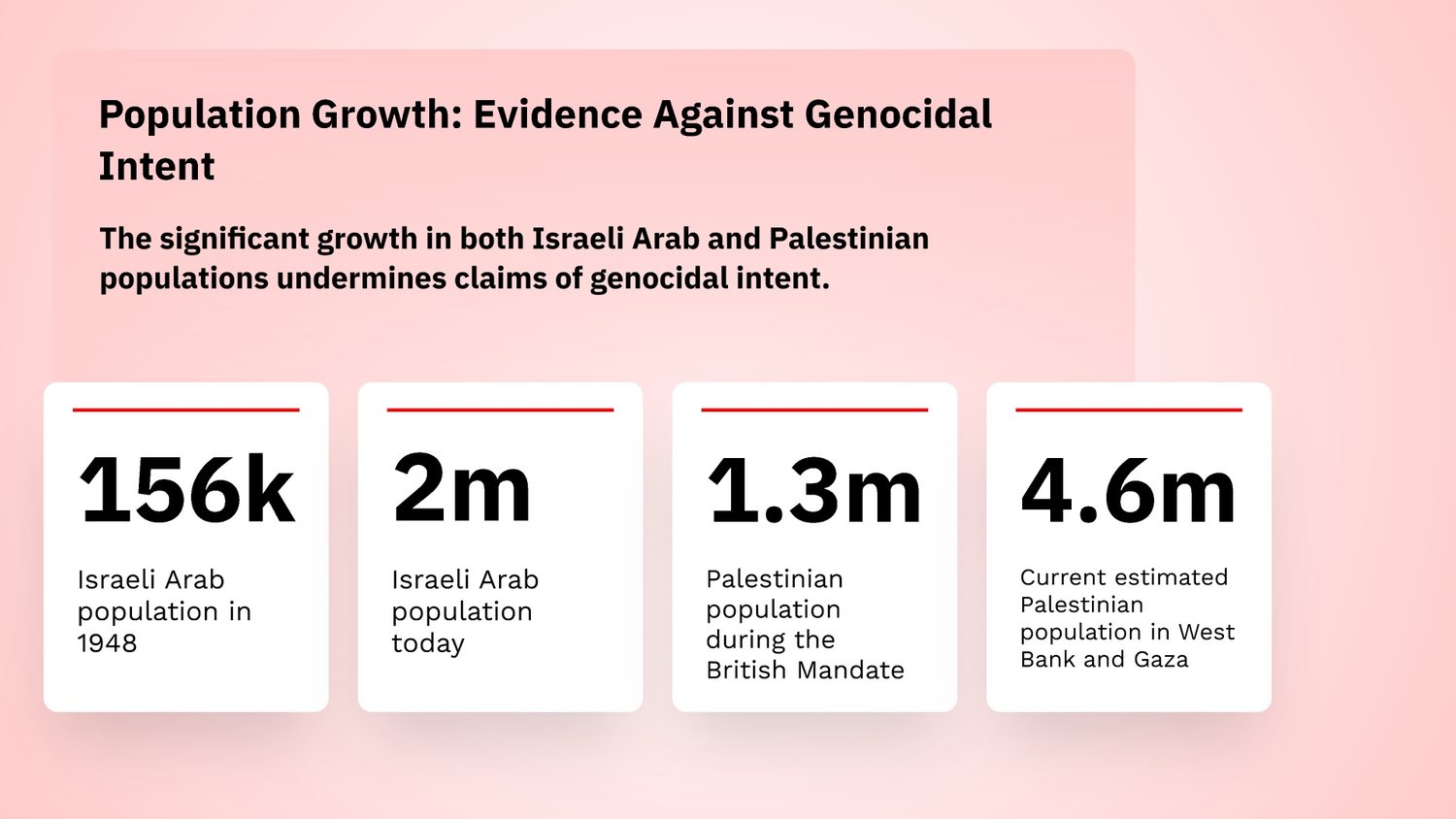
The structural point is not that the war was not terrible. It is that “genocide” is a claim about intent, and the coverage that advanced it did so on the strength of quotations that had been altered, a court ruling that had been misreported, definitions that had been changed mid-conflict, and a set of measures to protect civilians (Category 19) that no genocidal campaign has ever undertaken.
The result
By July 2026, an Economist/YouGov survey found that 43 percent of American voters believed Israel was committing genocide against the Palestinians, with only 24 percent disagreeing.[263]
That is what three years of the coverage documented in this report produced: a legal finding no court has made, believed by a plurality of the public in the country that supplies Israel’s weapons.
37. Antisemitic Tropes at the Edges of Coverage
The technique. This last category calls for the most care, and the claim must be stated precisely. The argument is not that mainstream journalists are anti-Semites, though some may be. It is that certain framing choices produce coverage whose structure echoes historic anti-Semitic themes: assigning collective guilt, fixating on Jewish power, and holding Israel to standards applied to no other democracy at war. And at the far edge of that coverage, actual blood libels have appeared in the most respected outlets in the English-speaking world.
The double standard as the underlying trope
Friedman quantified the attention: Israel occupies one one-hundredth of one percent of the world’s surface, and one-fifth of one percent of the Arab world’s landmass, yet his AP bureau covered it more heavily than any other foreign country. His account of the resulting story describes a trope, not a policy dispute: “By selectively emphasizing some facts and not others, by erasing historical and regional context, and by reversing cause and effect, the story portrayed Israel as a country whose motivations could only be malevolent, and one responsible not only for its own actions but also for provoking the actions of its enemies.”
He also identified the closed epistemic loop that gives the story its authority: “The activist-journalists, I found, were backed up by an affiliated world of progressive NGOs and academics who we referred to as experts, creating a thought loop nearly impervious to external information.” Since October 7, the loop has expanded “to include much of the United Nations apparatus and supranational legal institutions like the International Criminal Court — which can cite reporters citing human rights groups citing reporters, who then report that international courts agree with their opinions, now referred to as ‘international law.’”
And he named the pattern: “this mental virus catching on again, among educated people who viewed themselves as liberal, as if history had never happened. In keeping with the spirit of the era, this time the charges against the Jews were presented as a matter not of religion, race theory, or economics, but of human rights.”[264]
The Nazi analogy
The most direct trope in the coverage is the recasting of Jews as Nazis — Category 6’s false analogy, carried to its endpoint.
The Guardian published at least three op-eds, two penned by Jews, comparing Israel to Nazi Germany. The first was Raz Segal’s “Israel must stop weaponising the Holocaust,” which appeared only two weeks after the Hamas attack. The second was by U.S. writer John Oakes and ran in July 2024. The third was Brown University professor Omer Bartov’s “As a former IDF soldier and historian of genocide, I was deeply disturbed by my recent visit to Israel,” published August 13, 2024.[265]
The New Yorker made Masha Gessen its lead voice on Gaza. It published three lengthy pieces by Gessen which David Mikics describes as arguing that Netanyahu’s Israel is equivalent to Hitler’s Germany.[266] The December 2023 piece supplied the line: “The ghetto is being liquidated.” It elaborated: “For the last seventeen years, Gaza has been... not like the Jewish ghetto in Venice or an inner-city ghetto in America but like a Jewish ghetto in an Eastern European country occupied by Nazi Germany.”
Mikics’s rebuttal in Tablet rests on a distinction basic enough that it should not have required stating: “Israel has repeatedly displaced the population of Gaza in order to avoid killing them, while the Nazis displaced Jews in order to murder them en masse.”
Mikics cataloged the rest. Gessen’s February piece asserted that “Israeli officials probably speak for their country when they say, in effect, ‘How can you call it genocide if it’s waged by us?’” — ventriloquizing Jewish opinion as the belief that Jews may slaughter anyone because they can never, by definition, commit genocide. It attributed to a single historian a “consensus opinion among historians of genocide” that Gaza is a genocide, without citing another. Its evidence — “the statements of Israeli officials” — consisted of the misreported quotations documented in Category 36. It claimed the ICJ had “ordered Israel to minimize casualties,” which the court did not do. It described Gazans killed “in retaliation for the lives of Jews killed by Hamas,” a word choice Mikics identified precisely: “It’s the word ‘retaliation’ here that stings. The Jew is vengeful, willing to do anything to satisfy his bloodlust.”
It asserted that “on average, a child in Gaza is killed every ten minutes” — a figure Mikics called “plucked out of thin air” — and that most of Gaza’s population was starving, at a time when even Hamas sources claimed 32 starvation deaths among two million people. On 1948 it stated that Palestinians who did not flee “were driven out of their villages by Israeli forces”; Benny Morris’s research establishes that the Haganah expelled roughly 2 percent, with the overwhelming majority fleeing a combat zone, and that large numbers remained and became Israeli citizens — 20 percent of the population, some of whom Hamas murdered on October 7. Gessen mentions none of them.
Mikics’s central charge concerns the fact-checking apparatus of a magazine once famous for it — H.L. Mencken’s line that “Ross has the most astute goons of any editor in the country,” and the checkers who refused to believe he had eaten at a Paris restaurant until he produced the menu. “Which is another way of saying that fact-checking is a relic of the 20th century.”[267]
Zadie Smith, brought in as the acceptable counterweight, nonetheless condemned “the monstrous and brutal mass murder (at the time of writing) of a reported fourteen thousand five hundred children.” Mikics’s response contains this report’s own methodological point: “Did Israel really commit a ‘brutal mass murder’ of children in Gaza — like, by selecting out children under 14, in Aktions, then mowing them down with machine guns, and tossing their bullet-riddled little bodies into pits dug for that purpose, just like the Nazis did during the Holocaust...? Of course not. So why use language making it appear to any unfamiliar or biased reader that they did? You can stop right there, because there is no good answer to that question, other than the deliberate choice by the writer and editor to employ antisemitic tropes to color Israeli actions as uniquely monstrous and beyond the pale of normal human behavior — the shorthand for which is ‘anti-Semitism.’”
Mikics also noted the comparison Gessen declines to make: “Hundreds of thousands of German and Japanese children were burned to death by Allied bombers. Before and after D-Day alone, America and Great Britain killed an estimated 50,000 French civilians. Were those Allied actions the equivalent of Nazism?... Apparently, only Israeli actions can be equivalent to Nazism. Why is that?”
Organ harvesting in the Washington Post
In late December 2023, the Washington Post published a report on Israel’s return of bodies recovered in northern Gaza — bodies the IDF had brought back to determine whether they were Israeli hostages and then returned once identified as Hamas fighters.
The Post quoted the Hamas-run government media office: “After examining the bodies, it is clear that features of those killed had changed greatly in a clear indication that the Israeli occupation had stolen vital organs from them.” And: “The media office denounces in the strongest terms the Israeli occupation army’s disdain for the dignity of the bodies of our 80 martyrs that Israel had stolen during its genocidal war because it delivered them mutilated.”
The paper noted only that “the claims could not be independently verified,” and that the IDF had referred questions to a civilian coordination agency that did not immediately respond. As is often the case, the absence of an Israeli response before the reporter’s deadline was allowed to serve as a substitute for evidence—and implicitly treated as an admission of guilt.
Reuters, Barron’s, AFP, and the Times of Israel all declined to give the allegation any credibility. The Post stood alone among reputable Western outlets. The outlets that joined it were the Yemen Press Agency, Al Jazeera, Iran Press, and Al Mayadeen English. When asked why it printed the claim while other outlets did not, the Post did not explain.
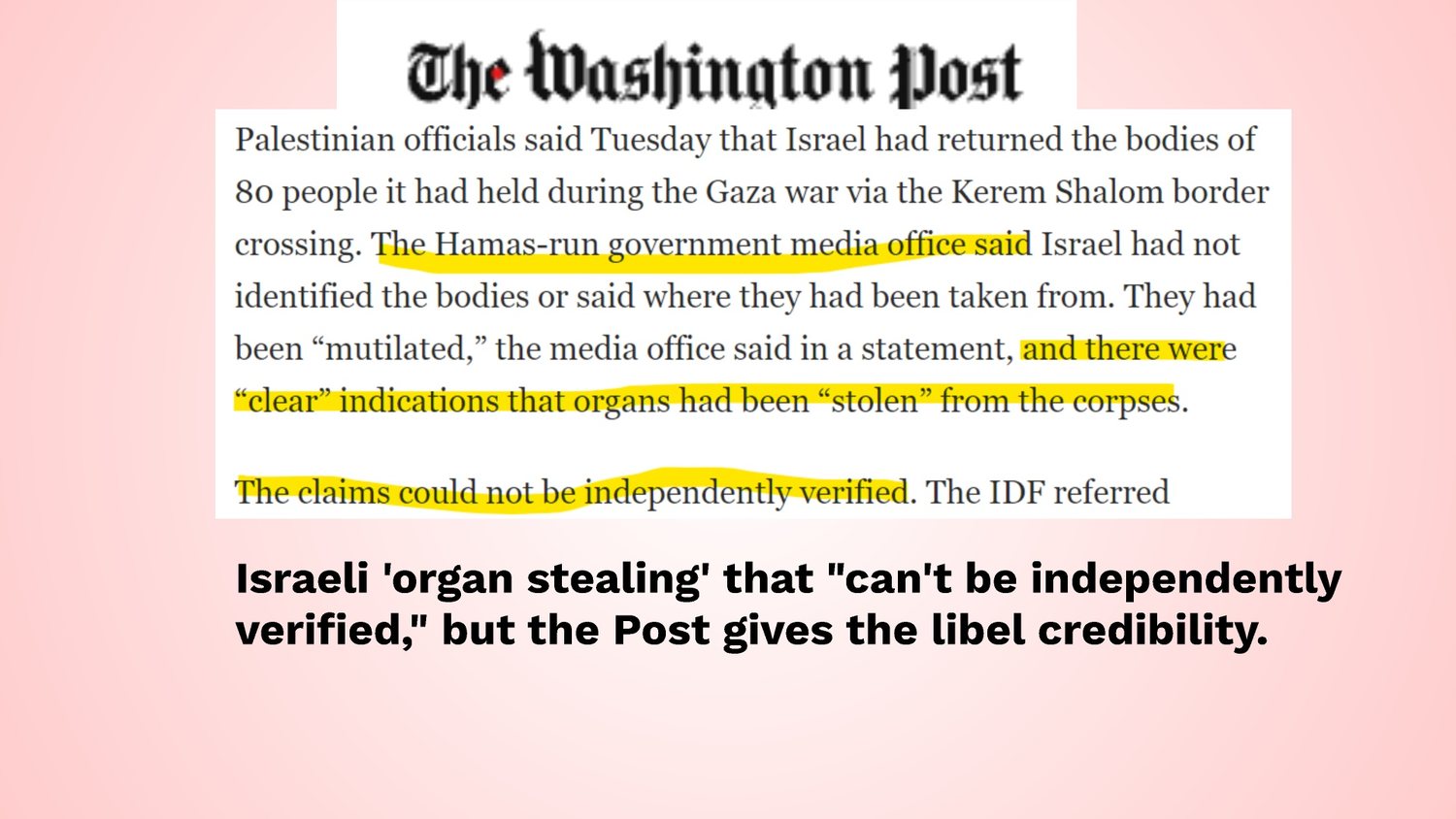
Reed Rubinstein’s response: “It’s factually absurd. They’re harvesting organs from dead terrorists who’ve been lying around for days? For years, there has been, primarily in academia and Palestinian propaganda outfits, this claim that the Israelis are harvesting organs. It evokes the worst of the blood libel; ‘taking the blood from little children’ kind of stuff which is still recycled to this day. The fact that the Post would publish this, and that somehow it got by the editors, is frankly a damning indictment of the operation over there now.”[268]
The staffing context is not incidental. As National Review documented, several of the journalists leading the Post’s war coverage came from Al Jazeera: the visuals expert who oversaw the “most destructive wars” analysis had a reporting gig there; the lead reporter on the premature-babies story had written for it; a prominent op-ed contributor had as well; and the paper’s Middle East editor is an Al Jazeera alumnus.
The Kristof column
In May 2026, the trope reached the New York Times opinion page in its oldest form.
Nicholas Kristof’s column, “The Silence That Meets the Rape of Palestinians,” alleged “a pattern of widespread Israeli sexual violence against men, women and even children — by soldiers, settlers, interrogators in the Shin Bet internal security agency and, above all, prison guards.” Among the allegations: that Israeli security personnel had trained dogs to mount and rape prisoners.
Canine behavior expert Michael Gould told National Review that the idea that dogs could be trained to rape prisoners was “absurd.”[269] Israel’s Foreign Ministry called the piece “one of the worst blood libels ever to appear in the modern press.” Prime Minister Netanyahu and Foreign Minister Sa’ar jointly called it “one of the most hideous and distorted lies ever published against the State of Israel in the modern press.”[270] The Israel Prison Service called the allegations “false and entirely unfounded.”[271] The Holocaust historian Deborah Lipstadt asked whether the Times had “no sense of decency.”[272] The Israeli government announced its intention to sue for defamation; the Conference of Presidents of Major American Jewish Organizations issued a formal condemnation.[273]
An independent commission investigating Hamas’s sexual violence on October 7 told the Times weeks in advance that its report would come out around May 12. According to Israel’s Foreign Ministry, the Times turned down an offer to see the findings early. Then on May 11, a day before the report’s release, the Times published Kristof’s column, which cast the victims of mass sexual violence as perpetrators. The Times disputed the Foreign Ministry’s account and said the timing was unrelated to the report.
The Times later ran a shorter piece on the commission’s findings, but by then it was too late. Under the psychological principle of primacy, people are most persuaded by the story they hear first, and the first impression had already been made.[274]
The sources. Kristof’s key institutional source was the Euro-Mediterranean Human Rights Monitor, an organization with documented ties to Hamas. Its chairman, Ramy Abdu, wrote on October 8, 2023, that footage from the attacks on Ofakim and Magen showed “Hollywood-like amazing scenes”; has publicly idolized Yahya Sinwar as a “legendary figure”; has advocated for “a million October 7ths”; and has previously promoted claims of Israeli organ-harvesting and “mass field executions.” Israel’s ambassador to the United States posted a 2011 photograph of Abdu and a colleague with then-Hamas leader Ismail Haniyeh. Euro-Med has alleged that the October 7 crime scene was “doctored” and has described the hostages as having been “arrested and moved to the Gaza Strip.”
Kristof described the group as “often critical of Israel” — which Judge Roy Altman called “an almost laughable understatement” — and did not disclose Abdu’s affiliation. The June 2024 Euro-Med report from which the dog allegation originates contains an interviewee’s claim that he was shocked in an electric chair so severely that he awoke to find his “foot had exploded.”[275]
The witnesses. The named sources did not hold up better. Rachel O’Donoghue of HonestReporting compared the account Sami al-Sai gave Kristof — introduced only as a freelance journalist — with the testimony he gave the Israeli NGO B’Tselem in July 2025 and found the vivid details in the Times version absent from the earlier telling. In 2017, after his arrest by Palestinian Authority intelligence, his family had alleged torture that the Palestinian Journalists Syndicate reported he had called a false rumor before retracting that denial. Israel had detained him for incitement, including social media praise for Hamas and for October 7. Issa Amro had told the Washington Post months earlier that he was threatened with sexual assault, not subjected to it. Former Prime Minister Ehud Olmert, whose quotation appeared directly after a graphic allegation, said within hours that he had not validated the claims and that the placement misrepresented his views.[276]
Judge Roy Altman added what the column never told readers. Al-Sai’s own petition to Israel’s Supreme Court complained of food and treatment but made no sexual allegations, and the court found credible evidence of his affiliation with terror groups. Since 2023, Gazan detainees have filed 182 complaints about their confinement, four involving alleged sex offenses; the military had opened disciplinary proceedings and criminal investigations; soldiers had been convicted and imprisoned for abusing detainees; and an elite police unit, Lahav 433, investigates prison-service misconduct. None of this appeared in the column, which gave no dates, locations, or perpetrators that anyone could check.[277]
The dog allegation had a traceable pedigree. According to National Review, it first gained traction after being amplified by Shaiel Ben-Ephraim, a former UCLA academic who has himself acknowledged the claim was not verified, before circulating through the Electronic Intifada, Owen Jones, and Novara Media — and then Euro-Med, and then the New York Times. [278]
The defense. Asked by readers whether the Times stood by the column given the volume of critical response, Opinion editor Kathleen Kingsbury answered yes: “Nick built upon a growing body of evidence regarding the mistreatment of detainees in Israel. Numerous human rights organizations and reputable news outlets — including prominent Israeli media — have documented abuse by Israeli security forces and settlers.” The response noted that some readers, “including some who said they’re Jewish,” were grateful the column had run — the device documented in Category 35, deployed as a defense.[279]
That some readers praised the column did nothing to establish the truth of its claims. Invoking Jewish readers was merely another example of the “As-a-Jew” phenomenon: using the identity of individuals who represent only themselves to lend credibility to otherwise dubious assertions.
The defense of the defense. A week after publication, the Times told the Israeli press there were “no errors” in the column and stood by its allegations of systematic Israeli sexual abuse of Palestinian detainees.[280]
The newsroom’s verdict. Two months later, executive editor Joe Kahn distanced the newsroom from the column, indicating it would not have run as a news story. That is a significant admission: the Times’ own news standards would have excluded a piece its opinion section published and still stands behind.[281]
The shareholders. The column became the trigger for the first shareholder litigation over the paper’s Israel coverage. On May 29, 2026, lawyers for the National Center for Public Policy Research demanded the company’s board records, telling the board that Kristof’s sources included known and convicted criminals rather than the independent witnesses readers were promised. The demand grew into the September 2026 lawsuit described in the New York Times case study below.[282]
Where the tropes are unmediated
The edge of the mainstream coverage abuts a space where nothing is mediated at all. Rob Eshman documented UpScrolled, a social platform that became “a social media haven for unspeakable anti-Semitism.” He asked the question that applies equally to the legacy outlets: how does any of this help Palestinians?[283] The relationship between the two spaces is not one of contamination in a single direction. Mainstream framing supplies the raw material — the genocide charge, the Nazi analogy, the organ libel — which the unmediated space amplifies without the qualifications, and the amplified version then returns as evidence of public sentiment that the mainstream coverage must reflect.
CASE STUDIES, CONSEQUENCES, CONCLUSION
Five Institutional Case Studies
The thirty-seven categories operate simultaneously inside institutions. Five are worth examining as wholes because, in each case, the internal record now confirms what outside critics documented.
The BBC
No institution is better documented. The evidence comes in three layers: external analysis, a leaked internal review, and the complaints record.
External analysis. The Asserson Report identified 1,553 breaches of the BBC’s own editorial guidelines in the war’s first four months, on top of the lopsided pattern of accusations described above (Categories 32 and 36).[284] The BBC questioned the report’s methodology, especially its use of artificial intelligence, and promised to “consider the report carefully.”[285]
Trevor Asserson had done this before. In 2001, his team monitored seven weeks of BBC Middle East coverage and concluded that the corporation often breached its charter duty of impartiality. His findings, together with Palestinian complaints of pro-Israel bias, led the BBC to commission an internal review by senior journalist Malcolm Balen, who produced a 20,000-word report in 2004. The BBC spent more than £330,000 fighting Freedom of Information requests for the Balen Report. In 2009 the House of Lords held that it was “a document held for journalistic purposes” and therefore exempt. Twenty-two years after it was written, the report is still sealed.[286]
Internal review. Michael Prescott, an independent external adviser to the BBC until June 2025, compiled a report, which was leaked in November 2025. It found “systemic problems” in BBC Arabic’s coverage, which Prescott said “pushed Hamas lies” and “minimized Israeli suffering.”[287]
Story selection. David Grossman reviewed five months of coverage, May 7 to October 6, 2024, covering 535 English-language and 523 Arabic website articles. The English site ran 19 stories on the hostages, and BBC Arabic ran none. Every English article critical of Israel was reproduced in Arabic. The English site carried three times as many stories focused on Israeli suffering, and it ran four articles critical of Hamas, compared with none in Arabic.[288]
Story treatment. Fawzia Sido was a Yazidi woman kidnapped by ISIS at age eleven and rescued by Israeli soldiers after ten years as a sex slave. The U.S. State Department and Iraqi authorities corroborated her account. BBC Arabic headlined the story “Israel says ‘Yazidi prisoner returned to Iraq after ten years in Gaza,’ Hamas tells BBC ‘Israel narrative is fabricated,’” and gave most of the article to a 582-word Hamas statement.
On October 1, 2024, terrorists killed seven Israeli civilians in Jaffa, among them Inbar Segev Vigder, who died shielding her baby. BBC Arabic headlined that story “The Qassam Brigades claims responsibility for the Jaffa operation, what do we know about it?” and gave no information about the victims.
On Majdal Shams, the Arabic story left out the evidence of nearby Hezbollah strikes, emphasized Hezbollah’s denials, and described the dead as “Israelis” rather than children. A follow-up repeated Iranian and Syrian claims that Israel had staged the attack.
When four hostages died on June 3, 2024, the English site gave them a dedicated article. BBC Arabic gave them four paragraphs in a story about Hezbollah.
One experienced member of the BBC’s Editorial Guidelines and Standards Committee called the paper the most “extraordinary” she had ever seen. [289]
The executive response. The BBC’s deputy CEO of news rejected or minimized each finding. He said BBC Arabic delivers on its responsibilities “with the vast majority of its reporting” and that stories absent from Arabic were “not necessarily ‘missing.’” He conceded that the Yazidi headline was not “complete enough,” but said, “no headline is designed to be read in isolation.” On Majdal Shams, he said culpability “still is disputed.” He answered the imbalance in coverage of Israeli perspectives by citing stories from outside the review period. He defended BBC Arabic’s prominent use of Hamas messaging as helping “understanding of what Palestinians... may be hearing.”[290]
The contributors. Media reports forced another internal review in June 2025. Samer Elzaenen, who had posted that Jews should be burned “as Hitler did,” was publicly reported to have appeared “a dozen times.” Internal research found 244 appearances between November 2023 and April 2025. Ahmed Qannan, who called a gunman who killed five people a “hero,” appeared 217 times. Ahmed Alagha, who called Jews “devils,” appeared 522 times. The BBC routinely introduced these men as journalists, yet in public it called their contributions “eyewitness accounts” from people who were “not BBC members of staff” (Category 11).[291]
Other failures. In April and June 2024, the BBC reported mass graves at Nasser and al-Shifa hospitals in a way that implied Israeli forces had buried hundreds of bodies. It did not disclose that its source was the Hamas-controlled Civil Defense Agency. An internal report found “no independent corroboration” of the war-crimes allegations and found that one story wrongly implied a UN official had confirmed them. The graves had most likely been dug by Palestinians before Israeli forces arrived, as the BBC itself had reported at the time. A letter from 600 lawyers saying UK arms sales to Israel broke international law was covered across BBC platforms. A letter from more than 1,000 lawyers arguing the opposite got four Radio 4 mentions. One report described Hamas tunnels as being used to “move goods and people,” and an internal review warned that this left the BBC open to the charge of “aiming in some way to sanitize Hamas’s terror infrastructure.”[292]
Complaints. Over two years, CAMERA filed more than 100 complaints about BBC Arabic. 101 were upheld at first instance, and these produced 213 corrections, more than two a week. CAMERA appealed 31 rejections to the Executive Complaints Unit (ECU), whose rulings on World Service output are final. Twenty-two were rejected, nine were pending, and none were upheld. Among the rejected appeals:
- a profile of Mohammed Deif that mentioned only “accusations” that he had killed civilians.
- a report on campus encampments that quoted six pro-Palestinian protesters and no Jewish students.
- an interview with a mother mourning four sons that did not mention they were Hamas fighters. The BBC called their affiliation a “side detail,” even though Hamas itself had confirmed it.
The ECU also ruled that Hamas’s founding charter, which calls for Israel’s eradication, was “not directly relevant” to articles explaining the group’s ideology. CAMERA concluded that the ECU acts “not as an impartial watchdog but rather as a rubber stamp.”[293]
Consequences. Criticism came from across party lines. The Leader of the Opposition called the BBC Arabic failures “heinous,” a Labour MP spoke of “a culture of denial,” and a crossbench peer called the service a “swamp of anti-Semitism and Israel hatred.”[294] The BBC apologized for Gaza: How to Survive a War Zone after it emerged that the thirteen-year-old narrator was the son of a Hamas deputy minister and that the production company had paid his mother. Ofcom later found the film “materially misleading.”[295] A leaked memo told staff that “the argument over how much aid has crossed into Gaza is irrelevant” (Category 18).[296] In November 2025, Director-General Tim Davie and news chief Deborah Turness resigned over a deceptively edited Trump speech and the Gaza coverage scandal.[297]
Gerard Baker, a BBC alumnus, wrote in 2025 that BBC coverage of Gaza is “the most important factor in the recent rise of anti-Semitism in Britain.”[298]
The New York Times
The Times record has been documented in this report at every stage: the Al-Ahli headline and its five errors (Category 23); the “unprecedented” civilian killing rate and the “any Arab loss in 40 years” headline (Category 16); the serial misquotation of Israeli leaders that fed the ICJ case (Categories 12 and 36); the satellite-imagery maps of Israeli troop movements (Category 13); the 32-to-1 photograph count in a single magazine issue (Category 26); the newsroom campaign against its own sexual-violence investigation; the starvation front page (Category 26); the campus laundering (Category 7); the Makdisi op-ed (Category 7); and the Kristof column (Category 37).
The staffing record belongs here too. Soliman Hijjy, the Gaza photojournalist fired in 2022 for antisemitic social media posts, was rehired and contributed to thirteen war articles, including the false Al-Ahli report; his contributions ceased only after the New York Post exposed the rehiring, and the paper’s readers were never told his background. The paper defended freelance photographer Yousef Masoud against the October 7 border-crossing allegations in an account whose timeline proved wrong: its claim that his first transmitted photo was taken “more than 90 minutes after the attack began” was contradicted by AP metadata showing 6:41 a.m., eleven minutes after the attack started (Category 10).
Gilboa and Sigan’s tally: between October 7, 2023, and June 7, 2024, the Times admitted 72 errors in its war coverage, 48 of them about Israel. Every one was identified by external sources rather than by the paper.
Their conclusion identifies the systemic character of the failures: “These were not just sporadic failures. They seem to represent an endemic malaise... The Times has also failed to learn from its errors. The corrections were late, vague, and sometimes evasive, and seem to be used as a cover-up for much bigger reporting failures, and not as a tool to improve accuracy and journalistic practices. The Editor’s Note about the Ahli Hospital fiasco attributed the failure to ‘relying too heavily on reports by Hamas,’ yet this practice did not change.”
And on accountability: “A Palestinian journalist, fired for posting antisemitic material on the social media, was rehired, contributed to false articles, yet was publicly supported. The Times also strongly defended a Gaza photojournalist suspected of working with Hamas and even submitted him for a prestigious award. A reporter who made false arguments about casualties, and a commentator who repeatedly misquoted statements, continued to work for the Times and wrote more on the subject. Apparently, committing errors and distortions does not have consequences.”
Their proposed remedy is modest and pointed: the Times eliminated the Public Editor position in 2017. “Perhaps, it is time to restore it.”[299]
To this must be added the funding dimension documented in Category 34 — the undisclosed Pulitzer Center and OCCRP underwriting of the paper’s June 2026 Gaza project — and the executive editor’s July 2026 disavowal of the Kristof column, which established that the paper’s own news standards would have excluded material its opinion section published and continues to defend.
Framing. Pinker contrasts two ways of framing the Gaza war and shows how each lead to a different conclusion.
He says the New York Times frames the problem as the destruction in Gaza caused by Israel’s war on Hamas. In this framing, the cause is Israel’s response to the October 7, 2023, attack. The implied moral judgment is that Gaza’s suffering far outweighs Israel’s losses, so Israel’s conduct of the war is immoral and continuing it is unjustified. The Times never states a remedy outright, but one follows naturally: pressure Israel to stop or sharply scale back its operations. Since this framing treats the war’s cost to Israel as minimal, outside pressure appears to be the only way to “solve” the problem.
Pinker then offers an alternative framing. Here the problem is Hamas itself, a military force able and determined to fire rockets at Israeli cities and conduct large cross-border raids. The causes are the support Hamas gets from Iran, Qatar, Turkey, and others, along with Israel’s earlier reluctance to launch a full ground offensive. The moral judgment is that backing Hamas is wrong and that Israel’s government must protect its citizens by removing the threat. The remedy is strong international support for Israel to destroy Hamas and rescue the hostages, along with scrutiny of the states and groups that helped Hamas.
Pinker concludes that the two framings point toward vastly different strategies for resolving the conflict.[300]
The shareholder suit. On September 23, 2026, the State Board of Administration of Florida, which invests the Florida Retirement System’s funds and holds more than 160,000 Times shares, and the National Center for Public Policy Research petitioned the New York County Supreme Court to compel the Times Company’s board to produce governance records. Their argument was corporate rather than editorial: the company’s own SEC filings describe its credibility as a core business asset and warn investors that a perception of bias is a material risk, so shareholders are entitled to know whether the board oversees the standards that asset depends on. After the company twice called the demand pretextual, the shareholders narrowed it to board agendas, charters, the standards editor’s reporting line, and versions of the standards handbook. At a September 1 meeting, the company declined to produce any of them.[301]
The suit rests in part on a whistleblower, a Jewish former employee of nearly a decade on the video desk, who says she raised concerns about anti-Semitism and anti-Israel bias at least fifteen times between 2019 and her departure in March 2026, through managers, the standards desk, and human resources. According to the filing, desk staff spent weeks after the Israeli military released footage of the tunnels beneath al-Shifa looking for evidence that Hamas had not used them, and a supervisor referred to them at a November 20, 2023, meeting as “alleged tunnels.” A human resources representative allegedly told her that if she didn’t like the paper’s values, she could find a workplace whose values matched hers. Her supervisor allegedly told her it was not her job to be the paper’s ombudsman — a position the Times abolished in 2017.
The filing’s particulars extend the record documented elsewhere in this report. The photo caption calling Mohammed Zakaria al-Mutawaq “born healthy” was, according to the internal editing system, cleared by a named standards editor and two photo managers, although the freelancer’s own caption cited only malnutrition and a Getty image of the same child described congenital conditions. Soliman Hijjy, dropped in 2022 after posts praising Hitler surfaced, was rehired within days of October 7; after an outside monitor exposed the rehiring, his byline disappeared while, the whistleblower says, his work continued. A complaint about freelancer Matthew Cassel, a self-described critic of Zionism and former Electronic Intifada contributor, was closed in two days, and he worked for the paper through December 2025. Reports about an editor who posted “Rafah Holocaust — Will you join the global resistance?” produced no action the whistleblower knew of. A January 2024 video described hostages as “believed to be held” until she asked whether the qualifier was needed, and a February 2024 video cited journalist casualty figures without disclosing how many of the dead were identified combatants. The anti-Semitism component that A. G. Sulzberger promised in 2019 for the company’s bias training, after the paper published a cartoon it acknowledged contained antisemitic tropes, was, according to the suit, never implemented.[302]
The Times rejects all of it. A spokesman called the suit meritless, brought for an improper purpose, and a transparent attempt to exert agenda-driven pressure on an independent news organization and chill protected journalism, and said the company would defend itself vigorously.[303] Whatever a court decides about the shareholders’ right to the records, in the week before the suit was filed the paper published three more errors in its coverage of the region (Category 29).
The Washington Post
The Post’s record, cataloged by National Review’s Zach Kessel and Ari Blaff, stands out for the frequency and openness of its reliance on Hamas sourcing. Their review found 148 individual articles citing Gaza Health Ministry casualty statistics since October 7 — some describing it as “Hamas-run,” many with no modifier at all, and several inserting the figures into stories about domestic American politics, including coverage of a congressional hearing with three university presidents and of the November 2023 March for Israel in Washington. The paper led its site on November 6, 2023, with “Gaza Health Ministry: Death toll in Gaza surpasses 10,000 after four weeks of war.”
The Post defended the practice, arguing that “in conflict coverage, official numbers often provide the only view of casualty levels,” and citing Human Rights Watch’s Israel and Palestine director, who testified that the ministry’s tabulations “are generally proven to be reliable.” A Post editor added: “The relationship between the Gaza Health Ministry and the Hamas-run government has been fully established in our reporting, along lines similar to Israel’s IDF reporting to Israel’s elected leadership” — a comparison between an accountable military of a democracy and the statistics office of a terrorist organization, offered as reassurance.
The laundering effect compounds the problem. David Adesnik of the Foundation for Defense of Democracies pointed out that the Post’s December 23 destruction analysis drew its statistics from a UN OCHA report published the day before but did not link to it. “There is no indication that OCHA independently compiles the number of fatalities,” Adesnik wrote, “yet the Post tells readers that figures for the number of women and children among the dead have the OCHA imprimatur, rather than being Gaza ministry numbers.” OCHA confirmed to National Review that it does not: “The United Nations relies on the Health Ministry in Gaza as a source for casualty figures in that area... It is nearly impossible at the moment to provide any U.N. verification on a day-to-day basis.”
As discussed earlier, military professionals such as Chuck Pfarrer and Malcolm Nance dismissed the Post’s ranking of Gaza as among the century’s “most destructive wars” as data bent to fit a conclusion.[304]
The hospital coverage compounded the omissions (Category 30). Rantisi Children’s Hospital — where Hamas took hostages on October 7 and which the IDF documented as a command center holding suicide vests, grenades, assault rifles, explosives, and RPGs — was retold exclusively from the Gaza Health Ministry’s perspective, including the claim that Israel’s siege caused the deaths of “premature babies left behind on breathing machines,” with no credence given to evidence released a month earlier. Kamal Adwan Hospital, whose manager confessed to being a Hamas commander, is absent from the Post’s analysis of damaged medical institutions. Al-Quds Hospital appears, but the article ignores Israeli video showing a terrorist walking the premises with an RPG a day after the facility was reportedly closed, and shares only Palestinian Red Crescent video of Israeli strikes. Al-Ahli — where a Palestinian rocket caused the deaths — makes no appearance at all.
The Post also stood alone among reputable Western outlets in printing the organ-harvesting allegation (Category 37) and produced the “captives” headlines of November 2023 (Category 2), and published the Sudan editorial whose treatment of shrinking safe zones inverts its treatment of the same fact pattern in Gaza (Category 33).
Douglas Feith, formerly undersecretary of defense for policy, supplied the strategic reading: “In an asymmetric war, the influence that influential media outlets like the Washington Post have is especially important. Hamas is not trying to defeat the IDF. The essence of this war, as is true with other asymmetric wars, is political.” And on the effect: “The Washington Post, claiming to be an upholder of humanitarian law and claiming to be sympathetic to the Palestinians, is actually rewarding a Hamas strategy that’s catastrophic for the Palestinians. They’re rewarding this perverse determination by Hamas to maximize Palestinian civilian casualties so as to win condemnation of Israel.”[305]
NPR
NPR is worth a short case study because its failures are compact and its own published standards are unusually explicit.
The Code Switch episode of October 15, 2025, promised an account of “What does Israel mean to American Jews?” It delivered a selection of anti-Zionist voices, with an academic guest’s Jewish Voice for Peace affiliation undisclosed (Category 35).[306]
The pager-operation coverage of September 2024 converted eleven months of unprovoked Hezbollah bombardment into “cross-border fighting,” omitted Hezbollah’s terrorist designation, and led its follow-up with a sympathetic funeral scene without establishing whether the dead were combatants (Categories 5 and 1).
The Weekend Edition description of Hassan Nasrallah as “this towering figure and leader” is documented in Category 1; the Majdal Shams equivocation, in which NPR did not mention Hezbollah until halfway through an article that led with Gaza, is in Category 4.
The July 29 starvation coverage — “People Are Dying of Starvation in Gaza” — carried imagery whose subjects’ medical histories are cataloged in Category 26.
NPR’s own standards require accuracy, fairness, and completeness, and require that views be “rigorously challenged.” The pattern documented above is a serial departure from a code the organization wrote for itself.
CBS News
CBS supplies a short case because its failures are elementary and its response to them instructive.
In October 2024, the network couldn’t say where Jerusalem is. When asked directly, a CBS anchor couldn’t place the city in Israel. This error would be trivial coming from a member of the public, but not from a national news division covering a war in the region.
The Free Press discovered that Mark Memmott, the senior director of standards and practices at CBS News, emailed all CBS News employees, reminding them to “be careful with some terms when we talk or write about the news” from Israel and Gaza. And he specifically wrote that Jerusalem was one of those terms, directing journalists not to “refer to it as being in Israel.”
Oliver Wiseman observed that “acknowledging the competing claims on different parts of the city, or declining to refer to Jerusalem as Israel’s capital, are one thing; denying that it is in Israel at all is quite another.”[307]
In January 2025, a 60 Minutes segment on U.S. Gaza policy was built almost entirely on two former State Department officials who had resigned in protest, without disclosing their connections to the Council on American-Islamic Relations — whose executive director had said he was “happy to see” the October 7 attacks and argued that Israel has no “right to self-defense,” comments the White House called “shocking” and “antisemitic.” The correspondent’s introduction told viewers that the “war has led to charges of genocide against Israel — and has been fueled by American weapons and billions of taxpayer dollars,” framing the segment’s conclusion before its evidence.
The report did not mention the Hamas attack that precipitated the war, its use of civilian shields, or the 100 people the terrorists were holding hostage at the time. The American Jewish Committee said the segment “was shockingly one-sided, lacked factual accuracy, and relied heavily on misguided information.” [308]
The two failures are of distinct kinds — one of basic knowledge (Category 34 in its most literal form), one of disclosure (Category 12) — and they occurred within three months of each other at the same network.
Consequences
Media criticism is often dismissed as a partisan parlor game. In this case, the effects are measurable, and they operate at four levels: public opinion, policy, physical safety, and the credibility of the press itself.
Public opinion
The polling moved in step with the coverage. By October 2026, an Economist/YouGov poll found that a majority of American voters considered Israel’s continued military operations in Gaza unjustified; 44 percent believed Israel had gone too far, and 41 percent believed it was committing genocide.[309] The same month, a Harvard CAPS-Harris poll found that 42 percent of Americans had an unfavorable opinion of Prime Minister Netanyahu (25 percent favorable).[310] In 2026, for the first time, Gallup found that more Americans (41 percent) sympathized with the Palestinians than Israel (36 percent). Only 46 percent of Americans held a favorable view of Israel compared to 75 percent as recently as 2021.[311]
Abe Greenwald identified the mechanism that makes these numbers possible in a population that professes distrust of the media: “They don’t trust the media until they hear something they want to believe. At that moment, trust is temporarily restored, and news consumers go about parroting the story that confirms their beliefs.”
His inventory of what most believers do not know is a summary of this report: “Most of those who believe all these charges against Israel don’t know that every last published image of a supposedly starving Gazan child showed, in fact, a child suffering from a serious illness. Most don’t know that Gaza Health Ministry casualty statistics are pure Hamas inventions. Most don’t know that the small boy who was reported to have been killed while receiving aid from the Gaza Humanitarian Foundation was later found alive and well. And most don’t know that international ‘human-rights’ and medical organizations have recalibrated their standard metrics and reworded their operative definitions for the very purpose of pronouncing Israel guilty of famine and genocide.”
And on why the debunking never catches up: “We talk a lot about how the new media ecosphere facilitates the swift and accessible debunking of official claims. But while it’s true that there is a lot of debunking out there, few people seem to find their way to any of it. In fact, it’s the new-media liars who enjoy the largest audiences... This was a summer of blood libels. And no matter how quickly and thoroughly each was disproven, the lies formed the consensus narrative.”[312]
The effect reached the community with the strongest independent access to the facts. A Washington Post poll found 61 percent of American Jews believed Israel had committed war crimes in Gaza and 39 percent believed Israel was committing genocide; they disapproved of Israel’s conduct of the war 48 to 46 percent.[313]
Jonathan Tobin attributes the result substantially to the coverage: the answers “are in large measure a direct result of the biased coverage of Israel and the war in the Gaza Strip that has been provided by corporate legacy press outlets like the Washington Post, the New York Times, CNN and MSNBC. So, as much as anything else, what the Post is revealing in this poll is that people who depend on mainstream liberal media for their information are frankly ignorant of the truth about the war.”
His summary of the mechanism: “It’s simply a matter of ‘garbage in — garbage out’ as with any system. If people are fed biased coverage produced by a generation of liberal editors and writers more interested in activism than journalism, and who have already been indoctrinated to believe that Zionism is racism, then why be surprised that a demographic slice of their most loyal readers and viewers — liberal Jews — have been heavily influenced by their efforts?”
Tobin also documented the pattern inside the poll that supports the media explanation. Those less connected to Jewish religious life and community — 29 percent said their Jewish identity meant little or nothing to them, 24 percent did not consider Judaism their religion, 42 percent said they had little in common with Israelis, 44 percent were not emotionally attached to the Jewish state — were markedly more likely to blame Israel. Those with deeper communal ties, or who reject the frameworks of critical race theory and settler colonialism, are “more likely to have alternate sources of information about the war.”[314]
The feedback loop
By mid-2025, the coverage itself had shifted, and the shift was self-reinforcing. As Semafor’s Max Tani reported, NBC News and CNN both ran stories built on shocking visuals of malnourished children; the Times’ Ross Douthat wrote of “how Israel’s war became unjust;” center-left writers who had defended earlier tactics condemned the later ones. In alternative media, the movement was sharper: Joe Rogan reportedly declined an interview with the Israeli prime minister; Piers Morgan moved from defending Israel to grilling its diplomats; the Nelk Boys embarked on an apology tour after a softball Netanyahu interview, one founder saying it was a moment they would “always regret” and that they should have pressed him “100 times harder.”[315]
Tani also recorded the internal view at the Times: leadership believes that pro-Palestinian and pro-Israel groups alike are attempting “to cow the Times into tilting its reporting one way or the other, to make it painful to report a fact that does not align with their ideology.” Six Times journalists expressed frustration at the paper’s editors’ note on the starvation photograph, calling it an unnecessary concession. A senior staffer said, “starvation is real and happening in Gaza and the attacks over this photo and the editors’ note are just the latest instance that we have experienced where truthful, independent reporting gets weaponized by groups representing these biased perspectives.”
The Free Press commentator Eli Lake rejected the premise that a shift had occurred at all, pointing to the internal Times uproar over the October 7 rape reporting and to the famine stories: “The tone has been that way for a year and a half, to put it conservatively,” he said in August 2025.[316]
The amplification layer
The legacy coverage does not reach the public unmediated. It is amplified by platforms whose architecture magnifies the asymmetries documented above. The lopsided social-media numbers cited earlier make the point: that imbalance is one no editorial decision produced, and none can correct. Research at Yale identified the structural features of the platforms that make the imbalance self-reinforcing rather than self-correcting,[317] and the Institute for National Security Studies documented the state influence operations that exploit them.[318]
The relationship between the two layers is the mechanism this report has traced throughout. A legacy outlet supplies an unverified casualty figure or a miscaptioned photograph; the platforms carry it to an audience orders of magnitude larger; the correction, if it comes, travels through the first channel only.
Policy
The casualty framing entered the policy conversation directly. President Biden cited the figures — “you can’t have another 30,000 Palestinians dead as a consequence of going after Hamas.” Vice President Harris voiced “serious concerns” over Gaza casualties and, of one strike, said, “yet again, far too many civilians have been killed.” British Prime Minister Rishi Sunak said, “too many civilians were killed;” Spain’s Pedro Sánchez “denounced indiscriminate killing.” The toll drove debate at the UN Security Council and affected decisions by the international courts in The Hague.[319]
The Al-Ahli headline alone forced the cancellation of a summit between the American president and three Arab leaders. In November 2024, the U.S. Senate voted on three resolutions to block weapons transfers to Israel; they failed, but seventeen Senate Democrats and two independents backed at least one — a level of support the Times framed as reflecting “growing consternation” over “Israel’s war tactics.”[320]
Physical safety
The final consequence is not rhetorical. As one JNS analysis put it: “Frighteningly, with each reprint of Hamas propaganda, more and more Jew-haters are taking to the streets — no longer just to protest and disrupt civil society, but to actually kill Jews and their supporters.” It named the American victims of antisemitic violence since October 7: Pennsylvania Governor Josh Shapiro, targeted by arson; Israeli embassy staffers Yaron Lischinsky and Sarah Milgrim, murdered in Washington, D.C.; and 82-year-old Karen Diamond in Boulder, Colorado.
These victims, the piece argues, “deserve (but will not get) a mea culpa from the press. Short of that, they deserve to understand how the lies that fanned the flames of violence became ‘facts’ worthy of dissemination without investigation.”
Its structural warning: “When the propaganda arm of a jihadi terrorist organization, the manifesto of a Jew-shooter, the unified messaging of human-rights NGOs and the coverage of news outlets all align substantially — and the legacy news media takes no notice — something is deeply awry... As the Trojans demonstrated, no civilization — no matter how mighty — can survive having its own trusted sources of information feed them the enemy’s war propaganda as news.”
The piece also poses the question any remedy must confront. It proposes that the public “should be informed about the dangers of misinformation from news sources that claim to be trustworthy but that have chosen to present jihadi propaganda as facts” — and then concedes the difficulty: “Issues of free speech play heavily against government intervention here. Who’s to say what’s propaganda and not just an alternative narrative? Who’s to prioritize ‘factual’ over ‘narrative’ journalism? Given the partisan ferocity currently prevalent, surely not the government.”
Its final observation captures the irony: “Our current ‘free press’ consistently purveys the war propaganda of a movement profoundly hostile to any form of press freedom and joins them in their attack on the only participant in this regional conflict with a free press.”[321]
The line between persuasion and reporting, once a matter of professional self-definition, has been erased by degrees rather than by decision — a drift documented from inside the profession itself.[322]
The credibility the press spent
The institutions themselves pay a cost, and it is not incidental to the public interest.
Becket Adams, on the Kristof affair: “Trust is an especially precious thing for the press, considering that nothing we do matters unless audiences believe us. Your solid sourcing and top-notch writing skills matter little if readers think you’re a weasel. This is why it has been astonishing.
over the past 20 or so years, to watch major newsrooms fritter away what public trust they had in pursuit of political or cultural aims, with little to no thought given to the long-term consequences of sacrificing the one thing they need to remain functional and effective.”
His conclusion about the Times’ accumulated record on this war: “It’s all there in the Times’ ‘reporting,’ practically every journalism sin imaginable: botched math errors, bogus allegations that don’t hold up under even a whiff of scrutiny, and details about things that simply never happened. Yet we’re supposed to trust the Times’ opinion section when it prints allegations that the paper’s own news side has yet to confirm or substantiate?”[323]
Noah Rothman drew the same conclusion from the other end: “We might conclude that the international press’s credibility is all but spent, but the international press doesn’t care. They have their own war to win. If credibility and truth become its casualties, well, that’s acceptable collateral damage.” [324]
And Friedman connected the two phenomena this report treats as one: “This is why the growing derangement about Israel and the plummeting credibility of the press have progressed in tandem over the last decade: These are related phenomena.” What began as a distortion in one story became a method. “Asking ‘Who does this serve?’ instead of ‘What is going on?’ explains why a true story about a laptop belonging to the president’s son was dismissed as false... It explains the reticence in reporting the real effects of gender medicine, or the origins of Covid... It explains why President Biden’s cognitive decline, a story of obvious importance to people of any political affiliation, was avoided until it became impossible to ignore. And it explains why journalists rarely pay any price for these shortcomings. If the goal is ideological more than analytic, these aren’t shortcomings. They are the point.”
His summary of the loss: “The mainstream press was meant to be where you went to become oriented — to get what journalists called ‘the first rough draft of history,’ that is, an account of what happened as best understood at the time of telling. The activists who now hold sway have mostly abandoned that role but still want to claim the mantle, appending the attribution ‘experts say’ to their own ideology, and dismissing dissent as disinformation... The result is that huge swaths of the public know what they’re supposed to support but lack the tools to grasp what’s going on.”[325]
Conclusion
Individual journalists who produced the material described in this report are not, in the main, anti-Semites, and this report does not assert that they are. What it asserts is that the coverage documented across the preceding thirty-seven categories has a shape — collective guilt assigned to a people for the acts of a government; a fixation on Jewish power and Jewish money; a standard applied to one state and to no other; the vengeful Jew; the organ harvester; the trained dog — and that this shape is not new. It is the oldest shape in Western letters, arriving this time, as Friedman observed, “as a matter not of religion, race theory, or economics, but of human rights.”[326]
Journalists usually deny they have an anti-Israel bias by claiming they get just as many complaints from supporters of the Palestinians as they do from Israel’s supporters. They rationalize this as an indication that their coverage is balanced. This report demonstrates they may rationalize all they want, but they are guilty of at least 37 often overlapping failures. While independent analyses like the Asserson Report were conducted of the war coverage, none of the media organizations engaged in self-analysis to evaluate whether they upheld their own journalistic principles.
Moral equivalence between a state and a terrorist organization makes it reasonable to publish a casualty count that does not distinguish between the two. A casualty count that does not distinguish makes euphemism necessary, since one cannot write “terrorists” about numbers one has agreed not to disaggregate. Euphemism makes the erasure of October 7 easier, since a “militant group” that conducted an “attack” does not require the sustained moral attention that a genocidal massacre does. The erasure of the precipitating events makes Israeli operations look gratuitous, which invites disproportionate scrutiny of Israeli conduct. Disproportionate scrutiny requires a legal vocabulary, which is supplied selectively — proportionality without necessity, distinction demanded only of the party that observes it. The resulting verdict requires illustration, which is supplied by imagery whose context is not checked because checking it would complicate the verdict. Israeli voices that would complicate it are quoted less, doubted more, or not called at all. The whole is held together by a colonial framework that fixes the moral outcome before any fact is reported. And at the far edge, where all of this accumulates, appear anti-Semitic tropes.
The enemy’s role in producing this is neither incidental nor hidden. Hamas decides which reporters enter Gaza, which fixers survive, which images leave, and which numbers are issued. The press knew, and printed the results anyway, in its own voice, without the qualification that the reader would have needed to weigh them.
The evidence that this is a system rather than a series of accidents is its directionality. Errors distribute randomly. These do not. The casualty figures always run in Hamas’s favor. The skeptical qualifiers always attach to Israel. The euphemisms always soften Palestinian terrorism. The headlines always foreground Israeli agency and Palestinian victimhood. The omitted context is always the context that would explain Israel’s conduct. The miscaptioned photographs always indict Israel. The compromised contributors are always compromised in one direction. And the corrections, when they come, arrive days late, phrased minimally, and buried where the original readers will not find them.
The quantitative studies converge from independent directions: 1,553 breaches of the BBC’s own guidelines in four months; Israel associated with genocide 283 times to Hamas’s 19; 98 percent of casualty articles citing Hamas-controlled sources; 96 percent of casualty information drawn from Hamas; fewer than 4 percent of New York Times war articles containing any account of Israeli suffering after October 7 — 52 articles out of 1,559; nine week-long stretches with no mention of Israeli military casualties; only 10 percent of Times war articles in 182 days mentioning any of the 414 clashes ACLED recorded; “Israel” appearing 27,205 times to Hamas’s 8,499; 85 percent of Gaza casualty headlines over two years describing the dead as civilians or simply “Palestinians,” against fourteen headlines in two years about Hamas fighters killed in battle, half of those framed as doubtful Israeli claims; the CBC thirteen times more likely to humanize a Palestinian than an Israeli; 244, 217, and 522 BBC Arabic appearances by three contributors with documented records of antisemitic incitement; 72 admitted Times errors in eight months, 48 of them about Israel, every one identified by outsiders; 148 Washington Post articles citing Hamas casualty statistics; 213 forced corrections at BBC Arabic and not one complaint upheld on appeal.
The institutions have begun, unevenly and reluctantly, to confirm the diagnosis. The BBC’s director-general and news chief resigned; its Arabic service’s contributors were exposed; its staff was ordered into anti-Semitism training; its own internal reviewers described story treatment designed to minimize Israeli suffering and paint Israel as the aggressor. The New York Times’ executive editor disavowed his own paper’s most notorious column. The Washington Post conceded in an editor’s note that it had not sought Israeli comment on a front-page accusation. Corrections accumulated. But the correction never catches the lie, and the incentive structure that produced the lie remains untouched. As Gilboa and Sigan observed, committing errors and distortions has no consequences.
The stakes go beyond any one country’s reputation. Friedman warns that Israel was only the first sign of a broader problem. A press that asks whom a story serves rather than what happened no longer informs. It becomes a weapon in someone else’s information war. Here, it serves a movement that tolerates no free press of its own, and it is aimed at the only party to the conflict that has one.
Claud Cockburn’s line holds. The humbug begins with the pretense of impartiality, and it becomes dangerous when the public is fool enough to believe it. Media credibility did not die of natural causes. It was surrendered — one unverified Hamas statistic, one euphemism, one uncorrected front page at a time.
Notes
Claud Cockburn, quoted in Great Quotations, pp. 165–66. ↑
Matti Friedman, “When We Started to Lie,” Free Press, (September 10, 2024). ↑
Gil Troy, “The Essential Guide to October 7th and its Aftermath,” Jewish People Policy Institute, (July 14, 2024). ↑
“Foreign Ministry fires Noa Tishby as special envoy on anti-Semitism,” Times of Israel, (April 2, 2023); Josh Kaplan, “Star Israeli spokesman Eylon Levy fired after row over Cameron tweet,” Jewish Chronicle, (March 26, 2024). ↑
Robert Satloff, “Truth Is Hard to Get in Gaza Media War,” Wall Street Journal, (2025). ↑
Leonard Downie Jr., “Newsrooms that move beyond ‘objectivity’ can build trust,” Washington Post, (January 30, 2023). ↑
Bret Stephens, “The Media Is Losing Its Grip on Objectivity,” New York Times, (February 9, 2023). ↑
“An Open Letter on U.S. Media Coverage of Palestine,” Medium, (June 9, 2021). ↑
Matthew Kassel, “War of words: Marty Baron weighs in on media coverage of terrorism against Israel,” Jewish Insider, (October 11, 2023). ↑
Eytan Gilboa and Lilac Sigan, “The New York Times coverage of the Israel-Hamas war: errors, omissions, and poor editorial supervision,” Israel Affairs, (2024). ↑
Eytan Gilboa and Lilac Sigan, “The New York Times coverage of the Israel-Hamas war: errors, omissions, and poor editorial supervision,” Israel Affairs, (2024). ↑
Zvika Klein, “The Washington Post death by comfort,” Jerusalem Post, (February 5, 2026). ↑
Howard Kurtz, “Commentators Are Quick to Beat Their Pens into Swords,” Washington Post, (September 12, 2001). ↑
Daniel Okrent, “The War of the Words: A Dispatch from the Front Lines,” New York Times, (March 6, 2005). ↑
Associated Press style guidance, entry for “militant, militants,” AP Stylebook, (2025). ↑
Craig Simpson, “BBC criticised for refusing to call Hezbollah terrorists,” The Telegraph, (September 24, 2024). ↑
Matthew Kassel, “War of words: Marty Baron weighs in on media coverage of terrorism against Israel,” Jewish Insider, (October 11, 2023). ↑
Patrick Kingsley, “At Least 10 Palestinians Killed During Israeli Raid in West Bank,” New York Times, (February 22, 2023). ↑
Miriam Berger and Shira Rubin, “At least 11 Palestinians killed, 100 wounded in Israeli raid in the West Bank,” Washington Post, (February 22, 2023). ↑
Louisa Loveluck, Mohamad El Chamaa, Miriam Berger, Susannah George, and Victoria Bisset, “Israel kills senior Hezbollah commander in strike on Beirut suburb,” Washington Post, (September 21, 2024); Sammy Westfall and Susannah George, “Who was Ibrahim Aqil, the Hezbollah leader killed in Israeli strike?” Washington Post, (September 20, 2024). ↑
Patrick Sawer, “BBC under fire for describing Hamas suicide bomb attacks as ‘military operations’,” The Telegraph, (August 24, 2024). ↑
Jane Prinsley, “Revealed: BBC’s complaints unit rejected every appeal by watchdog over Gaza stories,” The Jewish Chronicle, (November 13, 2025). ↑
Jane Arraf and Vincent Ni, “Hezbollah accuses Israel as thousands hurt in unusual pager blasts,” NPR, (September 17, 2024); “Israel rigged pagers and radios to explode across Lebanon,” NPR, (September 18, 2024). ↑
Aviya Kushner, “Hassan Nasrallah was not a ‘towering leader’ — he was a terrorist,” The Forward, (September 30, 2024). ↑
Richard Kemp, “The New York Times’ Hezbollah terrorist worship exposes the Left’s moral collapse,” The Telegraph, (September 30, 2024). ↑
Eytan Gilboa and Lilac Sigan, content analysis of 361 New York Times items on Israel published in 2022; see also Mitchell Bard, “To the media, not even an attack on a synagogue is terror,” JNS, (2023). ↑
Editorial Board, “How the Hamas leader’s end can help end the war,” Washington Post, (October 17, 2024). ↑
@EFischberger, (August 12, 2025). ↑
Khaled Abu Toameh, “Palestinian Journalists Attacked — By Whom?” Gatestone Institute, (September 8, 2025). ↑
John Hudson and Michael Birnbaum, “Netanyahu vows to continue Hezbollah war, defying U.S. cease-fire plan,” Washington Post, (September 27, 2024). ↑
Yasmeen Abutaleb, Shane Harris, John Hudson, and Ellen Nakashima, “U.S. scrambles after Hezbollah leader killed, braces for potential Iranian retaliation,” Washington Post, (September 28, 2024). ↑
Kareem Fahim, Mohamad El Chamaa, and Suzan Haidamous, “Israeli airstrikes in Lebanon take heavy toll on civilians,” Washington Post, (October 11, 2024). ↑
Liam Stack and Fatima AbdulKarim, “Destructive Israeli Raid in West Bank Kills 5, Palestinians Say,” New York Times, (November 1, 2024); see also Ephrat Livni and Adam Rasgon, “Israeli Raids in West Bank Kill 4, Palestinians Say,” New York Times, (November 5, 2024). ↑
New York Times Editorial Board, “The Only Way Forward,” (November 25, 2023); “A U.S. Call for a Humanitarian Cease-Fire in Gaza,” (February 24, 2024); and “Military Aid to Israel Cannot Be Unconditional,” (April 13, 2024). ↑
“Aaron Boxerman, “Israeli Forces Rescue Hostage From Gaza,” New York Times, (August 27, 2024). ↑
Lilac Sigan, “The vanishing terrorists: The New York Times’ new Gaza reporting strategy — opinion,” Jerusalem Post, (July 31, 2026). ↑
Cameron Adams, “CNN Anchor Apologizes for ‘Insensitive’ Comment About Israeli Hostages,” The Daily Beast, (October 13, 2025); Christiane Amanpour, X, (October 13, 2025). ↑
Matthew Kassel, “The Washington Post accused of anti-Israel bias in its war coverage,” Jewish Insider, (November 27, 2023). ↑
Eytan Gilboa and Lilac Sigan, “The New York Times coverage of the Israel-Hamas war: errors, omissions, and poor editorial supervision,” Israel Affairs, (2024). ↑
Itamar Eichner, “Israeli advocacy fumbled the ball after Majdal Shams,” Ynet, (July 29, 2024). ↑
Hadar Sela, “BBC News qualifies ‘Israeli air strike’ claim three days on,” CAMERA UK, (August 18, 2024). ↑
Liam Stack and Fatima AbdulKarim, “Destructive Israeli Raid in West Bank Kills 5, Palestinians Say,” New York Times, (November 1, 2024). ↑
Patrick Kingsley, “At Least 10 Palestinians Killed During Israeli Raid in West Bank,” New York Times, (February 22, 2023). ↑
“Daily Kickoff: Israel considers response to deadly Hezbollah attack,” Jewish Insider, (July 29, 2024). ↑
Chris Nesi, “WaPo dragged for front page about Hezbollah airstrike,” New York Post, (July 29, 2024); see also Ronny Reyes, “IDF identifies 11 kids killed by Hezbollah rockets that struck Israeli playground,” New York Post, (July 28, 2024). ↑
Tamar Sterntahl, “Bloomberg: Ceasefire Deal To Exchange Hostages, Palestinian ‘Political Prisoners’,” CAMERA, (September 4, 2024); see also Sean Durns, “The Washington Post: Murdering Jews is ‘Armed Resistance’,” CAMERA, (September 4, 2024). ↑
Matthew Kassel, “The Washington Post accused of anti-Israel bias in its war coverage,” Jewish Insider, (November 27, 2023). ↑
Niha Masih, Frances Vinall, Bryan Pietsch and Rachel Pannett, “What we know about Hamas hostage releases in the Israel-Gaza deal,” Washington Post, (November 27, 2023). ↑
Mohamad El Chamaa, “Israeli airstrikes in Lebanon take heavy toll on civilians,” Washington Post, (October 11, 2024). ↑
Eytan Gilboa and Lilac Sigan, “The New York Times coverage of the Israel-Hamas war: errors, omissions, and poor editorial supervision,” Israel Affairs, (2024). ↑
Eytan Gilboa and Lilac Sigan, “The New York Times coverage of the Israel-Hamas war: errors, omissions, and poor editorial supervision,” Israel Affairs, (2024). ↑
Zach Kessel and Ari Blaff, “How the Washington Post Abandoned Basic Journalistic Standards Covering the Israel–Hamas War,” National Review, (January 22, 2024). ↑
Zach Kessel and Ari Blaff, “How the Washington Post Abandoned Basic Journalistic Standards Covering the Israel–Hamas War,” National Review, (January 22, 2024). ↑
Zach Kessel and Ari Blaff, “How the Washington Post Abandoned Basic Journalistic Standards Covering the Israel–Hamas War,” National Review, (January 22, 2024). ↑
Aviya Kushner, “Hassan Nasrallah was not a ‘towering leader’ — he was a terrorist,” The Forward, (September 30, 2024). ↑
David Mikics, “The New Yorker’s Fact Crisis,” Tablet, (August 5, 2024). ↑
Denver Riggleman, Rachel Fish, Alex Goldenberg et al., “Memes, Missiles, and Mobilizations,” Network Contagion Research Institute, (January 18, 2023). ↑
“An Open Letter on U.S. Media Coverage of Palestine,” Medium, (June 9, 2021). ↑
Max Tani, “Inside Condé Nast’s Gaza war,” Semafor, (October 14, 2024). ↑
Adam Levick, “The Financial Times and the Oct. 7th massacre test,” CAMERA UK, (August 27, 2024). ↑
Lydia Polgreen, “Restoring the Past Won’t Liberate Palestine,” New York Times, (February 18, 2024). ↑
Steven Emerson, “What Were They Thinking? The New York Times Has Some Serious Explaining To Do,” Investigative Project on Terrorism, (April 24, 2026). ↑
Gilead Ini, “NY Times Launders Pro-Hamas Extremism on Campus,” CAMERA, (October 15, 2025); “The New York Times Tries to Rebrand the Campus Antisemites Who Terrorized Their Colleges for Two Years,” HonestReporting, (2025). ↑
Raja Abdulrahim, “Homeless and Hungry, Gazans Fear a Repeat of 1948 History,” New York Times, (September 7, 2025). ↑
David Mikics, “The New Yorker’s Fact Crisis,” Tablet, (August 5, 2024). ↑
Jared Malsin and Saeed Shah, “The Ruined Landscape of Gaza After Nearly Three Months of Bombing,” Wall Street Journal, (December 30, 2023). ↑
Chaim Lax, “Skewed Stories: The Wall Street Journal’s Biased Coverage of the Israel-Hamas War,” Honest Reporting, (August 29, 2024).; see, e.g., HonestReporting, X, (October 17, 2023); X, (November 2023); X, (December 2023); X, (December 2023); X, (January 2024); X, (May 2024); X, (July 2024); and X, (June 2024). ↑
Paul Adams, “Fears mounting of another Israeli war with Hezbollah,” The Globe and Mail, (December 13, 2002). ↑
Christa Case Bryant, “Iran nuclear deal: Israelis say West gave away too much,” Christian Science Monitor, (April 15, 2015). ↑
Jane Prinsley, “Revealed: BBC’s complaints unit rejected every appeal by watchdog over Gaza stories,” The Jewish Chronicle, (November 13, 2025). ↑
Joanna Sugden and Jared Malsin, “What Is Hamas and Why Did It Attack Israel?” Wall Street Journal, (October 7, 2023). ↑
The Editorial Board, “Israel’s darkest day,” Financial Times, (October 8, 2023). ↑
Edward Luce, “Biden, Netanyahu and America’s choice,” Financial Times, (October 11, 2023). ↑
Kim Ghattas, “Hamas conflict should heed the warnings of 1982,” Financial Times, (October 10, 2023). ↑
Adam Levick, “The Financial Times and the Oct. 7th massacre test,” CAMERA UK, (August 27, 2024). ↑
Anderson Cooper, remarks on Anderson Cooper 360°, CNN, (November 13, 2023). ↑
Matti Friedman, “An Insider’s Guide to the Most Important Story on Earth,” Tablet, (August 2014). ↑
“Hamas Hiding in Shifa Hospital?” PBS, (January 13, 2009). ↑
“Hamas Interior Ministry to Social Media Activists: Always Call the Dead ‘Innocent Civilians;’ Don’t Post Photos of Rockets Being Fired from Civilian Population Centers,” MEMRI, (July 17, 2014). ↑
Marvin Kalb, “The Israeli-Hezbollah War of 2006: The Media as a Weapon in Asymmetrical Conflict,” Joan Shorenstein Center on the Press, Politics and Public Policy, Harvard Kennedy School, (February 18, 2007); quoted in “To the media, Hamas terrorists are ghosts,” JNS, (December 27, 2023). ↑
Khaled Abu Toameh, “Palestinian Journalists Attacked – By Whom?” Gatestone Institute, (September 8, 2025). ↑
Center for Peace Communications and The Free Press, video testimony of Gazans on Al Jazeera’s collaboration with Hamas, X, (September 2025). ↑
Ahmad Sharawi, “Journalist admits: Anti-Israel narrative driving protests is based on Hamas lies,” New York Post, (September 21, 2026). ↑
Avi Mayer, “The Betrayal of Journalism in Gaza,” Jerusalem Journal, (August 19, 2025). ↑
Eytan Gilboa and Lilac Sigan, “The New York Times coverage of the Israel-Hamas war: errors, omissions, and poor editorial supervision,” Israel Affairs, (2024). ↑
Eytan Gilboa and Lilac Sigan, “The New York Times coverage of the Israel-Hamas war: errors, omissions, and poor editorial supervision,” Israel Affairs, (2024). ↑
Chaim Lax, “Skewed Stories: The Wall Street Journal’s Biased Coverage of the Israel-Hamas War,” Honest Reporting, (August 29, 2024). ↑
“The Prescott Report on the BBC’s recent errors and bias,” On the Dark Side, (November 11, 2025); see also Jake Wallis Simons, “How the BBC became the propaganda arm of Hamas,” Spiked, (November 10, 2025). ↑
Ahmad Sharawi, “Journalist admits: Anti-Israel narrative driving protests is based on Hamas lies,” New York Post, (September 21, 2026). ↑
Ishaan Tharoor, “Israel’s unprecedented slaughter of journalists in Gaza,” Washington Post, (August 27, 2025); see also “Airstrike kills three journalists in Lebanon; Gaza hospital raided,” Washington Post, (October 25, 2024). ↑
Salo Aizenberg, analysis of Nick Turse’s “News Graveyards” report for the Watson Institute, Brown University, X, (August 14, 2025). ↑
“About 60% of the Gazans classified as journalists and other media personnel killed in the Gaza Strip war belonged to Hamas and other terrorist organizations,” Meir Amit Intelligence and Terrorism Information Center, (2025). ↑
Avi Mayer, “The Betrayal of Journalism in Gaza,” Jerusalem Journal, (August 19, 2025). ↑
Lahav Harkov, “One-third of journalists killed in Gaza were affiliated with terrorist groups,” Jewish Insider, (May 2024). ↑
Khaled Abu Toameh, “Palestinian Journalists Attacked – By Whom?” Gatestone Institute, (September 8, 2025). ↑
Amit Segal, “How Hamas Stopped and Started the Presses,” It’s Noon in Israel, (September 20, 2026). ↑
Ronny Reyes, “Gaza journalist who met with Mamdani admits he buried Oct. 7 footage of Israeli hostages being beaten to protect perpetrators,” New York Post, (September 21, 2026). ↑
David Collier, “Exclusive: How a Fake ‘Journalists Killed’ Story Spread Around The World,” david-collier.com, (2026). ↑
Mathilda Heller, “Reporters Without Borders removes Gazan terror operatives from its official media casualty database,” Jerusalem Post, (August 13, 2026). ↑
Emanuel Fabian, “IDF documents terror affiliations of 170 Palestinian journalists killed in Gaza war,” Times of Israel, (October 1, 2026); “Exposed: Hamas And PIJ Military Operatives Posed As Journalists,” Israel Defense Forces. ↑
Ruthie Blum, “The Gray Lady’s latest anti-Israel hit job,” JNS, (December 30, 2024). ↑
“NGOs 101: The Basics on NGOs, Delegitimization, and the Role of Europe,” NGO Monitor. ↑
Robert L. Bernstein, “Rights Watchdog, Lost in the Mideast,” New York Times, (October 19, 2009). ↑
Judy Maltz, “Ex-Human Rights Watch Editor Slams Its ‘Unbalanced’ Coverage of Israel: ‘Toxic and Important Moment,’” Haaretz, (November 21, 2023). ↑
Zach Kessel and Ari Blaff, “How the Washington Post Abandoned Basic Journalistic Standards Covering the Israel–Hamas War,” National Review, (January 22, 2024). ↑
Josh Holder and Aaron Boxerman, “Maps: See Israel’s Moves in Syria Since al-Assad Was Toppled,” New York Times, (December 19, 2024); see also the paper’s satellite-imagery reports on Israeli troop movements in Lebanon and Gaza cataloged in the author’s manuscript. ↑
Asheley Rindsberg, “The ‘Israeli rape dogs’ blood libel fits a long, troubling tradition at The New York Times,” The Jewish Chronicle, (May 14, 2026). ↑
Ashley Rindsberg, “The ‘Israeli rape dogs’ blood libel fits a long, troubling tradition at The New York Times,” The Jewish Chronicle, (May 14, 2026). ↑
Khaled Abu Toameh, “Palestinian Journalists Attacked – By Whom?” Gatestone Institute, (September 8, 2025). ↑
Becket Adams, “The Bottomless Demand for Stories of Israel’s Malevolence,” National Review, (September 13, 2026). ↑
Eytan Gilboa and Lilac Sigan, “The New York Times coverage of the Israel-Hamas war: errors, omissions, and poor editorial supervision,” Israel Affairs, (2024). ↑
Andrew Fox, “Questionable Counting: Analysing the death toll from Gaza,” Substack, (December 15, 2024); Andrew Fox, “The Numbers Game: Why the death total in Gaza is an irrelevance,” Investigative Project on Terrorism, (October 31, 2025). ↑
Benjamin Q Huynha, Elizabeth T. Chinc and Paul B. Spiegel, “No evidence of inflated mortality reporting from the Gaza Ministry of Health,” The Lancet, (January 6, 2024). ↑
Miriam Berger, “More than 40,000 killed in Israel’s war in Gaza, Health Ministry says,” Washington Post, (August 15, 2024); see also “Gaza’s death toll, explained,” Washington Post, (October 24, 2023), and Israel Defense Forces statement, Telegram, (July 2024). ↑
Lilac Sigan, “The vanishing terrorists: The New York Times’ new Gaza reporting strategy — opinion,” Jerusalem Post, (July 31, 2026). ↑
Andrew Fox, “Questionable Counting: Analysing the Death Toll From the Hamas-Run Ministry of Health in Gaza,” Henry Jackson Society, (December 2024). ↑
Serge Milshtein, “The Dark Side of Modern ‘Journalism and Human Rights,’” The Edge Note, (January 25, 2026). ↑
Eytan Gilboa and Lilac Sigan, “The New York Times coverage of the Israel-Hamas war: errors, omissions, and poor editorial supervision,” Israel Affairs, (2024). ↑
Michael Prescott, “The Prescott Report on the BBC’s recent errors and bias,” We are the 99% of Jews, (November 11, 2025). ↑
David Horovitz, “The ambassador’s farewell warning: You can’t ignore the impact of this war on future U.S. policymakers,” Times of Israel, (January 12, 2025). ↑
Marvin Kalb, “The Israeli-Hezbollah War of 2006: The Media as a Weapon in Asymmetrical Conflict,” Joan Shorenstein Center on the Press, Politics and Public Policy, Harvard Kennedy School, (February 2007). ↑
Matti Friedman, “What the Media Gets Wrong About Israel,” The Atlantic, (November 30, 2014). ↑
Edieal Pinker, “How the New York Times Framed the War Between Israel and Hamas,” Studies in Conflict & Terrorism, (September 7, 2026). ↑
Lilac Sigan, “The vanishing terrorists: The New York Times’ new Gaza reporting strategy — opinion,” Jerusalem Post, (July 31, 2026). ↑
Suzan Haidamous, “Israel drops massive bomb in Beirut strike, as Lebanon mulls cease-fire,” Washington Post, (November 15, 2024). ↑
Miriam Berger, Evan Hill, Imogen Piper and Meg Kelly, “How Israeli forces killed Palestinians in Nablus: A visual investigation,” Washington Post, (March 10, 2023). ↑
Patrick Kingsley, Natan Odenheimer, Aaron Boxerman, Adam Sella and Iyad Abuheweila, “How Hamas Fights in Gaza,” New York Times, (July 13, 2024). ↑
“Readout of President Biden’s Call with President Abdel Fattah Al-Sisi of Egypt,” The White House, (October 29, 2023). ↑
“The Propaganda War on Israel Never Stops,” Wall Street Journal, (December 2024). ↑
Peter Baker, “With Gaza Plan, an Unbound Trump Pushes an Improbable Idea,” New York Times, (February 5, 2025). ↑
Ira Stoll, “Far-Left Foundations, Foreign Governments Pay For New York Times to Demonize Israel,” Washington Free Beacon, (June 8, 2026). ↑
Evan Hill, Meg Kelly, and Imogen Piper, “A barrage and a midair explosion: What visual evidence shows about the Gaza hospital blast,” Washington Post, (October 26, 2023); Emanuel Fabian, “IDF: 9,500 rockets fired at Israel since Oct. 7, including 3,000 in 1st hours of onslaught,” Times of Israel, (November 9, 2023). ↑
Gerry Shih, Siham Shamalakh, and Mohamad El Chamaa, “As Israel seeks to empty Gaza City, its residents weigh whether to leave,” Washington Post, (August 29, 2025). ↑
Stephen Kalin, “Gaza’s Hunger Crisis Deepens in the South,” Wall Street Journal, (June 25, 2024). ↑
“Readout of President Biden’s Call with President Abdel Fattah Al-Sisi of Egypt,” The White House, (October 29, 2023). ↑
John Hudson and Missy Ryan, “Blinken presses Israel’s Netanyahu on dire conditions in northern Gaza,” Washington Post, (October 22, 2024). ↑
Vivian Yee, “Gaza City and Surrounding Areas Are Officially Under Famine, Monitors Say,” New York Times, (August 2025). ↑
UN Office for the Coordination of Humanitarian Affairs, Gaza Crossings Monitoring; and Israel Coordinator of Government Activities in the Territories, COGAT Gaza Aid Data, (2023–2025). ↑
Stephen Kalin, Vivian Salama, Dov Lieber and Summer Said, “Israel Resumes Combat Operations in Gaza as Cease-Fire Stalls,” Wall Street Journal, (December 1, 2023). ↑
Chaim Lax, “Skewed Stories: The Wall Street Journal’s Biased Coverage of the Israel-Hamas War,” Honest Reporting, (August 29, 2024). ↑
Bilal Shbair, David M. Halbfinger and Aaron Boxerman, “Inside the Doctors Without Borders Clinics that Israel Is Closing in Gaza,” New York Times, (January 17, 2026); Gerald M. Steinberg, “'New York Times' becomes megaphone for NGO propaganda in Gaza,” Jerusalem Post, (January 26, 2026) ↑
Ruthie Blum, “The Gray Lady’s latest anti-Israel hit job,” JNS, (December 30, 2024). ↑
Zach Kessel and Ari Blaff, “How the Washington Post Abandoned Basic Journalistic Standards Covering the Israel–Hamas War,” National Review, (January 22, 2024). ↑
Eytan Gilboa and Lilac Sigan, “The New York Times coverage of the Israel-Hamas war: errors, omissions, and poor editorial supervision,” Israel Affairs, (2024). ↑
Zach Kessel and Ari Blaff, “How the Washington Post Abandoned Basic Journalistic Standards Covering the Israel–Hamas War,” National Review, (January 22, 2024). ↑
Andrew Fox, X, (August 10, 2024); see also Andrew Fox, X, (August 10, 2024). ↑
Edieal Pinker, “How the New York Times Framed the War Between Israel and Hamas,” Studies in Conflict & Terrorism, (September 7, 2026). ↑
Isabel Kershner, “After Accolades Abroad, an Israeli Documentary Faces a Backlash at Home,” GVWire, (September 14, 2026); “New York Times removes line saying Israelis ‘view themselves’ as 7 October victims,” Jewish News, (September 2026); Ira Stoll, “New York Times Owns Up to Two Israel-Related ‘Editing Errors’ in Two Days,” Washington Free Beacon, (September 16, 2026). ↑
Adam Levick, “The premise of ‘NAZA’ doesn’t hold up,” JNS, (September 20, 2026). ↑
Manohla Dargis, “‘NAZA’ Review: Intimate Interviews About War’s Human Costs,” New York Times, (September 30, 2026). ↑
Seth Mandel, “The Media Blackout on Israeli Experts’ Responses to ‘NAZA,’” Commentary, (October 5, 2026). ↑
See, for example, Yair Miron, “I Watched NAZA in Full. Here Are Eleven Ways It Misleads Viewers,” Matir Asurim | Yair Miron, (October 4, 2026). ↑
Michelle Goldberg, “Why Israel Fears This Searing New Documentary,” New York Times, (September 18, 2026). ↑
Mohammed Sawwaf, “‘NAZA’ Is a Window Into a World Even Gazans Can’t Reach,” New York Times, (November 7, 2026). ↑
@sfrantzman, (October 8, 2025). ↑
David Mikics, “The New Yorker’s Fact Crisis,” Tablet, (August 5, 2024). ↑
Ellie Grant, “Guardian pulls controversial October 7 documentary review that didn’t ‘meet editorial standards’,” The Jewish Chronicle, (October 10, 2024); “Corrections and clarifications,” The Guardian, (October 14, 2024). ↑
John Ware, “7 October and the Alt Media: A Critical Examination,” Fathom Journal, (July 2024). ↑
Serge Milshtein, “The Dark Side of Modern ‘Journalism and Human Rights,’” The Edge Note, (January 25, 2026). ↑
Edieal Pinker, “How the New York Times Framed the War Between Israel and Hamas,” Studies in Conflict & Terrorism, (September 7, 2026). ↑
Warren Kinsella, “Study concludes CBC biased against Israel,” Toronto Sun, (January 14, 2026). ↑
Robert Satloff, “Did Israel really separate Palestinian mothers from their babies?” Times of Israel, (December 13, 2023); the original article is Louisa Loveluck, Sufian Taha and Hajar Harb, “Israel’s war with Hamas separates Palestinian babies from their mothers,” Washington Post, (November 17, 2023). ↑
Zach Kessel and Ari Blaff, “How the Washington Post Abandoned Basic Journalistic Standards Covering the Israel–Hamas War,” National Review, (January 22, 2024). ↑
David Horovitz, “The ambassador’s farewell warning: You can’t ignore the impact of this war on future US policymakers,” Times of Israel, (January 12, 2025). ↑
Abbie Cheeseman and Siham Shamalakh, “Israel must give U.N. full access to Gaza to halt starvation, allies say,” Washington Post, (August 12, 2025). ↑
Isabel Kershner, “Just Over the Border from Israel, a Hezbollah Cache of Explosives and Mines,” New York Times, (October 13, 2024). ↑
@Mr_Andrew_Fox, (August 10, 2024). ↑
@HonestReporting, (October 17, 2023). ↑
Zach Kessel and Ari Blaff, “How the Washington Post Abandoned Basic Journalistic Standards Covering the Israel–Hamas War,” National Review, (January 22, 2024). ↑
Neville Teller, “BBC bias on Israel: How did the UK broadcaster lose impartiality?” Jerusalem Post, (September 21, 2024). ↑
Eytan Gilboa and Lilac Sigan, “The New York Times coverage of the Israel-Hamas war: errors, omissions, and poor editorial supervision,” Israel Affairs, (2024). ↑
Ashley Ahn, “Here’s What to Know About the Millions of Pages of Epstein Documents,” New York Times, (January 30, 2026). ↑
Deborah Turness, “‘If you know how it’s made, you can trust what it says - trust is earned,’” BBC, (September 25, 2022). ↑
Noah Rothman, “The International Press Has Exhausted All Credibility on Israel,” National Review, (September 5, 2025). ↑
Brittany Bernstein, “Anti-Israel Media Outlets Spread Viral Story of Gazan Boy Killed by the IDF. It Turns Out He’s Alive,” National Review, (September 4, 2025). ↑
Zach Kessel and Ari Blaff, “How the Washington Post Abandoned Basic Journalistic Standards Covering the Israel–Hamas War,” National Review, (January 22, 2024). ↑
“A UN Official, Then Journalists, Lied About 14,000 Babies,” CAMERA, (2025); see also Stav Levaton, “Image of Gazan child with genetic illness being used to falsely smear Israel, COGAT charges,” Times of Israel, (2025), and David Collier, “The truth behind the viral Gaza famine photo,” david-collier.com, (July 27, 2025). ↑
Miriam Berger, “More than 40,000 killed in Israel’s war in Gaza, Health Ministry says,” Washington Post, (August 15, 2024). ↑
Press roundup of coverage of the Majdal Shams attack quoting the New York Times, Washington Post, BBC, and NPR; the U.S. administration had verified Hezbollah’s responsibility for the strike, (July 2024). ↑
Lilac Sigan, “The vanishing terrorists: The New York Times’ new Gaza reporting strategy — opinion,” Jerusalem Post, (July 31, 2026). ↑
Patrick Kingsley and Iyad Abuheweila, “Israel Seizes Gaza Hospital That Became Symbol of the War Itself,” New York Times, (November 15, 2023). ↑
Ruthie Blum, “The Gray Lady’s latest anti-Israel hit job,” JNS, (December 30, 2024). ↑
David Collier, “Exclusive: How a Fake “Journalists Killed” Story Spread Around The World,” David Collier, (April 3, 2026). ↑
David Horovitz, “The ambassador’s farewell warning: You can’t ignore the impact of this war on future US policymakers,” Times of Israel, (January 12, 2025). ↑
David Horovitz, “The ambassador’s farewell warning: You can’t ignore the impact of this war on future US policymakers,” Times of Israel, (January 12, 2025). ↑
Louisa Loveluck, Evan Hill, Jonathan Baran, Jarrett Ley, and Ellen Nakashima, “The case of al-Shifa: Investigating the assault on Gaza’s largest hospital,” Washington Post, (December 21, 2023). ↑
William Booth, “While Israel held its fire, the militant group Hamas did not,” Washington Post, (July 15, 2014). ↑
Zach Kessel and Ari Blaff, “How the Washington Post Abandoned Basic Journalistic Standards Covering the Israel–Hamas War,” National Review, (January 22, 2024). ↑
Ellen Nakashima and Louisa Loveluck, “U.S. ‘confident’ that Hamas used al-Shifa Hospital as command center,” Washington Post, (January 3, 2024); see also “Israel’s case for the al-Shifa Hospital raid,” Washington Post, (November 15, 2023), and Louisa Loveluck, Evan Hill, Jonathan Baran, Jarrett Ley, and Ellen Nakashima, “The case of al-Shifa: Investigating the assault on Gaza’s largest hospital,” Washington Post, (December 21, 2023). ↑
“Top Secret Hamas Command Bunker in Gaza Revealed,” Tablet, (July 29, 2014); “Hamas Hiding in Shifa Hospital?” PBS, (January 13, 2009). ↑
Olivia Reingold and Tanya Lukyanova, “They Became Symbols for Gazan Starvation. But All 12 Suffer from Other Health Problems,” Free Press, (August 17, 2025). ↑
Rawan Sheikh Ahmad, Isabel Kershner and Abu Bakr Bashir, “Gazans Are Dying of Starvation,” New York Times, (July 24, 2025). ↑
Grace Gilson and Philissa Cramer, “NY Times front-page image of emaciated Gaza toddler sparks backlash, then an edit,” Jewish Telegraphic Agency, (July 30, 2025). ↑
Max Tani, “As the Gaza narrative shifts against Israel, The New York Times lives under a microscope,” Semafor, (August 1, 2025). ↑
Olivia Reingold and Tanya Lukyanova, “They Became Symbols for Gazan Starvation. But All 12 Suffer from Other Health Problems,” Free Press, (August 17, 2025). ↑
Amy Gibbons, “BBC Admits Gazan Woman Who ‘Starved to Death’ Had Cancer,” The Telegraph, (August 18, 2025). ↑
Phyllis Chesler, “Fair and balanced?” JNS, (December 22, 2024). ↑
“Our Pulitzer Prize-Winning Photographer’s Work From Gaza,” New York Times, (May 4, 2026). ↑
Asheley Rindsberg, “The ‘Israeli rape dogs’ blood libel fits a long, troubling tradition at The New York Times,” The Jewish Chronicle, (May 14, 2026). ↑
Krystyna Sikora and Bret Schafer, “The State(s) of Foreign Information Operations,” German Marshall Fund, (February 2025); “Capitalising on crisis: Russia, China and Iran use X to exploit Israel-Hamas information chaos,” Institute for Strategic Dialogue, (October 25, 2023). ↑
Cyabra data on inauthentic accounts, cited in “Russia, China and Iran are backing Hamas online, report says,” Times of Israel, (2023); see also Dr. Yaakov Dostri, “The Israel-Gaza War,” Military Review, (2024). ↑
Omer Kabir, “Israel is losing on the online advocacy front: 15 times more posts with pro-Palestinian tags,” CTECH, (September 11,2023); “Cyrus Moulton, “Pro-Palestinian posts outpace pro-Israeli posts on TikTok, research finds,” Northeastern Global News, (May 10, 2024). ↑
Hannah Rose, Milo Comerford, and Jakob Guhl, “Rise in anti-Semitism on both mainstream and fringe social media platforms following Hamas terrorist attack,” Institute for Strategic Dialogue, (October 31, 2023). ↑
Lenny Ben-David, “A Coordinated Media Attack on Israel by the New York Times, Washington Post, and CNN,” Jerusalem Center for Public Affairs, Vol. 23, No. 17, (December 28, 2023). ↑
Zach Kessel and Ari Blaff, “How the Washington Post Abandoned Basic Journalistic Standards Covering the Israel–Hamas War,” National Review, (January 22, 2024). ↑
Zach Kessel and Ari Blaff, “How the Washington Post Abandoned Basic Journalistic Standards Covering the Israel–Hamas War,” National Review, (January 22, 2024). ↑
Zach Kessel and Ari Blaff, “How the Washington Post Abandoned Basic Journalistic Standards Covering the Israel–Hamas War,” National Review, (January 22, 2024); Lenny Ben-David, “The Media in the 2021 Gaza War: The New York Times’ Journalistic Malpractice,” Jerusalem Center for Security and Foreign Affairs, (July 7, 2021). ↑
Brittany Bernstein, “Financial Times Claims Gaza Has the Highest Rate of Child Amputees. Where’s the Evidence?” National Review, (August 31, 2026). ↑
“Gaza: “This is the Shame of Our Time,” Press Briefing by Special Rapporteur Francesca Albanese, United Nations, (September 15, 2025); “Francesca Albanese’s Made-Up Math and False ‘Facts,’” UN Watch, (August 23, 2025). ↑
“More than 38,000 women and girls were killed in Gaza between October 2023 and December 2025,” Press Release, UN Women, (April 17, 2026). ↑
Eytan Gilboa and Lilac Sigan, “The New York Times coverage of the Israel-Hamas war: errors, omissions, and poor editorial supervision,” Israel Affairs, (2024); Maya Sulkin, “EXCLUSIVE: ‘The New York Times’ Sued by Shareholders Over Biased Israel Coverage,” Free Press, (September 23, 2026). ↑
Ira Stoll, “New York Times owns Up to Two Israel-Related ‘Editing Errors’ in Two Days,” Washington Free Beacon, (September 16, 2026). ↑
Maya Sulkin, “EXCLUSIVE: ‘The New York Times’ Sued by Shareholders Over Biased Israel Coverage,” Free Press, (September 23, 2026). ↑
@EFischberger, (September 16, 2026). ↑
Lilac Sigan, “The vanishing terrorists: The New York Times’ new Gaza reporting strategy — opinion,” Jerusalem Post, (July 31, 2026). ↑
Olivia Reingold and Tanya Lukyanova, “They Became Symbols for Gazan Starvation. But All 12 Suffer from Other Health Problems,” Free Press, (August 17, 2025). ↑
Zach Kessel and Ari Blaff, “How the Washington Post Abandoned Basic Journalistic Standards Covering the Israel–Hamas War,” National Review, (January 22, 2024). ↑
Ephrat Livni, “In Israeli Video, Detainee Says Hamas Operates Out of Gaza Hospital,” New York Times, (January 7, 2025). ↑
David Collier, “Exclusive: October 7 — The al-Shifa Hospital Hostage Convoy,” david-collier.com, (December 17, 2025). ↑
Emanuel Fabian, “Resurfaced photo shows detained Gaza hospital director wearing Hamas uniform,” Times of Israel, (February 1, 2026). ↑
Joby Warrick and Loveday Morris, “Hamas built an underground war machine to ensure its own survival,” Washington Post, (October 5, 2024). ↑
Patrick Kingsley and Iyad Abuheweila, “Israel Seizes Gaza Hospital That Became Symbol of the War Itself,” New York Times, (November 15, 2023). ↑
William Booth, “While Israel held its fire, the militant group Hamas did not,” Washington Post, (July 15, 2014); Louisa Loveluck, Evan Hill, Jonathan Baran, Jarrett Ley, and Ellen Nakashima, “The case of al-Shifa: Investigating the assault on Gaza’s largest hospital,” Washington Post, (December 21, 2023). ↑
Neville Teller, “BBC bias on Israel: How did the UK broadcaster lose impartiality?” Jerusalem Post, (September 21, 2024). ↑
The Prescott Report on the BBC’s recent errors and bias,” On the Dark Side, (November 11, 2025). ↑
Andrew Fox, “The Numbers Game: Why the death total in Gaza is an irrelevance,” Investigative Project on Terrorism, (October 31, 2025). ↑
Bruce Hill, “Hamas casualty figures are lies says expert,” Australian Jewish News, (December 23, 2024). ↑
Michael Walzer, “Israel’s Pager Bombs Have No Place in a Just War,” New York Times, (September 21, 2024). ↑
Peter Berkowitz, “Israel’s retaliation is completely lawful,” in “A new kind of war is unfolding in Lebanon,” Washington Post, (September 20, 2024). ↑
Gordon Rayner, “Revealed: The devastating memo that plunged the BBC into crisis,” Telegraph, (November 6, 2025). ↑
Michelle Goldberg, “America Must Face Up to Israel’s Extremism,” New York Times, (January 5, 2024). ↑
Adam Kredo, “UN-Backed Famine Watchdog Quietly Changed Standards, Easing Way To Declare Famine in Gaza,” Washington Free Beacon, (August 112, 2025). ↑
Noah Rothman, “The International Press Has Exhausted All Credibility on Israel,” National Review, (September 5, 2025). ↑
Baraa Anwer and Sarah El Deeb, “Banning UNRWA will lead to a vacuum and more suffering for Palestinians, the agency’s chief says,” AP, (October 30, 2024); Tamar Sternthal, “AP Upgrades Palestinian ‘Right of Return’ Demand to International Law,” CAMERA, (November 4, 2024). ↑
The Dan Senor podcast, Call Me Back, (October 27, 2025). ↑
Trevor Asserson, “The Asserson Report,” Asserson Law Offices, (September 9, 2024). ↑
Danny Cohen, “BBC’s bias laid bare will be sickening to British Jews,” The Telegraph, (September 7, 2024). ↑
Edieal Pinker, “How the New York Times Framed the War Between Israel and Hamas,” Studies in Conflict & Terrorism, (September 7, 2026). ↑
Sanjana Varghese, Malachy Browne, and Lauren Leatherby, “2,000-Pound Bombs Likely Used in Al-Mawasi Strike,” New York Times, (September 10, 2024). ↑
Zach Kessel and Ari Blaff, “How the Washington Post Abandoned Basic Journalistic Standards Covering the Israel–Hamas War,” National Review, (January 22, 2024). ↑
Ira Stoll, “Far-Left Foundations, Foreign Governments Pay For New York Times to Demonize Israel,” Washington Free Beacon, (June 8, 2026). ↑
Ira Stoll, “Far-Left Foundations, Foreign Governments Pay For New York Times to Demonize Israel,” Washington Free Beacon, (June 8, 2026). ↑
Andrew Fox, “The Numbers Game: Why the death total in Gaza is an irrelevance,” Investigative Project on Terrorism, (October 31, 2025). ↑
Chaim Lax, “Did Popular NPR Podcast Break Its Own Journalistic Standards?” HonestReporting, (October 20, 2025). ↑
David Manchester and Meg Siritzky, “The Bilateral Relationship Between American and Israel Jews,” Berman Jewish Databank, (2026); Naftali Bendavid, Scott Clement, and Emily Guskin, “Many American Jews sharply critical of Israel on Gaza, Post poll finds,” Washington Post, (October 6, 2025). ↑
Nicholas Kristof and Kathleen Kingsbury, responses to reader questions on the Kristof column, New York Times, (May 21, 2026). ↑
Neville Teller, “BBC bias on Israel: How did the UK broadcaster lose impartiality?” Jerusalem Post, (September 21, 2024). ↑
Danny Cohen, “BBC’s bias laid bare will be sickening to British Jews,” The Telegraph, (September 7, 2024). ↑
Becket Adams, “The Bottomless Demand for Stories of Israel’s Malevolence,” National Review, (September 13, 2026). ↑
The Prescott Report on the BBC’s recent errors and bias,” On the Dark Side, (November 11, 2025). ↑
Megan K. Stack, “I’ve Been Under Bombardment. There Must Be a Cease-Fire in Gaza,” New York Times, (October 30, 2023); Megan K. Stack, “Don’t Turn Away From the Charges of Genocide Against Israel,” New York Times, (January 12, 2024). ↑
Michelle Goldberg, “America Must Face Up to Israel’s Extremism,” New York Times, (January 5, 2024). ↑
Olivia Reingold and Tanya Lukyanova, “They Became Symbols for Gazan Starvation. But All 12 Suffer from Other Health Problems,” Free Press, (August 17, 2025). ↑
Noah Rothman, “The International Press Has Exhausted All Credibility on Israel,” National Review, (September 5, 2025). ↑
Olivia Reingold and Tanya Lukyanova, “They Became Symbols for Gazan Starvation. But All 12 Suffer from Other Health Problems,” Free Press, (August 17, 2025). ↑
Economist/YouGov, (July 25-27, 2026). ↑
Matti Friedman, “When We Started to Lie,” Free Press, (September 10, 2024). ↑
Adam Levick, “Why Does This UK Paper Keep Printing Blood Libels Against Jews and Israel?” Algemeiner, (August 20, 2024). ↑
Masha Gessen, “In the Shadow of the Holocaust,” New Yorker, (December 9, 2023); Gessen, “The Limits of Accusing Israel of Genocide,” New Yorker, (February 7, 2024); Gessen, “What We Know About the Weaponization of Sexual Violence on October 7th,” New Yorker, (July 20, 2024). ↑
David Mikics, “The New Yorker’s Fact Crisis,” Tablet, (August 5, 2024). ↑
Zach Kessel and Ari Blaff, “How the Washington Post Abandoned Basic Journalistic Standards Covering the Israel–Hamas War,” National Review, (January 22, 2024). ↑
Brittany Bernstein, “Kristof Doubles Downs on Widely Debunked Claim That Israelis Train Dogs to Rape Palestinians,” National Review, (September 24, 2026). ↑
Raffi Berg, “New York Times defends journalist after Israel threatens to sue,” BBC, (May 15, 2026). ↑
“Prison Service: NYT article alleging widespread rape of Palestinian prisoners ‘entirely unfounded,’” Times of Israel, (May 11, 2026). ↑
Asheley Rindsberg, “The ‘Israeli rape dogs’ blood libel fits a long, troubling tradition at The New York Times,” The Jewish Chronicle, (May 14, 2026). ↑
“Jewish Leaders Condemn Kristof’s New York Times Column,” Conference of Presidents, (May 15, 2026). ↑
Roy K. Altman, “The New York Times’ Miscarriage of Journalism,” The Free Press, (May 2026). ↑
Roy K. Altman, “The New York Times’ Miscarriage of Journalism,” The Free Press, (May 2026). ↑
Rachel O’Donoghue, “Time for the Times to Retract the Israeli-Rape Column,” National Review, (May 14, 2026). ↑
Roy K. Altman, “The New York Times’ Miscarriage of Journalism,” The Free Press, (May 2026). ↑
Brittany Bernstein, “Kristof Doubles Downs on Widely Debunked Claim That Israelis Train Dogs to Rape Palestinians,” National Review, (September 24, 2026). ↑
“Your Questions About Nicholas Kristof’s Column on Palestinians and Sexual Assault,” New York Times, (May 22, 2026). ↑
Stav Levaton, “‘No errors’: NYT defends its allegations of systematic Israeli sexual abuse of Palestinian inmates,” Times of Israel, (May 22, 2026). ↑
Ira Stoll, “Top New York Times Editor Joe Kahn Distances Newsroom From Kristof Dog-Rape Column — ‘Wouldn’t Have’ Run It,” Washington Free Beacon, (July 8, 2026). ↑
“Shareholders Sue New York Times Over Editorial Oversight Records,” Press Release, National Center for Public Policy Research, (September 23, 2026). ↑
Rob Eshman, “UpScrolled is a social media haven for unspeakable anti-Semitism. How does that help Palestinians?” Forward, (February 14, 2026). ↑
Trevor Asserson, “The Asserson Report,” Asserson Law Offices, (September 9, 2024). ↑
“BBC response to Asserson report,” BBC, (October 28, 2024). ↑
Neville Teller, “BBC bias on Israel: How did the UK broadcaster lose impartiality?” Jerusalem Post, (September 21, 2024). ↑
The Prescott Report on the BBC’s recent errors and bias,” On the Dark Side, (November 11, 2025). ↑
Mathilda Heller, “BBC Arabic ‘minimized Israeli suffering’ to portray Israel as aggressor, whistle-blower reports,” Jerusalem Post, (November 5, 2025). ↑
Gordon Rayner, “Revealed: The devastating memo that plunged the BBC into crisis,” Telegraph, (November 6, 2025). ↑
Gordon Rayner, “Revealed: The devastating memo that plunged the BBC into crisis,” Telegraph, (November 6, 2025). ↑
Gordon Rayner, “Revealed: The devastating memo that plunged the BBC into crisis,” Telegraph, (November 6, 2025). ↑
Gordon Rayner, “Revealed: The devastating memo that plunged the BBC into crisis,” Telegraph, (November 6, 2025). ↑
Jane Prinsley, “Revealed: BBC’s complaints unit rejected every appeal by watchdog over Gaza stories,” The Jewish Chronicle, (November 13, 2025). ↑
Jane Prinsley, “Revealed: BBC’s complaints unit rejected every appeal by watchdog over Gaza stories,” The Jewish Chronicle, (November 13, 2025). ↑
“Ofcom investigation finds BBC Gaza documentary in breach of Broadcasting Code,” Ofcom, (October 17, 2025). ↑
Leo Pearlman, “How much more evidence is required for the BBC to engage in genuine change?” Jewish News, (January 9, 2026). ↑
Aleks Phillips and Helen Bushby, “BBC director general and News CEO resign over Trump documentary edit,” BBC, (November 9, 2025). ↑
Gerard Baker, “The Biased BBC Is Bad for Britain and the World,” Wall Street Journal, (November 17, 2025). ↑
Eytan Gilboa and Lilac Sigan, “The New York Times coverage of the Israel-Hamas war: errors, omissions, and poor editorial supervision,” Israel Affairs, (2024). ↑
Edieal Pinker, “How the New York Times Framed the War Between Israel and Hamas,” Studies in Conflict & Terrorism, (September 7, 2026). ↑
Maya Sulkin, “EXCLUSIVE: ‘The New York Times’ Sued by Shareholders Over Biased Israel Coverage,” Free Press, (September 23, 2026). ↑
Maya Sulkin, “EXCLUSIVE: ‘The New York Times’ Sued by Shareholders Over Biased Israel Coverage,” Free Press, (September 23, 2026). ↑
Mitch Perry, “Florida sues N.Y. Times alleging anti-Israel bias and demanding internal records,” WLRN Public Media, (September 24, 2026). ↑
Zach Kessel and Ari Blaff, “How the Washington Post Abandoned Basic Journalistic Standards Covering the Israel–Hamas War,” National Review, (January 22, 2024). ↑
Zach Kessel and Ari Blaff, “How the Washington Post Abandoned Basic Journalistic Standards Covering the Israel–Hamas War,” National Review, (January 22, 2024). ↑
Chaim Lax, “Did Popular NPR Podcast Break Its Own Journalistic Standards?” HonestReporting, (October 20, 2025). ↑
Oliver Wiseman, “Does CBS News Know Where Jerusalem Is?” Free Press, (October 9, 2024). ↑
Jonathan Greenblatt, X, (January 13, 2025); the segment is “Former State Department officials concerned about U.S. role in Israel’s war in Gaza,” CBS News, (January 2025); “AJC Slams Biased and Misguided 60 Minutes Segment on Israel’s Actions in Gaza,” AJC, (January 2025). ↑
Harvard CAPS-Harris Poll, (October 24-26, 2026). ↑
Benedict Vigers, “Israelis No Longer Ahead in Americans' Middle East Sympathies,” Gallup, (February 27, 2026). ↑
Abe Greenwald, “Doubtful Dupes Against Israel,” Commentary, (September 10, 2025). ↑
Washington Post, (September 2-9, 2025) ↑
Jonathan S. Tobin. “Biased media fuels American Jewish opposition to Israel,” JNS, (October 10, 2025). ↑
Aymann Ismail, “They Thought They’d Scored the Interview of a Lifetime. It Did Not Go as Planned,” Slate, (August 18, 2025). ↑
Max Tani, “As the Gaza narrative shifts against Israel, The New York Times lives under a microscope,” Semafor, (August 1, 2025). ↑
Jeffrey A. Sonnenfeld and Steven Tian, “The Israel-Hamas War Reveals the Fundamental Flaws of Social Media,” Yale Insights, (December 4, 2023). ↑
Ofir Dayan, “A Chinese Influence Campaign Against Israel as a Means of Harming the United States,” Institute for National Security Studies, (September 17, 2026). ↑
Eytan Gilboa and Lilac Sigan, “The New York Times coverage of the Israel-Hamas war: errors, omissions, and poor editorial supervision,” Israel Affairs, (2024). ↑
Karoun Demirjian, “Democrats Split as Senate Rejects Bills to Block Weapons Transfers to Israel,” New York Times, (November 20, 2024). ↑
Richard Landes and Lauri B. Regan, “It’s Time to Hold the Media to Account,” JNS, (October 6, 2025). ↑
Yisral Medad, “Walking a fine line between persuasion and reporting in political media,” Jerusalem Post, (August 2024). ↑
Becket Adams, “The Times Has Been Getting the Israel–Hamas War Wrong from the Start,” National Review, (May 17, 2026). ↑
Noah Rothman, “The International Press Has Exhausted All Credibility on Israel,” National Review, (September 5, 2025). ↑
Matti Friedman, “When We Started to Lie,” Free Press, (September 10, 2024). ↑
Matti Friedman, “When We Started to Lie,” Free Press, (September 10, 2024). ↑