
 |
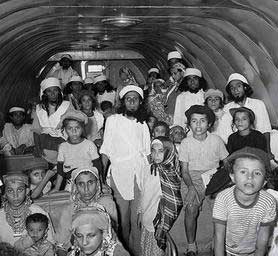
In May 1949, after the Imam of Yemen agreed to allow most of the Jews in his country to leave, Israel and Jewish relief organizations launched Operation Magic Carpet, also known as Operation On Wings of Eagles. Nearly 49,000 Yemenite Jews, many of them children, were brought “home” to Israel between late 1948 and September 1950. Before boarding the planes, many had made extremely dangerous journeys from across Yemen to the British-controlled port city of Aden, often arriving sick, exhausted, and destitute. This was one of the most extraordinary and complex immigration operations the state has ever known. The operation was kept secret and was released to the media only after it had been completed.
The Jews were airlifted from Aden to Israel on hundreds of flights. Earlier accounts referred generally to British and American planes, but the reality was more complex. Because Israeli aircraft could not openly land in hostile Arab territory, the rescue effort relied heavily on foreign aircraft, foreign markings, and non-Israeli crews. Alaska Airlines played a central role in the Yemenite airlift, using DC-4 and C-46 aircraft, while other planes involved in the broader rescue of Jews from Arab and Muslim countries operated under foreign registration or markings.
A lesser-known element of the operation involved Intercontinental Aerea de Cuba, a Cuban airline company associated with Colonel Narciso Roselló Otero of the Cuban Red Cross. According to family testimony and aviation records, Colonel Matthew “Nat” Kohn, an American who had served in World War II and later assisted Israel’s fledgling air force, asked Roselló to help form an airline that could be used in the rescue effort. The planes, including DC-4 and C-46 aircraft, were painted or registered under Cuban markings because Arab countries would not allow Israeli aircraft, and in some cases would not allow openly American aircraft, to land for this purpose. The crews reportedly included American and British pilots operating under Cuban cover. The planes were inspected in Rome before being approved for use.
This arrangement was part of the broader rescue of Jews from Arab and Muslim countries between 1949 and 1952, including Yemen, Iraq, Iran, and other transit points. The flights reportedly included one or two daily flights to Tehran, four to six flights to Baghdad, and occasional flights connected to Yemen, depending on conditions and permissions. The use of foreign aircraft and disguised markings reflected the urgency and sensitivity of the operation: Jews had to be evacuated from countries that were often hostile to Israel and would not permit an openly Israeli rescue mission.
The year 1949 saw massive waves of immigration to Israel. Some 250,000 Jews arrived that year alone and were placed first in military barracks and tent camps, and later moved to ma’abarot, or transit camps. The young state nearly collapsed under the burden. Calculations made that year showed that Israel needed roughly $3,000 to absorb each immigrant — an enormous sum for a country with very limited resources, meaning the overall cost of absorbing that year’s immigrants ran into the hundreds of millions of dollars. Yet, despite everything, Israel was willing to do what was necessary to absorb the immigrants, believing that this was one of the central reasons for the state’s establishment.
Sources: Nissim Mishal, Those Were The Years...Israel's 50th, p. 31; Israeli Foreign Ministry. Photo from the National Photo Collection.
Inputs from A. Trujillo Newtell.