
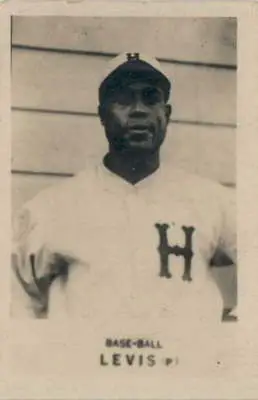
Oscar Joseph Levis (1898–1983), born Oscar Joseph Levy and also known as “Chick” and “Oscal,” was a Jamaican-born Jewish baseball pitcher who played in the Negro Leagues and Cuba. He was born on August 7, 1898, in Oracabessa, Jamaica, to Amos DaCosta Levy and Theodosia Elizabeth Foreman. His father was a Jewish merchant and member of Jamaica’s Legislative Council, with Sephardic ancestry that stretched through the Caribbean to Portugal. His mother was a Black Jamaican dressmaker.
Levis grew up in Panama, where he played baseball before moving to the United States in 1918. He worked at the Newark Bay Shipyard and subsequently as a chauffeur in Manhattan. In 1921, he joined Alex Pómpez’s eastern Cuban Stars, a Black professional team. A right-handed sidearm pitcher known for his spitball and curve, Levis played during an era when racial segregation barred Black players from the white major leagues.
He began playing winter baseball in Cuba with Almendares in 1922–1923, later pitching for Habana and Marianao. On October 11, 1924, he threw a no-hitter for Habana against Almendares. Fans selected him for an All-Eastern team in 1925. In 1926, the Brooklyn Citizen identified him as a “Spanish Jew.” Another 1927 article discussed his ability to pitch for the New York Giants while highlighting the racial barrier that prevented him from doing so.
In the 1927–1928 Cuban season, Levis went 7–2 for the champion Habana club and finished second in strikeouts to Willie Foster. He pitched for Pennsylvania’s Hilldale Daisies in 1930 and 1931. In 1933, he began managing a revived Cuban Stars team in New York’s semiprofessional circuit, continuing through 1937. Fluent in English and Spanish, he helped recruit and manage Latin American players. A 1934 Brooklyn Times Union report again noted his Jewish ancestry.
In 1936, Levis and his wife, Lovana, opened Chick’s Bar and Grill in Harlem. He became chairman of the Harlem Riverside Tavern Owners Association, supported local charitable institutions, and organized interracial amateur boxing. He also chaired the Jackie Robinson Day Committee and presented Robinson with gifts from supporters. Levis later moved to Virginia and died in Norfolk on May 24, 1983, aged 84.
In 2018, historian Gary Ashwill used immigration, census, and birth records to establish Levis’s Jamaican birthplace, correcting longstanding descriptions of him as Panamanian or Cuban. MLB recognized seven Negro Leagues as major leagues in 2020 and added their statistics to its historical record in 2024.
In October 2026, researcher Zachary Kranc publicized findings documenting Levis’s Jewish identity. Drawing on Jamaican civil and synagogue records, historical newspapers, and interviews with relatives, Kranc traced his paternal family’s connection to Jamaica’s Jewish community. Family members confirmed that Levis knew his Jewish heritage and took pride in it. The research also connected the earlier newspaper references, showing that his Jewish identity was publicly recorded during his career but largely omitted from later accounts of Jewish baseball history.
Sources: Gary Ashwill, “A Negro Leaguer from Jamaica,” Agate Type, (October 3, 2018).
Zachary Kranc, “Oscar Levis,” Society for American Baseball Research, (July 1, 2026).
“MLB officially designates the Negro Leagues as ‘Major League,’” MLB, (December 16, 2020).
“What to know about Negro Leagues stats entering MLB record,” MLB, (May 29, 2024).
Zachary Kranc, “The discovery of a Jewish Negro League star forces a rewrite of Jewish baseball history,” JTA, (October 23, 2026).
Photo: Aguilitas Cigarettes, Public domain, via Wikimedia Commons.