
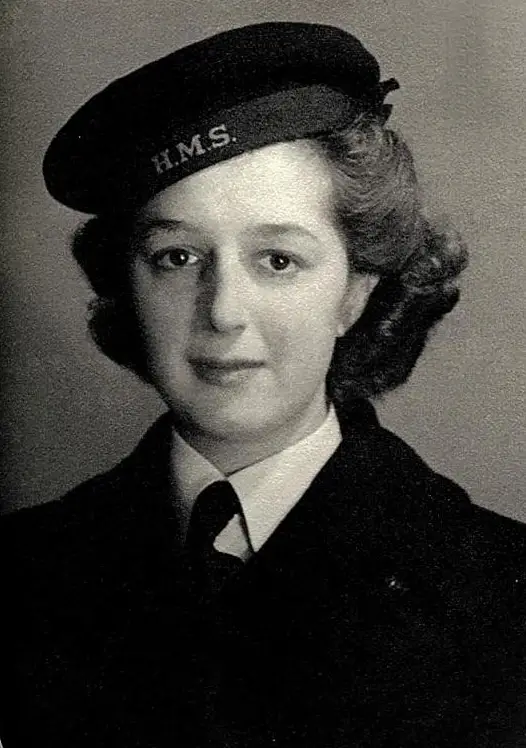
Ruth Bourne was born in Salford, Manchester, in 1926, to Dr Isaac Henry (formerly Isaacson) of Dublin and Sarah, nee Pollecoff, who was from North Wales. After some time in Birmingham, the family evacuated to North Wales in 1939, on the outbreak of war, where Ruth attended Caernarvon County High School until 1944. She then immediately joined the WRENS from the 6th Form at 18 years old at a recruiting office in Birmingham. She was posted to the Tulliechewan Estate Royal Navy Camp near Loch Lomond, Scotland, for square bashing, floor scrubbing, and formal training, as 78519 WREN R. Henry. Very little of the estate and buildings survives today.
Here she was categorised for special duties and told it would be secret work with no chance of promotion, long working hours, and once ‘in’ she could not come ‘out’. Ruth agreed to this and was obliged to sign the ‘Official Secrets Act’, at which point she was told the work explicitly involved the breaking of German codes. She was sent to Bletchley Park (BP) for a very brief time, but permanently worked at a ‘Bombe’ outstation of Bletchley Park, at Lime Grove, Eastcote, in west London (for the WRENS serving there, it was code-named HMS Pembroke V), & later at Stanmore. These outstations were also sites for Britain’s code-breakers during WW2; in this case, only staffed by WRENs, and Ruth lived on-site in custom-built barracks. Ruth’s role, with others, was to operate the ‘Bombe’ machines. Alan Turing initially designed these to decipher the equivalent of 36 ‘Enigma’ machines - sometimes in as little as 15 minutes - which the Germans used to send secret messages. These decrypts were then sent to Hut 6 at Bletchley for interpretation and onward dispatch to leaders at the battle fronts.
Ruth was responsible, with many others, for fixing the circuits and changing the drums on the ‘Bombes’, which mimicked the ‘Enigma’ rotors. It was pressurised, demanding labour that required complete accuracy. Hundreds of ‘Bombe’ operators worked 8-hour shifts, 24 hours a day. (Some ‘Bombe’ machines were located in nearby outstations where Ruth was posted, as well as at BP). Unscrambled messages were sent to linguists for translation, and officials then decided how the information should be used.
As with most Jewish veterans, Ruth did overhear quite a bit of anti-Semitism; for example, after returning from a social event at the Balfour Club, when asked about the visit, two WRENs opined that ‘you would not have liked it; it was full of Jews.’
Overall, about 8,000 people were involved in codebreaking, with 4,000 support staff. At the end of the war, Winston Churchill ordered that the ‘Bombe’ machines be dismantled, and Ruth found herself destroying the machines she had spent so long working with. It has been universally acknowledged that the intelligence produced by BP shortened the war by 2 to 4 years. However, after decades of secrecy, the contribution of all those at BP has now been widely publicised (see ‘Jews at Bletchley Park’ by Martin Sugarman).
In December 1946, Ruth was demobbed and married Stephen Benetall, aka Blumental, a Czech serving in the RAF, at the West London Synagogue. The couple had two sons, John and David (who pre-deceased her). Later, she and Stephen separated, and she changed her name to Bourne.
After the war, Eastcote remained as part of the MoD but was finally sold off and is now a housing estate called Pembroke Park in honour of its wartime use.
In civilian life, Ruth opened and ran a launderette in north London, wryly commenting, “there I was sitting in front of 12 machines with the drums going round - it literally was a home from home.” She later trained in the 1960s at London University, as a Special Needs teacher for children, and as a Bereavement and Family Counsellor in the Jewish Community. But Ruth never lost her connection with BP and was a volunteer tour guide there for 24 years. She demonstrated a rebuilt ‘Bombe’ machine to ever-increasing visitor numbers to the museum and met the Queen in 2011 when she came to unveil a long-overdue memorial. In 2009, the Government finally recognised the contribution made by presenting Ruth and other surviving BP veterans with a commemorative badge engraved with the words 'We also Served’. She was also awarded the Legion d’honneur from France, met other Royals, was interviewed on the BBC during the British Legion commemorations at the Albert Hall in 2019, and gave talks on her wartime work at the Jewish Museum, on Saga cruises, and for various charities. She donated her WREN cap several years ago to the Jewish Military Museum.
Bourne died on December 19, 2025, at the age of 99, and was the last Jewish member of the Bletchley Park code-breaking staff who worked there in WW2.
Source: Research by Martin Sugarman (AJEX Archivist and Author).