
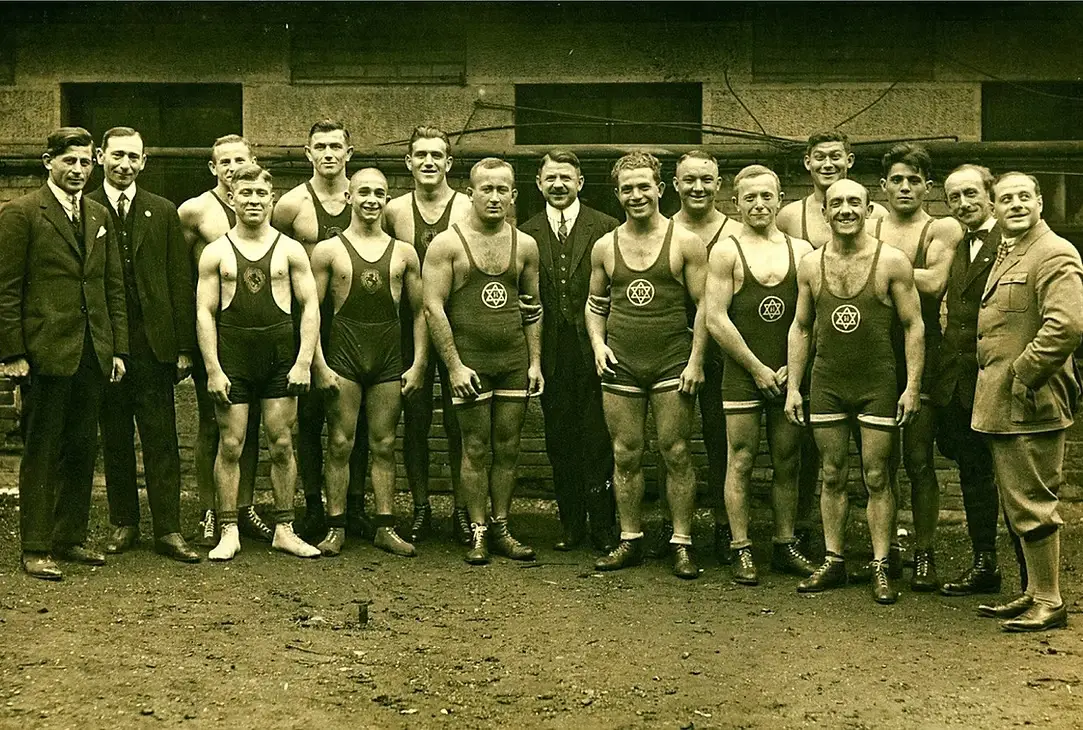
Long before soccer became an American sport, it survived in the United States largely through immigrant communities. Among the groups that helped keep the game alive were Jewish athletes, club owners, promoters, administrators, and refugee organizations. Their role was not to invent American soccer, which also had deep roots among British, Irish, German, Italian, and other immigrants, but to help make the sport visible, organized, and durable during decades when it struggled for national attention.
One of the most important early figures was Nathan “Nat” Agar, a Jewish soccer organizer, player, manager, and owner in Brooklyn. Agar was associated with the Brooklyn Wanderers, one of the leading clubs in the American Soccer League, and helped arrange visits by foreign teams at a time when international exhibitions were among the best ways to attract American crowds. His most consequential achievement was helping bring the all-Jewish Hakoah Vienna team to the United States in the 1920s.
Hakoah Vienna was founded in Austria in 1909 as a Jewish sports club, part of a broader movement to foster Jewish physical strength and pride at a time when Jews were often excluded from European sports clubs. Its name, Hakoah (הכוח), means “the strength” in Hebrew. The club became a symbol of Jewish athletic achievement, particularly after its soccer team won the Austrian championship in 1925.
When Hakoah Vienna arrived in New York in April 1926, it was treated not merely as a visiting soccer club but as a Jewish communal event. The team was welcomed by Congressman Emanuel Celler and received at City Hall by Mayor Jimmy Walker. President Calvin Coolidge also received a delegation from the club, whose representatives described Hakoah’s mission as the physical development of Jewish youth in Europe.
The tour became a landmark in American soccer history. On May 1, 1926, Hakoah played at the Polo Grounds in New York before about 46,000 spectators, one of the largest soccer crowds the United States had seen to that point. The attraction was not only the quality of the visiting team but also its Jewish identity. In a city with a large Jewish population, Hakoah’s appearance turned a soccer match into a mass ethnic and communal occasion.
The tour had lasting consequences because several Hakoah players remained in the United States. Among them was Erno Schwarz, a Hungarian-born player who became one of the most influential administrators in American soccer. Others, including Bela Guttmann and Moritz Haeusler, also became part of the American soccer scene. Their arrival strengthened American professional soccer and linked the domestic game to European traditions.
Hakoah returned to the United States in 1927 for a second tour. Agar, who owned the Brooklyn Wanderers, helped arrange the visit and emphasized its importance to the sport’s growth. The tour also produced another milestone: a June 1927 match at the Polo Grounds that became the first professional soccer game played at night under lights in the United States.
The legacy continued through New York Hakoah, a club formed by former Hakoah Vienna players. In 1929, New York Hakoah won the National Challenge Cup, now known as the U.S. Open Cup, giving Jewish soccer in America one of its most prominent championships. The Hakoah name became part of the history of the American Soccer League, which then served as one of the country’s most important professional soccer institutions.
Jewish involvement in American soccer did not end with the interwar period. In the 1930s and 1940s, German-Jewish refugees and other Jewish immigrants helped maintain a lively soccer culture in New York. The New World Club, founded by German-Jewish émigrés, fielded a soccer team and was connected to Aufbau, the major German-Jewish émigré newspaper. Jewish teams competed in immigrant leagues alongside Italian, Irish, German, and other clubs, and fields such as the Sterling Oval in the Bronx became important gathering places for soccer and immigrant life.
After World War II, the Jewish soccer tradition continued through New York Hakoah and related clubs. One of the most important later figures was Kurt Lamm, a German-born Jewish immigrant who coached New York Hakoah to American Soccer League championships in the late 1950s and later served as president of the ASL and general secretary of the U.S. Soccer Federation. His career showed how Jewish immigrants moved from ethnic club soccer into national soccer administration.
Jewish influence also appeared in later chapters of American soccer. Eddy Hamel, a New York-born Jewish winger, became the first American to play for Ajax Amsterdam in 1922 and later was murdered at Auschwitz in 1943. In the 1970s, Steve Ross, born Steven Rechnitz, helped transform the North American Soccer League by bringing Pelé to the New York Cosmos. Herman Sarkowsky co-founded the Seattle Sounders. Alan Rothenberg, as president of the U.S. Soccer Federation and head of the 1994 World Cup organizing committee, helped bring the World Cup to the United States and laid the groundwork for Major League Soccer. Robert Kraft later became one of the owners whose financial commitment helped MLS survive its early years, and he chaired the United Bid Committee that helped secure the 2026 World Cup for the United States, Canada, and Mexico.
There were also Jewish players and executives whose stories reflected the many sides of American soccer. Jeff Agoos, one of the most accomplished Jewish American players, earned 134 appearances for the U.S. men’s national team. Chuck Blazer became a powerful soccer executive and later a central witness in the FIFA corruption investigations. More recently, Jewish players such as Jonathan Bornstein, Benny Feilhaber, Kyle Beckerman, DeAndre Yedlin, Yael Averbuch West, and Matt Turner have been part of the American soccer story.
Unlike baseball, basketball, or boxing, soccer never became known as a central arena of Jewish achievement in the United States. Yet Jewish players, promoters, owners, and administrators helped attract crowds, import talent, build clubs, sustain leagues, and preserve the sport during periods when it remained outside the American mainstream. Their story is part of the larger history of how immigrant communities carried soccer in America before it became a national game.
Sources: “Pres. Coolidge Receives Delegation of Hakoah,” Jewish Telegraphic Agency, (April 12, 1926).
“Hakoah Soccer Team Arrives in United States,” Jewish Telegraphic Agency, (April 19, 1926).
“Viennese Hakoah Team to Come to U.S. on Second Soccer Tour,” Jewish Telegraphic Agency, (November 1, 1926).
“The History of the Vienna Hakoah,” SC Hakoah Vienna.
Roger Allaway, “Hakoah Left Its Mark on America,” Society for American Soccer History, March 1, 2023.
“Erno Schwarz,” National Soccer Hall of Fame.
“Kurt Lamm,” National Soccer Hall of Fame.
“Showdown at the Sterling Oval: 1942,” Leo Baeck Institute, November 1, 2014.
Dan Friedman, “At the Dawn of the World Cup, the Story of the Jews Who Helped Bring Soccer to America,” Forward, June 10, 2026.
Photo: Vienna HaKoah. Credit: SC Hakoah Vienna.