
UN Watch’s May 2026 special report argues that the UN Human Rights Council’s Special Procedures system, once described as the “crown jewel” of UN human rights work, has been weakened by politicized appointments, anti-Western ideological bias, disproportionate targeting of Israel, poor evidentiary standards, opaque funding, and inadequate accountability. The report profiles 13 mandate-holders and claims many use their UN authority not as neutral experts but as ideological advocates, amplifying selective narratives against democratic states while minimizing abuses by authoritarian regimes.
The following is an executive summary of the report. For the full report, click here.
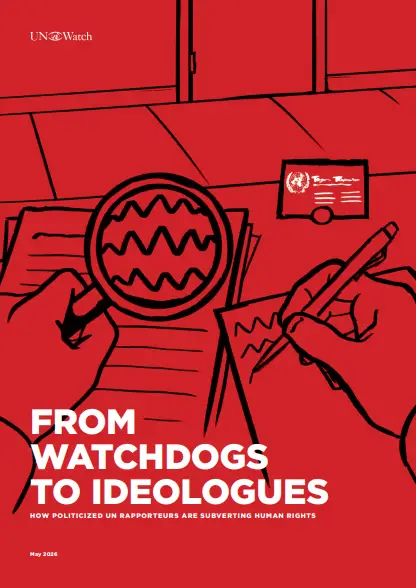
UN Watch’s May 2026 special report argues that the UN Human Rights Council’s Special Procedures system has drifted far from its intended role as an independent human rights mechanism. The report says mandate-holders, including Special Rapporteurs, are treated by courts, governments, media outlets, universities, and NGOs as authoritative UN experts, even though many now allegedly use that authority to promote ideological agendas rather than impartial human rights analysis.
UN Watch identifies several structural problems: politicized appointments, the expansion and dilution of mandates, weak evidentiary standards, limited financial transparency, donor influence, institutional pressure from OHCHR, and almost no accountability for misconduct or bias.
The report’s central claim is that these weaknesses have enabled some rapporteurs to disproportionately target Western democracies, especially the United States and Israel, while giving far less scrutiny to authoritarian regimes such as China, Russia, Iran, Cuba, Venezuela, Syria, and Qatar.
It also argues that since Hamas’s October 7 attack, UN experts have issued an unusually high number of statements against Israel compared with other major conflicts, often using language that UN Watch says denies Israel’s right to self-defense, minimizes Hamas’s crimes, or legitimizes anti-Israel activism.
Through profiles of 13 mandate-holders, the report portrays the system as one in which UN platforms can “launder” selective, unverified, or politicized claims into globally influential human rights discourse. UN Watch concludes that the Special Procedures mechanism requires major reforms to restore credibility, including stricter appointment standards, greater transparency in funding, stricter evidentiary rules, clearer professional conduct requirements, and real consequences for mandate-holders who violate impartiality or misuse their UN role.
Source: “From Watchdogs to Ideologues: How Politicized UN Repporteurs are Subverting Human Rights,” UN Watch, (May 26, 2026).