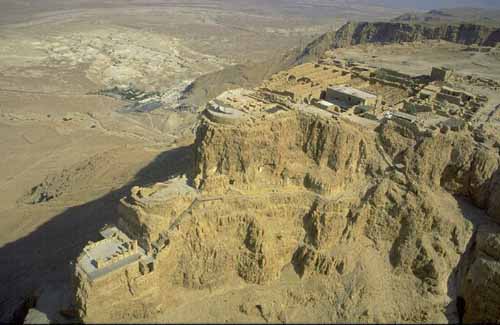
Masada Desert Fortress
Masada (Hebrew for fortress) is a place of gaunt and majestic beauty that has become one of the Jewish people's greatestsymbols as the place where the last Jewish stronghold against Roman invasion stood. Next to Jerusalem, it is the most popular destination of tourists visiting Israel.
More than two thousand years have passed since the fall of the Masada fortress yet the regional climate and its remoteness have helped to preserve the remains of its extraordinary story.
Geography
Masada is located atop an isolated rock cliff at the western end
of the Judean Desert overlooking the Dead Sea.
On the east side, the rock falls in a sheer drop of about 450
meters to the Dead Sea and on the western edge it stands about 100 meters above the surrounding
terrain. The natural approaches to the cliff top are very difficult.
History
The only written source about Masada is Josephus Flavius’ The
Jewish War. Born Joseph ben Matityahu into a priestly family, Flavius was a
young leader at the outbreak of the Great
Jewish Rebellion against Rome (66
CE) when he was appointed governor of Galilee. Calling himself Josephus Flavius, he became a Roman citizen and a
successful historian.
According to Flavius, Herod the Great built the
fortress of Masada between 37 and
31 BCE. Herod, an Idumean, had been made King of Judea by his Roman
overlords and
“furnished this fortress as a refuge for himself.” It included a
casemate wall around the plateau, storehouses, large cisterns ingeniously
filled with rainwater, barracks, palaces and an armory.
Some 75 years after Herod’s death, at the beginning of
the Revolt of the Jews against the Romans in 66 CE, a group of Jewish
rebels overcame the Roman garrison of Masada.
After the fall of Jerusalem and
the destruction of the Temple (70
CE) they were joined by zealots and their families who had fled from Jerusalem. There, they held out for
three years, raiding and
harassing the Romans.
Then, in 73 CE, Roman governor
Flavius Silva marched against Masada with the Tenth Legion, auxiliary units and thousands of Jewish
prisoners-of-war. The Romans established camps at the base of Masada, laid siege to it and built a
circumvallation wall. They then constructed a rampart of thousands of tons
of stones and beaten earth against the western approaches of the fortress
and, in the spring of 74 CE, moved a battering ram up the ramp and
breached the wall of the fortress.
Once it became apparent that the Tenth Legion's
battering rams and catapults would succeed in breaching Masada's
walls, Elazar ben Yair - the Zealots’ leader - decided that all the Jewish
defenders should commit suicide; the alternative facing the fortress’s defenders were
hardly more attractive than death.
Flavius dramatically recounts the story told
him by two surviving women. The defenders – almost one thousand men,
women and children – led by ben Yair, burnt down the fortress and killed each other. The Zealots cast lots to choose 10 men to kill the
remainder. They then chose among themselves the one man who would kill the
survivors. That last Jew then killed himself.
Elazar’s final speech clearly
was a masterful oration:
"Since we long ago resolved never to be servants to the Romans, nor to any other than to God Himself, Who alone is the true and just Lord of mankind, the time is now come that obliges us to make that resolution true in practice ...We were the very first that revolted, and we are the last to fight against them; and I cannot but esteem it as a favor that God has granted us, that it is still in our power to die bravely, and in a state of freedom."
The story of Masada survived in the writings of
Josephus but not many Jews read his works and for well over fifteen
hundred years it was a more or less forgotten episode in Jewish history.
Then, in the 1920's, Hebrew writer Isaac Lamdan wrote
"Masada," a poetic history of the anguished Jewish fight against
a world full of enemies. According to Professor David Roskies, Lamdan's
poem, "later inspired the uprising in the Warsaw Ghetto."
The heroic story of Masada and its dramatic end attracted many explorers to the Judean desert in
attempts to locate the remains of the fortress. The site was identified in
1842, but intensive excavations took place only in the mid-1960's with the help
of hundreds of enthusiastic volunteers from Israel and from many foreign
countries.
To
many, Masada symbolizes the determination of the Jewish
people to be free in its own land.
Herodian Fortress
The rhomboid, flat plateau of Masada measures 600 x 300 m. The
casemate wall (two parallel walls with partitions dividing the space
between them into rooms), is 1400 m. long and 4 m. wide. It was built along
the edge of the plateau, above the steep cliffs, and it had many towers.
Three narrow, winding paths led from below to fortified gates. The water
supply was guaranteed by a network of large, rock-hewn cisterns on the
northwestern side of the hill. They filled during the winter with rainwater
flowing in streams from the mountain on this side. Cisterns on the summit
supplied the immediate needs of the residents of Masada and could be relied upon in
time of siege.
To maintain interior coolness in the hot and dry climate
of Masada, the many buildings of
various sizes and functions had thick walls constructed of layers of hard
dolomite stone, covered with plaster. The higher northern side of Masada was densely built up with
structures serving as the administrative center of the fortress and
included storehouses, a large bathhouse and comfortable living quarters for
officials and their families.
King Herod's Residential Palace
On the
northern edge of the steep cliff, with a splendid view, stood the elegant,
intimate, private palace-villa of the king. It was separated from the
fortress by a wall, affording total privacy and security. This northern
palace consists of three terraces, luxuriously built, with a narrow,
rock-cut staircase connecting them. On the upper terrace, several rooms
served as living quarters; in front of them is a semi-circular balcony with
two concentric rows of columns. The rooms were paved with black and white
mosaics in geometric patterns.
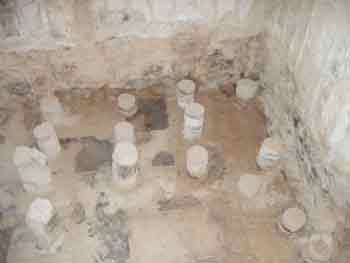 Remains of the Masada bathhouse
 |
The two lower terraces were intended for entertainment
and relaxation. The middle terrace had two concentric walls with columns,
covered by a roof; this created a portico around a central courtyard. The
lowest, square terrace has an open central courtyard, surrounded by
porticos. Its columns were covered with fluted plaster and supported
Corinthian capitals. The lower parts of the walls were covered in frescos
of multicolored geometrical patterns or painted in imitation of cut marble.
On this terrace was also a small private bathhouse. Here, under a thick
layer of debris, were found the remains of three skeletons, of a man, a
woman and a child. The beautifully braided hair of the woman was preserved,
and her sandals were found intact next to her; also hundreds of small,
bronze scales of the man’s armor, probably booty taken from the Romans.
The Storehouse Complex
This consisted of two rows of long halls opening onto a central corridor.
The floor of the storerooms was covered with thick plaster and the roofing
consisted of wooden beams covered with hard plaster. Here, large numbers of
broken storage jars which once contained large quantities of oil, wine,
grains and other foodstuffs were found.
The Large Bathhouse
Elaborately built, it probably served the guests and senior officials of Masada. It consisted of a large
courtyard surrounded by porticos and several rooms, all with mosaic or
tiled floors and some with frescoed walls. The largest of the rooms was the
hot room (caldarium). Its suspended floor was supported by rows of
low pillars, making it possible to blow hot air from the furnace outside,
under the floor and through clay pipes along the walls, to heat the room to
the desired temperature.
The Western Palace
This is
the largest building on Masada,
covering over 4,000 square meters (one acre). Located along the center of
the western casemate wall, near the main gate towards Judea and Jerusalem,
it served as the main administration center of the fortress, as well as the
king’s ceremonial palace. It consists of four wings: an elaborate royal
apartment, a service and workshop section, storerooms and an administrative
unit. In the royal apartment, many rooms were built around a central
courtyard. On its southern side was a large room with two Ionic columns
supporting the roof over the wide opening into the courtyard. Its walls
were decorated with molded panels of white stucco. On the eastern side were
several rooms with splendid colored mosaic floors. One of these, the
largest room, has a particularly decorative mosaic floor with floral and
geometric patterns within several concentric square bands. This room may
have been King Herod’s throne room, the seat of authority when he was in
residence at Masada.
Stronghold of the Zealots
 Remains of the Masada Synagogue
 |
The synagogue, part of the
Herodian construction, was a hall measuring 12.5 x 10.5 m., incorporated
into the northwestern section of the casemate wall and oriented towards
Jerusalem. This synagogue also served the Jews who lived in Masada during the Revolt. They built
four tiers of plastered benches along the walls, as well as columns to
support its ceiling. This synagogue is considered to be the best example of
the early synagogues, those predating the destruction of the Temple of
Jerusalem in 70 CE.
An ostracon bearing the inscription me'aser kohen (tithe for the priest) was found in the synagogue. Also, fragments of two
scrolls, parts of Deuteronomy and Ezekiel 37 (including the vision of the
"dry bones"), were found hidden in pits dug under the floor of a
small room built inside the synagogue.
Among the many
small finds of artifacts – most from the occupation period of the zealots – were
pottery and stone vessels, weapons (mainly arrowheads), remnants of
textiles and of foodstuffs preserved in the dry climate of this area; also
hundreds of pottery sherds, some with Hebrew lettering, coins and shekels.
Of special interest among the postherds of amphora used
for the importation of wine from Rome (inscribed with the name C. Sentius
Saturninus, consul for the year 19 BCE), is one bearing the inscription: To
Herod King of the Jews Several hoards of bronze coins and dozens of silver shekels and half-shekels had been hidden by the zealots; the shekalim were found in superb condition and represent all the years of the Revolt,
from year one to the very rare year 5 (70 CE), when the Temple was
destroyed.
In the area in front of the northern palace, eleven
small ostraca were uncovered, each bearing a single name. One reads "ben
Yai’r" and could be short for Eleazar ben Ya’ir, the commander of
the fortress. It has been suggested that the other ten names are those of
the men chosen by lot to kill the others and then themselves, as recounted
by Josephus.
Evidence of a great conflagration were found everywhere.
The fire was pobably set by the last of the zealots before they committed
suicide. Josephus Flavius writes that everything was burnt except the
stores – to let the Romans know that it was not hunger that led the
defenders to suicide.
Sources: Israeli Foreign Ministry; Joseph Telushkin Jewish Literacy, NY: William Morrow and Co., 1991. Reprinted by permission
of the author. Masada photo courtesy of the Israeli Ministry of Tourism. All rights reserved to Itamar Greenberg and to the Ministry of Tourism.
|