Background & Overview
(1947 - 1949)
Background
Violence in the Holy Land broke out almost immediately
after the United Nations announced partition on November 29, 1947. Jamal Husseini, the Arab Higher Committee's
spokesman, had told the UN prior to the partition vote the Arabs would
drench "the soil of our beloved country with the last drop of our
blood."1
Husseini's prediction began to come true after the
UN announcement. The Arabs declared a protest strike and instigated
riots that claimed the lives of 62 Jews and 32 Arabs. By the end of
the second week, 93 Arabs, 84 Jews and 7 Englishmen had been killed
and scores injured. From November 30-February 1, 427 Arabs, 381 Jews
and 46 British were killed and 1,035 Arabs, 725 Jews and 135 British
were wounded. In March alone, 271 Jews and 257 Arabs died in Arab attacks
and Jewish counterattacks.2
The chairman of the Arab Higher Committee said the
Arabs would "fight for every inch of their country."3 Two days later, the holy men of Al-Azhar University in Cairo called on the
Muslim world to proclaim a jihad (holy war) against the Jews.4
The first large-scale assaults began on January 9,
1948, when approximately 1,000 Arabs attacked Jewish communities in
northern Palestine. By February, the British said so many Arabs had
infiltrated they lacked the forces to run them back.5 In fact,
the British turned over bases and arms to Arab irregulars and the Arab
Legion.
The Arab Invasion
 |
In the first phase of the war, lasting from November
29, 1947 until April 1, 1948, the Palestinian Arabs took the offensive,
with help from volunteers from neighboring countries. The Jews suffered
severe casualties and passage along most of their major roadways was
disrupted.
On April 26, 1948, Transjordan's King Abdullah said:
[A]ll our efforts to find a peaceful solution to the
Palestine problem have failed. The only way left for us is war. I will
have the pleasure and honor to save Palestine.7
On May 4, 1948, the Arab Legion attacked Kfar Etzion.
The defenders drove them back, but the Legion returned a week later. After
two days, the ill-equipped and outnumbered settlers were overwhelmed. Many
defenders were massacred after they had surrendered.6 This was
prior to the invasion by the regular Arab armies that followed Israel's declaration
of independence.
Arabs Take Responsibility
The UN blamed the Arabs for the violence. The UN
Palestine Commission was never permitted by the Arabs or British to go to
Palestine to implement the resolution. On February 16, 1948, the
Commission reported to the Security Council:
Powerful Arab interests, both inside and outside
Palestine, are defying the resolution of the General Assembly and are
engaged in a deliberate effort to alter by force the settlement
envisaged therein.8
The Arabs were blunt in taking responsibility for
starting the war. Jamal Husseini told the Security Council on April 16,
1948:
The representative of the Jewish Agency told us
yesterday that they were not the attackers, that the Arabs had begun the
fighting. We did not deny this. We told the whole world that we were
going to fight.9
The British commander of Jordan's Arab Legion, John
Bagot Glubb admitted:
Early in January, the first detachments of the Arab
Liberation Army began to infiltrate into Palestine from Syria. Some came
through Jordan and even through Amman . . . They were in reality to
strike the first blow in the ruin of the Arabs of Palestine.10
Despite the disadvantages in numbers, organization
and weapons, the Jews began to take the initiative in the
weeks from April 1 until the declaration of independence
on May 14. The Haganah captured several major towns including Tiberias and Haifa,
and temporarily opened the road to Jerusalem.
The partition resolution was never suspended
or rescinded. Thus, Israel, the Jewish State in Palestine,
was born on May 14, as the British finally left the country.
Five Arab armies (Egypt, Syria, Transjordan, Lebanon and
Iraq) immediately invaded Israel. Their intentions were declared
by Azzam Pasha, Secretary-General of the Arab League: "It will be a war of annihilation. It will be a momentous massacre in history that will be talked about like the massacres of the Mongols or the Crusades."11
Superpowers Recognize Israel

Military Situation On Effective Date of Cease-Fire (June 11, 1948)
|
The United States, the Soviet Union and most other
states immediately recognized Israel and indicted the Arabs. The United
States urged a resolution charging the Arabs with breach of the peace.
Soviet delegate Andrei Gromyko told the Security
Council, May 29, 1948:
This is not the first time that the Arab states,
which organized the invasion of Palestine, have ignored a decision of
the Security Council or of the General Assembly. The USSR delegation
deems it essential that the council should state its opinion more
clearly and more firmly with regard to this attitude of the Arab states
toward decisions of the Security Council.12
The initial phase of the fighting ended after the
Security Council threatened July 15 to cite the Arab governments for
aggression under the Charter. By this time, the Haganah had been renamed the Israel
Defense Forces (IDF) and succeeded in stopping the Arab offensive.
The Bernadotte Plan
During the summer of 1948, Count
Folke Bernadotte was sent by the UN to Palestine to mediate a truce
and try to negotiate a settlement. Bernadotte's
plan called for the Jewish State to relinquish the Negev and Jerusalem
to Transjordan and to receive the western Galilee. This was similar to the
boundaries that had been proposed prior to the partition vote, and had
been rejected by all sides. Now, the proposal was being offered after the
Arabs had gone to war to prevent partition and a Jewish state had been
declared. The Jews and Arabs both rejected the plan.
Ironically, Bernadotte found little enthusiasm among
the Arabs for independence. He wrote in his diary:
The Palestinian Arabs had at present no will of their
own. Neither have they ever developed any specifically Palestinian
nationalism. The demand for a separate Arab state in Palestine is
consequently relatively weak. It would seem as though in existing
circumstances most of the Palestinian Arabs would be quite content to be
incorporated in Transjordan.13
The failure of the Bernadotte scheme came as the Jews
began to have greater success in repelling the invading Arab forces and
expanding control over territory outside the partition boundaries.
The United States Holds Back Support
The Jews won their war of independence with minimal
help from the West. In fact, they won despite efforts to undermine their
military strength.
Although the United States vigorously supported the
partition resolution, the State Department did not want to provide the
Jews with the means to defend themselves. "Otherwise,"
Undersecretary of State Robert Lovett argued, "the Arabs might use
arms of U.S. origin against Jews, or Jews might use them against
Arabs."14 Consequently, on December 5, 1947, the U.S.
imposed an arms embargo on the region.
Many in the State Department saw the embargo as yet
another means of obstructing partition. President Truman nevertheless went
along with it hoping it would be a means of averting bloodshed. This was
naive given Britain's rejection of Lovett's request to suspend weapons
shipments to the Arabs and subsequent agreements to provide additional
arms to Iraq and Transjordan.15
The Arabs had no difficulty obtaining all the arms they
needed. In fact, Jordan's Arab Legion was armed and trained by the
British, and led by a British officer. At the end of 1948 and beginning of
1949, British RAF planes flew with Egyptian squadrons over the
Israel-Egypt border. On January 7, 1949, Israeli planes shot down four of
the British aircraft.16
The Jews, on the other hand, were forced to smuggle
weapons, principally from Czechoslovakia. When Israel declared its
independence in May 1948, the army did not have a single cannon or tank.
Its air force consisted of nine obsolete planes. Although the Haganah had 60,000 trained fighters, only 18,900 were fully mobilized, armed and
prepared for war.17 On the eve of the war, chief of operations Yigael
Yadin told David Ben-Gurion:
"The best we can tell you is that we have a 5050 chance."18
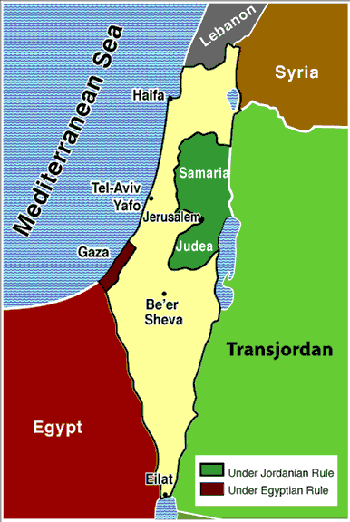
The Arab war to destroy Israel failed. Indeed, because
of their aggression, the Arabs wound up with less territory than they
would have had if they had accepted partition.
The cost to Israel, however, was enormous. "Many
of its most productive fields lay gutted and mined. Its citrus groves, for
decades the basis of the Yishuv's [Jewish community] economy, were largely
destroyed."19 Military expenditures totaled approximately
$500 million. Worse yet, 6,373 Israelis were killed, nearly one percent of
the Jewish population of 650,000.
Had the West enforced the partition resolution or given
the Jews the capacity to defend themselves, many lives might have been
saved.
Israel's longest war lasted 1 year 3 months and 10 days starting November 30, 1947. The Arab countries signed armistice agreements with
Israel in 1949, starting with Egypt (Feb. 24), followed by Lebanon (March
23), Jordan (April 3) and Syria (July 20). Iraq was the only country that
did not sign an agreement with Israel, choosing instead to withdraw its
troops and hand over its sector to Jordan's Arab Legion.
Sources: 1J.C. Hurewitz, The Struggle For Palestine, (NY:
Shocken Books, 1976), p. 308.
2Facts on File Yearbook, (NY: Facts on File, Inc.,
1948), p. 231.
3New York Times, (December 1, 1947).
4Facts on File 1948, p. 48.
5Facts on File 1947, p. 231.
6Netanel Lorch, One Long War, (Jerusalem: Keter
Books, 1976), p. 47; Ralph Patai, ed., Encyclopedia of Zionism and
Israel, (NY: McGraw Hill, 1971), pp. 307308.
7Howard Sachar, A History of Israel, (NY: Alfred A.
Knopf, 1979), p. 322.
8Security Council Official Records, Special Supplement,
(1948), p. 20.
9Security Council Official Records, S/Agenda/58, (April 16,
1948), p. 19.
10John Bagot Glubb, A Soldier with the Arabs,
(London: Staughton and Hodder, 1957), p. 79.
11“Interview with Abd al-Rahman Azzam Pasha,” Akhbar al-Yom (Egypt), (October 11, 1947); translated by R. Green.
12Security Council Official Records, SA/Agenda/77, (May 29,
1948), p. 2.
13Folke Bernadotte, To Jerusalem, (London: Hodder and
Stoughton, 1951), p. 113.
14Foreign Relations of the United States 1947, (DC:
GPO, 1948), p. 1249. [Henceforth FRUS].
15Mitchell Bard, The Water's Edge and Beyond, (NJ:
Transaction Books, 1991), pp. 171175; FRUS, pp. 53739; Robert
Silverberg, If I Forget Thee O Jerusalem: American Jews and the State
of Israel, (NY: William Morrow and Co., Inc., 1970), pp. 366, 370;
Shlomo Slonim, "The 1948 American Embargo on Arms to Palestine," Political Science Quarterly, (Fall 1979), p. 500.
16Sachar, p. 345.
17Larry Collins and Dominique Lapierre, O Jerusalem!,
(NY: Simon and Schuster, 1972), p. 352.
18Golda Meir, My Life, (NY: Dell, 1975), pp. 213,
222, 224
19Sachar, p. 452.
|