SITES & INFORMATION:
Tiberias has been a popular destination for
tourists for more than 2,000 years.
As early as Roman times, this thriving recreation spa, built around 17 natural mineral hot
springs more than 600 feet below sea level, welcomed visitors from every
part of the ancient world. Built by Herod Antipas (one of Herod
the Great's three sons who divided up Palestine after their father's
death), the city was named Tiberias in honor of the Roman Emperor Tiberius.
History
Tiberias plays an important role in Jewish history. It
was part of the land bequeathed to Naphtali (Joshua 19:35). The Sanhedrin
(the High Court of Israel during the period of the Second Temple)
relocated to Tiberias from Sepphoris.
In the Mishnaic and Talmudic period, Tiberias was an important spiritual
center. The Mishna was completed in Tiberias in 200 C.E. under the supervision of Rabbi
Yehuda Ha-Nasi ("Judah the Prince"). The Jerusalem Talmud was compiled in 400 C.E.
After
his death in 1204, the great Jewish sage Maimonides was buried in Tiberias. His tomb is on Ben Zakkai Street, a short distance
from the town center. The street's namesake, Rabbi Yochanan
ben Zakkai, is also believed to be buried nearby. Yet another shrine is
the Tomb of Rabbi Akiva.
A Samaritan center existed in Tiberias in the middle of the 4th century. The Crusaders later captured the city and made it the capital of the Galilee, but Saladin
retook the city for the Muslim
Empire in 1187. The city suffered a decline until it was revived by the Ottoman Turks. After
the city was built up over a period of about a century, it was devastated
by an earthquake in 1837.
The early Zionist pioneers established some of Israel's first kibbutzim at the turn of the
century in this area. After the establishment
of the state, newcomers flocked to the city and the population
quadrupled. Today, it is home to about 30,000 people.
The Sea of Galilee
Tiberias
sits along the 32-mile shoreline of the Sea
of Galilee. The Sea lies roughly 650 feet below sea level and is 14
miles long and 7 1/2 miles wide at its widest point. The Sea is the major
source of fresh water for
the entire country. The Sea, really a lake, lies on the ancient "Via
Maris," a route that linked Egypt and Mesopotamia.
The New Testament contains several references to the lake, which is known alternatively as
the Sea of Galilee, Sea of Tiberias and the Sea of Gennesaret. This is
where Jesus calmed the stormy sea (Mathew 8) and walked on the water (Mathew 14).
Israel Fact
The Sea of Galilee
is shaped like a harp, kinnor in Hebrew, but this is not where
the name of the lake comes from. |
Israelis call the Sea by the biblical name Kinneret.
This was the name of a city on the northwestern edge of the lake during the
Canaanite and Israelite periods. The reference to the Sea of Tiberias is
attributable to the newer riparian city.
Beyond the Sea
Just
outside of Tiberias is the ancient town of Hammat,
which boasts the hottest (140º) mineral springs in Israel and has, not
surprisingly, become a popular spa. The town also has a synagogue built
in 341, that has a magnificent mosaic floor. It is unusual, in part, because
it contains human figures that are nude. This is rare because synagogues
rarely have human representations in them and, when they do, they are
fully clothed.
On the northeastern shore of the Sea of Galilee, you'll find
the ancient fishing village of Bethsaida,
the traditional home of Jesus' apostles Peter and Andrew. In this area,
the Jordan River and several streams from the Golan
Heights form a marshy delta that is home to a large variety of animals
and birds, especially water-fowl.
About six miles north of Tiberias, you can visit Kibbutz
Ginosar, the former home of one of Israel's great statesmen, Yigal Allon. The kibbutz has a museum devoted to Allon's life and the history of the Galilee region.
It also houses the so-called “Jesus boat,” a 2,000-year-old
boat excavated from the Kinneret in 1985 that was probably used at
the time of Jesus.
At the southern tip of the sea is Degania
Aleph, Israel's oldest kibbutz,
founded in 1909, and its nearby twin Degania
Bet (built in 1920). Degania Aleph was named after its spiritual
father, A.D. Gordon,
and later was the birthplace of Moshe
Dayan. Israeli Prime Minister Levi
Eshkol came from Degania Bet.
When the Arab
armies invaded Israel from the north in 1948, they ran over the
settlements farther north in the Golan, but were stopped by the defenders
of Degania Aleph. A French-made Syrian tank was left at the gate as a
memorial to the battle.
At the opposite bank of the sea, is the country's second
agricultural commune, Kibbutz Kinneret, which was established in
1911. Nearby is a cemetery, Ohalo, which not only is the final resting
place for many of the people from the kibbutz, but also some of Israel's
most famous personalities, including Rahel
Bluwstein (known simply as Rachel to most Israelis), Ber
Borochov and Moses Hess.
Sites of
Christian Pilgrimage
Two miles north of Tiberias
is the agricultural settlement of Migdal.
This is near the ancient town where Mary Magdalene
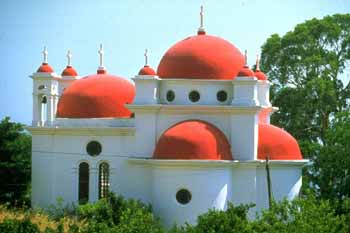
was born. Further north is the town of Tabgha,
one of many sites in the Galilee where Christians
of the early Byzantine period built monasteries, churches and shrines
to commemorate the ministry of Jesus and the
miracles ascribed to him. Tabgha is the traditional site of the Miracle
of the Multiplication of the Loaves and the
Fishes. (Matt.
14: 13-21). Nearby is the Mount of the Beatitudes.
An Italian convent now stands on the hill.
This is where Jesus is thought to have preached
the Sermon on the Mount, which begins:
And seeing the multitudes, he went up into a mountain:
and when he was set, his disciples came unto him: And he opened his
mouth, and taught them, saying, Blessed are the poor in spirit: for
theirs is the kingdom of heaven. (Matthew 5)
Standing on the church porch overlooking the Sea and the surrounding
hills makes for a powerful setting to recall the sermon.
About two miles south is Capernaum (Kfar Nahum), the lakeside town where Jesus preached, and his disciples,
Peter and Andrew lived. This is where Jesus told his followers, "Follow
me, and I will make you fishers of men." He spent three years based
here and performed many miracles, but was rejected by the townspeople, provoking
Jesus to curse them, "And thou, Capernaum, which art exalted unto Heaven,
shall be brought down to hell!"
The synagogue may be on the site where Jesus preached, but was built two or three
centuries later. We know it is a synagogue because of the Jewish symbols --
a menorah and a shofar
-- inscribed on one of the columns.
The Jordan River also passes near Kibbutz
Kinneret. Perhaps you have an image of the Jordan as a mighty body of
water like the Mississippi, an understandable expectation given its role
in history and scripture. In fact, it is more like a muddy stream that
is only a few feet wide in places. Since Jesus was baptized by John in
the river (near Jericho), it has become traditional for Christian pilgrims
to come to a special park along the river established as a baptism site.
Previous
Next
|