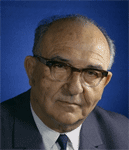
Levi Eshkol was an Israeli soldier, Zionist advocate and political statesman who served as the third Prime Minister of Israel.
Eshkol (born October 1895; died February 26, 1969) was born in the Ukrainian village of Oratovo
(near Kiev). He had a traditional Jewish upbringing and education
which continued when he entered a Hebrew high school in Vilna at the age of 16 and joined the Zionist group, "Tzeirei Tzion"
(Youth of Zion). In 1914, at the age of 19, he came to Palestine,
then still a part of the Ottoman Empire, where he worked as an
agricultural laborer and political activist.
During World War I, he volunteered for the Jewish Legion of the
British Army, and joined the group which founded the settlement
of Degania Beth.
Eshkol later worked in the Histadrut Labor Federation's Agricultural
Center. He participated in the establishment of "Mekorot,"
Israel's water utility, in 1937, and served as its chief executive
until 1951.
In 1940, he became a member of the Haganah, and in 1947 he organized
the recruiting drive for what became the Israel Defense Forces.
With the establishment of the State he became the first DirectorGeneral
of the Ministry of Defense, in effect the supplier of the material
which kept the Israeli army in the field. He also became the head
of the World Zionist Organization/Jewish Agency's Settlement Department
in 1948.
In 1951, Eshkol was appointed Minister of Agriculture and Development
and from 1952 until 1963 he served as Minister of Finance. He
remained Chairman of the WZO/JAFI Settlement Department until
1963. Eshkol is largely responsible for obtaining funds to develop
the country, absorb massive immigration waves and equip the army.
In June 1963, Eshkol assumed the post of Prime Minister. The high
point of his premiership was the Six Day War of June 1967. When Egypt and Syria precipitated the crisis, Eshkol established a
Government of National Unity, relinquishing the Defense portfolio
to Moshe Dayan and bringing Menachem Begin of Herut into the Cabinet.
Eshkol found other sources of military supplies for the Israeli
armed forces, particularly in the United States, after France began its military boycott of the Jewish state before the 1967
war. The war itself was a vindication of his efforts at the Ministry
of Defense to provide the IDF with the best equipment available.
In just six days, Israel succeeded in liberating Judea and Samaria, the Gaza Strip and the Golan Heights, reuniting Jerusalem, and capturing
the Sinai peninsula.
Eshkol died in office on February 26, 1969 of a heart attack. He was the first Israeli Prime Minister to die in office. In recognition of his service to the country, Eshkol National Park in Beersheba was named after him as well as the Ramat Eshkol neighborhood of Jerusalem. In 2005, he was voted the 86th-greatest Israeli of all time.