The Sykes-Picot Agreement
(1916)
The Sykes-Picot Agreement (officially the 1916 Asia Minor Agreement) was a secret agreement reached during World War I between the British and French governments pertaining to the partition of the Ottoman Empire among the Allied Powers. Russia was also privy to the discussions.
The first round of discussions took place in London on November 23, 1915 with the French government represented by François-Georges Picot, a professional diplomat with extensive experience in the Levant, and the British delegation led by Sir Arthur Nicolson. The second round of discussions took place December 21 with the British now represented by Sir
Mark Sykes, a leading expert on the East.
Having juxtaposed the desiderata of all the parties concerned - namely the British, the French and the Arabs - the two statesmen worked out a compromise solution. The terms of the partition agreement were specified in a letter dated May 9, 1916, which Paul Cambon, French ambassador in London, addressed to Sir Edward Grey, British foreign secretary. These terms were ratified in a return letter from Grey to Cambon on May 16 and the agreement became official in an exchange of notes among the three Allied Powers on April 26 and May 23, 1916.
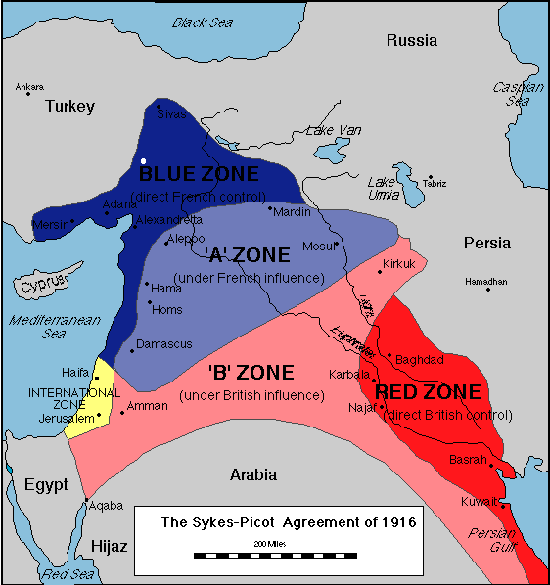
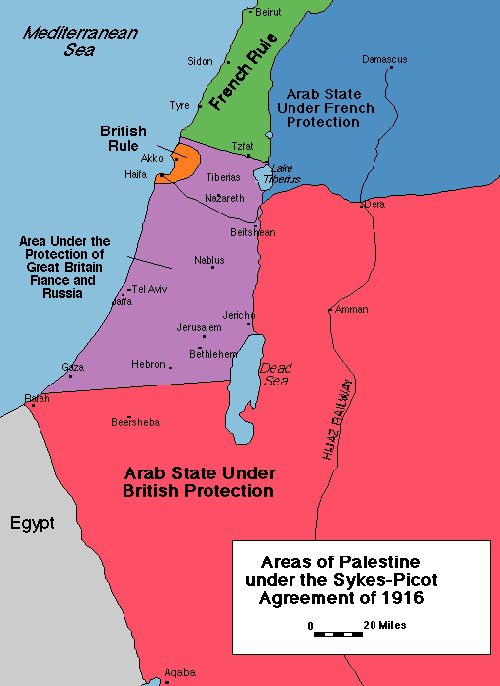
According to the agreement, France was to exercise direct control over Cilicia, the coastal strip of Syria, Lebanon and the greater part of Galilee, up to the line stretching from north of Acre to the northwest corner of the Sea of Galilee ("Blue Zone"). Eastward, in the Syrian hinterland, an Arab state was to be created under French protection ("Area A"). Britain was to exercise control over southern Mesopotamia ("Red Zone"), as well as the territory around the Acre-Haifa bay in the Mediterranean with rights to build a railway from there to Baghdad. The territory east of the Jordan River and the Negev desert, south of the line stretching from Gaza to the Dead Sea, was allocated to an Arab state under British protection ("Area B"). South of France's "blue zone," in the area covering the Sanjak of Jerusalem and extending southwards toward the line running approximately from Gaza to the Dead Sea, was to be under international administration ("Brown Zone").
In the years that followed, the Sykes-Picot Agreement became the target of bitter criticism both in France and in England. Lloyd George referred to it as an "egregious" and a "foolish" document. Zionist aspirations were also passed over and this lapse was severely criticized by William R. Hall, head of the Intelligence Department of the British Admiralty, who pointed out that the Jews have "a strong material, and a very strong political interest in the future of the country and that in the Brown area the question of Zionism… [ought] to be considered."
The agreement was officially abrogated by the Allies at the San Remo Conference in April 1920, when the Mandate for Palestine was conferred upon Britain.
Text of Sykes-Picot Agreement
It is accordingly understood between the French
and British governments:
That France and Great Britain are prepared to
recognize and protect an independent Arab states or a confederation
of Arab states (a) and (b) marked on the annexed map, under the
suzerainty of an Arab chief. That in area (a) France, and in area (b)
great Britain, shall have priority of right of enterprise and local
loans. That in area (a) France, and in area (b) great Britain, shall
alone supply advisers or foreign functionaries at the request of the
Arab state or confederation of Arab states.
That in the blue area France, and in the red area
great Britain, shall be allowed to establish such direct or indirect
administration or control as they desire and as they may think fit to
arrange with the Arab state or confederation of Arab states.
That in the brown area there shall be established
an international administration, the form of which is to be decided
upon after consultation with Russia, and subsequently in consultation
with the other allies, and the representatives of the Shariff of
Mecca.
That great Britain be accorded (1) the ports of
Haifa and acre, (2) guarantee of a given supply of water from the
Tigres and Euphrates in area (a) for area (b). His majesty's
government, on their part, undertake that they will at no time enter
into negotiations for the cession of Cyprus to any third power
without the previous consent of the French government.
That Alexandretta shall be a free port as regards
the trade of the British empire, and that there shall be no
discrimination in port charges or facilities as regards British
shipping and British goods; that there shall be freedom of transit
for British goods through Alexandretta and by railway through the
blue area, or (b) area, or area (a); and there shall be no
discrimination, direct or indirect, against British goods on any
railway or against British goods or ships at any port serving the
areas mentioned.
That Haifa shall be a free port as regards the
trade of France, her dominions and protectorates, and there shall be
no discrimination in port charges or facilities as regards French
shipping and French goods. There shall be freedom of transit for
French goods through Haifa and by the British railway through the
brown area, whether those goods are intended for or originate in the
blue area, area (a), or area (b), and there shall be no
discrimination, direct or indirect, against french goods on any
railway, or against french goods or ships at any port serving the
areas mentioned.
That in area (a) the Baghdad railway shall not be
extended southwards beyond Mosul, and in area (b) northwards beyond
Samarra, until a railway connecting Baghdad and Aleppo via the
Euphrates valley has been completed, and then only with the
concurrence of the two governments.
That great Britain has the right to build,
administer, and be sole owner of a railway connecting Haifa with area
(b), and shall have a perpetual right to transport troops along such
a line at all times. It is to be understood by both governments that
this railway is to facilitate the connection of Baghdad with Haifa by
rail, and it is further understood that, if the engineering
difficulties and expense entailed by keeping this connecting line in
the brown area only make the project unfeasible, that the french
government shall be prepared to consider that the line in question
may also traverse the Polgon Banias Keis Marib Salkhad tell Otsda
Mesmie before reaching area (b).
For a period of twenty years the existing Turkish
customs tariff shall remain in force throughout the whole of the blue
and red areas, as well as in areas (a) and (b), and no increase in
the rates of duty or conversions from ad valorem to specific rates
shall be made except by agreement between the two powers.
There shall be no interior customs barriers
between any of the above mentioned areas. The customs duties leviable
on goods destined for the interior shall be collected at the port of
entry and handed over to the administration of the area of
destination.
It shall be agreed that the french government will
at no time enter into any negotiations for the cession of their
rights and will not cede such rights in the blue area to any third
power, except the Arab state or confederation of Arab states, without
the previous agreement of his majesty's government, who, on their
part, will give a similar undertaking to the french government
regarding the red area.
The British and French government, as the
protectors of the Arab state, shall agree that they will not
themselves acquire and will not consent to a third power acquiring
territorial possessions in the Arabian peninsula, nor consent to a
third power installing a naval base either on the east coast, or on
the islands, of the red sea. This, however, shall not prevent such
adjustment of the Aden frontier as may be necessary in consequence of
recent Turkish aggression.
The negotiations with the Arabs as to the
boundaries of the Arab states shall be continued through the same
channel as heretofore on behalf of the two powers.
It is agreed that measures to control the
importation of arms into the Arab territories will be considered by
the two governments.
I have further the honor to state that, in order
to make the agreement complete, his majesty's government are
proposing to the Russian government to exchange notes analogous to
those exchanged by the latter and your excellency's government on the
26th April last. Copies of these notes will be communicated to your
excellency as soon as exchanged. I would also venture to remind your
excellency that the conclusion of the present agreement raises, for
practical consideration, the question of claims of Italy to a share
in any partition or rearrangement of turkey in Asia, as formulated in
Article 9 of the agreement of the 26th April, 1915, between Italy and
the allies.
His Majesty's Government further consider that the
Japanese government should be informed of the arrangements now
concluded.
Sources:Encyclopaedia
Judaica. © 2008 The Gale Group.
All Rights Reserved.
The
Avalon Project and Middle
East Maps [the maps are not in the original document]
L. Stein, The Balfour Declaration (1961), 237–69, index; E. Kedourie, England and the Middle East (1956), 29–66, 102–41; J. Nevakivi, Britain, France and the Arab Middle East (1969), 35–44, index; C. Sykes, Two Studies in Virtue (1953), index; H.F. Frischwasser-Ra'ana, The Frontiers of a Nation (1955), 5–73; I. Friedman, The Question of Palestine, 1914 – 1918. British-Jewish-Arab Relations (1973, 19922), 97–118; idem, Palestine: A Twice Promised Land? The British, the Arabs and Zionism, 1915 – 1920 (2000), 47–60.
|