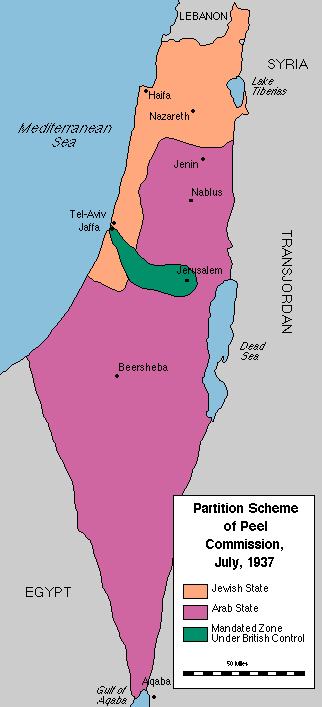
At the height of the 1936-39
disturbances, a royal
commission of inquiry came to Palestine
from London to investigate the roots of the
Arab-Jewish conflict and to propose solutions.
The commission, headed by Lord Robert Peel,
heard a great deal of testimony in Palestine,
and in July 1937 issued its recommendations:
to abolish the Mandate and partition the country between the two
peoples. Only a zone between Jaffa and Jerusalem would remain under the British mandate and
international supervision.
The Jewish state would include
the coastal strip stretching from Mount Carmel
to south of Be'er Tuvia, as well as the Jezreel
Valley and the Galilee.
The Arab state was to include the hill regions,
Judea and Samaria, and the Negev.
Until the establishment of the two states,
the commission recommended, Jews should be
prohibited from purchasing land in the area
allocated to the Arab state.
To overcome demarcation problems, it was proposed that land exchanges be carried out concurrently with the transfer of population from one area to the other. Demarcation of the precise borders of the states was entrusted to a technical partition committee. The Peel Commission did not believe that Jewish immigration was detrimental to the financial well-being of the Arab population and assumed that the issue of Jewish immigration would be resolved within the Jewish state.
The British government accepted the recommendations of the Peel Commission regarding the partition of Palestine, and the announcement was endorsed by Parliament in London. Among the Jews, bitter disagreements erupted between supporters and opponents, while the Arabs rejected the proposal and refused to regard it as a solution. The plan was ultimately shelved.