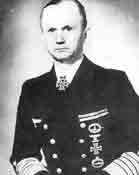
The course of the war waged against neutral
and allied merchant shipping by German U-boats followed,
under Doenitz's direction, a course of consistently increasing
ruthlessness.
(1) Attacks on Merchant Shipping. Doenitz displayed "his masterly understanding in adjusting
himself to the changing fortunes of war" (1463-PS).
From the very early days, merchant ships, both allied and
neutral, were sunk without warning, and when operational
danger zones had been announced by the German Admiralty,
these sinkings continued to take place both within and without
those zones. With some exceptions in the early days of the
war, no regard was taken for the safety of the crews or passengers
of sunken merchant ships, and the announcement claiming a
total blockade of the British Isles merely served to confirm
the established situation under which U-boat warfare was
being conducted without regard to the established rules of
international warfare or the requirements of humanity.
The course of the war at sea during the
first eighteen months is summarized by two official British
reports made at a time when those who compiled them were
ignorant of some of the actual orders issued which have since
come to hand. An official report of the British Foreign Office
summarizes German attacks on merchant shipping during the
period 3 September 1939 to September 1940, that is to say,
the first year of the war (D-641-A). is report, made shortly
after September 1940, states in part follows:
" During the first twelve months
of the war, 2,081,062 tons of Allied shipping, comprising
508 ships, have been lost by enemy action. In addition,
769,213 tons of neutral shipping comprising 253 ships,
have also been lost. Nearly all these merchant ships have
been sunk by submarine, mine, aircraft or surface craft,
and the great majority of them sunk while engaged on their
lawful trading occasions. 2,836 Allied merchant seamen
have lost their lives in these ships.
"In the last war the practice of
the Central Powers was so remote from the recognized procedure
that it was thought necessary to set forth once again the
rules of warfare in particular as applied to submarines.
This was done in the Treaty of London 1930, and in 1936
Germany acceded to these rules. The rules laid down:
"1) In action with regard to merchant
ships, submarines must conform to the rules of International
Law to which surface vessels are subjected.
"2) In particular, except in the
case of persistent refusal to stop on being summoned, or
of active resistance to visit and search, a warship, whether
surface vessel or submarine, may not sink or render incapable
of navigation a merchant vessel without having first placed
passengers, crew, and ship's papers in a place of safety.
For this purpose, the ship's boats are not regarded as
a place of safety unless the safety of the passengers and
crew is assured in the existing sea and weather conditions,
by the proximity of land, or the presence of another vessel
which is in a position to take them on board. "At
the beginning of the present war, Germany issued a Prize
Ordinance for the regulation of sea warfare and the guidance
of her naval officers. Article 74 of this ordinance embodies
the submarine rules of the London Treaty. Article 72, however,
provides that captured enemy vessels may be destroyed if
it seems inexpedient or unsafe to bring them into port,
and Article 73 (i) (ii) makes the same provision with regard
to neutral vessels which are captured for sailing under
enemy convoy, for forcible resistance, or for giving assistance
to the enemy. These provisions are certainly not in accordance
with the traditional British view but the important point
is that, even in these cases, the Prize Ordinance envisages
the capture of the merchantman before its destruction.
In other words, if the Germans adhered to the rules set
out in their own Prize Ordinance, we might have argued
the rather fine legal point with them, but we should have
no quarrel with them, either on the broader legal issue
or on the humanitarian one. In the event, however, it is
only too clear that almost from the beginning of the war
the Germans abandoned their own principles and waged war
with steadily increasing disregard for International Law,
and for what is, after all, the ultimate sanction of all
law, the protection of human life and property from arbitrary
and ruthless attacks." (D-641-A)
Two instances are then set out:
"On 30 September 1939, came the first
sinking of a neutral ship by a submarine without warning
and with loss of life. This was the Danish ship 'Vendia'
bound for the Clyde in ballast. The submarine fired two
shots and shortly after torpedoed the ship. The torpedo
was fired when the master had already signalled that he
would submit to the submarine's orders and before there
had been an opportunity to abandon ship. By November submarines
were beginning to sink neutral vessels without warning
as a regular thing. On the 12th November the Norwegian
'Arne Kjode' was torpedoed in the North Sea without any
warning at all. This was a tanker bound from one neutral
port to another. The master and four of the crew lost their
lives and the remainder were picked up after many hours
in open boats. Henceforward, in addition to the failure
to establish the nature of the cargo, another element is
noticeable, namely an increasing recklessness as to the
fate of the crew." (D-641-A)
And then, dealing with attacks on allied
merchant vessels, certain figures are given:
"Ships sunk 241
"Recorded attacks
211
"Illegal attacks
112
"At least 79 of these 112 ships were
torpedoed without warning." (D-641-A)
The report continues:
"By the middle of October submarines
were sinking merchant vessels without any regard to the
safety of the crews. Yet four months later the Germans
were still officially claiming that they were acting in
accordance with the Prize Ordinance. Their own semi-official
commentators however, had made the position clearer. As
regards neutrals, Berlin officials had early in February
stated that any neutral ship that is either voluntarily
or under compulsion bound for an enemy port -- including
contraband control harbors -- thereby loses its neutrality
and must be considered hostile. At the end of February
the cat was let out of the bag by a statement that a neutral
ship which obtained a navicert from a British Consul in
order to avoid putting into a British contraband control
base was liable to be sunk by German submarines, even if
it was bound from one neutral port to another. As regards
Allied ships, in the middle of November 1939 a Berlin warning
was issued against the arming of British vessels. By that
date a score of British merchantmen had been illegally
attacked by gunfire or torpedo from submarines, and after
that date some fifteen more unarmed Allied vessels were
torpedoed without warning. It is clear, therefore, that
not only was the arming fully justified as a defensive
measure, but also that neither before nor after this German
threat did the German submarines discriminate between armed
and unarmed vessels." (D-641- A)
A similar report covering the next six months
(D-641-B) makes these statements:
"On 30 January 1941, Hitler proclaimed
that 'every ship, with or without convoy, which appears
before our torpedo tubes is going to be torpedoed.' On
the face of it, this announcement appears to be uncompromising;
and the only qualification provided by the context is that
the threats immediately preceding it are specifically addressed
to the-peoples of the American Continent. German commentators,
however, subsequently tried to water it down by contending
that Hitler was referring only to ships which attempted
to enter the area within which the German 'total blockade'
is alleged to be in force.
"From one point of view it probably
matters little what exactly was Hitler's meaning, since
the only conclusion that can be reached after a study of
the facts of enemy warfare on merchant shipping is that
enemy action in this field is never limited by the principles
which are proclaimed by enemy spokesmen, but solely by
the opportunities or lack of them which exist at any given
time."
*******
"The effect of the German total blockade
is to prohibit neutral ships from entering an enormous
stretch of sea round Britain (the area extends to about
500 miles west of Ireland, and from the latitude of Bordeaux
to that of the Faroe Islands), upon pain of having their
ships sunk without warning and their crews killed. As a
matter of fact, at least thirty-two neutral ships, exclusive
of those sailing in British convoys, have been sunk by
enemy action since the declaration of the 'total blockade'."
*******
"Yet, though information is lacking
in very many cases, details are available to prove that,
during the period under review, at least thirty-eight Allied
merchant ships, exclusive of those in convoys, have been
torpedoed without warning in or near the 'total blockade'
area.
"That the Germans themselves have
no exaggerated regard for the area is proved by the fact
that of the thirty- eight ships referred to at least sixteen
were torpedoed outside the limits of the war-zone."
*******
"The sinking of the 'City of Benares'
on 17 September 1940 is a good example of this. The 'City
of Benares was an 11,000-ton liner with 191 passengers
on board, including nearly 100 children. She was torpedoed
without warning just outside the 'war zone,' with the loss
of 258 lives, including 77 children. It was blowing a gale,
with hail and rain squalls and a very rough sea when the
torpedo struck her at about 10 p.m. In the darkness and
owing to the prevailing weather conditions, at least four
of the twelve boats lowered were capsized. Others were
swamped and many people were washed right out of them.
In one boat alone sixteen people, including 11 children,
died from exposure; in another 22 died, including 15 children;
in a third 21 died. The point to be emphasized is not the
unusual brutality of this attack but rather that such results
are inevitable when a belligerent disregards the rules
of sea warfare as the Germans have done and are doing."
"There are hundreds of similar stories,
stories of voyages for days in open boats in Atlantic gales,
of men in the water clinging for hours to a raft and gradually
dropping off one by one, of crews being machine-gunned
as they tried to lower their boats or as they drifted away
in them, of seamen being blown to pieces by shells and
torpedoes and bombs. The enemy must know that such things
are the inevitable result of the type of warfare he has
chosen to employ." (D-641-B)
The total sinkings by U-boats during the
war (1939 to 1945) Amounted to 2775 British, Allied, and
Neutral ships totalling 14,572,435 gross tons (D-641-C).
Another example of the ruthless nature of
the actions conducted by Doenitz's U-boat commanders, particularly
as both British and German versions of the sinking are available,
is the sinking of "S.S. Sheaf Mead." The British
report, which includes the German account in the shape of
a complete extract from the U-boat's log, states:
"The British 'S.S. Sheaf Mead' was
torpedoed without warning on 27 May 1940 with the loss
of 31 of the crew. The commander of the U-boat responsible
is reported to have behaved in an exceptionally callous
manner towards the men clinging to upturned boats and pieces
of wood. It was thought that this man was Kapitaenleutnant
Oehrn of U-37. The following extract from his diary for
27 May 1940 leaves no doubt on the matter and speaks for
itself as to his behaviour." (D-644)
The relevant extract from the log, at 1554
hours, reads:
"Surface. Stern [referring to the
ship which has been torpedoed] is underwater. Bows rise
higher. The boats are now on the water. Lucky for them.
A picture of complete order. They lie at some distance.
The bows rear up quite high. Two men appear from somewhere
in the forward part of the ship. They leap and rush with
great bounds along the deck down to the stern. The stern
disappears. A boat capsizes. Then a boiler explosion. Two
men fly through the air, limbs outstretched. Bursting and
crashing. Then all is over. A large heap of wreckage floats
up. We approach it to identify the name. The crew have
saved themselves on wreckage. We fish out a buoy. No name
on it. I ask a man on the raft. He says, hardly turning
his head -- 'Nix Name.' A young boy in the water calls
'Help, help, please.' The others are very composed. They
look damp and somewhat tired. An expression of cold hatred
is on their faces. On to the old course. After washing
the paint off the buoy, the name comes to light: Greatafield,
Glasgow. 5006 gross registered tons." (D- 644)
"On to the old course" means
merely that the U-boat makes off.
The report of the Chief Engineer of the
"S. S. Sheaf Mead" contains this description of
the situation:
"When I came to the surface I found
myself on the port side, .that is, nearest to the submarine,
which was only about five yards away. The submarine Captain
asked the steward the name of the ship, which he told him,
and the enemy picked up one of our lifebuoys, but this
had the name 'Gretaston on it, as this was the name of
our ship before it was changed to 'Skeaf Mead' last January."
*******
"She had cutaway bows, but I did
not notice a net cutter. Two men stood at the side with
boat hooks to keep us off.
"They cruised around for half an
hour, taking photographs of us in the water. Otherwise
they just watched us, but said nothing. Then she submerged
and went off, without offering us any assistance whatever."
(D-644)
The U-boats log at 1444 hours contains a
description of the sighting of the ship, the difficulty in
identification, and then the
"The distance apart is narrowing.
The steamship draws in quickly, but the position is still
40-50. I cannot see the stern yet. Tube ready. Shall I
or not? The gunnery crews are also prepared. On the ship's
side a yellow cross in a small, square, dark blue ground.
Swedish? Presumably not. I raise the periscope a little.
Hurrah, a gun at the stern, an ack-ack gun or something
similar. Fire! I cannot miss"
The actual documents by which Doenitz and
his fellow conspirators issued their orders in disregard
of International Law indicate that the compiler of the above
reports understated the case. These orders cover not only
the period referred to in the above reports, but also the
subsequent course of the war. It is interesting to note in
them the steps by which the conspirators progressed. At first
they were content with breaching the rules of International
Law to the extent of sinking merchant ships, including neutral
ships, without warning where there was a reasonable prospect
of being able to do so without discovery. The facts already
quoted show that the question of whether ships were defensively
armed or outside the declared operational areas was in practice
immaterial.
A memorandum by the German Naval War Staff,
dated 22 September 1939, (C-191) provides:
"Flag Officer U-boats intends to
give permission to U- boats to sink without warning any
vessels sailing without lights. *** In practice there is
no opportunity for attacking at night, as the U-boat cannot
identify a target which is a shadow in a way that entirely
obviates mistakes being made.
If the political situation is such that
even possible mistakes must be ruled out, U-boats must be
forbidden to make any attacks at night in waters where French
and English Naval forces or merchant ships may be situated.
On the other hand, in sea areas where only English units
are to be expected, the measures desired by F. O. U-boats
can be carried out; permission to take this step is not to
be given in writing, but need merely be based on the unspoken
approval of the Naval War Staff. U-boat commanders would
be informed by word of mouth and the sinking of a merchant
ship must be justified in the War Diary as due to possible
confusion with a warship or an auxiliary cruiser. In the
meanwhile, U-boats in the English Channel have received instructions
to attack all vessels sailing without lights." (C-191)
The War Diary of the Naval War Staff of
the German Admiralty contains the following report by Ia
(Staff Operations Officer on the Naval War Staff) on directive
of the Armed Forces High Command of 30 December 1939:
"According to this the Fuehrer, on
report of the Commander in Chief, Navy, has decided:
"a) Greek merchant vessels are to
be treated as enemy vessels in the zone blockaded by USA.
and Britain.
"b) In the Bristol Channel all ships
may be attacked without warning. For external consumption
these attacks should be given out as hits by mines.
"Both measures may be taken with
immediate effect." (C- 21)
Another report by Ia, refers to intensified
measures in naval and air warfare in connection with "Fall
Gelb"
"In consequence of this Directive,
the Navy will authorize, simultaneously with the general
intensification of the war, the sinking by U-boats, without
any warning, of all ships in those waters near the enemy
coasts in which mines can be employed. In this case, for
external consumption, pretence should be made that mines
are being used. The behaviour of, and use of weapons by,
U-boats should be adapted to this purpose." (C-21)
A third extract from the Naval War Diary,
dated 6 January 1940, states:
"the Fuehrer has in principle agreed
(see minutes of report of C. in C. Navy of 30 December)
to authorize firing without warning whilst maintaining
the pretence of mine hits in certain parts of the American
blockaded zone." (C-21)
Whereupon, the order is given to Flag Officer,
Submarines, carrying out that decision (C-21). The report
for 18 January 1940 states:
"The High Command of the Armed Forces
has issued the following Directive dated 17th of January,
cancelling the previous order concerning intensified measures
of warfare against merchantmen.
"The Navy will authorize, with immediate
effect, the sinking without warning by U-Boats of all ships
in those waters near the enemy coasts in which the use
of mines can be pretended. U-Boats must adapt their behavior
and employment of weapons to the pretence, which is to
be maintained in these cases, that the hits were caused
by mines. Ships of the United States, Italy, Japan and
Russia are exempted from these attacks." (C-21)
An extract from the BDU War Diary (Doenitz's
War Diary) dated 18 July 1941, reveals a further extension
of the above order so as to cut down the protected categories:
"Supplementary to the order forbidding,
for the time being, attacks on U. S. warships and merchant
vessels in the operational area of the North Atlantic,
the Fuehrer has ordered the following:
"1. Attack on U. S. merchant vessels
sailing in British or U. S. convoys or independently is
authorized in the original operational area which corresponds
in its dimensions to the U. S. blockade zone and which
does not include the sea-route U. S. to Iceland."
(C-118)
As these orders slow, at one date the ships
of a particular neutral under certain conditions could be
sunk, while those of another could not. The attitude to be
adopted toward ships of particular neutrals changed at various
times, for Doenitz conducted the U-Boat war against neutrals
with cynical opportunism. It all depended on the political
relationship of Germany toward a particular country at a
particular time whether her ships were sunk or not.
(2) The Orders Concerning Treatment of
Survivors. A series of orders led up to the issue of
an order which enjoined U- Boat commanders not merely to
abstain from rescuing crews and give them no assistance,
but deliberately to annihilate them.
Among these preliminary standing orders
of the U-Boat Command is Order Number 154, signed by Doenitz:
"Paragraph (e). Do not pick up survivors
and take them with you. Do not worry about the merchant-ship's
boats. Weather conditions and distance from land play no
part. Have a care only for your own ship and strive only
to attain your next success as soon as possible. We must
be harsh in this war. The enemy began the war in order
to destroy us, so nothing else matters." (D-642)
In 1942, when the United States entered
the war with its enormous ship-building capacity, the change
thus brought about necessitated a further adjustment in the
methods adopted by the U-Boats. Doenitz accordingly issued
an order, which intended not merely the sinking of merchant
ships, not merely the abstention from rescue of the crews,
but their deliberate extermination.
The course of events is shown by the record
of a conversation between Hitler and the Japanese Ambassador,
Oshima, (D-423) in the presence of Ribbentrop, on 3 January
1942:
"The Fuehrer, using a map, explains
to the Japanese Ambassador the present position of marine
warfare in the Atlantic, emphasizing that he considers
his most important task is to get the U-Boat warfare going
in full swing. The U-Boats are being reorganized. Firstly,
he had recalled all U-Boats operating in the Atlantic.
As mentioned before, they would now be posted outside United
States ports. Later, they would be off Freetown and the
larger boats even as far down as Capetown."
*******
"After having given further explanations
on the map, the Fuehrer pointed out that, however many
ships the United States built, one of their main problems
would be the lack of personnel. For that reason, even merchant
ships would be sunk without warning with the intention
of killing as many of the crew as possible. Once it gets
around that most of the seamen are lost in the sinkings,
the Americans would soon have difficulties in enlisting
new people. The training of sea-going personnel takes a
very long time. We are fighting for our existence and our
attitude cannot be ruled by any humane feelings. For this
reason he must give the order that in case foreign seamen
could not be taken prisoner, which is not always possible
on the sea, U-boats were to surface after torpedoing and
shoot up the lifeboats.
"Ambassador Oshima heartily agreed
with the Fuehrer's comments, and said that the Japanese
too are forced to follow these methods."
An extract from the B.D.U. War Diary of
16 September 1942 is part of the story in the sense that
it was on the following day that the annihilation order was
issued. It records an attack on a U-boat, which was rescuing
survivors, chiefly the Italian survivors of the Allied liner
"Laconia," when it was attacked by an Allied aircraft
(D-446).
A Top Secret order, sent to all commanding
officers of U- boats from Doenitz's headquarters, dated 17
September 1942, provided:
"1. No attempt of any kind must be
made at rescuing members of ships sunk, and this includes
picking up persons in the water and putting them in lifeboats,
righting capsized lifeboats, and handing over food and
water. Rescue runs counter to the rudimentary demands of
warfare for the destruction of enemy ships and crews.
"2. Orders for bringing in Captains
and Chief Engineers still apply.
"3. Rescue the shipwrecked only if
their statements will be of importance for your boat.
"4. Be harsh, having in mind that
the enemy takes no regard of women and children in his
bombing attacks on German cities." (D-630)
The intentions of this carefully worded
order are made clear by an extract from Doenitz's War Diary
which is personally signed by Doenitz. The War Diary entry
for 17 September 1942 reads:
"The attention of all commanding
officers is again drawn to the fact that all efforts to
rescue members of the crews of ships which have been sunk
contradict the most primitive demands for the conduct of
warfare by annihilating enemy ships and their crews. Orders
concerning the bringing in of the Captains and Chief Engineers
still stand." (D-630). [Page 828]
(2) The Orders Concerning Treatment of
Survivors. A series of orders led up to the issue of
an order which enjoined U- Boat commanders not merely to
abstain from rescuing crews and give them no assistance,
but deliberately to annihilate them.
Among these preliminary standing orders
of the U-Boat Command is Order Number 154, signed by Doenitz:
"Paragraph (e). Do not pick up survivors
and take them with you. Do not worry about the merchant-ship's
boats.
Weather conditions and distance from land
play no part. Have a care only for your own ship and strive
only to attain your next success as soon as possible. We
must be harsh in this war. The enemy began the war in order
to destroy us, so nothing else matters." (D-642)
In 1942, when the United States entered
the war with its enormous ship-building capacity, the change
thus brought about necessitated a further adjustment in the
methods adopted by the U-Boats. Doenitz accordingly issued
an order, which intended not merely the sinking of merchant
ships, not merely the abstention from rescue of the crews,
but their deliberate extermination.
The course of events is shown by the record
of a conversation between Hitler and the Japanese Ambassador,
Oshima, (D-423) in the presence of Ribbentrop, on 3 January
1942:
"The Fuehrer, using a map, explains
to the Japanese Ambassador the present position of marine
warfare in the Atlantic, emphasizing that he considers
his most important task is to get the U-Boat warfare going
in full swing. The U-Boats are being reorganized. Firstly,
he had recalled all U-Boats operating in the Atlantic.
As mentioned before, they would now be posted outside United
States ports. Later, they would be off Freetown and the
larger boats even as far down as Capetown."
*******
"After having given further explanations
on the map, the Fuehrer pointed out that, however many
ships the United States built, one of their main problems
would be the lack of personnel. For that reason, even merchant
ships would be sunk without warning with the intention
of killing as many of the crew as possible. Once it gets
around that most of the seamen are lost in the sinkings,
the Americans would soon have difficulties in enlisting
new people. The training of sea-going personnel takes a
very long time. We are fighting for our existence and our
attitude cannot be ruled by any humane feelings. For this
reason he must give the order that in case foreign seamen
could not be taken prisoner, which is not always possible
on the sea, U-boats were to surface after torpedoing and
shoot up the lifeboats.
"Ambassador Oshima heartily agreed
with the Fuehrer's comments, and said that the Japanese
too are forced to follow these methods."
An extract from the B.D.U. War Diary of
16 September 1942 is part of the story in the sense that
it was on the following day that the annihilation order was
issued. It records an attack on a U-boat, which was rescuing
survivors, chiefly the Italian survivors of the Allied liner
"Laconia," when it was attacked by an Allied aircraft
(D-446).
A Top Secret order, sent to all commanding
officers of U- boats from Doenitz's headquarters, dated 17
September 1942, provided:
"1. No attempt of any kind must be
made at rescuing members of ships sunk, and this includes
picking up persons in the water and putting them in lifeboats,
righting capsized lifeboats, and handing over food and
water. Rescue runs counter to the rudimentary demands of
warfare for the destruction of enemy ships and crews.
"2. Orders for bringing in Captains
and Chief Engineers still apply.
"3. Rescue the shipwrecked only if
their statements will be of importance for your boat.
"4. Be harsh, having in mind that
the enemy takes no regard of women and children in his
bombing attacks on German cities." (D-630)
The intentions of this carefully worded
order are made clear by an extract from Doenitz's War Diary
which is personally signed by Doenitz. The War Diary entry
for 17 September 1942 reads:
"The attention of all commanding
officers is again drawn to the fact that all efforts to
rescue members of the crews of ships which have been sunk
contradict the most primitive demands for the conduct of
warfare by annihilating enemy ships and their crews. Orders
concerning the bringing in of the Captains and Chief Engineers
still stand." (D-630).
In this connection, a telegram from the
Commander of the U- boat "Schacht" to Doenitz's
headquarters, and the reply, are significant. "Schacht"
had been taking part in the rescue of survivors from the
"Laconia." The telegram from "Schacht,"
dated 18 September 1942, reads:
"163 Italians handed over to 'Annamite.'
Navigating Officer of 'Laconia' and another English Officer
on board." (D-630)
The telegram goes on to set out the position
of English and Polish survivors in boats.
The reply from Doenitz's headquarters was
sent on the 20th:
"Action as in wireless telegram message
of 17th of September was wrong. Boat was detailed to rescue
Italian allies and not for the rescue of English and Poles."
(D-630)
Such were Doenitz's plans before the bombing
incident ever occurred.
"Operation Order Atlantic No. 56,"
dated 7 October 1943, contains the sailing orders of a
U-boat (D-663). Although the date of this order is 7 October
1943, in fact it is only a reproduction of an order issued
earlier, in the autumn of 1942. The following is an extract
from this order:
"Rescue ships: A so-called rescue
ship is generally attached to every convoy, a special ship
of up to 3000 gross registered tons, which is intended
for the picking up of survivors after U-boat attacks. These
ships are, for the most part, equipped with a shipborne
aircraft and large motor-boats, are strongly armed with
depth-charge throwers, and very maneuverable, so that they
are often called U-Boat Traps by the commander. In view
of the desired destruction of ships' crews, their sinking
is of great value." (D-663)
The Prosecution does not complain against
attacks on rescue ships. They are not entitled to protection.
But the point of the foregoing order to U-boats was that
priority in attack should be given to rescue ships. This
order, therefore, is closely allied with order of 17 September
1942 (D-630): in view of the Allied shipbuilding program
the German Navy had resolved to take all means to prevent
Allied ships from being manned.
To summarize, it would appear from the War
Diary entry of 17 September that orders on the lines discussed
between Hitler and Oshima were, in fact, issued. They have
not, however, been captured. It may be that they were issued
orally, and that Doenitz awaited a suitable opportunity before
confirming them. The incident of the bombing of the U-boats
detailed to rescue the Italian survivors from the "Laconia"
afforded the opportunity, and the order to all commanders
was issued. Its intent is clear when it is considered in
the light of the War Diary entry. The wording is, of course,
extremely careful, but to any officer of experience its intention
was obvious: he would know that deliberate action to annihilate
survivors would be approved under that order.
It may be contended that this order, although
perhaps unfortunately phrased, was merely intended to stop
a commander from jeopardizing his ship by attempting a rescue,
which had become increasingly dangerous as a result of the
extended coverage of the ocean by Allied aircraft; and that
the notorious action of U-Boat Commander Eck in sinking the
Greek steamer "Peleus" and then machine-gunning
the crew on their rafts in the water, was an exception; and
that, although it may be true that a copy of the order was
on board, this action was taken solely, as Eck himself swore,
on his own initiative.
In reply it may be said that if the intention
of this order was to stop rescue attempts, in the interests
of the preservation of the U-boat, it would have been done
by calling attention to Standing Order 154. Secondly, this
very fact would have been prominently stated in the order.
Drastic orders of this nature are not drafted by experienced
staff officers without the greatest care and an eye to their
possible capture by the enemy. Thirdly, if it was necessary
to avoid the risks attendant on surfacing, not only would
this have been stated but there would have been no question
of taking any prisoners at all except possibly in circumstances
where virtually no risk in surfacing was to be apprehended.
Fourthly, the final sentence of the first paragraph would
have read very differently. And fifthly, if in fact -- and
the Prosecution does not accept it -- Doenitz did not mean
to enjoin murder, his order was so worded that he cannot
escape the responsibility which attaches to such a document.
The instructions given by Admiral Doenitz
with regard to the murder of shipwrecked Allied seamen are
described in an affidavit by Oberleutnant Zur See Peter Josef
Heisig (D- 566). (Heisig was called as a prosecution witness
in the case against Doenitz and testified on direct examination
to the same effect, in substance, as the statements in his
affidavit.) In September 1942 Heisig was a Midshipman in
a training course for U-boat officers of the watch. On the
last day of the course Grand Admiral Doenitz, who was then
Commander-in-Chief, U-boats, held an inspection tour and
made a speech to the officers in training. Heisig describes
the content of Doenitz's speech as follows:
"According to news received from
America we were bound to reckon with the possibility that
in the Allied countries more than 1,000,000 net registered
tons of new merchant shipping space would be brought into
service monthly. This was more shipping space than would
be sunk even with good U-boat successes. The bottleneck
of the Allies lay only in the problem of personnel for
these newly built ships. The Atlantic route was too dangerous
for seamen so that they even had to be brought aboard ship
under compulsion. This was the point where we, the U-boat
crews, had to take a hand. He therefore demanded that we
should from now on carry on total warfare against ship
and crew. That meant: so far as possible, no seaman from
a sunk ship was to get home any more. Only thus could the
supply line of the British Isles be seriously endangered
and only thus in the long run could we strike a noticeable
blow at Allied merchant shipping traffic. In this way it
would be impossible for the opponent even to make use of
his newly built ships, since no more crews would be available
to him. After the sinking of a ship, every possibility
of rescue must be denied to the crew, through the destruction
of every means of saving life. "I later discussed
these remarks of Admiral Doenitz's with the others, and
all present unanimously and unambiguously took them to
mean that after the sinking of a ship, all possibility
of escape, whether in boats, on rafts, or by any other
means, must be denied to the crew and the destruction of
the crew was to be attempted by every means. This mode
of warfare was for me as for most of my comrades completely
new. Owing to Admiral Doenitz's authoritative position,
it was nevertheless fully and completely accepted by many
of them. He sought to invalidate in advance any doubts
which might arise, by pointing to the air war and the bombing."
(D-566)
Further light on the real meaning of the
Top Secret radio message sent by the Commander in Chief,
U-boats, to all U- boat and operational flotillas in September
1942 (D-630) is contained in the statement of Korvettenkapitaen
Karl Heinz Moehle (382-PS). (Moehle was called as a Prosecution
witness in the case against Doenitz and testified on direct
examination to the same effect, in substance, as the statements
in his affidavit.) Concerning this order which was couched
in terms of a prohibition against the rescue of survivors,
Moehle states as
"This W/T message was without any
doubt sent out at the instigation of the Commander in Chief
U-boats himself, i.e. Grand Admiral Doenitz. In view of
my knowledge of the way in which the Staff of the Chief
Command U-boats worked, I consider it quite impossible
that an order of such importance could have been given
without his knowledge."
*******
"So far as concerns the order itself,
it undoubtedly states, and in particular for those who
know the manner in which Commander in Chief U-Boats is
wont to give his orders, that the High Command regard it
as desirable that not only ships but also their crews should
be regarded as objects of attack, i.e. that they should
be destroyed; at that time German propaganda was continually
stressing the shortage of crews for enemy merchant ships
and the consequent difficulties. I too understood this
order in that way.
"Had the point of view of the High
Command been otherwise the order would undoubtedly have
been expressed in different words. It would then only have
stated that for reasons of security rescue measures were
to cease and this order would have passed as a normal secret
W/T message. It was perhaps even the intention that this
order could be interpreted in two ways and the reason may
be that in the first place, it contravenes international
laws of warfare and secondly, that it was an order which
must give rise to serious conflicts of conscience in commanding
officers."
"To conclude, I can only stress that
the order of September 1942 appeared to me personally to
go too far and I am in total disagreement with it at heart.
As a serving officer I had however to carry out the command
to pass on this order to commanding officers for their
instruction.
"During the long time that I was
senior officer of the Flotilla no single commanding officer
mentioned to me that he could not reconcile obedience to
this order with his conscience and that he was therefore
unable to carry it out." (382-PS)
Moehle graphically describes Doenitz's incitement
of his men to the murder of survivors:
"A type VII boat (600-tonner) reported
in her war log that when outward bound from a base in France
she met far out in the Bay of Biscay a raft with five enemy
airmen, but was not able to take them on board owing to
shortage of room (she had a complement of 54 and carried
full provisions for 14 weeks). The boat therefore proceeded
without taking any notice of the survivors.
"This action of the U-boat was vehemently
denounced by the Commander in Chief U-boats' staff. It
was stated that she would have acted more correctly in
destroying this raft since it was highly probably that
the enemy air crew would be rescued by the enemy and in
the meantime might once more have destroyed a German U-
boat.
"This occurrence made the views of
the Commander in Chief U-boats clear to me." (382-PS)
As senior officer of the Fifth U-boat Flotilla,
it was Moehle's duty to transmit orders from the Commander
in Chief, U-boats, to commanding officers of U-boats. In
this connection, Doenitz' ambiguous order against the rescue
of survivors caused difficulties.
"I was wont to pass on this controversial
and serious order with more or less the following words:
-- `I have now to inform you of a High Command order concerning
conduct towards survivors. It is a very ticklish matter.
Commander in Chief U-boats in September 1942 gave the following
order in an 'officers only' signal (*** the exact words
of the order were then read out).'
"Since I am myself in my innermost
conscience in disagreement with this order, I was very
glad that in most cases commanding officers raised no queries
and I was therefore relieved of any further discussion
on this point.
"Sometimes however queries were raised
and I was wont to answer somewhat as follows:
" 'I will explain the viewpoint of
the High Command, which gave this order, by reference to
the following event:' I then mentioned the example of the
Type VII boat in the Bay of Biscay together with the explanation
and viewpoint expressed to me by commander in Chief U-
boats' staff. I then went on to say, 'Gentlemen, you must
yourselves decide what is compatible with your own consciences.
The safety of your own boat must always remain your prime
consideration.' "
*******
"I also remember that many commanding
officers after the order of September 1942 had been read
said, 'That is quite clear and unequivocal however hard
it may be.' Had this order been given to me as a commanding
officer I would have taken note of it in silence but in
practice would always have been able with a clear conscience
not to carry it out since I consider I would endanger my
own boat by acting in this way, (i.e., by shooting at lift-boats)."
(382-PS)
Finally, Moehle describes the orders to
omit from U-boat logs the notation of any actions in violation
of International Law:
"There was an order -- I do not remember
whether it was in the form of a written or verbal instruction
-- that no events during a war patrol which contravened
established international agreements should be entered
in the war log. I believe that the reason for this order
was that eight copies were made of war logs and were available
to many authorities; there was always the danger therefore
that events of this nature would become known and it was
undoubtedly undesirable for reasons of propaganda that
this should be so.
"Events of this nature were only
to be reported if asked for when commanding officers made
their personal reports; these were invariably made after
every patrol to Commander in Chief U-boats or later in
certain instances to Captain U-boats." (382-PS)
Two cases may be noted in which the order
of 17 September 1942 (D-60) was apparently put into effect.
The first case is the sinking of a steam trawler, the "Noreen
Mary," which was sunk by U-247 on 5 July 1944. The log
of the U-Boat shows that at 1943 hours two torpedoes were
fired, which missed (D- 645). At 2055 hours the log reads:
"Fishing Vessels: [Bearings of 3
ships given].
"Engaged the nearest. She stops after
three minutes." (D-645)
There follows an account of a shot fired
as the trawler lay stopped, and then, the final entry:
"Sunk by flak, with shots into her
side. Sank by the stern." (D-645)
The U-Boat Command made this comment on
the action:
"Recognized success: Fishing vessel
'Noreen Mary' sunk by flak."
An affidavit by James MacAlister, who was
a deck-hand on board the "Noreen Mary" at the time
of the sinking, describes the torpedo tracks which missed
the trawler, and continues as follows:
"At 2110 hours, while we were still
trawling, the submarine surfaced on our starboard beam,
about 50 yards to the northeast of us, and without any
warning immediately opened fire on the ship with a machine
gun. We were 18 miles west from Cape Wrath, on a north-
westerly course, making 3 knots. The weather was fine and
clear, sunny, with good visibility. The sea was smooth,
with light airs."
*******
"When the submarine surfaced I saw
men climbing out of the conning tower. The skipper [of
the trawler] thought at first the submarine was British,
but when she opened fire he immediately slackened the brake
to take the weight off gear, and increased to full speed,
which was about 10 knots. The submarine chased us, firing
her machine gun, and with the first rounds killed two or
three men, including the skipper, who were on deck and
had not had time to take cover. The submarine then started
using a heavier gun from her conning tower, the first shot
from which burst the boiler, enveloping everything in steam.
"By now the crew had taken cover,
but in spite of this all but four were killed. The submarine
then commenced to circle round ahead of the vessel, and
passed down her port side with both guns firing continuously.
We were listing slowly to port all the time but did not
catch fire.
"The Mate and I attempted to release
the lifeboat, which was aft, but the Mate was killed whilst
doing so, so I abandoned the attempt. I then went below
into the pantry, which was below the water line, for shelter.
The ship was listing more and more to port, until finally
at 2210 she rolled right over and sank, and the only four
men left alive on board were thrown into the sea. I do
not know where the other three men had taken cover during
this time, as I did not hear or see them until they were
in the water.
"I swam around until I came across
the broken bow of our lifeboat, which was upside down,
and managed to scramble on top of it. Even now the submarine
did not submerge, but deliberately steamed in my direction
and when only 60 to 70 yards away fired directly at me
with a short burst from the machine gun. As their intention
was quite obvious, I fell into the water and remained there
until the submarine ceased firing and submerged, after
which I climbed back on to the bottom of the boat. The
submarine had been firing her guns for a full hour."
(D-645)
The affidavit goes on to describe the attempts
of the Second Engineer and others to rescue themselves and
to help each other; they were later picked up by another
trawler. The affidavit continues:
"Whilst on board the 'Lady Madeleine'
the Second Engineer and I had our wounds dressed. I learned
later that the Second Engineer had 48 shrapnel wounds,
also a piece of steel wire 21/2 inches long embedded in
his body. *** I had 14 shrapnel wounds."
*******
"This is my fourth wartime experience,
having served in the whalers 'Sylvester' (mined) and 'New
Seville' (torpedoed), and the Trawler 'Ocean Tide', which
ran ashore.
"As a result of this attack by U-boat,
the casualties were six killed, two missing, two injured."
(D-645).
The next case is that of the ship "Antonico"
which was torpedoed, set afire, and sunk on 28 September
1942, off the coast of French Guiana. The date of the incident
is some eleven days after the issue of the order (D-630).
A statement given by the Second Officer describes the attack
on the ship, which by then was on fire (D-647):
" That the witness saw the dead on
the deck of the 'Antonico' as he and his crew tried to
swing out their lifeboat; that the attack was fulminant,
lasting almost 20 minutes; and that the witness already
in the lifeboat tried to get away from the side of the
'Antonico' in order to avoid being dragged down by the
same 'Antonico' and also because she was the aggressor's
target; that the night was dark, and it was thus difficult
to see the submarine, but that the fire aboard the 'Antonico'
lit up the locality in which she was submerging, facilitating
the enemy to see the two lifeboats trying to get away;
that the enemy ruthlessly machined-gunned the defenseless
sailors in No. 2 lifeboat, in which the witness found himself,
and killed the Second Pilot Arnaldo de Andrade de Lima,
and wounded three of the crew; that the witness gave orders
to his company to throw themselves overboard to save themselves
from the bullets; in so doing, they were protected and
out of sight behind the lifeboat, which was already filled
with water; even so the lifeboat continued to be attacked.
At that time the witness and his companions were about
20 meters in distance from the submarine." (D-647)
The U-boat's log in that case is not available,
but it may be surmised, in view of the order that nothing
compromising should be included in entries in logs, that
it would be no more helpful than in the case of the previous
incident.
A broadcast by a German Naval War Reporter
on the long wave propaganda service from Friesland, (D-646-A)
in English, on 11 March 1943, stated:
"Santa Lucia, in the West Indies,
was an ideal setting for romance, but nowadays it was dangerous
to sail in these waters -- dangerous for the British and
Americans and for all the colored people who were at their
beck and-call. Recently a U-boat operating in these waters
sighted an enemy windjammer. Streams of tracer bullets
were poured into the sails and most of the Negro crew leaped
overboard. Knowing that this might be a decoy ship, the
submarine steamed cautiously to within 20 yards, when hand
grenades were hurled into the rigging. The remainder of
the Negroes then leaped into the sea. The windjammer sank.
There remained only wreckage. Lifeboats packed with men,
and sailors swimming. The sharks in the distance licked
their teeth in expectation. Such was the fate of those
who sailed from Britain and America." (D-646-A)
This statement shows that it was the policy
of the enemy to seek to terrorize crews. It is a part with
the order with regard to rescue ships and with the order
on the destruction of steamers.
After Doenitz succeeded Raeder as Commander-in-Chief
of the Navy he presumably also succeeded to the equivalent
rank of a Minister of the Reich, which Raeder had held (2098-PS).
An official report certified by an official
of the British Admiralty sets out the number of meetings,
the dates of the meetings, and those present, on the occasion
of meetings between Doenitz or his representative with Hitler
from the time that he succeeded Raeder until the end (D-648).
The certificate states:
"I have compiled from them [captured
documents the attached list of occasions on which Admiral
Doenitz attended conferences at Hitler's headquarters.
The list of other senior officials who- attended the same
conferences is added when this information was contained
in the captured documents concerned. I certify that the
list is a true extract from the collective documents which
I have examined, and which are in the possession of the
British Admiralty, London."
Either Admiral Doenitz or his deputy, Konteradmiral
Voss, was present at each of the numerous meetings listed.
Among hose who were also constantly present were Speer, Keitel,
Jodl, Ribbentrop, Goering, and Himmler or his lieutenants,
Fegelein or Kaltenbrunner. The inference is clear that from
the time that he succeeded Raeder, Doenitz was one of the
rulers of the Reich and as undoubtedly aware of all major
decisions of policy.
(3) The Order to Kill Commandos.
An internal memorandum of the Naval War Staff, written by
the division dealing with International Law to another division,
discusses the order of 18 October 1942, with regard to the
shooting of Commandos (C-178).
Doubt appears to have arisen in some quarters
with regard to the understanding of this order. Accordingly,
in the last sentence of the memorandum it is suggested:
"As far as the Navy is concerned,
it remains to be seen whether or not this case should be
used to make sure, after a conference with the Commander-in-Chief
of the Navy, that all departments concerned have an entirely
clear conception regarding the treatment of members of
commando units." (C-178)
Whether that conference took place or not
is not known. The document is dated some 11 days after Doenitz
had taken over command from Raeder.
But in July 1943, the Navy handed over to
the SD Norwegian and British Navy personnel, whom the Navy
decided came under the terms of the order, for shooting.
An affidavit by a British barrister-at-Law who served as
judge advocate at the trial of the members of the SD who
executed the order states (D-649):
"The accused were charged with committing
a war crime, in that they at Ulven, Norway, in or about
the month of July 1943, in violation of the laws and usages
of war, were concerned in the killing of ***" [there
follow the names of six personnel of the Norwegian Navy,
including one officer, and one telegraphist of the British
Navy, prisoners of war.]
*******
"There was evidence before the Court;
which was not challenged by the Defense, that Motor Torpedo
Boat No. 345 set out from Lerwick in the Shetlands on a
naval operation for the purpose of making torpedo attacks
on German shipping off the Norwegian coast, and for the
purpose of laying mines in the same area. The persons mentioned
in the charge were all the crew of the Torpedo Boat.
"The defense did not challenge that
each member of the crew was wearing uniform at the time
of capture, and there was abundant evidence from many persons,
several of whom were German, that they were wearing uniform
at all times after their capture.
"On 27 July 1943, the Torpedo Boat
reached the island of Aspo off the Norwegian coast, north
of Bergen. On the following day the whole of the crew were
captured and were taken on board a German naval vessel
which was under the command of Admiral von Schrader, the
Admiral of the west coast. The crew were taken to the Bergenhus,
where they had arrived by 11 p.m. on 28th July. The crew
were there interrogated by Leut. H. P. W. W. Fanger, a
Naval Leutnant of the Reserve, on the orders of Korvettenkapitaen
Egon Drascher, both of the German Naval Intelligence Service.
This interrogation was carried out upon the orders of the
staff of the Admiral of the west coast. Leut. Fanger reported
to the Officer in Charge of the Intelligence Branch at
Bergen that in his opinion all the members of the crew
were entitled to be treated as prisoners of war, and that
officer in turn reported both orally and in writing to
the Sea Commander, Bergen, and in writing to the Admiral
of the west coast.
"The interrogation by the Naval Intelligence
Branch was concluded in the early hours of 29th July, and
almost immediately all the members of the crew were handed
over on the immediate orders of the Sea Commander, Bergen,
to Obersturmbannfuehrer of the SD, Hans Wilhelm Blomberg,
who was at that time Kommandeur of the Sicherheitspolizei
at Bergen. This followed a meeting between Blomberg and
Admiral von Schrader, at which a copy of the Fuehrer order
of 18 October 1942 was shown to Blomberg. This order dealt
with the classes of persons who were to be excluded from
the protection of the Geneva Convention and were not to
be treated as prisoners of war, but when captured were
to be handed over to the SD. Admiral von Schrader told
Blomberg that the crew of this Torpedo Boat were to be
handed over in accordance with the Fuehrer order, to the
SD." (D-649)
The affidavit goes on to describe the interrogation
by officials of the SD. These officials took the same view
as the Naval Intelligence officers, that the crew were entitled
to be treated as prisoners of war. Nevertheless, the crew
were taken out and shot by an execution squad composed of
members of the SD. The affidavit concludes as follows:
"It appeared from the evidence that
in March or April, 1945, an order from the Fuehrer Headquarters,
signed by Keitel, was transmitted to the German authorities
in Norway. The substance of the order was that members
of the crew of commando raids who fell into German captivity
were from that date to be treated as ordinary prisoners
of war. This order referred specifically to the Fuehrer
order referred to above." (D-649)
The date mentioned is important; it was
time "in March or April, 1945," for these men to
put their affairs in order.
(4) Reasons for Not Renouncing the Geneva
Convention. The minutes of conferences on 19 February
1945 and 20 February 1945 between Doenitz and Hitler read
as follows:
"The Fuehrer is considering whether
or not Germany should renounce the Geneva Convention ***
[the 1929 Prisoners of War Convention].
*******
"The Fuehrer orders the Commander-in-Chief
of the Navy to consider the pros and cons of their step
and to state his s opinion as soon as possible." (C-158)
Doenitz then stated his opinion in the presence
of Jodl and a representative of Ribbentrop:
"On the contrary, the disadvantages
[of renouncing the convention] outweigh the advantages.
It would be better to carry out the measures considered
necessary without warning, and at all costs to save face
with the outer world." (C-158)
An extract from the minutes of another meeting
between Doenitz and Hitler, on 1 July 1944, -- the extract
is signed by Doenitz -- states:
" *** Regarding the General Strike
in Copenhagen, the Fuehrer says that the only weapon to
deal with terror is terror. Court martial proceedings create
martyrs. History shows that the names of such men are on
everybody's lips, whereas there is silence with regard
to the many thousands who have lost their lives in similar
circumstances without court martial proceedings."
(C-171)
(5) Use of Concentration Camp Labor in
Shipyards. In a memorandum signed by Doenitz sometime
late in 1944, which was distributed to Hitler, Keitel, Jodl,
Speer, and the Supreme Command of the Air Force, Doenitz
reviews German shipping losses, and concludes:
"Furthermore, I propose reinforcing
the shipyard working parties by prisoners from the concentration
camps and as a special measure for relieving the present
shortage of coppersmiths, especially in U-boat construction,
I propose to divert coppersmiths from the construction
of locomotives to shipbuilding." (C-195)
In dealing with sabotage, Doenitz has this
to say:
"Since, elsewhere, measures for exacting
atonement taken against whole working parties amongst whom
sabotage occurred, have proved successful, and,-for example,
the shipyard sabotage in France was completely suppressed,
possibly similar measures for the Scandinavian countries
will come under consideration." (C-195)
Item 2 of the summing-up reads:
"12,000 concentration camp prisoners
will be employed in the shipyards as additional labor (security
service [SD] agrees to this) " (C-195)
It was not for nothing that at these meetings
Himmler and his Lieutenants, Fegelein and Kaltenbrunner,
were present.
They were not there to discuss U-boats or
the use of battleships. It is clear from this document that
Doenitz knew all about concentration camps and concentration
camp labor, and as one of the rulers of Germany he must bear
his full share of that responsibility.
(6) Doenitz's Incitement of Ruthless
Conduct By His Men. The orders issued by Doenitz in April
1945 (D-650) show his fanatical adherence to the Nazi creed,
and his preparedness even at that stage to continue a hopeless
war at the expense of human life, and with the certainty
of increased destruction and misery to his country:
"I therefore demand of the commanding
officers of the Navy: That they clearly and unambiguously
follow the path of military duty, whatever may happen.
I demand of them that they stamp out ruthlessly all signs
and tendencies among the men which endanger the following
of this
"I demand from Senior Commanders
that they should take just as ruthless action against any
commander who does not do his military duty. If a commander
does not think he has the moral strength to occupy his
position as a leader in this sense, he must report this
immediately. He will then be used as a soldier in this
fateful struggle in some position in which he is not burdened
with any tasks as a leader." (D-650)
In the secret Battle order of the day of
19 April 1945, Doenitz gives an example of the type of under-officer
who should be promoted:
"An example: In a prison camp of
the auxiliary cruiser 'Cormorau', in Australia, a petty
officer acting as camp senior officer, had all communists
who made themselves noticeable among the inmates of the
camp systematically done away with in such a way that the
guards did not notice. This petty officer is sure of my
full recognition for his decision and his execution. After
his return, I shall promote him with all means, as he has
shown that he is fitted to be a leader."