Hermann Wilhelm Goering
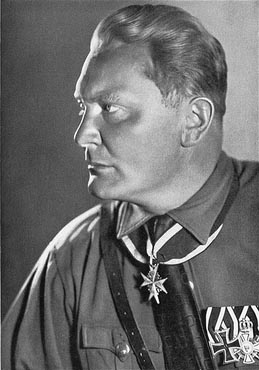
For more than two decades Hermann
Goering played one of the foremost roles
amongst the Nazi conspirators. He, who called
himself the most faithful paladin of the Fuehrer,
was a key figure within the conspiracy, participating
in nearly all phases of the conspiratorial
activities. He took part in the Munich Beer
Hall putsch of 1923; he promoted Hitler's rise to power in 1933; he founded the Gestapo in 1933 and the concentration
camps in 1934; and he created the German
Luftwaffe, making it an instrument for aggressive
war and using it to destroy other countries.
A Plenipotentiary for the Four-Year Plan and
chairman of the Ministerial Council for Defense,
Goering became the Czar of German economy
and administration and eventually the executive
manager of the entire conspiracy.
- Positions Held
- Crimes Against Peace
- War Crimes
- Crimes Against Humanity
Positions Held
The following list, the correctness of which has been certified by
Goering and his attorney (2836-PS) is a partial statement of positions
and offices held by him from 1922 to 1945:
1. Party member (1922-1945).
2. Supreme Leader of the SA (1923November 1923).
3. Member of the Reichstag (1928).
4. President of the Reichstag (1932).
5. Prussian Minister of the Interior (1933-34).
6. Prussian Prime Minister (1933-45).
7. Prussian Chief of Secret State Police (1933-36).
8. Prussian Chief of State Council (1933-36).
9. Plenipotentiary for the Four-Year Plan (1936-45).
10. Reichsminister for Air (1933-45).
11. Commander-in-Chief of the Air Force (1935-45).
12. President of the Cabinet Council for the Defense of the Reich
(1939-45).
13. Member of the Secret Cabinet Council (1938-45).
14. Reichsmarshall (1939-45).
15. Successor Designate to Hitler (1939-45).
16. Head of Reichswerke Hermann Goering (1938-45).
17. Head of Gestapo in Prussia (1933-34).
Goering was a member of and assisted in the Nazi conspiracy -to commit
crimes against peace, war crimes, and crimes against humanity, in the
following ways:
A.
CRIMES AGAINST PEACE.
(1) Acquisition and Consolidation of Power in Germany.
(a) Before 1933. Soon after joining the Party, Goering in 1923
was placed in command of the entire SA (2168-PS). In November 1923,
he took part in the ill-fated attempt at Munich to gain control of the
German State by force. In the encounter with the police, Goering was
wounded and fled from Germany. (2532-PS)
After his return, Goering became more than a commander of street fighters.
He was designated Hitler's first political assistant.
"The movement was conducted by the Fuehrer from Munich. But
one man has to act for him in Berlin, while Gauleiter Goebbels stirs
up the masses and makes them ripe for National Socialism, a man on
whom he could rely unconditionally to the same extent as if he acted
himself. And thus, Hermann Goering became the political deputy of
Adolf Hitler."
Goering's official biographer, the Ministerial Dirgent Gritzbach, tells
of his dealings with the Bruening government, his attempts to "break
down the barrier" around the Reich President, von Hindenburg, and
of his "coup" as Reichstag President in September 1932 in
procuring a vote of nonconfidence against the Papen government just
before the Reichstag could be dissolved (3252-PS). Goering says in his
own book, Aufbau einer Nation:
"The moment was unforgettable for me who have gone back and
forth as representative so often between the Kaiserhof and the Wilhelmstrasse
during the past year, when I hurried out to my car and could report
to the questioning masses as the first one: 'Hitler has become Reich
Chancellor.' " (3251-PS)
Goebbels also gave him full measure of credit:
'This is surely Goering's happiest hour,' wrote Dr. Goebbels in his
book Von Kaiserhof zur Reichskanzlei, and, quoting from it, said:
that 'Goering prepared diplomatically and politically in a long lasting
all hard struggle the-basis for Hitler's rise." (3252-PS.)
In a letter written in 1935, Hitler summarized Goering's contributions
as follows:
"My dear Goering: When in November 1923 the Party tried -for
the first time to conquer the power of the State, you as Commander
of the SA created within an extraordinarily short time that instrument
with which I could bear that struggle. Highest necessity had forced
us to act, but a wise providence at that time denied that success.
After receiving a grave wound you again entered the ranks as soon
as circumstances permitted as my most loyal comrade in the battle
for power. You contributed essentially to creating the basis for the
30th of January. Therefore, at the end of a year of the National Socialist
Revolution, I desire to thank you wholeheartedly my dear Party Comrade
Goering, for the great values which you have for the National Socialist
Revolution and consequently, for the German people. In cordial friendship
and grateful appreciation.
Yours, Adolf Hitler." (3259-PS)
Goering himself has boasted:
"Numerous titles and honors have been bestowed on me during
the past months, and still no title and no decoration could make me
so proud, as the designation, given to me by the German people: 'The
most faithful paladin of our Fuehrer.' In that, my relationship to
the Fuehrer finds expression. I followed him for over a decade with
unreserved faith, and I will follow him with the same unconditional
faith until my end." (3251- PS)
(b) Prussia, 1933-36. Immediately after 30 January 1933, Goering
was awarded the key post of acting Prussian Minter of the Interior,
and shortly thereafter, that of Minister President of Prussia. In these
capacities, he proceeded promptly to establish a regime of terror in
Prussia designed to suppress all opposition to the Nazi program.
His chief tool was the Prussian police, which remained under jurisdiction
until 1936. As early as February 1933, he ordered the entire police
forces to render unqualified assistance to the para-military organizations
supporting the new government, such as the SA and the SS, and to crush
all political opponents with firearms, if necessary, regardless of the
consequences. (Directive of 1 February 1933, Ministerialblatt fuer die
Preussische innere Verwaltung 1933, p. 148; Directive of 17 February
1933, id, p 169). Goering has frequently and proudly acknowledged his
own personal responsibility for the crimes committed pursuant to orders
of this character:
"I declared at that time before thousands of fellow Germans,
each bullet which leaves the barrel of a police pistol now is my bullet.
If one calls this murder, then I have murdered; I ordered all this,
I back it up. I assume the responsibility, and I am not afraid to
do so." (2324-PS; 3252-PS.)
Soon after he became Prussian Minister President, Goering began to
develop the Gestapo, or Secret State Police. To quote from his own book:
"The most important thing for me was first, to get the instrument
of power of the protective police and political police firmly in my
hand. Here I undertook the first sweeping changes of personnel. Of
the 32 available colonels of the protective police, I dismissed 22.
Hundreds of officers and thousands of sergeants followed them in the
course of the next months. New forces were procured, and everywhere,
these forces were taken out of the large reserve pool of the SA and
the SS. For weeks, I personally worked on this transformation, and
finally I created alone and from my own conviction and own thought
the 'Secret State Police Office'. That instrument, feared so much
by the enemies of the state, which above all has contributed so much,
that today a Communist or Marxist danger in Germany or Prussia is
hardly worth talking about anymore." (3251-PS)
In a public address delivered on 11 December 1934, Goering boasted:
"We were firmly determined after assumption of power to hit
the Communists so that in Germany they would never recover from our
blow. For that we do not require a Reichstag fire. That has been one
of the most important points on our program. In the former Weimar
Constitution the destruction of Communism was unthinkable. For the
execution of these measures we needed the instrument of a through
and through reliable, and of the highest degree powerful, police force.
I have created this instrument through the reorganization of the field
police (Landespolizei) and the formation of a Secret State Police.
These organizations will constitute a means for implanting fear in
all enemies of the State, which a State needs if it wishes to defend
itself for always" (3440-PS)
On 26 April 1933 Goering signed the first law officially establishing
the Secret State Police in Prussia (2104-PS). On 30 November 1933, Goering
signed a law naming himself, as Prime Minister, Chief of the Prussian
Secret State Police (2105-PS). He continued in this position until sometime
in 1936, when Himmler secured control of all police in the Reich.
Men and women taken into custody by the Gestapo were thrown, without
judicial or other form of trial, into concentration camps, which had
been established in Prussia as early as the spring of 1933. (3252-PS;
L-83.)
As explained by Goering in his own book:
"Against the enemies of the State, we must proceed ruthlessly.
It cannot be forgotten, that at the moment of our rise to power, according
to the official election figures of March 1933, six million people
still confess their sympathy for Marxism. *** Therefore the concentration
camps have been created, where we have first confined thousands of
Communists and Social Democrat functionaries. ***" (2344-PS)
On 10 February 1936 , Goering, as Prussian Minister President, signed
a further basic law on the Prussian Secret State Police. Article 7 of
this law provided:
"Orders in matters of the Secret State Police are not subject
to the review of the administrative courts" (2107-PS)
Thus it was made quite clear by Goering's own law that those imprisoned
in concentration camps without trial of any kind were to have no recourse
to any court. On the same day Goering signed a decree for the execution
of the foregoing law, which further acknowledged his responsibility
for Prussian concentration camps. Its provisions included the following:
"Art. 2 *** (4) The Secret State Police Bureau administers the
state concentration camps." (2108-PS)
The range of police terrorism under Goering's leadership was almost
limitless. A glance at a few of his police directives in these early
days will indicate the extent and thoroughness with which every dissident
voice was silenced:
Directive of 22 June 1933 (Ministerial-Blatt fuer die Preussische
innere Verwaltung, 1933, p. 731): Ordered all officials to watch
the statements of employees of the Prussian civil service and to denounce
to Goering those who made critical remarks ("Miesrnacher"
failure to do so regarded as proof of hostile attitude.
Directive of 23 June 1933 (Ministerial-Blatt fuer die Preussische
innere Verwaltung, 1933, p. 749): Suppressed all activities of
the Social Democratic Party, including meetings and press, and ordered
confiscation of its property.
Directive of 30 June 1933, (Ministerial-Blatt fuer die Preussische
innere Verwaltung, 1933, p. 793): Ordered the Gestapo authorities
to report to the Labor Trustees on political attitudes of workers,
particularly in cases of criticism of the regime.
Directive of 15 January 1934 (Ministerial-Blatt fuer die Preussische
innere Verwaltung, 1933 p. 137): Ordered the Gestapo and frontier
police to keep track of and to watch emigres particularly political
emigres and Jews, residing in neighboring countries, and ordered them
arrested and put into concentration camps if they returned to Germany.
After the elimination of the forces of the opposition, the Nazis felt
it necessary to dispose of nonconformists within their own ranks. During
the Roehm purge of 30 June 1934, many people were murdered who had nothing
to do with the internal SA revolt but were just "not liked very
well" (2950- PS). Goering's role in this bloody affair was related
less than two weeks later by Hitler in a speech to the Reichstag:
"Meanwhile Minister President Goering had previously received
my instructions that in case of a purge, he was to take analogous
measures at once in Berlin and in Prussia. With an iron fist he beat
down the attack on the National Socialist State before it could develop."
(3442-PS)
(c) The Reich, 1933-39. Meanwhile, in the central Reich government,
Goering occupied a series of the highest and most influential positions.
The broad powers which devolved upon him made him, under Hitler, the
Chief Executive of the Nazi State.
With the accession to power, Goering retained the somewhat empty title
of Reichstag President but was also appointed Minister Without Portfolio
and became a cabinet member. When in an early meeting (15 March 19333)
the cabinet discussed the pending Enabling Act (which gave the Cabinet
plenary powers of legislation) he offered the suggestion that the required
two-thirds majority might be obtained simply by refusing admittance
to the Social Democratic delegates (2962- PS). He became Reich Air Minister
in May 1933 (2089-PS). In his capacity as Air Minister and Supreme Commander
of the Luftwaffe, he sat as a member of and the Fuehrer's deputy on
the Reich Defense Council, which was established by the secret law of
21 May 1933 and continued by the secret law of 4 September 1938 (2261-PS;
2194-PS). This Council was a war planning group whose purpose was "to
plan preparations and decrees in case of war which later on were published
by the Ministerial Council for the Defense of the Reich." (2986-PS)
In 1936, Goering was made Plenipotentiary for the Four-Year Plan and
acquired plenary legislative and administrative powers over all-German
economic life. (1862-PS)
Goering was a member of the Secret Cabinet Council established in 1938
to act as "an advisory board in the direction of foreign policy"
(2031-PS).
The Ministerial Council for the Defense of the Reich, created in 1939,
took over, in effect, all the legislative powers of the Cabinet which
had not been reserved to Hitler's personal control or to Goering as
the Delegate for the Four-Year Plan. Goering became the Chairman of
this Council. (2018-PS)
Finally as the invading Nazi armies marched into Poland, Hitler announced
the designation of Goering as successor designate, the heir apparent
of the "New Order."
d) Economic Preparation for War, 1933-1939. April 1936, Goering
was appointed Coordinator for Raw Materials and Foreign Exchange and
empowered to supervise all State and Party activities in these fields
(2827-PS). In this capacity he convened the War Minister, the Minister
of Economics, the Reich Finance Minister, the President of the Reichsbank,
and the Prussian Finance Minister to discuss inter-agency problems connected
with war mobilization. At a meeting of this group on 12 May 1936, when
the question of the prohibitive cost of synthetic raw material substitutes
arose, Goering said:
"If we have war tomorrow, we must help ourselves by substitutes.
Then money will not play any role at all. If that is the case, then
we must be ready to create the prerequisites for that in peace."
(1301-PS)
At a subsequent meeting of the same men on 27 May 1936, Goering suggested
a program of plant construction for the production of synthetic substitutes
but warned against the financial strain involved in excessive overexpansion.
He opposed any limitations dictated by orthodox financial policy and
stated:
"All measures are to be considered from the standpoint of assured
waging of war.
"Ready reserves must ordinarily be accumulated already in peace
in certain amounts." (1301-PS).
On the Nurnberg Party Day in the fall of 1936, Hitler proclaimed the
establishment of the Four-Year Plan, a comprehensive program of national
self-sufficiency, and announced the appointment of Goering as "Plenipotentiary"
in charge. In October, a decree was promulgated which implemented this
announcement and provided for the execution of the plan. (1862-PS)
It is clear from Goering's own statements in an interrogation on 25
June 1945 that the purpose of the Plan was to place Germany on a war
footing economically:
"Goering: 'My job was to organize the German economy and my
energy was put to work to get things started and carried through ***.
My main task was to secure the food supply for Germany for many years
ahead and to make Germany self-sufficient. The most important items
were iron, petroleum and rubber. *** The industry only wanted to have
very high grade Swedish iron for business reasons. There was danger
that during the war Germany would not be able to get iron from Sweden
and there would be no iron.'
Interrogator: 'What war are you talking about? This is 1936 you're
speaking of.'
Goering: 'Any possibility of war. Perhaps with Russia, or in case
there was war with anyone at any time and anywhere.' "
When asked the reasons why the Four-Year Plan lost importance in 1942,
Goering explained that his preoccupation with the Air Force did not
allow him the necessary concentration on the affairs of the Four-Year
Plan, and stated:
"The main task of the Four-Year Plan had been accomplished.
This task was to get Germany ready."
These answers confirm the comment Goering made in 1936, that his chief
task as Plenipotentiary for the Four-Year Plan was "to put the
whole economy on a war footing within four years." (EC-408) As
Plenipotentiary for the Four-Year Plan, Goering was virtually the economic
dictator for Germany with control over all other interested Reich agencies.
He was the "boss of the economy," and all important decisions
had to be referred to him.
Two important conferences show clearly how Goering inspired and directed
the preparation of the German economy for aggressive war. On 8 June
1938 he addressed a number of leading German aircraft manufacturers,
explained the political situation, and laid the groundwork for a vast
increase in aircraft production. After stating that war with Czechoslovakia
was imminent and boasting that the German air force was already superior
in quality and quantity to the English, he continued:
"If Germany wins the war, she will be the greatest power in
the world, dominating the world market, and Germany will be a rich
nation. For this goal, risks must be taken. The only thing that matters
is increased output regarding quantity and quality. Even if the manufacturers
know that their present policies may mean their bankruptcy within
three years, they will have to do it all the same *** I want you to
be perfectly resolved, today already, how you will run your business
when war comes. The earlier the manufacturers make their preparations
for mobilization today, the less danger there will be of work being
held up. It must be determined for every worker whether he is essential
for production upon outbreak of war, and measures must be taken to
secure his deferment in case of mobilization. (3441- PS). An executive
will be put in charge to work on nothing but the complete preparation
of each plant for mobilization day." (R-140)
A few weeks after the Munich agreement, on 14 October 1938, another
conference was held in Goering's office. He began with the statement
that Hitler had instructed him to organize a gigantic armament program
which would make insignificant all previous achievements. He indicated
that he had been ordered to build as rapidly as possible an air force
five times as large, to increase the speed of Army and Navy armament,
and to concentrate on offensive weapons, principally heavy artillery
and heavy tanks. He then proposed a specific program designed to accomplish
these ends. (1301-PS)
(e) Military Mobilization for War. In his dual role as Reich
Air Minister and Commander-in-Chief of the German Air Force, it was
Goering's function to develop the Luftwaffe to practical war strength.
As early as March 1935 Goering frankly announced to world that he was
in the process of building a true military air force:
"After the German government expressed willingness to help,
it became necessary to make a clear demarcation within German aviation,
namely in this respect: which air force will be able to be made available?
This situation brought about the decision as to those of the German
aviation who will in future belong to the Air Force and those who
will in future remain in civil aviation or in sport aviation. It was
necessary to mark this separation also outwardly, so that the members
of the German Air Force became soldiers according to the law and their
leaders became officers." (2292-PS)
Two months later, in a speech to 1,000 Air Force officers, Goering
spoke in a still bolder vein:
"I repeat: I intend to create a Luftwaffe which, if the hour
should strike, shall burst upon the foe like a chorus of revenge.
The enemy must have a feeling of being lost already before even having
fought ***"
In the same year, he signed his name to the Conscription Law which
provided for compulsory military service and constituted an act of defiance
on the part of Nazi Germany in violation of the Versailles Treaty. (1654-PS)
Goering's statements during this period left no doubt in the minds
of Allied diplomats that Germany was engaged in full mobilization of
air power for an impending war.
"Goering and Milch often said to me or in my presence that the
Nazis had decided to concentrate on air power as the weapon of terror
most likely to give Germany a dominant position and the weapon which
could be developed the most rapidly and in the shortest time . . .
High ranking Nazis with whom I had to maintain official contact, particularly
men such as Goering, Goebbels, Ley, Frick, Frank, Darre and others,
repeatedly scoffed at my position as to the binding character of treaties
and openly stated to me that Germany would observe her international
undertakings only so long as it suited Germany's interests to do so."
(2385-PS)
(2) The Launching of Aggressive War. Goering was the central
figure in the preparation of Germany for military aggression. In German
economic development and military growth he held the key positions throughout
the prewar period. Although he held no official position in the field
of foreign affairs, Goering also figured prominently in all of the major
phases of Nazi international aggression between 1937 and 1941. As "No.
2 Nazi" he was a leading participant in every major plan of territorial
aggrandizement or offensive military strategy.
Goering was the prompter and director of the diplomatic tragicomedy
leading to the Austrian Anschluss. In the middle of November 197, Mr.
Bullitt, the American Ambassador to France, reported the following conversation
with Goering:
"I asked Goering if he meant that Germany was absolutely determined
to annex Austria to the Reich. He replied that this was an absolute
determination of the German Government. The German Government at the
present time was not pressing this matter because of certain momentary
political considerations, especially in their relations with Italy;
but Germany would tolerate no solution of the Austrian question other
than the consolidation of Austria in the German Reich. He then added
a statement which went further than any I have heard on this subject:
He said, 'There are schemes being pushed now for a union of Austria,
Hungary, and Czechoslovakia, either with or without a Hapsburg at
the head of the unit. Such a solution is absolutely inacceptable to
us, and for us the conclusion of such an agreement would be an immediate
casus belli." (L- 151)
When the time came, on 11 March 1938, Goering was in complete command.
Throughout the afternoon and evening of that day he directed by telephone
the activities of Seyss- Inquart, also of Keppler, Ullrich, and the
other Nazi operatives in Vienna. (2949-PS); the pertinent portions of
these telephone conversations have already been referred to in Section
3 of Chapter IX on Aggression against Austria.)
In the late afternoon Goering gave the following order to Seyss-Inquart:
"Now, remember the following: You go immediately together with
Lt. General Muff and tell the Federal President that if the conditions
which are known to you are not accepted immediately, the troops who
are already stationed in and advancing to the frontier will march
in tonight along the whole line, and Austria will cease to exist."
(2949-PS)
Early the same evening he dictated to Seyss-Inquart the telegram which
the latter was to send to Berlin requesting the Nazi Government to send
German troops to "prevent bloodshed" Two days later he was
able to call Ribbentrop in London and say:
"Yes, the last march into the Rhineland is completely over-shadowed.
The Fuehrer was deeply moved, when he talked to me last night. You
must remember it was the first time that he saw his homeland again.
Now, I merely want to talk about political things. Well, this story
we have given an ultimatum, that is just foolish gossip." (2949-PS)
Goering played a similarly important role in the attack on Czechoslovakia.
In March of 1938, at the time of the Anschluss with Austria, he had
given a solemn assurance to the Czechoslovakian Minister in Berlin that
the developments in Austria would in no way have a detrimental influence
on the relations between Germany and Czechoslovakia, and had emphasized
the continued earnest endeavor on the part of Germany to improve these
mutual relations. In this connection, Goering used the expression: "Ich
gebe Ihnen mein Ehrenwort. (I give you my word of honor) " (TC-27).
On the other hand, in his address to German airplane manufacturers on
8 July 1938, he made his private views on this subject clear:
"Beyond this they fear that once we have pocketed Czechoslovakia,
we will attack Hungary, the Romanian oil wells, etc. Moreover, since
there are democratic countries on the one hand, and authoritarian
ones on the other, there is enough inflammable matter in the world
anyway. When, how and where this inflammable matter will explode,
no one among us can say. It may happen within some months, but it
may also take some years. At present, the situation is this that Czechoslovakia
has promised the Sudeten Germans to meet them half way. I am convinced
that they will satisfy no more than some of their unimportant demands.
Such action on their part would probably suit our policy best, since
in this case we could put the entire responsibility on England because
she has engaged herself so deeply in this business." (R-140)
On 14 October 1938, shortly after the Munich agreement, Goering gave
his views on the Czechoslovakian question at a conference in the Air
Ministry:
"The Sudetenland has to be exploited with all the means. General
Field Marshal Goering counts upon a complete industrial assimilation
of the Slovakia. Czech and Slovakia would become German dominions.
Everything possible must be taken out. The Oder-Danube Canal has to
be speeded up. Searches for oil and ore have to be conducted in Slovakia,
notably by State Secretary Keppler." (1301-PS)
Meanwhile, he was deceiving the representatives of the puppet Slovakian
government to the same end:
"The Field Marshal considers that the Slovak negotiations toward
independence are to be supported in a suitable manner. Czechoslovakia
without Slovakia is still more at our mercy." (2801-PS)
In the following year, with the rape of Czechoslovakia complete Goering
frankly stated what Germany's purpose had been throughout the whole
affair:
"In a rather long statement the field marshal explained that
the incorporation of Bohemia and Moravia into the German economy had
taken place, among other reasons to increase the German War potential
by exploitation of the industry there." (R-133)
Goering was also a moving force in the later crimes against the peace.
As the successor designate to Hitler, as Chief of the Air Forces and
as economic czar of Greater Germany, he was a party to all the planning
for military operations of the Nazi forces in the East and the West.
In the Polish affair, for example, it was Goering who in 1935 gave assurances
to the Polish government that "there should be not the slightest
fear in Poland that on the German side it (the German-Polish alliance)
would not be continued in the future." Yet, four years later, Goering
helped formulate plans for the invasion of Polish territory.
With regard to the attack upon the Soviet Union, plans for the ruthless
exploitation of Russian territory were made months in advance of the
opening of hostilities. Goering was placed in charge of this army of
spoliation, whose mission was that of "seizing raw materials and
taking over all important concerns." (1317-PS; 1157-PS.)
These specific instances cover only a small part of Goering's activities
in the field of aggressive war. There follows a partial list of additional
documents which demonstrate Goering's knowledge of and continued participation
in the Nazi war program. They deal either with conferences on the highest
war-planning levels which he attended, or with secret orders communicated
to him outlining in advance the official plans for the execution of
the successive acts of aggression.
Meetings and Conferences Attended:
Conference in Reichskanzlei, 5 November 1937, to outline the necessity
for expanding German foreign policy; plans discussed for the acquisition
of Austria and Czechoslovakia. (386-PS)
Entry in Jodl diary, 10 March 1938, referring to meeting attended by
Goering and others at which the preparation of "Case Otto"
and the mobilization of the army and the air force were ordered. (1780-PS)
Top secret conference with Hitler on 23 May 1939, the subject of which
was indoctrination on the political situation and foreign aims.
Meeting with Hitler, 22 August 1939, attended by commanders of the
armed forces at which immediate plans for Polish invasion were discussed.
(L-3, 798-PS, 1014-PS)
Hitler's speech to all military commanders on 23 November 1939, regarding
the invasion of the low countries. (789-PS)
Meetings of 8 February 1941 and 27 March 1941, at which Hitler outlined
the prospective operations against Yugoslavia and Greece. (1746-PS)
Orders and Other Directives Received:
Directive of Blomberg to the armed forces containing plans for military
operations in the event that sanctions were applied against German withdrawal
from League of Nations. (C- 140)
Top secret directive of Blomberg of 2 May 1935, with plans for operation
"Schulung" (the reoccupation of the Rhineland). (C-139)
Top secret letter from Blomberg dated 24 June 1935, enclosing copy
of secret Reich Defense Law of 21 May 1935 and decision of Reich Cabinet
of the same date. (2261-PS)
Order of Blomberg of 2 March 1936 , giving the operational basis for
the Rhineland occupation. (C-159)
Directives from Hitler and Keitel April to August 1939 on preparation
and invasion of Poland. (C-120)
Operational file, "Fall Weiss," the code name for the Polish
operation. (C-126)
Directive from GAF, dated 25 August 1938, regarding the acquisition
of bases in the low countries. (375-PS)
Directive No. 6 for the conduct of the war, dated 9 October 1939, signed
by Hitler, and orders of Keitel, dated 15 November 1939, on the plans
for "Fall Gelb" (operation in the West). (C-62)
Orders of the Supreme Command from 7 November 1939 to 9 May 1940, regarding
the opening of the invasion in the West. (C- 72)
Order of Hitler No. 8, 20 November 1939, for the execution of "Fall
Gelb" (440-PS)
Operational plans signed by Keitel on 28 November 1939, on action near
the French-Belgium borders. (C-10)
Entries in Jodl diaries from 1 February 1940 to 26 May 1940 confirming
plans for invasion of the West. (1809-PS)
OKW orders, 27 January 1940, signed by Keitel on preparation for "Fall
Weseruebung" (Invasion of Norway and Denmark) (C- 63)
Fuehrer order of 1 March 1940 for the execution of "Fall Weseruebung."
(C-174)
Most secret order from Hitler's headquarters, dated 19 February 1941,
on plans for the invasion of Greece. (C-59)
Top secret operational order on "Case Barbarossa" (invasion
of the Soviet Union), dated 13 March 1941, signed by Keitel. (447-PS)
Time table for "Case Barbarossa," signed by Keitel. (C-39)
Top secret memorandum of 29 October 1940, signed by Falkenstein, Luftwaffe
liaison officer with OKW, discussing need for the seizure of air bases
in the event of future war with the United States. (376-PS)
Basic order No. 24, dated 5 March 1941, signed by Keitel, regarding
German collaboration with Japan. (C-75)
B.
WAR CRIMES.
(1) Forced Labor, Deportation, and Enslavement of Residents of Occupied
Territories.
The slave labor program of the Nazi conspirators had two criminal purposes.
The first was to satisfy the labor requirements of the Nazi war machine
by forcing residents of occupied countries to work in Germany, often
directly in the German armament industry, and the second was to destroy
or weaken the peoples of the occupied territories. Millions of foreign
workers were taken to Germany, for the most part under pressure and
generally by physical force. These workers were forced to labor under
conditions of undescribable brutality and degradation, and often they
were used in factories and industries devoted exclusively to the production
of munitions of war. (See Chapter X The Slave Labor Program.)
Goering was at all times implicated in the slave labor program. recruitment
and allocation of man-power and determination of working conditions
were included in his jurisdiction as Plenipotentiary for the Four-Year
Plan, and from its beginning a part of the Four-Year Plan Office was
devoted to such work. (1862-PS; 2827-PS.)
The defendant Goering was present at a meeting in Hitler's study on
23 May 1939 at which Hitler, after declaring his intention to attack
Poland at the first suitable opportunity, said:
"If fate brings us into conflict with the West, the possession
of extensive areas in the East will be advantageous. *** The population
of non-German areas will perform no military service and will be available
as a source of labor." (L-79)
Soon after the fall of Poland, Goering as Plenipotentiary for Four-Year
Plan, began the enslavement of large numbers of Poles. On 25 January
1940, the defendant Frank, then Governor General of Poland, reported
to Goering as follows:
"For the execution of the task of systematically placing the
economic strength of the Generalgouvernement, within the framework
of the Four- Year Plan, in the service of the German defense industry,
I give the following
DIRECTIVES
"1. In view of the present requirements of the Reich for the
defense industry, it is at present fundamentally impossible to carry
on a long-term economic policy in the General governement. Rather,
it is necessary so to steer the economy of the General governement
that it will, in the shortest possible time, accomplish results representing
the maximum that can be gotten out of the economic strength of the
Generalgouvernement for immediate strengthening of our capacity for
defense. ***
"2. (g) Supply and transportation of at least 1 million male
and female agricultural and industrial workers to the Reich -- among
them at least 7500 000 [sic] agricultural workers of which at least
50% must be women -- in order to guarantee agricultural production
in the Reich and as a replacement for industrial workers lacking in
the Reich. ***" (1375-PS)
That orders for this enormous number of workers originated with the
defendant Goering is clear from the following statement in Frank's Diary
for 10 May 1940:
"Then the Governor General deals with the-problem of the Compulsory
Labor Service of the Poles. Upon the demands from the Reich it has
now been decreed that compulsion may be exercised in view of the fact
that sufficient manpower was not voluntarily available for service
inside the German Reich. This compulsion means the possibility of
arrest of male and female Poles. Because of these measures a certain
disquietude had developed which, according to individual reports,
was spreading very much, and which might produce difficulties everywhere.
General Fieldmarshal Goering some time ago pointed out in his long
speech the necessity to deport into the Reich a million workers. The
supply so far was 160,000. However, great difficulties had to be overcome.
Therefore it would be advisable to consult the district and town chiefs
in the execution of the compulsion, so that one could be sure from
the start that this action would be reasonably successful. The arrest
of young Poles when leaving church service or the cinema would bring
about an increasing nervousness of the Poles. Generally speaking,
he had no objections at all if the rubbish, capable of work yet often
loitering about, would be snatched from the streets. The best method
for this, however, would be the organization of a raid, and it would
be absolutely justifiable to stop a Pole in the street and to question
him what he was doing, where he -was working, etc." (2233-A-PS)
Goering was also responsible for the harsh treatment given these workers
when they reached Germany. On 8 March 1940, as Plenipotentiary of the
Four-Year Plan and as Chairman of the Cabinet Counsel for the Defense
of the Reich, he issued a directive to the Supreme Reich authorities,
entitled: "Treatment of male and female civilian workers of Polish
Nationality in the Reich." In this directive Goering provided in
part:
"The mass employment of male and female civilian workers of
Polish nationality in the Reich necessitates a comprehensive ruling
on treatment of these workers.
"The following orders are to be executed at once:
"4. The blameless conduct of the Poles is to be assured by special-regulations.
The legal and administrative regulations, necessary for this, will
be issued by the Reichsfuehrer-SS and Chief of the German Police at
the Reich Ministry of the Interior.
"6. Attention is drawn to the explanations enclosed as appendix."
(R-148)
Attached to this directive, and also dated 8 March 1940, were a series
of regulations issued by Himmler, as Reichsfuehrer SS and Chief of the
German Police. These regulations provided for stringent measures and
discrimination against Polish workers in the Reich. In a covering Express
Letter addressed to all State Police district-offices and State Police
offices, also dated 8 March 1940, Himmler made clear what was intended
in order to secure "blameless conduct" He stated:
"The steps to be taken to combat insubordination and noncompliance
with the duty to work, must be decided according to the severity of
the case and to the spirit of resistance of the offender. It is of
most importance that they be taken immediately after the offense is
committed so that they have a decisive effect. In accordance with
my instructions in the appended decrees, especially severe measures
must be taken during the first eight weeks, in order to bring home
to the workers of Polish nationality from the outset the consequences
of noncompliance with the orders issued. ***
"In general, in all cases where a warning, by the State Police
or a short imprisonment is not sufficient to induce the worker to
fulfill his duties, application is to be made for his transfer to
a labor training camp, and an opinion given on what treatment he should
receive there. The treatment in the labor training camps will have
to be in accordance with the severity of the offense. It is suitable,
e. g., to make obstinate shirkers work in the stone-quarries of the
Mauthausen camp. By a special decree, to the heads of SS-Deathshead
Units and concentration camps, I have ordered that the treatment of
these persons under protective custody be undertaken in a concentration
camp.
"Extraordinarily serious cases have to be reported to the Chief
of the Security Police and the SD who, after examination, make the
decision on a special treatment of the workers of Polish nationality
in question." (R- 148)
On 29 January 1942 the Division for the Employment of labor in the
Four-Year Plan Office issued a circular, signed by Dr. Mansfeld, the
General Delegate for Labor Employment in the Four-Year Plan Office,
and addressed to various civilian and military authorities in the occupied
territories, explaining the various means to be used to force workers
to go to Germany. The circular provides in part:
"Subject: Increased mobilization of man-power for the German
Reich from the occupied territories and preparations for mobilization
by
"On the one hand, the labor shortage which was rendered more
acute by the draft for the Wehrmacht, and on the other hand, the increased
scope of the armament problem in the German Reich, render it necessary
that manpower for service in the Reich be recruited from the occupied
territories to a much greater extent than heretofore, in order to
relieve the shortage of labor. Therefore, any and all methods must
be adopted which make possible the transportation, without exception
and delay, for employment in the German Reich, of manpower in the
occupied territories which is unemployed or which can be released
for use in Germany after most careful screening.
"This mobilization shall first of all, as heretofore, be carried
out on a voluntary basis. For this reason, the recruiting effort for
employment in the German Reich must be strengthened considerably.
But if satisfactory results are to be obtained, the German authorities,
who are functioning in the occupied territories, must be able to exert
any pressure necessary to support the voluntary recruiting of labor
for employment in Germany. Accordingly, to the extent that may be
necessary, the regulations in force in the occupied territories in
regard to shift in employment and withdrawal of support upon refusal
to work, must be tightened. Supplementary regulations concerning shift
in employment must above all insure that older personnel who are freed
must be exchanged for younger personnel to make up for it, so that
the latter may be made available for the Reich. A far-reaching decrease
in the amount of relief granted by Public Welfare must also be effected
in order to induce laborers to accept employment in the Reich. Unemployment
relief must be set so low that the amount in comparison with the average
wages in the Reich and the possibilities there for sending remittances
home may serve as an inducement to accept employment in the Reich.
When refusal to accept work in the Reich is not justified, the compensation
must be reduced to an amount barely enough for subsistence, or even
be cancelled. In this connection, partial withdrawal of ration cards
and assignment to particularly heavy obligatory labor may be considered.
"However, all misgivings must give way before the necessity
of supplying the deficit in manpower caused by excessive draft calls
into the Armed Forces, in order to avoid detriment to the armament
industry. For this purpose the forcible mobilization of workers from
the occupied territories cannot be disregarded, in case the voluntary
recruiting is unsuccessful. The mere possibility of mobilization by
force will, in many cases, make recruiting easier.
"Therefore, I ask you immediately to take any measures in your
district which will promote the employment of workers in the German
Reich on a voluntary basis. I herewith request you to prepare for
publication regulations applying to forced mobilization of laborers
from your territory for Germany, so that they may be decreed at once,
in case recruiting on a voluntary basis will not have the desired
result, that is relief of the manpower shortage in the Reich. I request
you to inform me of the measures taken by you." (1183-PS)
On 21 March 1942, Hitler promulgated a decree appointing Sauckel Plenipotentiary
General for Man Power. This decree provided in part:
"In order to secure the manpower requisite for the war industries
as a whole, and particularly for armaments, it is necessary that the
utilization of all available manpower, including that of workers recruited
[erwerben] abroad and of prisoners of war should be subject to a uniform
control, directed in a manner appropriate to the requirements of war
industry, and further that all still incompletely utilized manpower
in the Greater German Reich, including the Protectorate, and in he
General Government and in the occupied territories should be mobilized.
"Reichsstatthalter and Gauleiter Fritz Sauckel will carry out
this task within the framework of the Four- Year Plan, as plenipotentiary
general, for the employment of manpower. In that capacity he will
be directly responsible to the Commissioner for the Four- Year Plan."
On 27 March 1942, Goering, as Plenipotentiary for the Four Year Plan,
issued a decree in pursuance of the Fuehrer's decree of 21 March 1942.
This decree provided:
"In pursuance of the Fuehrer's Decree of 21 March 1942 (RGBl
I, 179), I decree as follows:
"1. My manpower sections (Geschaeftsgruppen Arbeitseinsatz)
are hereby abolished (circular letter of 22 October 1936/ St M. Dev.
265). Their duties (recruitment and allocation of manpower, regulations
for labor conditions (Arbeitsbedingungen) ) are taken over by the
Plenipotentiary General for Arbeitseinsatz, who is directly under
me.
"2. The Plenipotentiary General for Arbeitseinsatz will be responsible
for regulating the conditions of labor (wage policy) employed in the
Reich Territory, having regard to the requirements of
"3. The Plenipotentiary General for Arbeitseinsatz is part of
the Four-Year Plan. In cases where new legislation is required, or
existing laws required to be modified, he will submit appropriate
proposals to me.
"4. The Plenipotentiary General for Arbeitseinsatz will have
at his disposal for the performance of his task the right delegated
to me by the Fuehrer for issuing instructions to the higher Reich
authorities, their branches and the Party offices, and their associated
organisms and also the Reich Protector, the General Governor, the
Commander-in-Chief, and heads of the civil administrations. In the
case of ordinances and instructions of fundamental importance a report
is to be submitted to me in advance." (1666-PS)
Since Sauckel was an authority of the Four-Year Plan, it is clear that
Goering remains responsible for the war crimes committed by Sauckel
as Plenipotentiary-General for Manpower. (See Chapter X on The Slave
Labor Program.)
(2) Employment of Prisoners of War in War Industry. The Nazi
conspirators ordered prisoners of war to work under dangerous conditions,
and in the manufacturing and transportation of arms or munitions, in
violation of the Laws of War and of Articles 31 and 32 of the Geneva
Convention of 27 July 1929 on Prisoners of War. (See Chapter X on The
Illegal Use of Prisoners of War.)
Goering had a part in these crimes. At a conference on 7 November 1941,
the subject of which was the employment of Russians, including Russian
prisoners of war, it appears from a memorandum signed by Koerner, State
Secretary to the defendant Goering as Plenipotentiary for the Four-Year
Plan, that Goering gave the following directives for use of Russians
as laborers:
"I. The stronger labor reserves in the zone of the interior
are also decisive for the war.
"The Russian workers have proved their productive capacity during
the development of the huge Russian industry. Therefore it must be
made available to the Reich from now on. Objections against this order
of the Fuehrer are of the secondary nature. The disadvantages which
can be created by the Arbeitseinsatz have to be reduced to a minimum:
the task especially of counter- intelligence and security police.
"II. The Russian in the zone of operations.
"He is to be employed particularly in building roads and railroads,
in clearing work, clearing of mines and in building airports. The
German construction battalions have to be dissolved to a great extent
(Example: Air Forces!); the German skilled workers belong to the war
industry; it is not their task to shovel and to break stones, the
Russian is there for that."
"IV. The Russian in the Reich territory including the Protectorate.
"The number of the employed depends on the requirement. By
determining the requirement, it is to be considered that workers of
other states who produce little and eat much are to be shipped out
of the Reich and that in the future the German woman should come less
into the foreground in the labor process. Beside the Russian prisoners
of war, free Russian workers should also be used.
"A. The Russian Prisoner of War.
"1. The selection has to take place already in the collecting
camps, beyond the Reich border. The profession and physical condition
are decisive. At the same time screening as to nationality and according
to the requirements of the security police and counter- intelligence
must take place.
"2. The transportation has to be organized just as the selection
and not improvised. The prisoners are to be forwarded rapidly. Their
feeding should be orderly and their guarding unconditionally secured.
"3. Officers are to be excluded from the work as much as possible,
commissars as a matter of principle.
"4. The Russian belongs in first line to the following work
places (in order of priorities):
Mining.
Railroad maintenance (including repair shops and construction of
vehicles).
War industry (tanks, artillery pieces, airplane parts).
Agriculture.
Building industry.
Large scale workshops (shoe shops!)
Special units for urgent, occasional and emergency work.
B. The Free Russian Worker.
Employment and treatment, will not be handled in practice
differently than for Russian prisoners of war. In both categories,
particularly good production can be acknowledged by a limited distribution
of luxury items. Sufficient, adequate nourishment is also the main
thing for the free workers." (1193-PS)
In a set of top secret notes on what was apparently the same conference,
the following appears:
"NOTES
On outlines layed down by the Reichsmarschall in the meeting of 7
November 1941 in the Reich Ministry for Air (RLM)
"SUBJECT: Employment of laborers in war industries.
"The Fuehrer's point of view as to employment of prisoners of
war in war industries has changed basically. So far a total of 5 million
prisoners of war employed so far 2 million.
"Directives for employment:
"Frenchmen: Individual employment, transposition into armament
industry (Rue-wirtschaft).
"Serbs: Preferably agriculture.
"Poles: If feasible no individual employment achievement of
Russian armament industry surpasses the German one. Assembly-line
work, a great many mechanical devices with relatively few skilled
workers.
"Readiness of Russians in the operational area to work is strong.
In the Ukraine and other areas discharged prisoners of war already
work as free labor. In Krivoy Rog, large numbers of workers are available
due to the destruction of the factories. ***
"Some points as to general Arbeitseinsatz
"Rather employ PW's than unsuitable foreign workers. Seize Poles,
Dutchmen, etc. if necessary as PW's and employ them as such, if work
through free contract cannot be obtained. Strong action." (1206-PS)
In a secret letter from the Reichsminister of Labor to the Presidents
of the Regional Labor Exchange Offices, the following appears:
"Upon personal order of the Reich Marshal, 100,000 men are to
be taken from among the French PW's not yet employed in the armament
industry, and are to be assigned to the armament industry (airplane
industry). Gaps in manpower supply resulting therefrom will be filled
by Soviet PW's. The transfer of the above-named French PW's is to
be accomplished by 1 October." (3005- PS)
(3)Looting and Destruction of Works of Art. The Nazi conspirators
planned and organized the cultural impoverishment of every country in
Europe: the plunder of works of art by the Government General in occupied
Poland and the activities of the Einsatzstab Rosenberg are outstanding
examples. (See Chapter IV on the Plunder of Art)
Goering was continuously connected with these activities. In October
1939 he requested a Dr. Kajetan Muehlmann to undertake immediately the
"securing" of all Polish art treasures. In an affidavit, Dr.
Muehlmann states:
"I was the special deputy of the Governor General of Poland,
Hans Frank, for the safeguarding of art treasures in the General Government,
October 1939 to September 1943.
"Goering, in his function as chairman of the Reich Defense Council,
had commissioned me with this duty.
"I confirm, that it was the official policy of the Governor
General, Hans Frank, to take into custody all important art treasures,
which belonged to Polish public institutions, private u collections
and the Church. I confirm, that the art treasures, mentioned, were
actually confiscated, and it is clear to me, that they would not have
remained in Poland in case of a German victory, but that they would
have been used to complement German artistic property." (3042-PS)
Indicative of the continued interest taken by Goering in these operations,
it appears from Dr. Muehlmann's report that at one time 31 valuable
sketches by the artist Albrecht Durer were taken from a Polish collection
and personally handed to the defendant Goering, who took them to the
Fuehrer's headquarters. (1709-PS)
The part played by Goering in looting of art by the Einsatzstab Rosenberg
has been shown in Chapter XIV. On 5 November Goering issued an order
under his own signature directed the Chief of the Military Administration
Paris, and to the Einsatzstab Rosenberg, as follows:
"In conveying the measures taken until now, for the securing
of Jewish art property by the Chief of the Military Administration
Paris and the special service staff Rosenberg (the Chief of the Supreme
Command of the Armed Forces 2 f 28.14. W.Z.Nr 3812/40 g), the art
objects brought to the Louvre will be disposed of in the following
way:
"1. Those art objects about which the Fuehrer has reserved for
himself the decision as to their use.
"2. Those art objects which serve to the completion of the Reich
Marshal's collection.
"3. Those art objects and library stocks the use of which seem
useful to the establishing of the higher institutes of learning and
which come within the jurisdiction of Reichsleiter Rosenberg.
"4. Those art objects that are suited to be sent to German museums,
of all these art objects a systematic inventory will be made by the
special purpose staff Rosenberg; they will then be packed and shipped
to Germany with the assistance of the Luftwaffe." (141-PS)
In view of the high priority afforded by the foregoing order to the
completion of Goering's own collection, it is not surprising to find
that he continued to aid the operations of the Einsatzstab Rosenberg.
Thus, on 1 May 1941, Goering issued an order to all Party, State, and
Wehrmacht Services, under his own signature, requesting them
" to give all possible support and assistance to the Chief of
Staff of Reichsleiter Rosenberg's staffs. *** The above-mentioned
persons are requested to report to us on their work, particularly
on any difficulties that might arise." (1117-PS)
By 30 May 1942, Goering was able to boast of the assistance which he
had rendered to the work of the Einsatzstab Rosenberg. In a letter to
Rosenberg, of that date, he stated:
" On the other hand I also support personally the work of your
Einsatzstab wherever I can do so, and a great part of the seized cultural
goods can be accounted for because I was able to assist the Einsatzstab
with my organization." (1015-I-PS)
(4) Germanization and Spoliation. With respect to Poland the
Nazi conspirators' plans for Germanization and spoliation commenced
with the incorporation of the four western provinces of Poland into
the German Reich. In the remaining portions occupied by Germany they
set up the Government General. The Nazis planned to Germanize the so-called
incorporated territories ruthlessly by deporting Polish intelligentsia,
Jews, and dissident elements to the Government General, for eventual
elimination; by confiscating Polish property, particularly farms; by
sending those so deprived of their property to Germany as laborers;
and by importing German settlers. It was specifically planned to exploit
the people and material resources of the territory within the Government
General by taking whatever was needed to strengthen the Nazi war machine,
thus impoverishing this region and reducing it to a vassal state. (See
Chapter XIII on Germanization and Spoliation.)
Goering, together with Hitler, Lammers, Frick, and Hess, signed the
decree purporting to incorporate certain parts of Polish territory into
the Reich. (Decree of the Fuehrer and Reich Chancellor concerning the
Organization and Administration of the Eastern Territories, 8 October
1939, 1939 Reichsgesetzblatt, Part I, p. 2042.)
Purporting to act by virtue of section 8 of the foregoing decree, Goering
as Plenipotentiary for the Four-Year Plan, signed an order concerning
the introduction of the Four-Year Plan in the Eastern Territories. (Order
concerning the Introduction of the Four-Year Plan in the Eastern Territories,
30 October 1939,1939 Reichsgesetzblatt, Part I, p. 2125.)
Goering in a directive dated 19 October 1939 stated:
In the meeting of October 13th, I have given detailed instructions
for the economical administration of the occupied territories. I will
repeat them here in short: 1. The task for the economic treatment
of the various administrative regions is different depending on whether
a country is involved which will be incorporated politically into
the German Reich or whether we deal with the Government General, which,
in all probability, will not be made a part of Germany.
"In the first mentioned territories the reconstruction and expansion
of the economy, the safeguarding of all their production facilities
and supplies must be aimed at, as well as a complete incorporation
into the Greater German economic system at the earliest possible time.
On the other hand there must be removed from the territories of the
Government General all raw materials, scrap materials, machines, etc.,
which are of use for the German war economy. Enterprises which are
not absolutely necessary for the meager maintenance of the naked existence
of the population must be transferred to Germany, unless such transfer
would require an unreasonably long period of time and would make it
more practical to exploit those enterprises by giving them German
orders to be executed at their present location." (EC-410)
Goering acted as chairman of a meeting on 12 February 1940 to discuss
"questions concerning the East," attended also by Himmler
and Frank. From the minutes of this meeting it appears:
"By way of introduction, the General Field Marshal explained
that the strengthening of the war potential of the Reich must be the
chief aim of all measures to be taken in the East." (EC-305)
The hand of Goering may also be found in the remainder of the Nazi
plans for Poland. It was he, for example, who signed, with Hitler and
Keitel, the secret decree which entrusted Himmler with the task of executing
the Germanization program (686-PS). Similarly, it was Goering who, by
virtue of his powers as Plenipotentiary for the Four-Year Plan, issued
a decree concerning confiscations in the incorporated eastern territories.
This decree applied to "property of citizens of the former Polish
State within the territory of the Greater German Reich, including the
incorporated Eastern Territories" and provided in
"SECTION 1. (1) The property of citizens of the former Polish
State within the territory of the Greater German Reich, including
the incorporated Eastern territories, shall be subject to sequestration,
trustee administration, and confiscation in accordance with the following
provisions.
"2) Subsection I shall not apply to the property of persons
who, in accordance with Section 6 of the decree of the Fuehrer and
Reich Chancellor relating to the organization and administration of
the Eastern Territories of 8 October 1935 (RGBI, I, p. 2042), have
acquired German nationality. The agency having jurisdiction in accordance
with Section 12 may allow further exemptions.
"SECTION 2. (2) Sequestration shall be ordered in connection
with the property of:
b. Persons who have fled or are not merely temporarily absent.
"2) Sequestration may be ordered:
a. If the property is required for the public welfare, particularly
in the interests of Reich defense or the strengthening of
b. If the owners or other title holders immigrated into the territory
of the German Reich as it was then delimited, after
*******
SECTION 9. (1) Sequestrated property may be confiscated by the competent
agency (Section 12) for the benefit of the German Reich if the public
welfare, particularly the defense of the Reich, or the strengthening
of Germanism, so requires." (1665-PS) .
The spoliation of Soviet territory and resources and the barbarous
treatment inflicted on Soviet citizens were the result of plans long
made and carefully drawn up by the Nazis before they launched their
aggressive war on the Soviet Union. The Nazis planned to destroy the
industrial potential of the northern regions occupied by their armies
and to administer the production of food in the south and southeast,
which normally produced a plus of food, in such a way that the population
of the northern region would inevitably be reduced to starvation- because
of diversion of such surplus food to the German Reich. The Nazis also
planned to incorporate Galicia and all the Baltic countries into Germany
and to convert the Crimea, an area north of the Crimea, the Volga territory,
and the district around Baku into German colonies. Their plans were
to Germanize or destroy. (See Chapter XIII on Germanization and Spoliation.)
By 29 April 1941, seven weeks prior to the invasion of the Soviet Union,
it appears that Hitler had entrusted Goering with over-all direction
of the economic administration in the area operations and in the areas
under political administration. It her appears that Goering had set
up an economic staff and subsidiary authorities to carry out this function.
(1157-PS)
The form of organization thus created by Goering and the duties of
its various sections appear more clearly in a set of directives the
operation of the economy in the newly occupied territories" issued
by Goering, as Reich Marshal of the Greater German Reich in July 1941.
By the terms of these directives, it is stated "The Orders of the
Reich Marshal cover all economic field, including nutrition and agriculture.
They are to be executed by the subordinate economic offices." An
"Economic Staff, East" was charged with the execution of orders
transmitted to it from higher authority. One subdivision of this staff,
entitled "Group La" was charged with the following functions:
"Nutrition and Agriculture, the economy of all agricultural products,
provision of supplies for the Army, in cooperation with the Army groups
concerned." (EC-472; 1743-PS.) appears from the foregoing documents,
it was a subdivision the economic organization set by Goering, the Economic
Staff, East, Agricultural Group, which rendered a top secret report
on 23 May 1941, containing a set of policy directives for the exploitation
of Soviet agriculture. These directives contemplated abandonment of
all industry in the food deficit regions, with certain exceptions, and
the diversion of food from the food surplus regions to German needs,
even though millions of people would inevitably die of starvation as
a result. (EC-126)
Minutes of a meeting at Hitler's Headquarters on 16 July 1941, kept
by Bormann, disclose Hitler's announcement that the Nazis never intended
to leave the countries then being occupied by their Armies. The Fuehrer
further declared that although the rest of the world was to be deceived
on this point, nevertheless, "this need not prevent us taking all
necessary measures -- shooting, desettling, etc. --.and we shall take
them," and he discussed making the Crimea and other parts of Russia
into German colonies. Goering was present and participated in this conference.
(L-221)
As a final illustration, it appears from a memorandum dated 16 September
1941 that Goering presided over a meeting of German military officials
concerned with the "better exploitation of the occupied territories
for the German food economy" and that in discussing this topic,
Goering said:
"It is clear that a graduated scale of food allocations is needed.
"First in line are the combat troops, then the remainder of
troops in enemy territory, and then those troops stationed at home.
The rates are adjusted accordingly. The supply of the German non-military
population follows and only then comes the population of the occupied
"In the occupied territories
on principle only those people are to be
supplied with an adequate amount of food
who work for us. Even if one wanted to feed
all the other inhabitants, one could not
do it in the newly occupied eastern areas.
It is, therefore, wrong to funnel off food
supplies for this purpose, if it is done
at the expense of the Army and necessitates
increased supplies from home." (EC-3)
C.
CRIMES AGAINST HUMANITY.
(1) Murder, Extermination, Enslavement, Deportation, and other Inhumane
Acts Committed against Civilian Populations before and during the War. In 1936, Himmler became Chief of the German Police. Goering was thereafter
able to devote his attention chiefly to the tasks of creating the German
Air Force and preparing the nation economically for aggressive war.
As was inevitable from his position, however, Goering continued to be
concerned from time to time with the institutions of his creation, such
as the Gestapo and the concentration camps. For example, on 14 February
1944, he sent the following teletype to Himmler:
"I received your request to form another squadron of air force
group for special purposes 7 (Z.B.V.7) and ordered examination by
the air force operational staff [Luftwaffenfuerungstab]. At the same
time I ask you to put at my disposal as great a number of concentration
camp [KZ-] convicts as possible for air armament, as this kind of
manpower proved to be very useful according to previous experience.
The situation of the air war makes subterranean transfer of industry
necessary. For work of this kind concentration camp [KZ--] convicts
can be especially well concentrated at work and in the camp. Such
installations are necessary in order to secure production of the now
fully developed most modern airplanes. The Fuehrer upon his visit
in Insterburg has attached great value to these airplanes. Intermediate
negotiations have already been held between my and your departments.
I would be especially grateful for your support in carrying out this
task." (1584-I-PS)
On 9 March 1944 Himmler replied to the foregoing teletype as follows:
"Most honored Reichsmarshal:
"Following my teletype letter of the 18 February 1944 I herewith
transmit a survey on the employment of prisoners in the aviation industry.
"This survey indicates that at the present time about 36,000
prisoners are employed for the purposes of the air force. An increase
to a total of 90,000 prisoners is contemplated.
"The production is being discussed, established and executed
between the Reich Ministry of Aviation and the chief of my Economic-Administrative
Main Office, SS- Obergruppenfuehrer and General of the Waffen-SS,
Pohl respectively.
"We assist with all forces at our disposal."
There follows a report on the use of concentration camp prisoners he
aviation industry. (1584-III-PS)
In Chapter XI on Concentration Camps and Chapter XV, section 5, on
the SS, reference is made to medical experiments performed on humans
at the concentration camp in Dachau. On 20 May 1942, Field Marshal Milch,
Secretary of State and Deputy to Goering as Air Minister, wrote to SS-
Obergruppenfuehrer Wolff the following letter:
"Dear Wolffy:
"In reference to your telegram of 12 May our sanitary inspector
reports to me that the altitude experiments carried out by the SS
and Air Force at Dachau have been finished. Any continuation of these
experiments seems essentially unreasonable. However, the carrying
out of experiments of some other kind, in regard to perils at high
seas, would be important. These have been prepared in immediate agreement
with the proper offices; Major (M.C.) Weltz will be charged with the
execution and Capt. (M.C.) Rascher will be made available until further
orders in addition to his duties within the Medical Corps of the Air
Corps. A change of these measures does not appear necessary, and an
enlargement of the task is not considered pressing at this time.
"The low-pressure chamber would not be needed for these low-temperature
experiments. It is urgently needed at another place and therefore
can no longer remain in Dachau. "I convey the special thanks
from the supreme commander of the Air Corps to the SS for their extensive
cooperation. "I remain with best wishes for you and in good comradeship
and with
Heil Hitler!
/s/ yours
E. Milch" (343-PS).
That Milch kept informed of the progress of the experiments may be
seen from the following letter which he sent to Himmler on 31 August
1942:
"Dear Mr. Himmler:
"I thank you very much for your letter of the 25 Aug. I have
read with great interest the reports of Dr. Rascher and Dr. Romberg.
I am informed about the current experiments. I shall ask the two gentlemen
to give a lecture combined with the showing of motion pictures to
my men in the near future. "Hoping that it will be possible for
me to see you at the occasion of my next visit to Headquarters I remain
with best regards and
Heil Hitler!
/s/ yours
E. Milch" (343-PS).
Thus it is clear that the highest circles in the Air Ministry, of which
Goering was the head, were interested in these experiments.
(2) Persecution of the Jews. As was to be expected from his
position as Number 2 Nazi, Goering took an active part in the waging
of the Nazi program of persecution, the ultimate purpose of which was
the extermination of all Jews. To quote from Goering's own book:
"The solution of the Jewish question has not yet been reached.
Whatever has happened so far has been done in a state of necessity,
in the interest of our own people; it was a reaction against the ruin
which this race has brought upon us." (3461-PS)
In 1935 Goering, as President of the Reichstag, in a speech urging
that body to pass the Nurnberg race laws, said:
"God has created the races. He did not want equality and therefore
we energetically reject any attempt to falsify the concept of race
purity by making it equivalent with racial equality. *** This equality
does not exist. We have never accepted such an idea and therefore
we must reject it in our laws likewise and must accept that purity
of race which nature and providence have destined for us." (3458-PS)
Again, on 26 March 1938 Goering said in a speech in Vienna:
"I must direct a serious word to the City of Vienna. Today Vienna
cannot rightly claim to be a German City. One cannot speak of a German
City in which 300,000 Jews live. This city has an important German
mission in the field of culture as well as in economics. For neither
of these can we make use of the Jews." (3460-PS)
In the late fall of 1938 using as an excuse the murder of von Rath,
Secretary of the German Legation in Paris, the Nazi conspirators, acting
within the frame-work of economic preparation for aggressive war, began
the complete elimination of Jews from economic life, preparatory to
their physical annihilation. Goering head of the Four-Year Plan, was
in active charge of this phase of the persecutions. The first step in
his campaign was a law requiring registration of all Jewish-owned property.
In April 1938 Goering and Frick signed such a law (1406-PS). Armed with
the information thus secured, the Nazi conspirators were fully prepared
to take the next step. The killing of von Rath in Paris on 9 November
1938 was made the pretext for widespread "spontaneous" riots,
which included the looting and burning of many Jewish synagogues, homes,
and shops, all of which were carefully organized and supervised by the
Nazi conspirators. Goering was fully informed of measures taken. (3051-PS;
3058-PS)
Immediately after these riots, on 12 November 1938 Goering acted as
Chairman of a meeting at the Reich Ministry of Air, on the "Jewish
question," attended by Funk, Goebbels, Heydrich, and others (1816-PS).
Goering made the purpose of the meeting clear at the outset. He said:
"Today's meeting is of a decisive nature. I have received a
letter written on the Fuehrer's orders by the Stabsleiter of the Fuehrer's
deputy, Bormann, requesting that the 'Jewish Question be now, once
and for all, coordinated and solved one way or another. And yesterday,
once again did the Fuehrer request by phone for me to take coordinated
action in the matter'.
"Since the problem is mainly an economic one, it is from an
economic angle that it shall have to be tackled. Naturally a number
of legal measures shall have to be taken which fall into the sphere
of the Minister for Justice and into that of the Minister of the Interior;
and certain propaganda measures shall have to be taken care of by
the office of the Minister for Propaganda. The Minister for Finance
and the Minister for Economic Affairs shall take care of problems
falling into their respective resorts." (1816-PS)
Goering then said that it was not sufficient to have demonstrations
and to burn down Jewish property. In such cases the real loss usually
fell on German insurance companies. He continued:
"I should not want to leave any doubt, gentlemen, as to the
aim of today's meeting. We have not come together merely to talk again
but to make decisions, and I implore the competent agencies to take
all measures for elimination of the Jews from German economy and to
submit them to me, as far as it is necessary.
"The fundamental idea in this program of elimination of the
Jew from German economy, is first, the Jew being ejected from the
economy transfers his property to the State. He will be compensated.
The compensation is to be listed in the debit ledger and shall bring
a certain percentage of interest. The Jew shall have to live out of
this interest. It is a foregone conclusion, that this aryanizing,
if it is to be done quickly, cannot be made in the Ministry for Economy
in Berlin. That way, we would never finish ***.
"It is my lot, so that the damage will not be greater than the
profit, which we are striving for.
"It is obvious, gentlemen, that the Jewish stores are for the
people, and not the stores. Therefore, we must begin here, according
to the rules previously laid down.
"The Minister for Economic Affairs shall announce which stores
he'll want to close altogether. These stores are excluded from aryanizing
at once. Their stocks are to be made available for sale in other stores;
what cannot be sold, shall be processed through the "Winterhilfe"
or taken care of otherwise. However, the sales values of these articles
shall always be considered, since the State is not to suffer but should
profit through this transformation. For the Chain and Department stores
-- I speak now only of that, which can be seen, certain categories
have to be established, according to the importance of the various
branches.
"The trustee of the State will estimate the value of the property
and decide what amount the Jew shall receive. Naturally, this amount
is to be set as low as possible. The representative of the State shall
then turn the establishment over to the "Arian" proprietor,
that is, the property shall be sold according to its real value.
"There begins the difficulties. It is easily understood that
strong attempt will be made to get all these stores to Party members
and to let them have some kind of compensations. I have witnessed
terrible things in the past; little chauffeurs of Gauleiters have
profited so much by these transactions that they have now about half
a million. You, gentlemen, know it. Is that correct?" (1816-PS)
Specific measures to effect the "Arianization" of Jewish
businesses were then discussed. A representative of German insure companies
was called in to assist in solving the difficulties created by the fact
that most of the Jewish stores and other property destroyed in the rioting
were in fact insured, in some cases ultimately by foreign insurance
companies. All present were agreed that it would be unfortunate to pass
a law which would have the effect of allowing foreign insurance companies
to escape from liability, and that moreover, so far as the insurance
companies were concerned, they had made a bargain and should stand by
it. The defendant Goering then suggested a solution:
"Goering: No. I don't even dream of refunding the insurance
companies the money. The companies are liable. No, the money belongs
to the State. That's quite clear. That would indeed be a present for
the insurance companies. You make a wonderful Petidum there. You'll
fulfill your obligations, you may count on that." (1816-PS)
It is impossible here to quote further from the extensive division
of all phases of persecution of the Jews which took place meeting. It
is sufficient to point out that on the same day Goering, over his own
signature, promulgated three decrees putting into effect the most important
matters decided at the meeting. In the first of these decrees, a collective
fine of 1,000,000,000 RM was placed on all German Jews (1412-PS). The
second decree, entitled "A Decree on Elimination of Jews from German
Economic Life" barred Jews from trades and crafts (2875-PS). The
third decree took care of the insurance question raised in the mornings
meeting by providing that insurance due to Jews for various losses sustained
by them was to be collected by the State.
For other examples, the energetic manner in which Goering took part
in driving the Jews from economic life at this period, see: 069-PS;
1208-PS.
As the German armies moved into other countries, the anti- Jewish laws
were extended, often in a more stringent form, to the occupied territories.
Many of the decrees were not signed by Goering himself, but were issued
on the basis of decrees signed by Goering and introducing the Four-Year
Plan in the occupied territories. For example, reference is made to
the:
Order Concerning the Introduction of the Four-Year Plan in the Eastern
Territories, 30 October 1939. 1939 Reichsgesetzblatt, Part I, p. 2125
Nevertheless, in his capacity as Commissioner of the Four- Year Plan,
or as Chairman of the Ministerial Council for National Defense, Goering
himself signed several anti-Jewish decrees for occupied territories,
including the following:
1939 Reichsgesetzblatt I, p. 1703, Verordnung ueber die Ammeldung
der Vermoegens von Juden in den sudetendeutschen Gebieten, 2 December
1938 (Order concerning the registration of the property of Jews in
the Sudeten German territories), which was the preliminary for sequestration
of such property,
1939 Reichsgesetzblatt I, p. 702, Verordnung ueber die Einfuehrung
der Luftschutzgesetzes in den sudetendeutschen Gebieten, 31 March
1939 (Order concerning the introduction of the Air Defense Law in
the Sudeten German territories), discriminating against Jews,
1940 Reichsgesetzblatt, I, p. 1270, Verordnung ueber die Behandlung
von Vermoegen der Angehoerigen des ehemaligen polnischen Staates,
17 September 1940 (Order concerning treatment of property of nationals
of the former Polish State), by which the property of Polish Jews
was confiscated,
1940 Reichsgesetzblatt I, p. 147, Kriegsachschaeden Verordnung (War
Damages Law), 30 November 1940, also discriminating against Jews,
and
1941 Reichsgesetzblatt I, p. 759, Decree regarding Administration
of Criminal Law against Poles and Jews in the Incorporated Eastern
Territories, 4 December 1941, which introduced especially stringent
penal laws for Jews.
During the later years of the war, the program of the Nazi conspirators
for the complete physical annihilation of all Jews in Europe achieved
its full fury. While the execution of this program was for the most
part handled by the SS and the Security Police, Goering remains implicated
in the final phases of the Nazi "Solution" of the Jewish problem.
On 31 July 1941, he wrote the following letter to the conspirator Heydrich:
"Complementing the task that was assigned to you on 24 January
1939, which dealt with arriving at -- through furtherance of emigration
and evacuation, a solution of the Jewish problem, as advantageous
as possible, I hereby charge you with making all necessary preparations
in regard to organizational and financial matters for bringing about
a complete solution of the Jewish question in the German sphere of
influence in Europe.
"Wherever other governmental agencies are involved, these are
to cooperate with you.
"I charge you furthermore
to send me, before long, an overall plan
concerning the organizational, factual and
material measures necessary for the accomplishment
of the desired solution of the Jewish question."
(710-PS)
Sources: Nizkor.
Nazi Conspiracy & Aggression, Volume II, Chapter XVI, pp. 690-710.
|