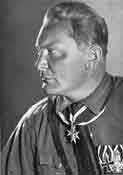
Hermann
Goering was a Nazi military leader, Commander of the Luftwaffe, President of the Reichstag, Prime Minister of Prussia and Hitler's designated successor.
Goering (born January 12, 1893; died October 15, 1946) was born in Rosenheim, Bavaria. The son of a judge who had been sent by Bismarck to South-West Africa as the first Resident
Minister Plenipotentiary, Goering entered the army in 1914 as an Infantry Lieutenant, before
being transferred to the air force as a combat pilot. The last Commander in 1918 of the
Richthofen Fighter Squadron, Goering distinguished himself as an air ace, credited with
shooting down twenty-two Allied aircraft. Awarded the Pour le Merite and the Iron Cross
(First Class), he ended the war with the romantic aura of a much decorated pilot and war hero.
After World
War I he was employed as a showflier and pilot in Denmark and Sweden, where he
met his first wife, Baroness Karin von Fock-Kantzow, whom he married in Munich in February
1922.
Goering's aristocratic background and his prestige as a war
hero made him a prize recruit to the infant Nazi
Party and Hitler appointed him to command the SA Brownshirts in
December 1922. Nazism offered the swashbuckling Goering the promise
of action, adventure, comradeship and an outlet for his unreflective,
elemental hunger for power.
In 1923 he took part in the Munich Beer-Hall
putsch, in which he was seriously wounded and forced to flee from
Germany for four years until a general amnesty was declared. He escaped
to Austria, Italy and then Sweden, was admitted to a mental hospital
and, in September 1925, to an asylum for dangerous inmates, becoming
a morphine addict in the course of his extended recovery.
Returning to Germany in 1927, he rejoined the NSDAP and was elected as one of its first deputies to the Reichstag a year
later. During the next five years Goering played a major part in smoothing
Hitler's road to power, using his contacts with conservative circles,
big business and army officers to reconcile them to the Nazi Party and
orchestrating the electoral triumph of 31 July 1932 which brought him the Presidency of the Reichstag.
Following Hitler's appointment as Chancellor on 30
January 1933,
Goering was made Prussian Minister of the Interior, Commander-in-Chief
of the Prussian Police and Gestapo and Commissioner for Aviation. As
the creator of the secret police, Goering, together with Himmler (q.v.) and Heydrich (q.v.),
set up the early concentration camps for political opponents, showing
formidable energy in terrorizing and crushing all resistance.
Under the pretext of a
threatened communist coup, Prussia was “cleansed” and hundreds of officers and thousands of
ordinary policemen were purged, being replaced
from the great reservoir of SA and SS men
who took over the policing of Berlin. Goering
exploited the Reichstag fire —
which many suspected that he had engineered — to
implement a series of emergency decrees
that destroyed the last remnants of civil
rights in Germany, to imprison communists
and Social Democrats and ban the left-wing
press. He directed operations during the Blood
Purge, which eliminated his rival Ernst
Rohm and other SA leaders on 30 June 1934.
On 1 March 1935 he was appointed Commander-in-Chief of the Air Force and, with Udet
and Milch, was responsible for organizing the rapid build-up of the
aircraft industry and training of pilots. In 1936 his powers were further extended by his appointment as Plenipotentiary
for the implementation of the Four Year Plan, which gave him virtually
dictatorial controls to direct the German economy. The creation of the
state-owned Hermann Goering Works in 1937,
a gigantic industrial nexus which employed 700,000 workers and amassed
a capital of 400 million marks, enabled him to accumulate a huge fortune.
Goering used his position to indulge in ostentatious
luxury, living in a palace in Berlin and building a hunting mansion
named after his first wife Karin (she had died of tuberculosis in 1931)
where he organized feasts, state hunts, showed off his stolen art treasures
and uninhibitedly pursued his extravagant tastes. Changing uniforms
and suits five times a day, affecting an archaic Germanic style of hunting
dress (replete with green leather jackets, medieval peasant hats and
boar spears), flaunting his medals and jewelry, Goering's transparent
enjoyment of the trappings of power, his debauches and bribe-taking,
gradually corrupted his judgment. The "Iron Knight," a curious
mixture of condottiere and sybarite, "the last Renaissance man"
as he liked to style himself with characteristic egomania, increasingly
confused theatrical effect with real power. Nevertheless, he remained
genuinely popular with the German masses who regarded him as manly,
honest and more accessible than the Fuhrer, mistaking his extrovert
bluster and vitality for human warmth.
Goering's cunning, brutality and ambition were displayed
in the cabal he engineered against the two leading army Generals, von
Fritsch and von Blomberg,
whom he helped to bring down in February 1938,
in the misplaced hope that he would step into their shoes. Following
the Crystal Night [Kristallnacht]
pogrom of 9 November 1938, it was Goering who fined the German Jewish
community a billion marks and ordered the elimination of Jews from the
German economy, the "Aryanization" of their property and businesses,
and their exclusion from schools, resorts, parks, forests, etc. On 12
November 1938 he warned of a "final reckoning with the Jews"
should Germany come into conflict with a foreign power. It was also
Goering who instructed Heydrich on 31 July 1941 to "carry out all preparations with regard to . . . a general solution
[Gesamtlosung] of the Jewish question in those territories of Europe
which are under German influence.. . ."
Goering identified with Hitler's territorial aspirations,
playing a key role in bringing about the Anschluss in 1938 and the bludgeoning
of the Czechs into submission, though he preferred to dictate a new
order in Europe by "diplomatic" means rather than through
a general European war. Appointed Reich Council Chairman for National
Defence on 30 August 1939 and officially designated as Hitler's successor on 1 September, Goering
directed the Luftwaffe campaigns against Poland and France, and on 19
June 1940 was promoted to Reich Marshal.
In August 1940 he confidently threw himself into the great offensive against Great
Britain, Operation Eagle, convinced that he would drive the RAF from
the skies and secure the surrender of the British by means of the Luftwaffe
alone. Goering, however, lost control of the Battle
of Britain and made a fatal, tactical error when he switched to
massive night bombings of London on 7 September 1940 just when British
fighter defences were reeling from losses in the air and on the ground.
This move saved the RAF sector control stations from destruction and
gave the British fighter defences precious time to recover. The failure
of the Luftwaffe (which Hitler never forgave) caused the abandonment
of Operation Sea Lion, the planned invasion of England,
and began the political eclipse of Goering. Further failures of the
Luftwaffe on the Russian front and its inability to defend Germany itself
from Allied bombing attacks underlined Goering's incompetence as its
supreme commander. Technical research was run down completely, not surprisingly
with a Commander-in-Chief who prized personal heroism above scientific
know-how and whose idea of dignified combat was ramming enemy aircraft.
Goering rapidly sank into lethargy and a world of
illusions, expressly forbidding General Galland to report that enemy
fighters were accompanying bomber squadrons deeper and deeper into German
territory in 1943.
By this time Goering had become a bloated shadow of his former self,
discredited, isolated and increasingly despised by Hitler who blamed
him for Germany's defeats. Undermined by Bormann's intrigues, overtaken in influence by Himmler, Goebbels and Speer, mentally humiliated by his servile dependence on the Fuhrer,
Goering's personality began to disintegrate. When Hitler declared that
he would remain in the Berlin bunker to the end, Goering, who had already
left for Bavaria, misinterpreted this as an abdication and requested
that he be allowed to take over at once; he was ignominiously dismissed
from all his posts, expelled from the Party and arrested. Shortly afterwards,
on 9 May 1945,
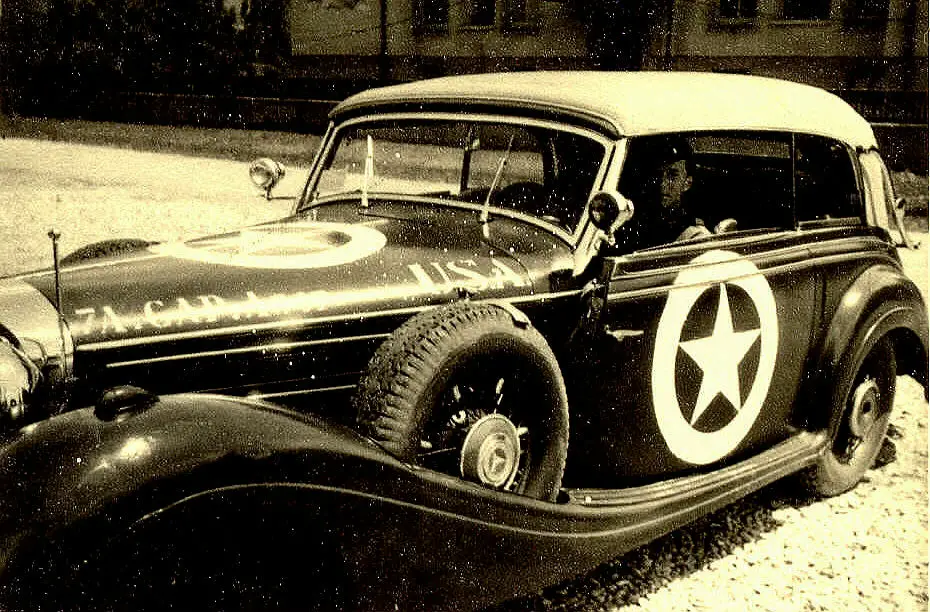
Goering was captured by forces of the American Seventh Army and, to
his great surprise, put on trial at Nuremberg in 1946.