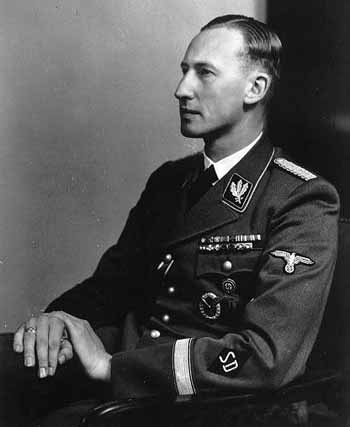
In a time of barbarity, Reinhard
Tristan Heydrich, “the Hangman,” stood out as one of the
cruelest and most brutal mass murderers in Nazi
Germany. Those who worked Heydrich feared him, as did those who
were unfortunate enough to be under his control. Heydrich's own protégé, Walter Schellenberg,
described him as a man with "a cruel, brave and cold intelligence"
for whom "truth and goodness had no intrinsic meaning." (1) On the side, Heydrich was a fencer, a musician and a pilot.
As his main job, Heydrich murdered thousands of Jews and other "enemies"
of the Reich.
Heydrich was born on March 7, 1904, in Halle an
der Salle, Germany. His father, Bruno, was a non-religious singer and
composer who was kept out of the upper echelons of German society due
to a humble background and a persistent, though false, rumor that he
was Jewish. Reinhard's mother, Elizabeth Kranz, was a practicing
Catholic from a rich musical family in Dresden. As Reinhard grew up,
both his father and his classmates inculcated him with a virulent
anti-Semitism. He was a loner who tried to prove his superiority
through his studies and through sports.
Heydrich was in his early teens during World War I. When
Germany lost the war, he followed his family's example in blaming the
Jews for his country's defeat. At 15, he joined the paramilitary Maracker
Freikorps, a band that fought against revolutionary groups in Germany.
He later enlisted in a home defense force and joined the Deutscher Schutz
und Truzbund, a nationalist and anti-Semitic organization. At age 18, he began work as an officer cadet in the Kiel
naval dockyard. Six years later, he was promoted to first lieutenant
and for the next three years, from 1928 to 1931, he worked in naval
intelligence. He was a womanizer until he met Lina von Osten, a member
of a nationalist, anti-Semitic family, and asked her to marry him. While
they were engaged, Heydrich was brought to naval court by a girl who
claimed he had tried to seduce her. In April 1931, he was discharged
from the Navy. In June 1931, he joined the Nazi party as a member of
the SA, a group of thugs who fought street battles and barroom brawls
against communists.
In July 1931, he moved to Heinrich
Himmler's chicken farm in Bavaria and subsequently became an intelligence
officer in the SS in Munich.
He married von Osten in December and asked Himmler and Ernst
Rohm to be the godfathers of his first child, Klaus.
Heydrich earned a reputation for toughness and jailed
a man for declaring that Heydrich did not have Aryan ancestry. He spent
two years creating and building up the SD,
a Nazi intelligence agency. Under Heydrich, the SD watched for dissent within the party and created files on all the Jews
in Germany. Over time, Heydrich and Himmler used the power of political
police forces to consolidate Nazi control throughout Germany. By April
1934, Heydrich ran the Prussian Gestapo,
the largest political police force in the Reich, also known as the Security
Police. In 1935, he described the police as "the state's defensive
force that could act against the legally identifiable enemy" with
the SS as "the offensive
force that could initiate the final battle against the Jews." (2)
As violence against Jews grew with Kristallnacht in 1938, Heydrich continued to control the police force. His orders
included: "Whatever actions occurred should not endanger German
lives or property; synagogues could be burned only if there was no
danger to the surrounding buildings. Healthy, nonelderly adult Jewish
males were to be seized first, and concentration
camps notified." (3)
On September 21 1939, Heydrich hosted a conference
at which he stressed the necessity of keeping the Jews in "as
few concentration centers as possible," as a prerequisite for
the "ultimate aim." (4) He
also mandated the creation of a Council of Jewish Elders to ensure
that all orders given to the Jews were executed. If they were not,
the Council members were to be threatened with "the severest
measures." (5)
At a meeting on November 12, 1938, Heydrich stated
that simply restricting the Jews, whom he called "the eternal subhumans," (6) was insufficient, one had to completely get rid of them.
On January 24, 1939, Field Marshal Hermann Goering told Heydrich to solve the "Jewish problem" by "emigration
and evacuation." (7) Goering created
an agency for Jewish emigration and gave it over to Heydrich. In June
1940, after 200,000 Jews had emigrated, Heydrich wrote to the Reich
Foreign Secretary Joachim von Ribbentrop that emigration alone could
not take care of all the Jews and that "A territorial Final
Solution has thus become necessary." (8) In May 1941, Heydrich sent his underlings out with the message that
due to the pending "Final Solution," emigration of Jews from
France and Belgium was forbidden.
Heydrich was involved in the execution of this "Final
Solution" from the start. In the summer of 1939, Himmler assigned
the job of mass murder to the Einstatzgruppen,
killing squads under the control of Heydrich's security police. Most
of the commanders came from Heydrich's SD. Heydrich oversaw the massacre
of thousands of Jews, Polish leaders, communists and clergymen. He once
commented, "We have had to be hard. We have had to shoot thousands
of leading Poles to show how hard we can be." (9) In 1941, after the SS established extermination
camps in Poland,
Heydrich took the job of coordinating the deportation of European Jews
to these camps.
On January 20, 1942, Heydrich invited senior
officials from state and party offices to a conference in Wannsee,
Berlin. He revealed to them his plan for the "Final
Solution," which included Europe being "combed through from
west to east for Jews." (10) According to Heydrich, these eleven million Jews would be held in
transit ghettos, then sent east to form work gangs to build roads.
Many would "doubtless …fall away through natural
reduction" and those who survived would "be dealt with
appropriately." (11) Heydrich
did not mention the fate of Jews who were not fit to work, but
according to attendee Adolf
Eichmann, Heydrich's murderous intentions were obvious and
understood.
On September 24, 1941, Hitler appointed Heydrich Reich Protector of Bohemia-Moravia. This position
gave Heydrich the power to crush Czech resistance and to push for deportations
of Czech Jews to Poland.
On May 27, 1942 at approximately 10:30 am, two Czech
patriots, Jan Kubis and Josef Gabcik, parachuted from Britain into Prague,
ambushed Heydrich's Mercedes and threw a bomb into the front seat. Heydrich
was seriously wounded and the driver of a baker's van took him to the
Bulkova hospital. He remained in critical condition for days. On May
29, Joseph Goebbels blamed
Jewish terrorists for the attack, arrested 500 Berlin Jews and warned
the leaders of the Jewish community that "for every Jewish act
of terrorism or sedition, one hundred or one hundred fifty of the Jews
in our hands will be shot." (12) He also charged a crowd of Jews in the Sachsenhausen concentration camp with conspiracy and shot them on the spot. Nazi leaders
proclaimed a state of emergency and a curfew in Prague. They offered
a reward of 10,000,000 crowns for the capture of Heydrich's attackers.
A wave of Nazi executions swept the Czech areas and the entire villiage
of Lidice was wiped out. An SS general in charge of the deportation
of Jews to Treblinka, Belzec and Sobibor named the operation "Operation
Reinhard" after Heydrich.
Meanwhile, Heydrich's condition deteriorated and
he died on June 4 from "wound infection." Himmler delivered
the key address at a state funeral on June 9. Hitler recognized
Heydrich at the funeral for his contribution to Nazism.
Since the war, the man who felt it was his duty
"to save the world from intellectual and moral decay" (13) has become notorious as one of the most heinous Nazi
war criminals of the Holocaust. The
surviving comrades of Heydrich's assassins erected a monument in
their honor.