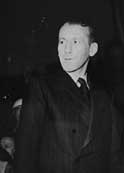
Ernst Kaltenbrunner was born on 4 October 1903 at Ried on Inn (near
Braunau) Austria. He spent his youth in Hitler's native district. Later
he moved to Linz, where he attended the State Realgymnasium. He studied
law and obtained a law degree in 1926. He spent the first year as apprentice
lawyer at Linze-on-Danube and then worked as a lawyer-candidate, first
at Salzburg and after 1928 at Linz (2938-PS).
Kaltenbrunner joined the Nazi Party and the SS in Austria in 1932.
Prior to 1933 he was the District speaker (Gauredner) and legal counsellor
(Rechtsberater) of the SS division (Abschnitt) VIII. After 1933 he was
the fuehrer of regiment (Standarte) 37 and later of the SS division
VIII (2892-PS).
In January 1934 Kaltenbrunner was jailed by the Dollfuss government
on account of his Nazi views, and sent with other leading National-Socialists
into the concentration camp Kaisersteinbruch. He is said to have started
and led a hunger strike of the prisoners and thereby to have forced
the government to dismiss 490 National Socialist prisoners. In the following
year he was jailed again because of suspicion of High Treason and committed
to the military court at Wels (Upper Danube). After an investigation
of many months the accusation of High Treason was dropped, but he was
condemned to six months' imprisonment for conspiracy. His right to practice
law was suspended because of his Nazi activities (2938-PS).
After the Spring of 1935 Kaltenbrunner was the leader of the Austrian
SS. In the magazine of the SIPO and SD, issue of 15 May 1943, it is
stated:
"It redounds to his credit that in this important position
he succeeded through energetic leadership in maintaining the unity
of the Austrian SS, which he had built up, in spite of all persecution,
and succeeded in committing it successfully at the right moment. After
the annexation, in which the SS was a decisive factor, he was appointed
State Secretary for Security Matters on 11 March 193& in the new
National Socialist cabinet of Seyss-Inquart. A few hours later he
was able to report to Reichsfuehrer SS Heinrich Himmler, who had landed
at Aspern, the Vienna airport, on 12 March 1938, 3 a.m., as the first
National Socialist leader, that the Movement had achieved a complete
victory and that 'The SS is in formation and awaiting further orders.'
" (2938-PS)
Hitler promoted Kaltenbrunner on the date of the Anschluss to the rank
of SS Brigadefuehrer and leader of the SS Oberabschnitt Donau. On 9/11/1938
he was promoted to the rank of SS Gruppenfuehrer. During the liquidation
of the Austrian national government and the reorganization of Austria
into Alps and Danube Districts, he was appointed Higher SS and Police
Leader of the governors of Vienna, Lower Danube, and Upper Danube, in
Corps Area (Wehrkreis) XVII, and in April 1941 was promoted to Major
General of the Police (2938-PS).
On 30 January 1943 Kaltenbrunner was appointed Chief of the Security
Police and SD (RSHA), succeeding Heydrich, who had been assassinated
in Prague in June 1942. Kaltenbrunner held this position until the end
of the war (2644-PS).
On 4 October 1943 at Pozen, Poland, in a speech delivered to Gruppenfuehrers
of the SS, Himmler. made special reference to "our comrade Obergruppenfuehrer
Kaltenbrunner, who has succeeded our fallen friend Heydrich" (1919-PS).
On 9 December 1944 the decoration known as the Knight's Cross of the
War Merit, Cross with Swords, was given to SS Obergruppenfuehrer and
General of the Police Dr. Ernst Kaltenbrunner, Chief of the Security
Police and the SD (2770- PS). -In addition he held the Golden insignia
of Honor and the Blutorden. He was a member of the Reichstag after the
9th election period 1938 (2892-PS).
Toward the end of the war, Kaltenbrunner's power increased greatly,
especially after the attack on Hitler of 20 July 944. He gained direct
access to Hitler. He was very friendly with Fegelein and his wife, who
was the sister of Eva Braun. So powerful had Kaltenbrunner become toward
the end that even Himmler feared him. On 13 April 1945 the chief of
the German foreign intelligence service, Schellenberg, asked Himmler
to receive the representative of the Jewish World Congress, Mr. Storsch,
from Stockholm, and Himmler said,
"But how am I going to do that in regard to Kaltenbrunner? I
shall then be completely at his mercy!" (2990 PS).
As Chief of the Security Police after 30 January 1943, Kaltenbrunner
was the head of the RSHA and the regional offices of the Gestapo, SD,
and Kripo. Directly under Kaltenbrunner were the Chiefs of the main
offices of the RSHA, including Amt III (the SD), Amt IV (the Gestapo),
Amt V (the Kripo), and Amt VI (the SD in foreign intelligence) (L-219).
Kaltenbrunner had direct responsibility over the offices of the RSHA.
All important matters had to be referred to him or had to be handled
under general or special authority granted by him to office chiefs.
"All decisions of principal character are signed by the Chief
of the Security Police personally. An office chief has only the authority
to sign 'acting for' and a chairman 'by order of' if the subjects
treated in the respective decrees fit into the general laid-down principles
according to the plan of distribution of authority. Ir. case of doubt
it was the duty to get the question cleared up by reporting it to
the Chief of Security Police and SD." (L-34)
"To my knowledge no chief of office or any of the officials
of the RSHA, authorized to sign, had the right to sign in any principal
affairs of particular political significance without consent of the
Chief of the Security Police -- not even during his temporary absence.
From my own experience I can furthermore declare that the chief of
Amt IV, Mueller, particularly was very hesitant in signing documents
concerning questions of general nature and in some cases of greater
importance, and that he put aside events of such nature in most cases
for the return of the Chief of the Security Police, whereby often
much time was lost." (L-50).
Schellenberg, the Chief of Amt VI of the RSHA, has stated:
"I know of no limitation placed on Kaltenbrunner's authority
as Chief of the Security Police and SD (RSHA). He promptly entered
upon the duties of the office and assumed direct charge of the office
and control over the Amts *** He made it very clear in his official
relations with all of us who were his Amt Chiefs that he was the head
of the office exercising full executive powers and deciding all matters
of policy. He permitted us to issue directives within the organization
in our own names pursuant to fixed policies established by him, but
all important matters had to be submitted to him whether he signed
them or we signed them. He was constantly informed of all matters
of importance which went on in the entire organization. (2939-PS)
During Kaltenbrunner's term in office as Chief of the Security Police
and SD, the following crimes were committed by the SIPO and SD pursuant
to policy established by the RSHA or orders issued out of the RSHA for
all of which he was responsible by virtue of his office.
(1) Mass murders of civilians of occupied countries
by Einsatz Groups. A general discussion of this and the following
twelve crimes of the Gestapo and SD appears in Section 6 of Chapter
XV. That this crime continued after January 1943 is shown by the following
documents: 3012-PS; 2752-PS; 2890-PS.
(2) Screening of prisoner of war camps and executing
racial and political undesirables. That this crime continued after
January 1943 is shown by the following document: 2622-PS.
(3) The taking of recaptured prisoners of war to
concentration camps, where in some cases they were executed. That
this crime continued after January 1943 is shown by the following documents:
1650-PS; L-158; 1514-PS.
(4) Establishing concentration camps and committing
racial and political undesirables to concentration and annihilation
camps for slave labor and mass murder. That this crime continued
after January of 1943 is shown by the following documents: D-50; D-46;
L-41; 701-PS.
(5) Deportation of citizens of occupied countries
for forced labor and disciplining of forced labor. That this crime
continued after January 1943 is shown by the following document: 3012-PS;
1063-B-PS.
(6) The execution of captured commandos and paratroopers
and protection of civilians who Iynched Allied fliers. That this
crime continued after January 1943 is shown by the following documents:
1276-PS; 532-PS; 526-PS; R-110; 745-PS.
(7) The taking of civilians of occupied countries
to Germany for secret trial and punishment. That this crime continued
after January 1943 is shown by the following document: 835- PS.
(8) Punishment of citizens of occupied territories
under special criminal procedure and by summary methods. That this
crime continued after January 1943 is shown by the following document:
L-5.
(9) The execution and confinement of persons in
concentration camps for crimes allegedly committed by their relatives. That this crime continued after January 1943 is shown by the following
document: L-37.
(10) Seizure and spoliation of public and private
property. That this crime continued after January 1943 is shown
by the following documents: 2620-PS; L-18.
(11) Murder of prisoners in SIPO and SD prisons. That this crime continued after January 1943 is shown by the following
document: L-53.
(12) Persecution of Jews. That this crime continued
after January 1943 is shown by the following documents: L-18; 1061-
PS; 2375-PS; 2605-PS.
(13) Persecution of the churches. That this
crime continued after January 1943 is shown by the following document:
1815- PS.
(1) Kaltenbrunner was fully cognizant of conditions
in concentration camps and of the fact that concentration camps were
used for slave labor and mass murder. Mauthausen concentration camp
was established in Austria while Kaltenbrunner was the Higher SS and
Police Leader for Austria, and was frequently visited by Kaltenbrunner
before he was appointed Chief of the Security Police and SD (L-51).
On the occasion of one such visit in 1942, Kaltenbrunner personally
observed the gas chamber in operation (2753-PS). After he became Chief
of the Security Police and SD, Kaltenbrunner visited Mauthausen concentration
camp but with less frequency (L-51). On one occasion he made an inspection
of the camp grounds with Himmler and had his photograph taken during
the course of the inspection (2641-PS). After a visit to Mauthausen
in 1944 Kaltenbrunner reported to his Amt Chiefs with pride that he
had helped to build up Mauthausen when he was Higher SS and Police Leader
in Austria and that the camp was engaged in valuable armament work (2990-PS).
Mauthausen concentration camp was classified by Heydrich in January
1941 in category III, a camp for the most heavily accused prisoners
and for asocial prisoners who were considered incapable of being reformed
(1063-A-PS).
There were frequent conferences between the RSHA and executives of
the SS Wirtshaft and Verwaltungshauptamt who had charge of the internal
administration of concentration camps. The affidavit of Rudolf Mildner
states with respect to these conferences:
"SS Obergruppenfuehrer Dr. Kaltenbrunner attended personally
conferences with SS Obergruppenfuehrer Pohl, Chief of the SS Wirtschaft
and Verwaltungshauptamt and Chief of the concentration camps. Due
to these conferences and through talks with the Chief of Office Gruppenfuehrer
Mueller of Amt IV and Gruppenfuehrer Nebe of Amt V, the Chief of the
Security Police and SD, SS Obergruppenfuehrer Dr. Kaltenbrunner, must
have known the state of affairs in the concentration camps."
(L-35)
(2) With full knowledge of conditions in and the
purpose of concentration camps, Kaltenbrunner ordered or permitted to
be ordered in his name the commitment of persons to concentration camps. All orders for protective custody other than short-term confinements
were issued in the name of Kaltenbrunner as Chief of the Security Police
and SD and bore the facsimile stamp of his signature (2477-PS).
The commandant of Buchenwald concentration camp in his affidavit
"With the exception of the mass delivery of prisoners from the
concentration camps of occupied territories, all prisoners were sent
to the concentration camp Buchenwald on orders of the Reichssicherheitschauptamt,
Berlin. These preventive arrest orders (red blanks) were in most cases
signed with the name Kaltenbrunner. The few other preventive arrest
orders were signed with 'Foerster."
On 7 July 1943 an order for protective custody was issued by the Gestapo
(Amt IV C 2, RSHA) bearing the facsimile signature of Kaltenbrunner,
to be sent in the form of a telegram to the Gestapo office in Koeslin
in the case of a woman whose offense was stated to be failure to work,
work sabotage, and asocial conduct. She was ordered to be confined in
the concentration camp at Ravensbrueck (2745- PS).
On 19 January 1944 a warrant for protective custody was issued by the
Gestapo (Amt IV C 2 of the RSHA) certified as signed by Kaltenbrunner,
to a British subject, C. S. James, on the grounds that he had been proven
guilty of activities to the detriment of the German Reich, and that
there was reason to expect that he would, if released, commit acts prejudicial
to the Reich (1574-PS).
Other instances of commitments to various concentration camps on orders,
signed by Kaltenbrunner, are contained in the dossiers of 25 Luxembourgers
committed to concentration camps by the Einsatzkommando of the Sipo
and SD in Luxembourg during the year 1944. The concentration camps to
which the persons were committed included Dachau, Natzweiler, Sachsenhausen,
and Buchenwald. Among the grounds were: "strongly suspected of
working to the detriment of the Reich; " "spiteful statements
inimical to Germany as well as aspersions and threats against persons
active in the National Socialist movement;" "strongly suspected
of aiding desertion;" "as relative of a deserter expected
to take advantage of every occasion to harm the German Reich."
(L- 215).
Further orders for commitments to concentration camps are contained
in file of 42 telegrams, all issued by the RSHA, Amt IV A 6, Prague,
to the Gestapo Office at Darmstadt, and all signed by Kaltenbrunner,
during the period from 20 September 1944 to 2 February 1945. The concentration
camps to which people were sent included Sachsenhausen, Ravensbrueck,
Buchenwald, Dachau, Bergen-Belsen, Flossenburg, and Theresienstadt.
Nationalities included Czech, German, French, Dutch, Italian, Corsican,
Lithuanian, Greek, and Jew. Grounds included "refusal to work;"
"religious propaganda;" "sex relations with PWs;"
"communist statements;" "loafing on job;" "working
against the Reich;" "spreading of rumors detrimental to morale;"
"Aktion Gitter;" "breach of work contracts;" "statements
against Germany;" "assault of foreman;" "defeatist
statements;" "theft and escape from jail" (2239-PS).
(3) Kaltenbrunner authorized executions in concentration
camps. Adolf Zutter, the adjutant of Mauthausen concentration camp,
avers that, until the assassination of Heydrich, orders for executions
at Mauthausen were signed by Heydrich or his substitute, and that after
Kaltenbrunner became Chief of the Security Police and SD they were signed
either by Kaltenbrunner or by his substitute, Mueller. Zutter mentions
a specific instance in which Kaltenbrunner ordered the execution of
a group of 12 to 15 uniformed members of an American military mission
(L-51).
(4) Kaltenbrunner had knowledge of the commitment
of thousands of Warsaw Poles to concentration camps and refused to release
them. During the suppression of the Warsaw uprising of 1944, about 50,000
to 60,000 inhabitants of Warsaw were sent to concentration camps.
As a result of entreaties by Hans Frank to Himmler the deportation was
stopped. Frank and Buehler, his State Secretary, requested Kaltenbrunner
to release the persons who had been committed. Kaltenbrunner refused
to release them on the grounds they were employed in making secret weapons
for the Reich and declared that the number transported into concentration
camps in the Reich was small. Buehler verified the fact that the number
of persons so placed in concentration camps for forced labor was 50,000
to 69,999 (2476-PS) .
(5) Kaltenbrunner controlled the deportation of
Poles, Jews, and other non-Germans from Poland. Otto Hofmann, former
Chief of the SS Main Office for Race and Settlement Matters, stated:
"The execution of all so-called resettlement actions, that is,
the sending away of Polish, Jewish, and people of non-German blood,
inhabitants of a territory in Poland destined for Germanization was
in the hands of the Chief of the RSHA, Heydrich, and, since the end
of 1942, Kaltenbrunner." (L-49)
(6) Kaltenbrunner ordered the deportation of Jews
from Der mark. In, September 1943 Himmler ordered the Danish Jews
arrested and shipped to Stettin and from there to Theresienstadt concentration
camp. Mildner, the Chief of the Sipo and SD, telegraphed the RSHA to
request that the Jewish persecutions be stopped. In reply he received
an order from Himmler through Kaltenbrunner to carry out the anti-Jewish
action. Shortly thereafter Mildner flew to Berlin to speak to Kaltenbrunner
personally about the matter. In Kaltenbrunner's absence he spoke to
Mueller. After his return to Copenhagen, Mildner received a direct order
from Himmler through Kaltenbrunner to carry out the anti-Jewish actions
immediately (2375-PS).
(7) Kaltenbrunner personally exercised punitive
authority over foreign workers. By order of Kaltenbrunner Labor
Reformatory Camps were established under the exclusive jurisdiction
of the Security Police (106-B-PS).
In addition to sending workers to Labor Reformatory Camps, Kaltenbrunner,
through orders for protective custody signed by him or by facsimile
of his signature, committed workers to concentration camps. On 9 February
1945 a French citizen was sent to Buchenwald by order of Kaltenbrunner
for shirking work and insubordinate behavior. On 18 June 1943 a Pole
was sent to Natzweiler "to be used as a skilled worker" by
order of Kaltenbrunner. On 2 December 1944 a citizen of the Netherlands
was taken into protective custody "for work sabotage" by order
of Kaltenbrunner. On 2 December 1944 a French citizen was taken into
protective custody for "work sabotage and insubmissive" (2582-PS;
2580-PS).
(8) Kaltenbrunner personally attended to matters
against Jews and political and concentration camp internees in the Protectorate. A memorandum found among Kaltenbrunner's personal effects states in
"Radio message to Gruppenfuehrer Fegelein Hq. of the Fuehrer
through Sturmbannfuehrer Sansoni, Berlin.
"Please report to RF SS and to the Fuehrer that all arrangements
against Jews, political and concentration camp internees in the Protectorate
have been taken care of by me personally today"
(9) Kaltenbrunner personally ordered the Sipo and
SD to encourage the populace to lynch American and English flyers.
In 1944 at a conference of Amt Chiefs Kaltenbrunner said:
"All offices of the SD and the security police are to be informed
that pogroms of the populace against English and American terror-fliers
were not to be interfered with; on the contrary, this hostile mood
is to be fostered" (2990-PS).
(10) Kaltenbrunner personally worked out the form
of justification to be submitted to cover up the execution of prisoners
of war. In connection with the shooting of some 50 recaptured prisoners
of war who had escaped from a prisoner of war camp near Breslau, Kaltenbrunner
worked out with Mueller and Nebe the false reasons which were to be
given to the Red Gross, that is, that they had been killed by bomb attacks,
or shot while escaping or resisting arrest (2990- PS).