Prague
by Rebecca Weiner
Prague, nicknamed the Golden City, is the capital of
the Czech Republic and ancient Bohemia. Today,
Prague looks like a fairytale village and is more beautiful than at
any other time during its one thousand-year history. The Jewish population of Prague today is approximately 5,000.
- Early History
- Prague Renaissance
- World War II
- Post-World War II
- Jewish Community Today
- Jewish Tourist Sites
Early History
Documentary evidence reveals that Jews have lived in Prague
since 970 C.E. By the end of the 11th century, a Jewish community
had been fully established.
In the late 11th century and early 12th century, the Jews of Prague suffered from persecution: first, in 1096,
at the hands of the Crusaders, and second, during the siege of
the Prague Castle in 1142. During the siege, the oldest synagogue in
Prague and sections of the Jewish quarter on the left side of the Vltava (Moldau) River near the castle were burned
down. Many survivors of the crusades were forced to convert to Christianity.
In 1179, the church announced that Christians should avoid touching Jews. In this period, civil rights granted to Jews were severely limited and
they were forced to build their community on the right bank of the Vltava, close to Staromestske Namesti, the Old Town Square.
This limited their movements and identified them as a minority group.
This was the origin of the Jewish ghetto. By day movement was free, but in the evening and on festivals the gates of the ghetto were locked.
The situation did not improve in the early 13th century. In 1215, the Fourth Lateran Council mandated that Jews must
wear distinctive clothes, were prohibited from holding public office
and were limited in the amount they could charge for interest on loans.
Jews were also considered servants (servi camerae) of the Royal
chambers.
During the early to mid 14th century, Emperor
Charles IV and his son/successor, Wenceslas, relinquished some of their
power over the Jewish community and allowed others to manage Jewish
affairs in return for a large sum of money. Charles IV and Wenceslas
allowed estates to renege on loans owned to Jewish lenders. This was
the beginning of the power struggle, which lasted into the 15th and 16th centuries, between royalty, Burgher landowners and
the countryside nobility over the control of Jewish affairs and finances.
During Easter 1389, members of the Prague clergy announced
that Jews had desecrated the host (Eucharistic wafer) and the clergy
encouraged mobs to pillage, ransack and burn the Jewish quarter. Nearly
the entire Jewish population of Prague (3,000 people) perished. Many
of the remaining women and children were baptized. One of the few survivors,
Rabbi Avigdor Kara (who lived until 1439 and whose tomb is preserved
in the Old Jewish Cemetery), wrote a moving elegy describing the attack;
this elegy is still read every year in Prague on Yom
Kippur.
In the 15th century, the Hussite Wars brought
a decline in royal authority. A new political balance existed that favored
the nobility and Burgher (middle class residents of the cities) and
landowners living in the countryside. Jews were forced to pledge allegiance
to various groups and to give them money in return for protection. However,
it was unclear which side could offer the best protection, leaving Jews
to play one side off the other. During this period, the Burgher populations
within the cities began to take jobs once held by Jews, such as banking.
In the second half of the 15th century,
the first Hebrew press was established in Prague. In the beginning it
was small, but it began to grow and gain a reputation around Europe,
especially for its Passover Haggadah,
which became the model in Europe for subsequent haggadot.
Prague Renaissance
The 16th century is considered to be the
age of the Prague Renaissance. The ghetto became a center of Jewish mysticism. Artisans and intellectuals came from
all over Europe and congregated in Prague. For the most part, Jews were
isolated from the “high” culture outside their community;
however, a number of Jews became mathematicians, astronomers, geographers,
historians, philosophers and artists and participated in the Renaissance.
 Grave of the Maharal of Prague
 |
In 1501, the landed nobility, called the Bohemian Lantag,
reaffirmed the ancient privileges of the Jews of Prague and fostered
an open atmosphere for economic activity.
From 1522 to 1541, the Jewish population of Prague almost
doubled; many Jewish refugees, who were expelled from Moravia, Germany, Austria and Spain, came to Prague. The Jewish Quarter officially became
the ghetto, however, its transition was not marked by any known legislation.
During this period, the ghetto expanded because Jews were given permission
to acquire lands adjacent to the ghetto to be used to build homes.
In 1541, a struggle between Ferdinand I and the Burghers
resulted in a Burgher demand that Jews be expelled from Prague. Ferdinand
I announced the Jews would have to leave Prague, but lifted the ban
four years later (the actual expulsion only lasted two years since the
ban only went into effect two years after it was announced). Another
temporary expulsion for the Jews of Prague took place in 1557. Following
Ferdinand’s death in 1564, the situation improved for Prague Jewry.
During the reign of Maximilian (1564-1576) and Rudolf
II (1576-1612), there was a golden age for Jewry in Prague. Rudolph
was considered a weak leader and was indifferent to the Catholic Counter-Reformation
in the Hapsburg Empire. This allowed a large number of scientists and
intellectuals to assemble in Prague and speak and practice without impediments
from the church. Economic freedom was given to the Jews and a flowering
of Jewish culture occurred.
One of the famous Jewish scholars and educators of
the time was Rabbi Judah Loew
ben Bezalel (1525-1609), also known as the Maharal. Rabbi Loew published
more than 50 religious and philosophical books and became the center
of legends, as the mystical miracle worker who created the Golem.
The Golem is an artificial man made of clay that was brought to life
through magic and acted as a guardian over the Jews. The Maharal had
positive relations with Rudolph II and was even invited to his castle. About 7,000 Jews lived in Prague during the time of Rabbi Loew.
Three other well-known Jewish figures of the time were
David Gans (1541-1613), a mathematician, historian and astronomer; Jacob
Bashevi (1580-1634), a financier and the first Jew to be knighted under
the Hapsburg Empire; and Mordechai Maisel, a brilliant financier, businessman
and philanthropist. Maisel served as the mayor of the Jewish town, sponsored
many Jewish organizations, funded the building of a public bathhouse,
ritual baths and an almshouse, and donated money to build the Jewish
town hall and numerous synagogues (including the High Synagogue). He
paid for the paving of the streets of the Jewish quarter, gave money
to charities to help feed the poor, clothe the needy and provide doweries
for poor women. Not only did Maisel contribute money for local causes,
he donated Torah scrolls to Jewish communities around the world, including Jerusalem. Maisel also maintained good relations with Rudolf II; he
helped Rudolph finance a war against Turkey and in return was given
permission to loan money.
In the early 18th century, more Jews lived
in Prague than anywhere else in world. In 1708, Jews accounted for one-quarter
of Prague’s population. Unfortunately, the golden age ended with
the ascension of Empress Maria Theresa who expelled the Jews from Prague
from 1745 to 1748.
The Jews returned to Prague, the gates of the ghetto were opened, and conditions improved
during the reign of Emperor Joseph II (1780-90). Joseph II issued the
Edict of Toleration in October 1781, which affirmed the notion of religious
tolerance. He allowed Jews to participate in all forms of trade, commerce,
agriculture and the arts. Jews were encouraged to build factories and
school systems. Jews were even allowed to attend institutions of higher
learning. In the chedar (study rooms), a western-style education
was encouraged. Jews were not only taught Hebrew and Yiddish, but also
basic accounting. The government also required Jews to switch their
business records from Hebrew and Yiddish to German to facilitate better
government monitoring. In fact, the Jews appreciated Joseph II so much
that they named the Jewish town, Josefov, after him, and this name still
exists today.
During
the 19th century, Jews gradually became emancipated. Temporary
civil equality was granted to Jews under the law in 1849. The ghetto
was abolished in 1852 and Josefov became a district of Prague. In the
1800s, Jews became caught up in the culture wars between the Czech-speaking
middle class and the German-speaking members of the Austro-Hungarian
Empire. From the 1830s to the 1870s, Jews began to adopt the German
language and assimilated German cultural patterns. Following the 1870s,
however, the growth of Czech nationalism increased the level of antagonism
felt by the Jews. By the last quarter of the 19th century,
a network of Jewish institutions dedicated to Czech-Jewish acculturation
emerged; however, not all Jews supported them - some remained faithful
to German language and culture, while others favored the new ideology of Zionism.
In 1899, Zionism began
to become popular in Prague among the young professionals and students.
They formed their own Zionist organization, Bar Kochba, which published Selbstwehr (“Self-defense”), a Zionist biweekly publication in Prague from
1907 to 1938. Conflict between the Zionists and the Czech-Jewish nationalists
existed; Jewish nationalists (Zionists) did not want to be involved
in the national conflict over the usage of German and Czech language,
while the Czech-Jewish assimilationists were involved because they resented
the German denigration of Czech culture and also wanted to have a rapprochement
between Jews and Slavs in Czech lands.
German was spoken widely among many members of the
Prague Jewish community and continued to be taught despite the tensions
with the Czech-Jewish nationalists. During the first decades of the
20th Century, German-speaking Jews in Prague produced a large
body of internationally acclaimed literature. The most famous of these
writers were Franz Kafka, Max Brod and Franz Werfel. This is the last
generation of writers and intellectuals in Prague before the outbreak of World War II.
World War II
On March 14, 1939, Slovakia declared independence from Prague and signed
the Treaty of Protection with Nazi Germany.
The next day, Germany occupied Czech lands.
At the outbreak of World War II, over 92,000 Jews
lived in Prague, almost 20 percent of the
city’s population. Prague was one of the largest Jewish communities in Europe. At least two-thirds
of the Jewish population of Prague perished
in the Holocaust.
In the Czech Republic, about 26,000 members of the
Czech Jewish community escaped and emigrated to various countries and
regions, including Palestine, the United States, South America and Western Europe.
Not all Czech Jews were so fortunate. Of the vast marority of Czech Jews were imprisoned
in Terezin, 80 percent of
those were deported to Auschwitz, Maidanek, Treblinka and Sobibor. Other Czech
Jews were sent directly to death camps. Over 97,000 perished, of which were 15,000 Czech Jewish children. Only 132 of those children were known to have survived.
More than a quarter of a million Czechoslovak Jews were murdered in the Holocaust and more than 60 synagogues in the Czech lands were destroyed.
Post-World War II
Following the war, about 15,000 Czech Jews remained.
By 1950, half of them emigrated to Israel.
On May 9, 1945, as Germany was being defeated, the Soviet
Red Army entered Prague. A provisional government was installed, but the
Soviet presence enabled the Communist party to gain influence. In February 1948,
the provisional government was ousted, and the Communist Party took
power. From 1948 to 1949, the Soviet block supported the newly created State of Israel and therefore allowed Jews in the Czech Republic to immigrate to Israel. However, following 1949, emigration was virtually impossible and Jewish life
was stifled by the Communist regime. Under pressure from Stalin, its leaders were soon encouraged to stamo out religious and cultural activity, including Judaism. The regime demolished around 90 synagogues amd dozens of Jewish cemeteries were shut down.
In 1952, Rudolf Slansky, then general secretary of the Czech Communist Party, and 13 others were accused of being disloyal elements amd of participating in a Trotskyite-Zionist conspiracy against the Communist parties in Central Europe. Eleven of the 14 accused were Jewissh and eight among then were executed. In subsequent trials, hundreds of Jews were sentenced to long-term imprisonment, sent to hard labor withour trial and dismissed from their posts. Those Jews who remained in Prague kept their Jewish identity a secret during these times.
By the mid-1960s, the obvious anti-semitism was replaced with state anti-semitism. Communist rule was unpopular and ruthless, and a movement
demanding “socialism with a human face” gradually emerged in the 1960s.
In 1968, a Slovak Communist, Alexander Dubcek, became the party leader
and, in a movement called the Prague Spring, began to introduce sweeping
reforms to make the government more democratic. He ordered an end to censorship and encouraged Communist reformers to start a broad debate about the political direction of Czechoslovakia. Many young Jews were involved in the events of the Prague Spring and were now able to ask questions openly about the Holocaust and their Jewish heritage for the first time since World War II.
The Soviet Union disapproved
of these changes and, together with the troops of other Soviet-bloc/Warsaw Pact
countries, invaded Czechoslovakia in August 1968. Some 90 civilians were shot dead, and 3,400 Jews feld the country. The secret police kept a close eye on the remaining Jewish community and many Jewish university professors and intellectuals lost their jobs. The subsequent period
of so-called normalization wiped out all democratic trends and intensified
the stagnation in all spheres of life. From 1968 to 1989, the Holocaust could not be mentioned, since this was considered a subversive topic by the secret police and survivors were silenced.
As change began to sweep through Eastern Europe in
the late 1980s, Czechs more openly protested and called for reform. The 1980s also saw the West’s interest in Prague’s Jewish legacy growing. In 1983 to 1985, the Jewish Museum held its largest foreign exhibition called “Precious Legacy” in cities across the United States and Canada. The exhibition had a great impact on tourism in Prague, and the reforms of Soviet leader Mikhail Gorbachev were being broadcast and Communist attitudes began to change throughout Europe.
Demonstrations resulted in the resignation of the Communist party leadership
in November 1989. Alexander Dubcek, the Prague Spring reformer, was
elected chairman of parliament and dissident playwright Václav Havel,
the acknowledged opposition leader who led the “Velvet Revolution,” a series of strikes, pickets, and celebrations, was named president on December 29, 1989. In June 1990,
the country held its first free election since 1946. On January 1, 1993,
the country split into Slovakia and the Czech Republic. Prague, the historical capital of the region since the Ancient Kingdom, was adopted
as the capital of the Czech Republic.
After the election of President Havel, Jewish topics became enormously popular. Diplomatic relations with Israel, which were broken after the 1967 Six Day War, were restored. The process of restitution of Jewish property began immediately, and the Federation of Jewish Communities assembled around 1,000 records of communal Jewish property. The list was incorporated into a government bill.
The Pinkas Synagogue was reopened in 1992 as a permanent exhibition site of the Jewish Museum. The Maisel Synagogue was restored in 1995, followed by the Spanish Synagogue in 1998. Both are also part of the Jewish Museum. An educational and cultural center was established in 1996, that offers courses on Jewish culture, anti-semitism, Jewish tradition and religion. A program entitled “Neighbors Who Disappeared” assists people in tracing Jewish friends or neighbors.
Jewish Community Today
Today, the Federation of Jewish Communities says about 3,000 to 5,000 people are registered members of the Jewish
community in the Czech Republic, of which 1,600 live in Prague. Numbers are difficult to calculate due to decades of intermarriage and emigration. It is estimated that there are an additional 10,000 to 15,000 unregistered Jews living in the contry. A revival of Jewish life is occurring.
Many Jews found it easier to be quiet and hide their identity during
the Communist era and so many people learned of being Jewish only after
1989. The average age in Prague’s Jewish community has dropped
from 70 (the average age in the 1980s) to about 55 because of increased
involvement of younger Jews.
There are a number of secular Jewish organizations that fall under the auspices of the FJC, including the Union of Jewish Youth, a branch of the World Union of Jewish Students, sporting clubs Maccabi and Hakoach, the Women’s Zionist Organization, and the Terezin Initiative, a non-profit that pursues research into the history of the Nazi’s “Final Solution” in Bohemia and Moravia.
The center of Jewish life is the historic Jewish Town
Hall, which houses Jewish cultural, social and religious events. A Jewish
kindergarten, sponsored by the Lauder Foundation, recently opened in
Prague. A new Jewish old age home also opened recently. There is also
a monthly journal, Rosh Chodesh, and a radio program called “Shalom
Aleichem.”
Prague has many beautiful historic synagogues,
and there are three regularly functioning Orthodox synagogues in Prague: the Altneuschul (Old-New Synagogue), the oldest functioning synagogue in Europe; the High Synagogue, which is modern Orthodox; and the Jubilee Synagogue, also known as the Jerusalem Synagogue. In addition, Chabad also holds serviced at its center of Parizska Street, in the heart of Josefov. Beit Praha is a Conservative congregation and conducts Kabbalat Shabbat services every Friday evening. The Reform community has several congregations as a result of different splits, the largest of which is Beit Simcha, which is even older than Beit Praha. The Beit Simcha community center offers educational programs, Hebrew lessons, and holds Shabbat serviced in its library. It also houses a private Jewish school and publishes a monthly magazine called Maskil, which is distributed to all the Jewish communities and other institutions throughout the country. The other liberal community, ZLU (Jewish Liberal Union), is a smaller congregation and rents a room to hold Friday night services.
Although anti-semitism is not considered a problem in the new Czech Republuc, one of the major problems facing the Jewish community
is the rise of skinheads and many of the Jewish leaders are worried
about the lack of action against the rise of xenophobia and violence
perpetrated by them. They believe the skinheads are misusing their rights
to free speech and the government should not protect them during their
marches. In November 2007, a right-wing extremist group linked to neo-Nazis planned a march through the Jewish Quarter. After opposition by the Jewish leaders, the march was eventually banned by City Hall. A 2000 law outlaws Holocaust denial and provides for prison sentences of six months to three years for public denial, questioning and approval of or attempts to justify the Nazi genocide.There were 5 reported acts of anti-semitism in the Czech Republic in 2007, but anti-semitism remains on the periphery of the society for the most part.
Jewish Tourist Sites
Prague
is filled with many Jewish historical sites that give testament to its
rich past as one of the centers of Jewish life. Many of these can be
found in Josefov, site of the Jewish ghetto and village. A popular tourist
site, the Hebrew and Roman faced clocks, (the clock with
the Hebrew letters turns counterclockwise) can be found on the offices
of the Jewish Community Federation of the Czech Republic and the Jewish
Town Hall. The Jewish Town Hall was built in the 16th century
by the Jewish mayor of Josefov. Today, it serves as the center of the Jewish community in Prague and houses the offices of the Federation of Jewish Communities in the Czech Lands. There are two kosher restaurants in Prague. Shalom, which is located within the Town Hall, and the King Salomon Restaurant on Siroka Street opposite the entrance to the Pinkas synagogue.
A life-sized bust in black bronze of Franz Kafka on
the corner of U Radnice and Maiselova marks the place where he was born on
July 3, 1883. In 1991, a Kafka Museum was opened in the house where he
was born. In the museum, there are exhibits highlighting Kafka’s
life, as well as Jewish life in Prague.
 Hebrew-faced Clocks
|
The largest and most complete collection of Judaica
can be found at the Jewish
Museum. It houses a collection of approximately 40,000 artistic
artifacts and 100,000 items of printed material. Synagogue objects,
mainly textiles and silver, comprise almost two-thirds of the collection.
The rest of the collection consists of household ritual items, paintings,
drawings, prints, manuscripts and photographs, as well as artifacts
from the Terezin concentration camp, including a unique collection of
children’s drawings.
ounded
in 1906, the original intent of the Jewish Museum was to preserve artifacts
from the synagogues of Prague that were being liquidated at the turn
of the century due to reconstruction of the Jewish town. The museum
was closed to the public after Nazi occupation in 1939. The Nazis decided
not to destroy the museum, but instead use it as a “Museum of an
Extinct Race.” In fact, Hitler intended the entire Jewish Quarter of the city to become a museum to the vanished race. The Germans hired Dr. Karel Stein, historian and founder
of the museum, to catalogue tens of thousands of confiscated items from
more than 153 destroyed Jewish communities throughout Bohemia and Moravia.
The wartime Jewish staff of the museum during Nazi rule devoted themselves to preserving this legacy, amidst constant threat of deportation and death, having already lost their families to the Nazi concentration camps. The staff only survived while they could prove that they were useful to the Nazis. The vast majority lost this fight and were deported to Terezin and Auschwitz. One survived however; Hana Volavkova returned to Prague after the war and became the director of the Jewish Museum. The museum became a storehouse for over 200,000 objects, books and archival material from all over Central Europe.
Following World War II, the museum was administered by the Council of
Jewish Communities in Czechoslovakia. In 1950, ownership was transferred
to the state, and the museum was renamed the State Jewish Museum. During the 1950s, when Jewish themes were suppressed, the only exhibition at the Jewish Museum displayed children’s drawings from Terezin. In 1961, Vilem Benda became the director and the “Millennium Judaicum Bohemicum” (The Thousand Years of the Jews of Bohemia) exhibit opened in 1968. However, the Soviets soon invaded (August 1968), and the museum fell into disrepair.
 Jewish Cemetery
|
After the collapse of communism in 1989, the museum’s
status changed again. It is now an independent body governed by a council composed of two representatives of the Community; two representatives of the Federation of Jewish Communities (FJC), which serves as an umbrella organization for the Jewish institutions in the country; and one representative from the Ministry of Culture. After ten years of restoration, the Jewish Museum is one of the most famous Jewish museums in the world. The director today is Leo Pavlat, the son of a Holocaust survivor.
Besides the main building, the Jewish Museum rents the
Old Jewish Cemetery, the Pinkas Synagogue, the Ceremonial Hall, the
Klausen Synagogue, the Maisel Synagogue and the Spanish Synagogue from the Jewish Community to display items belonging to the museum.
The Chevra Chadisha building (Burial Brotherhood Society
of Prague), situated at the entrance of the Jewish Cemetery, was built
in the early 1900s. The responsibility of the society was to watch
over and take care of the dead body in the hours before it was going
to be buried. Today this building is part of the Jewish Museum and contains
a unique collection of children’s drawings and poems from the Terezin concentration camp.
The Old Jewish Cemetery
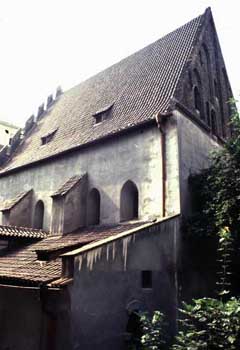 Altneuschul
|
It
is the oldest Jewish cemetery in Europe, opened from the 15th century to the late 18th century. In 1439, Avigdor Kara was
the first person to be buried there. Over the next 400 years, about
200,000 residents of the ghetto in Prague were buried in its confines.
Since the cemetery could only hold about 10 percent of that amount,
the tombs are layered on top of each other, at one section reaching 12 layers. Two of the cemetery’s
most famous tombs are Rabbi Loew (1609) and Mordechai Maisel (1601).
Since 1990, the Jewish Museum of Prague has been conserving and restoring
the cemetery. Today, about 12,000 tombstones remain.
The New Cemetery
In 1890, a second Jewish cemetery was founded in Prague
and opened next to the main Christian cemetery. The tomb of Franz
Kafka can be found there, with a memorial stone for his three sisters, all of whom perished in the Holocaust.
Prague Synagogues
 Maisel Synagogue
|
There are seven synagogues open today in Prague; during
the Nazi era all seven were used to store Judaica items. Five of those
synagogues can be found in the remains of the ghetto.
Staranova
Synagogue is also known as Altneuschul (the Old-New Synagogue).
It was originally built in 1270 and was called the New Synagogue because
it was the second synagogue built in the Jewish quarter; the first synagogue
no longer exists. The original floor still exists, however, other parts
of the building have been rebuilt because of damage from flooding in
the Jewish quarter. It is the oldest synagogue in Europe. During the
Nazi occupation, it showcased Jewish art, religious objects and books.
Today, services are still being conducted there, continuing a tradition
of nearly 700 years (only interrupted between 1941-1945).
The
Maisel Synagogue was originally built in 1591, thanks to a special
permit given by Emperor Rudolph II. The synagogue is named after Mordechai
Maisel, whose money was used to build the synagogue. It has been damaged
in several fires and its current facade is due to reconstruction in
1862 to 1864. In the 19th century, the synagogue was the birthplace
of liberal Judaism. During the Holocaust,
it housed more than 15,000 Jewish objects and art. Today, it functions
as the primary repository of religious objects, such as silver Torah
pointers, for the Jewish Museum.
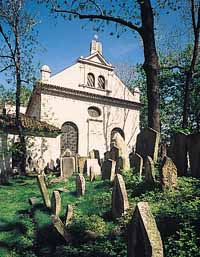 Klausen Synagogue
|
The Pinkas Synagogue, built in a Renaissance style, was first mentioned
in 1492. Located in a flood zone, it was frequently being repaired and
reconstruction occurred in 1953. One of its famous members was
Franz Kafka, who prayed there with his family. Following World War II,
it became a memorial to Moravian and Bohemian Jews who perished in the
war. On the walls of the synagogue, there is a list of 77,297 names
of those who died. Following the communist occupation in August 1968, all of the names were
erased, but these areas have since been restored. The synagogue was closed
from 1968 until 1992 because of the penetration of underground water.
Today you may once again see the over 77,000 names of Jews murdered in the Holocaust as well as a display of Jewish pictures
and drawings on the upper level.
The High Synagogue, located adjacent to the Jewish Town Hall, can be
found on the second floor of a building, not ground level. Originally,
it was only accessible from the first floor of the Jewish Town Hall.
It was used to service the seniors of the ghetto. At the turn of the
century, its original entrance was blocked and a new one was built on
Cervena Ulicka (Red Lane). Today, the High Synagogue is accessible from both the first floor of the Jewish Town Hall and from the Cervana Ulicka. Under the Communist reign, all synagogue,s including the High Synagogue, belonged to the state Jewish Museum. Today, the synagogue belongs to the Jewish community and is not part of the Jewish Museum.
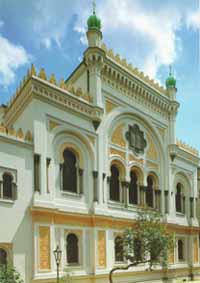 Spanish Synagogue
|
The Klausen Synagogue is located adjacent to the entrance to the Old Jewish Cemetery.
It was built on land acquired by the late Mordechai Maisel. The synagogue,
built in an early baroque style, was completed in 1694. It was remodeled
a couple of time and the last adaptation took place again in 1883 to 1884.
During the Holocaust, imagery of the
Jewish festivals and life cycle events were displayed. The
synagogue was restored to display exhibitions of old Hebrew manuscripts
and prints for the Jewish Museum.
Built
in 1867 to 1868, using Moorish decorations, the Spanish Synagogue provides
an interesting contrast to the other synagogues in Prague because its
interior is filled with Moorish and Islamic designs and art. During
the Holocaust, it was used to store
Torah curtains. Today, it houses the headquarters for the entire Jewish
Museum system.

Jubilee Synagogue |
Finally, there is the Jubilee Synagogue, also known as the Jerusalem Synagogue. This
synagogue was built in the early 20th century in the
New
Town of Prague. Currently, it is used to hold prayer services.
Terezin Concentration Camp
 |
The Terezin concentration camp, located about 60 kilometers from Prague, was meant
to be the “model” concentration camp, which was shown to the
outside world. Originally built as a military fortress by Joseph II, Terezin was a Big Fortress with a Small Fortress inside of it. While a military garrison, it looked like a mini-village, or a ghetto. Jews from Bohemia,
Moravia and the rest of Europe were brought here and then were sent
to the death camps. More than 30,000 Jewish adults and children died
in Terezin. Once a
child turned 14 years old, they were treated as an adult. Fifteen hundred
children lived at Terezin during the Holocaust, and only 100 survived.
The ashes of 30,000 people were thrown into the Eiger River in 1944.
A
small storeroom inside the town of Terezin was used as a makeshift synagogue
during the Holocaust. Fading Hebrew
inscriptions can be found on the walls; on the front wall is a verse
from the Amidah prayer, “May our eyes be able to envision
your return to Zion in mercy.” Another wall, which stands near
the railway track used to transport Jews to Auschwitz, also contains
verses in Hebrew from the liturgy, as well as drawings of Jewish symbols.
The writings and drawings were most likely done by a German Jewish ceramic
worker who lived in the town during the Holocaust;
the Nazis needed craftsmen for labor and therefore let them live in
relative comfort. This room was unknown to the public until after the
fall of Communism because the owner of the home kept the room secret; it was forbidden to talk about Judaism during the Communist
rule.
Sources: All photos Copyright � Mark Talisman, used with
permission, except the photos of the Jewish Museum and Maisel Synagogue,
which are courtesy of Jewish
Prague by Tom’s Travel and the photos of the Spanish Synagogue and
Klausen Synagogue, which are courtesy of the Jewish
Museum in Prague.
Project
Judaica Foundation
Altshuler, David (ed.). The
Precious Legacy: Judaic Treasures from the Czechoslovak State Collections.
Summit Books, 1983.
Bennett, Magnus. “Around
the World: Restored makeshift synagogue draws thousands to Czech site.”
Bridger, David (ed.). The New Jewish Encyclopedia. Behrman
House, Inc. Publishers, New York, 1962.
Gruber, Ruth Ellen. Jewish
Heritage Travel: A Guide to East-Central Europe. Jason Aronson,
Inc. Northvale, New Jersey, 1999.
Savery, Daniel. “A Precious Legacy.” The Jerusalem Report (August 18, 2008).
Jewish Museum
of Prague
Jews
of the Czech Republic
Prague
Marahal tombstone photo from Jewish
Prague |