Rudolf Hess
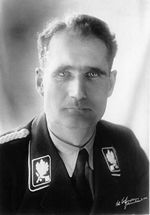
- Positions
Held by Rudolf Hess
- Promotion of
the Nazi Conspirators' Accession to Power
- Establishment
of Totalitarian Control over Germany
- Preparation
for War
- Participation
in the Conspiracy to Commit War Crimes and Crimes Against Humanity
- Conclusion
A. POSITIONS
HELD BY RUDOLF HESS.
(1)Between 1919 and 1941, Hess held the
following positions:
(a) Member of the Nazi Party, 1920-1941 (3191-PS).
(b) Deputy to the Fuehrer, 21 April 1933 to 10 May 1941 (3196-PS).
(c) Reich Minister without Portfolio, 1 December 1933-10 May 1941
(3178-PS).
(d) Member of the Reichstag, 5 March 1933-10 May 1941 (3192-PS).
(e) Member of the Council of Ministers for the Defense of the Reich,
30 August 1930-10 May 1941 (2018-PS).
(f) Member of the Secret Cabinet Council, 4 February 1938 -10 May
1941 (1377-PS).
(g) Successor Designate to the Fuehrer, after Goering, 1 September
1939-10 May 1941 (3190-PS).
(h) General in the SS (3198-PS).
(i) Private Secretary and A. d. C. to Hitler, 1925-1932 (3192-PS).
(j) Head of the Central Political Committee of the N.S.D.A.P.,
appointed 15 December 1932 (3132-PS).
(k) Reichsleiter of the N.S.D.A.P. (Member of the Party
Directorate)(3198-PS).
(l) Member of the Reichs Defense Council (2261-PS).
B. PROMOTION OF THE NAZI CONSPIRATORS' ACCESSION TO POWER.
The Nazi
Party was the conspiracy's main
instrument of control. As its directing head, Hess used this
instrument vigorously to advance the purposes of the conspiracy. He
thus played a decisive part in the preparation and execution of its
criminal designs.
Hess began his conspiratorial activities
immediately upon the termination of World War I by joining
militaristic and nationalistic organizations. He became a member of
the Thule Society and of the Free Corps Epp. In June 1920 he joined
the Nazi Party, receiving membership card No. 16 (191-PS; 347-PS).
By 1923 Hess was an SA leader and head of the Nazi
University Organization in Munich. He took part in the Nazi Putsch of
8 November 1923-9 November 1923. As a result he was tried and
convicted on a charge of high treason (3132- PS). He spent 7 1/2
months of his 18 months' sentence with Hitler at the Landsberg
Fortress (3191-PS). There Hitler dictated Mein Kampf to him (3132-
PS).
After their release, Hess remained extremely close
to Hitler. In 1925, he became officially his private secretary and A.
d. C (3192-PS).
During the Party crisis which resulted from the
sudden resignation of Gregor Strasser, head of the Party's Political
Organization, in December 1932, Hitler called on Hess to take charge
of the newly formed Central Political Committee of the Party, in
order to restore its strength and unity (3132-PS).
Shortly thereafter, Hess took part in the decisive
negotiations which brought the Nazi conspirators into power on 30
January 1933
C. ESTABLISHMENT OF TOTALITARIAN CONTROL OVER GERMANY.
Upon the conspirators' accession to power, Hess
was appointed Deputy to the Fuehrer of the NSDAP (3196-PS). His broad
powers and responsibilities in that position were officially
described as
"All the threads of the Party work are
gathered together by the Deputy of the Fuehrer. He gives the final
word on all intra-Party plans and all questions vital for the
existence of the German people. The Deputy of the Fuehrer gives the
directives required for all the Party work, in order to maintain
the unity, determination and striking power of the N.S.D.A.P. as
the bearer of the National-Socialist philosophy." (3163-PS;
Chart Number 15).
Through Hess, the Conspirators established the
control of the Party over the State. As a first step he obtained a
seat in the Cabinet, which had in effect become the sole legislative
organ of the Reich (2001-PS; 2426-PS; 1395-PS). As a Cabinet
Minister, Hess signed the laws which further strengthened the
political power of the Nazi Party. Among these enactments were the
law of 1 August 1934 consolidating the positions of Chief of State
and Leader of the Party (2003- PS); and the law of 20 December 1934
against treacherous attacks on Party and State
Through a long series of decrees Hess obtained
control over every aspect of public and private life in Germany, in
order to subvert it to the aims of the conspiracy, as represented by
the Party.
(1) Hess gained control over all legislation.
A Hitler Decree of 27 July 1934 provided for
Hess's participation in the drafting of all legislation (D-138). In a
circular to Cabinet members on 9 October 1939, Hess stated that he
would in the future veto every bill which reached him to late to
allow him enough time for its thorough study from the Party point of
view (D-139). A letter from Chief of the Reich Chancellery Lammers,
on 12 April 1938, announced a supplementary decree extending Hess's
participation, especially with regard to the drafting of laws
affecting individual States (D-140; see 1942-PS).
(2) Hess gained control over all government
appointments, including those of the judiciary and university
teachers.
A decree of 24 September 1935 provided for the
consultation of Hess in the appointment of Reich and State civil
servants (3180-PS). A decree of 10 July 1937 provided for the
participation of the Fuehrer's Deputy in the appointment of Reich and
State civil servants (3184-PS). A decree of 14 October 1936, signed
by Hess, regulated the status of Reich and State civil servants
(3183-PS). A further decree of 3 April 1936 provided for Hess's
participation in the appointment of Labor Service officials
(3182-PS).
(3) Hess gained control over Local Government
Administration.
This control was effected through the German
Municipality Act of 30 January 1935 provided for the participation of
Party delegates
(4) Hess gained control over the administration
of annexed territories.
Thus, the Ordinance of 10 June 1939 provided for
Hess's participation in the administration of Austria (Reichsgesetzblatt
1939, Part I, p. 995) while another Ordinance of the same date
provided for Hess's participation in the administration of the
Sudetenland (Reichsgesetzblatt 1939, Part I, p. 997).
(5) Hess, in his capacity as Deputy Leader of
the Party, gained control over the German Youth.
An order of 10 July 1934 set up a University
Commission of the NSDAP under Hess; an Order of 18 July 1934 placed
the NS German Student League directly under Hess; and an Order of 14
November 1934 delegated to the Student League exclusive jurisdiction
over the political and ideological education of German students
(3132-PS). A Hess Decree of 6 June 1936 established the NS Aid Fund
for the Struggle in the Universities (3203-PS; see also 3132-PS and
1392-PS).
The success of this entire program of legislation
was described by Hitler as follows:
"In this Reich everybody who has a
responsible position is a National Socialist *** Every institution
of this Reich is under the orders of the supreme political
leadership *** The Party leads the Reich (2715-PS; see 1774-PS and
3163-PS).
In order to enable the conspirators to buttress
their power through the armed terror of the SA and SS, Hess, while
not actually in control of these Party formations, nevertheless gave
them active support. Thus; he was instrumental in establishing the
Hitler Grant (a large fund contributed annually by heavy German
industry under the chairmanship of Krupp) and in directing part
thereof to the support of the SA and SS (D-151) .
When several SA men were convicted for
mistreatment of inmates of the Hohnstein concentration camp, two
members of the jury which had voted the conviction were expelled from
the party (784-PS) .
Finally, when Himmler, Reich Leader of the SS,
organized the SD, Hess issued an order establishing the SD as the
sole political information service of the Nazi Party, its functions
to be exercised through the SS (3385-PS).
Hess also sought to destroy the influence of the
independent churches among the German people, in order to wipe out
every opposition to the aims of the conspirators. Thus, Hess's Chief
of Staff, Bormann, issued numerous orders and communications from
Hess's office against the independent churches. Among these were the
Secret Order of 27 July 1938 making clergymen ineligible for party
offices (113-PS); the Party Directive of 14 July 1939 making the
clergy and theology students ineligible for Party membership
(840-PS); the letter of 22 February 1940 discussing ways and means of
eliminating religious instruction from the schools (098-PS); the
report of 25 April on the progressive substitution of National
Socialist mottoes in place of morning prayers in the schools
(070-PS); the letter to Rosenberg of 17 January 1940 concerning the
undesirability of religious literature for members of the Wehrmacht
(101-PS); the instructions of 8 March 1940 against the further
issuance of newsprint to confessional newspapers (089-PS); and the
letter to the Minister of the Interior, in May 1938, agreeing to the
invalidation of the Concordat between Austria and the Holy See
(675-PS; 838-PS and 107-PS).
D. PREPARATION FOR WAR.
Hess was one of the members of the conspiracy who
professed as early as 1933 the aim of complete world domination
(2385- PS).
In pursuance of that aim Hess threw the power of
the Party which he directed, behind the war preparations of the
conspiracy. Hess himself described the Party, in this connection, as
the mechanism with which to "organize and direct offensively and
defensively the spiritual and political strength of the people"
(2426-PS).
Hess's tasks in the preparations for aggressive
wars fell mainly into the fields of military preparedness, political
planning, and fifth-column activities.
(1) Rearmament. Even before 1933 Hess took
a personal interest in the secret military training program of the
uniformed Party organizations (1143-PS).
After the conspirators had come to power, Hess was
one of those who echoed the cry of "guns for butter" in his
speeches (2426-PS).
Hess signed the law which reintroduced
universal military conscription in Germany
on 16 March 1935 (1654-PS). Hess admitted
that signing this law was no mere formality
for him, but rather the realization of one
of his most important aims, when he declared
in a speech to Army officers in 1937:
"When I spoke about conscription after 16
March 1935, in what used to be the most radical industrial plant of
Munich *** to thousands and thousands of the same workers who but a
few years before had been singing the Internationale, I was
interrupted again and again by such applause and cheers as I would
never have believed possible. That was the most beautiful and at
the same time the most moving demonstration of my life (3124- PS).
When the Nazi conspirators were ready to launch
their aggressive wars in the fall of 1938, Hess and the Party
agencies under his control cooperated with the Army High Command in
the mobilization of the German Army (388-PS, Item 32).
(2) Political Planning for War. When the
Reich Defense Council was reorganized in September 1938, Hess became
one of its members with the express assignment of assuring "the
political direction of the nation" (2261-PS).
Hess was also made a member of the Ministers'
Council for the Defense of the Reich upon its creation in 1939. Here
he continued to exercise an important war-planning function with the
specific task of "guaranteeing the unity between Party and
State" within that body (2018-PS; 2608-PS).
Hess's functions in the field of political
planning for war were not limited to the domestic sphere. He was also
a member of the Secret Cabinet Council formed to advise Hitler on
foreign policy planning (1377-PS; 3189-PS).
(3) Fifth Column Activities. Hess' most
important contribution to the conspirators' preparations for
aggressive war lay in his organization of the German fifth- columns
abroad through the Foreign Organization (Auslands Organisation (AO))
of the Nazi Party and its various affiliated semi-official
organizations. Through these channels Hess succeeded in building up
conspiratorial shock- troops in foreign countries, composed of
citizens of these countries who were of German "racial
stock." These foreign citizens were incited by Hess to acts of
treason against their country in furtherance of the plans of the
conspiracy. It was the subversive activities of these fifth-column
groups which prepared the way for the conspirators' destruction of
independence d many countries. Principal among these were Austria,
Czechoslovakia, and Poland.
As his chief instrument in this conspiratorial
campaign Hess created the Foreign Organization of the Nazi Party on 3
October 1933. This office was placed directly under Hess, who from
then on was known to take the greatest personal interest in its rapid
development and expansion (3258-PS; 3401-PS; 3254-PS).
The Foreign Organization extended its activities
not only to German citizens living abroad but to all persons
allegedly of German ancestry regardless of their foreign citizenship.
In the early years after the conspirators' rise to power and up to
1937 his aim was openly admitted by the responsible heads of the
Foreign Organization (3258-PS).
Hess announced that it was the task of the Foreign
Organization to organize all persons of the German race who lived
abroad and to turn them into active Nazi supporters, thus making them
subservient to the purposes of the conspiracy. In his speech at the
1937 Congress of the Foreign Organization, Hess declared:
"You stand before me as a slice of the
great German racial community, the racial community which extends
beyond the borders of our Reich, for National Socialism has not
only at home created a national community transcending all classes
and groups in a way previously unknown, but it has also included
German racial comrades [Volks- Genossen] in foreign countries. It
has made them conscious and proud members of this racial community!
***
"Under the leadership of the Foreign
Organization, Germandom abroad is also becoming more and more
filled with the National Socialist spirit. The Foreign Organization
of the NSDAP has brought together the Germans out there, who even
long after the seizure of power were disunited and split by class
differences, and joined them with Adolf Hitler's Reich. The
National Socialist care for Germandom abroad is maintaining an
enormous number of Germans for the nation, who otherwise would be
absorbed as cultural fertilizer for other nations" (3258-PS).
The same principle was expressed bluntly by
Gauleiter Ernst Bohle, head of the Foreign Organization of the NSDAP
directly under Hess from 1933 to 1945, who stated in his address at
the Nurnberg Party Congress of 1936:
"The Fuehrer had to come in order to hammer
into all of us the fact that the German cannot choose and may not,
choose whether or not he will be German but that he was sent into
this world by God as a German, that God thereby had laid upon him
as a German duties of which he cannot divest himself without
committing treason to Providence. Therefore we believe and we know
that the German everywhere is a German whether he lives in the
Reich or in Japan, in France or in China or anywhere else in the
world. Not countries or continents, not climate or environments but
blood and race determine the world of ideas of the German."
(3258-PS).
Hess was also in control of all other
semi-official organizations associated with the Foreign Organization
in fifth-column work among foreign citizens of German ancestry, for
the purpose of gaining foreign support for the conspiracy. Thus, by a
Secret Circular of 3 February 1939, Hess ordered the consolidation of
the undercover activities of all organizations active in the foreign
field, subject to the central direction of SS Gruppenfuehrer Werner
Lorenz, head of the Volks-deutsche Mittelstelle (Central Agency for
Racial Germans) (837-PS).
The two most important of these semi-official
agencies were the VDA (League for Germandom Abroad) and the DAI
(German Foreign Institute). The VDA was a vast world-wide
organization giving financial support to various activities of German
groups abroad without regard to their nationality. Its large funds
were collected in Germany with the aid of the Nazi Government
(258-PS). The aim of the activities of the VDA was to establish a
great German world empire of 100,000,000 inhabitants, containing all
persons of German "racial stock" everywhere, including
millions of American citizens (3258-PS). The DAI was a world-wide
information intelligence and propaganda service (3258-PS).
Hess repeatedly stressed the importance of using
Germans abroad for spreading Nazi propaganda (124-PS).
The DAI also based its activities on the
proposition that all persons of German ancestry belonged to the Nazi
German Reich, though they held citizenship in foreign countries. This
was stated by Nazi Minister-President Mergenthaler of Wuerttemberg in
his address at the 1933 annual meeting of the DAI:
"The liberalist ideology which has been
overcome dealt with the formal concept of the citizen. We have
gotten rid of that. Today the blood-united German racial comrade
stands in the center. That is the new foundation upon which we must
build ***. Hence I want to impress on the DAI: Join us therefore in
taking care that the spirit of National Socialism also becomes
alive among the German racial comrades in foreign countries so that
streams of energy may emanate from it." (3258- PS).
At the annual meeting held by the DAI in 1937,
Frick restated in his address the fundamental aim of this
organization: to unite every person of German "racial
stock" under the control of the Nazi conspirators.
"*** the new Germany has recognized that
its attention and devotion to the welfare of the millions of
Germans who have not the fortune to owe political allegiance to
Germany, but who are condemned to live abroad, are not merely a
matter of natural sympathy and solidarity but are in a higher
degree dictated by the strong political and economic interests of
the Reich." (3258-PS).
It is noteworthy that the DAI was closely
affiliated with the German-American Bund, a subversive Nazi
organization in the United States. The DAI's official periodical,
"Germandom Abroad" (Deutschtum im Ausland), was edited
during the war Walter Kappe, former press chief of the Bund
(3258-PS). Walter Kappe and Fritz Gissibl, another former leader in
the Bund, established on the premises of the DAI in Stuttgart an
organization called "Comradeship USA." The purpose of this
"Comradeship USA." was to maintain during the war an
organization for all Nazi Party members who had been active in the
Bund in the United States (3258-PS). Even before the outbreak of the
war, in the spring of 1939, Walter Kappe had undertaken to collect a
complete archive of Nazi activities in the U. S. on behalf of the DAI
and the Nazi Party (3258- PS).
The success of this world-wide fifth column
directed by Hess now a matter of historical record. Hess himself
guided the subversive foreign groups which he had created until the
day when the conspirators were ready to annex the countries which
they had undermined.
Thus, the annexation of Austria was principally
due to the efforts of the Nazi Party's work within that country under
the orders of Hess. As early as 1934 Hess had appointed Reinthaler
leader of the Nazi peasants in Austria, and thus placed him in a
position to take over the leadership of the Nazi Fifth Column in
Austria (812-PS). Hess took a major part in the negotiations carried
on by Seyss-Inquart and other members of the conspiracy in
preparation of the Anschluss (3254-PS; 3425-PS). When on 12 March
1938 Germany invaded Austria, Hess, accompanied by Himmler, was the
first member of the conspiracy to arrive in Vienna at noon on the
same day (L-292). The next day Hess signed the decree by which the
conspirators destroyed the independence of Austria (2307-PS;
3075-PS).
Once the conspirators had achieved their aim, Hess
did not hesitate to admit publicly that he had approved of the steps
which led to the final subjection of Austria. On 24 July 1938 he
addressed a meeting held on the fourth anniversary of the
assassination of Austrian Chancellor Dollfuss by members of the 89th
SS Regiment. He devoted the larger part of his speech to a
justification of that assassination (L- 273).
When the conspirators turned their attention to
their next victim, Czechoslovakia, Hess was again in the forefront
directing the German fifth-column in the Sudetenland. In his speech
at the annual meeting of the Foreign Organization of the NSDAP on 28
August 1938, Hess declared that Nazi Germany was giving full backing
to the demands of the Sudeten German agitators. What such support
meant in fact became very clear when Hess pointed to the success of
the Nazi policy in Austria (3258-PS). All through the summer of 1938
Hess was engaged in consultations with Karl H. Frank and Konrad
Henlein, leaders of the Nazi Sudeten German Party (3061-PS).
A few months later Hess could mark up another
success for his fifth-column. When the Munich Agreement forced
Czechoslovakia to surrender the Sudeten territory to Germany, Hess
went to Reichenberg, the capital of that district, as Hitler's
representative in order to accept the official incorporation of the
Sudeten German Party into the Nazi Party on 5 November 1938. In his
address on that occasion he emphasized repeatedly that the Nazi
conspirators had been ready to go to war for the possession of the
Sudetenland (3204-PS).
Hess also put his signature to the Act of 14 April
1939 setting up the government of the Sudetenland as an integral part
of the Reich (3076-PS).
Later during the same year, after the conspirators
had loosed their first aggressive war, Hess signed the laws
incorporating first Danzig and then a large portion of Poland into
the Reich (3077-PS; see also Decree 8 October 1939 (RGBl 1939, Part
I, p. 2042); Decree of 12 October 1939, Part I, p.-2077).
When in July 1941 the Nazi conspirators occupied
Greece, the members of the local Nazi Party were ready to take over
as an auxiliary Army service (3258-PS).
Thus, wherever the conspirators sent their
invading armies Hess' fifth-column had prepared the soil.
E. PARTICIPATION IN THE CONSPIRACY TO COMMIT WAR CRIMES AND CRIMES
AGAINST HUMANITY.
Hess, as Deputy Leader of the Nazi Party, had the
task of realizing its "ideological" program (3200-PS).
One of the demands of this conspiratorial program
was the destruction of so-called inferior racial stock. Persons who
suffered -from hereditary insanity or other hereditary diseases were
considered useless to the Nazi community. They were therefore to be
killed or at least to be prevented from procreating their kind.
In order to carry out this plan Hess established a
special Racial -Policy Division on his Staff under Dr. alter Gross,
by his order of 17 November 1933. This Division was to
"participate with the competent government agencies in all race
and population measures" (3322-PS; 3163-PS). In addition, other
agencies of the Nazi Party, under Hess, actively cooperated in the
administration of this criminal program (D-181; 842-PS; 1969-PS).
In 1937 Hess publicly claimed credit for having
used his Party organization in order to gain the nation's approval
for compulsory sterilization (3124-PS; 3067-PS).
More important still in the Nazi program were the
persecution and extermination of religious and racial minorities.
Hess vigorously propagated the doctrine of the superiority of the
German race with which the conspirators sought to justify these
persecutions
The Nurnberg Laws, which constituted the legal
basis of this campaign, were the work of the Party. This was solemnly
announced by Hitler in the peroration of the address in which he
announced these laws to the Reichstag in Nurnberg 15 September 1935:
"I now propose to the Reichstag the
acceptance of those laws which Party member Goering will read to
you.
"The first and second laws fulfill the
program of the National Socialist Party in one important respect,
and thereby pay a debt of gratitude to the Movement under whose
symbol Germany has regained her freedom.
"The second law constitutes an attempt to
solve by legislation a problem, the final solution of which, if it
should again fail, will then have to be referred by law to the
National Socialist Party. All three laws are backed by the National
Socialist Party and with it and behind it by the German Nation.
"I ask you to accept these laws."
(3419-PS).
Hess, along with Frick, was placed in charge of
the administration of the Nurnberg Laws and of the issuance of
ordnances and regulations thereunder (1416-PS; 3179-PS; 1417- PS;
2124-PS) .
With the launching of their aggressive wars, the
Nazi conspirators embarked on the execution of their plan to
exterminate the non-German populations which fell into their hands.
This plan, especially insofar as it concerned the Jews, had been
bluntly revealed by Hitler well in advance in his address to the
Reichstag on 30 January 1939:
"If inter-national finance-Jewry inside and
outside Europe should succeed in throwing the nations into another
World War, the result will not be the Bolshevization of the earth
and thus the victory of Jewry, but the destruction of the Jewish
race n Europe!" (3418-PS).
In support of this campaign, which was continued
by his coconspirators after his flight to Scotland, Hess issued an
order through his Party Chancery on behalf of the SS, which had been
put in charge of the extermination program. In this order, Hess
demanded the support of all Party members for the recruiting drive of
the SS Army Corps (Waffen SS). Hess added that these SS formations
were scheduled for service in the Eastern occupied areas, where their
"special training in race matters" could be used to best
advantage (3245-PS).
By a series of further legislative and
administrative measures, Hess participated in the establishment of a
special regime in Poland which deprived the inhabitants of that
country of their legal protection, and thus initiated their wholesale
extermination (R-139; R-96; R-141).
In pursuance of the same policy Hess signed the
decree which forced certain groups of Polish citizens to surrender
their original national allegiance and to accept German citizenship
(Decree of 24 October 1939, RGBl 1939, Part I, p. 2077).
Hess also signed the decree establishing the
German Racial Register, under which Allied nationals of German stock
were registered and then compelled to accept German nationality and
to remove to German territory (2917-PS).
Hess also used Party channels in order to incite
the German people to violations of the rules of war. Thus, he ordered
that the population be instructed to seize Allied parachutists or to
"liquidate them"
Hess also issued instructions to enforce Hitler's
orders prohibiting the reconstruction of the city of Warsaw or of any
of Poland's destroyed industries (EC-411).
On 10 May 1941, Hess flew to Scotland for the
purpose of seeking an end to the war with England, and support for
Germany's demands against Russia. Upon his arrival, he was
incarcerated and thus forcibly eliminated from further participation
in the crimes of the conspiracy (D-614).
F. CONCLUSION.
Of all the members of the Nazi conspiracy, Hess
was closest to Hitler from the first. As Hitler's secretary and A. d.
C., as his Deputy, and finally as his Second Successor Designate,
Hess as at all times his direct representative in all Party matters.
Thus, the conspiracy's most powerful instrument of political action
rested in his hands.
Hess used this power to penetrate and dominate the
German government administration with National Socialist
functionaries; to control legislation and education; and to persecute
all independent groups, especially the churches and the Jews.
Being responsible for the political direction and
control of the German people, through the Party, Hess played a
decisive role in preparing the nation for war. He furthered the
secret rearmament of the Party's military formations; he signed the
Conscription Law of 1935; he sat on the Reichs Defense Council, the
inner Cabinet in which the heads of the conspiracy blue-printed the
administrative, economic, and political preparation of their
aggressive wars.
Hess, above all, was responsible for the creation
and direction of the Nazi fifth-column, in which foreign citizens of
German extraction joined under the Nazi banner to weaken and
undermine those countries which the Nazi conspirators had determined
to subjugate.
All through the years from 1920 to 1941 Hess
remained the most faithful and relentless executor of Hitler's aims
and designs. This complete devotion to the success of the conspiracy
was climaxed by his flight to Scotland in an attempt to end the war
with England and to receive English support for Germany's demands
against Russia, which he had helped to prepare.
The share of Hess' participation in the Nazi
conspiracy is as great as that of the Party which he directed. The
Party's crimes are his.
Sources: Nizkor.
Nazi Conspiracy & Aggression, Volume II, Chapter XVI, pp.
690-709.
*Conot, Robert. Justice
At Nuremberg. NY: Carroll & Graf, 1984.
|