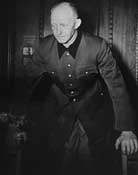
Alfred Jodl
A. POSITIONS HELD BY JODL.
Operations Department of the Army (Heer), 1932-35. Chief of the National
Defense Section in the High Command of the Armed Forces (Abteilung Landesverteidgung
im OKW), 1935 -- Oct. 1938. Artillery Commander ("Artillerie Kommandeur"
of the 44th Division. Vienna and Brno, Oct. 1938 -- 27 August 1939.
Chief of Operation Staff of the High Command of the Armed Forces (Chef
des Wehrmachtsfuhrungstabes in Oberkommndo der Wehrmacht), August 1939
-- 1945.
Dates of Promotion:
1932 -- Major and Oberstleutnant 1936 -- Oberst 1939 -- Generalmajor
1940 -- General der Artillerie 1944 -- Generaloberst (2865-PS).
B. FUNCTIONS OF JODL'S POSITIONS.
Jodl's most important office was that of Chief of the Operations Staff
(Wehrmachtsfuehrungstab) in OKW. In this capacity he was directly subordinate
to Keitel and equal in status to other departmental chiefs in OKW. However,
insofar as the planning and conduct of military affairs are concerned,
Jodl and his staff were more influential than the other departments.
The OKW Operations Staff was also divided into sections. Of these the
most important was the "National Defense" section, of which
Warlimont was chief. He was primarily concerned with the development
of strategic questions. From 1941 onwards Warlimont, though charged
with the same duties, was known as Deputy Chief of the OKW Operations
Staff. (3707-PS)
Jodl drafted many directives for Hitler to sign, for the preparation
of military operations and plans of deployment, and for the possible
initiation and commencement of military measures relating to matters
of organization, operations, or "war economics." While in
a theater of operations, Jodl would report twice daily to Hitler about
operations, and then prepare the Fuehrer directives. There was direct
contact between Hitler and Jodl, though Keitel was kept informed of
what passed between them.
In addition to certain ministerial functions, the OKW was Hitler's
military staff. Its most important duty was the development of strategic
and operational plans. Such plans were worked out by the OKW Operations
Staff in broad outline, and then in more detail by the Commanders and
Chiefs of Staffs of the Army, Navy, and Air Force. After Hitler had
approved the plans they were transmitted by the OKW to the appropriate
military authorities (3705-PS; 3702-PS; 3707-PS).
C. JODL'S PART IN THE CONSPIRACY TO COMMIT CRIMES AGAINST PEACE.
Jodl's loyalty to the Nazi party doctrine is evident in a speech he
delivered on 7 November 1943. He spoke of the National Socialist Movement
and its struggle for internal power as the preparation for liberation
from the Treaty of Versailles. (L-172)
He also stated, in a speech on the occasion of the attempted assassination
of Hitler, that his aims had been in general agreement with the aims
of the party. (1808-PS)
At the sixth meeting of the Working Committee of the Reich Defense
Council on 7 February 1934 Jodl pointed out that the practical execution
of the preparations for mobilization, which had been ordered by the
Army and the highest Reich authorities, were making a considerable enlargement
of personnel necessary. He suggested, however, that this enlargement
of personnel ought not to result in "the disquieting of foreign
countries through conspicuous mobilization measures." (EC-405)
In the presence of Jodl, Generalmajor Keitel pointed out at the eleventh
meeting that the mobilization year was to begin on 1 April and to end
on 31 March of the following year. A "Mobilization Book for Civilian
Agencies" was to be issued for the first time on 1 April 1936.
Keitel said that this day, to the extent possible, should find the nation
ready and prepared. He declared that, according to the will of the Fuehrer,
the economic management of the country should put the enhancement of
military capacity deliberately above all other national tasks It was
the function of all members of the Reich Defense Council, he emphasized,
to use all available resources economically and to ask for only such
funds and raw materials that were absolutely and exclusively needed
for the defense of the Reich. Colonel Jodl said that the Mobilization
Book for the Civilian Departments constituted the unified basis for
the carrying out of mobilization outside of the Army (EC-406).
D. JODL'S PART IN PLANING AND LAUNCHING WARS OF AGGRESSION.
(See "F," 1 through 7, in Section 4 of this Chapter on Keitel,
where the joint responsibility of Keitel and Jodl for these activities
is discussed.)
E. JODL'S PART IN THE CONSPIRACY TO COMMIT WAR CRIMES AND CRIMES
AGAINST HUMANITY.
(1) Murder and ill treatment of civilian population
in occupied territories and on the high seas. Jodl ordered the forcible
evacuation of all persons in a northern district of Norway, and the
burning of all their dwellings. This was to be done so that the inhabitants
of that area could not help the Russians (754-PS). Shortly thereafter
an evacuation took place in Finnmark County in northern Norway, in the
course of which 30,000 houses were damaged. (1800-PS)
Jodl was aware that in 1942 there were continual arrests in Belgrade,
and that from fifteen to thirty followers of Mihalovic were shot every
day. (1383-PS)
Jodl initialled an order signed for Hitler by Keitel, which provided
that enemy civilians guilty of offenses against German troops should
be killed without a military trial, and that punishment could be waived
in the case of German soldiers who committed offenses against enemy
civilians. (886-PS)
Rosenberg was appointed by Hitler on 20 April 1941 "Deputy for
a Centralized Treatment of Problems concerning the Eastern Territories."
The highest Reich authorities were to cooperate fully, and Keitel was
asked to designate a representative of OKW to sit with Rosenberg. Jodl
was appointed as Keitel's representative with Warlimont as his deputy,
and Keitel wrote to Rosenberg on 25 April 1941 that Jodl and Warlimont
would be the OKW representatives. (865-PS)
Responsibility for crimes committed under Rosenberg's authority thus
attach to Jodl as well. In this connection reference is made to Section
7 of this chapter on Rosenberg.
(2) Deportation of civilian populations of and in
Occupied Territories for slave labor and for other purposes. Jodl
knew of the deportation of workers, for he once told Hitler that the
military commander of France had reported tat over 220,000 workers had
been deported into the Reich in the past six months. (1383-PS)
(3) Murder and ill treatment of prisoners of war,
and of other members of the Armed Forces of the countries with whom
Germany was at war and of persons on the high seas. On 18 October
1942 Hitler ordered that commando troops, even if in uniform, should
be killed, not only in battle, but in flight or while attempting to
surrender. This order was issued by Jodl's department. (498-PS)
A supplementary explanation of the commando order, signed by Hitler,
was distributed to commanding officers only, with a covering memorandum
dated 19 October 1942, signed by Jodl (503-PS). Several cases are known
in which the order was carried out. (508-PS; 509-PS)
Three specific instances were mentioned by the G-3 of the C in C, Norway,
where captured members of sabotage units were executed after interrogations
which resulted in valuable intelligence. These occurred at Gloafjord,
Drontheim, and at Stavanger. (512-PS)
On 23 June 1944 C in C West requested instructions re- defining the
scope of the commando order. In view of the extensive landings in Normandy,
it had become difficult to decide which paratroops should be considered
sabotage troops under the terms of the order, and which should be considered
as engaged in normal combat operations. The question was answered by
an order of 25 June 1944, one copy of which was signed by Keitel, reaffirming
the full force of the original order. (531-PS; 551-PS)
When allied fliers were forced
to land in Germany, they were sometimes killed
by the civilian population. The police had
orders not to protect the fliers, nor to punish
civilians for lynching them. A proposal was
considered to order the shooting without court-martial
of enemy airmen who had been forced down after
engaging in specified "acts of terror."
It is not certain that the order was ever
issued, but it is certain that Keitel and
Jodl knew of the lynchings, did nothing to
prevent them and in fact considered giving
them official justification.
Sources: Nizkor.
Nazi Conspiracy & Aggression, Volume II,
Chapter XVI, pp.565-569. Photo: Harry S. Truman
Library, courtesy of USHMM
Photo Archives
|