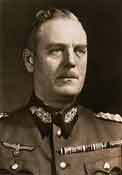
Keitel's conspiratorial activities started immediately after the Nazis
came to power. As early as in May 1933, when Germany was still a member
of the League of Nations, Keitel gave directives for deceiving "Geneva"
in rearmament matters.
At the second meeting of the Working Committee of the Councillors for
Reich Defense on 22 May 1933, Colonel Keitel emphasized that the supreme-consideration
guiding the work of the committee was to be secrecy. "No document"
he said, "ought to be lost, since otherwise it may fall into the
hands of the enemy's intelligence service. Orally transmitted matters
are not provable; they can be denied by us in Geneva." He requested
that written documents not be sent through the mails, or, if it was
absolutely necessary to do so, that they be addressed, not to a government
agency or office (where they might be opened by the mail clerks) but
to the recipient personally.
The fact that Keitel was a member of the Nazi conspiracy in good standing
is apparent from his statement that he held the Golden Party Badge,
and that consequently the Party considered him a member as from the
autumn of 1944, when the law against military personnel being members
of the Party was changed (1944 RGBl. I, 317). His political convictions
were those of National Socialism, and he was a loyal follower of Hitler.
(1954-PS)
At the second meeting of the Working Committee of the Councillors for
Reich Defense held on 26 April 1933, the chairman Colonel Keitel, pointed
out the necessity and desirability for the creation of the Reich Defense
Council which had been determined on by a cabinet decision of 4 April
1933. He said that a general program for the creation of a war economy
had already been completed, but that it would take a long time to carry
out the Program He explained that it was the purpose and objective of
the Working Committee of the new Defense Council to overcome these difficulties.
(EC-177)
On 6 December 1935 General Major Keitel, chairman of the eleventh meeting
of the Reich Defense Council, pointed out that the mobilization year
was to begin on 1 April and to end on 31 March of the following year.
For the first time, a "Mobilization Book for Civilian Agencies"
was to be issued on 1 April 1936. Keitel said that this day, to the
extent possible, should find the nation ready and prepared. He declared
that, according to the will of the Fuehrer, the economic management
of the country should put the enhancement of military capacity above
all other national tasks. Keitel emphasized that it was the function
of all members of the Reich Defense Council to use all available resources
economically and to ask for only such funds and raw materials as were
absolutely and exclusively needed for the defense of the Reich.
In the presence of Keitel, Colonel Jodl said that the "Mobilization
Book for the Civilian Agencies" constituted the unified basis for
the carrying out of mobilization outside of the Army. (EC-406)
The twelfth meeting of the Working Committee of the Reich Defense Council,
held on 14 May 1936, was opened by Field Marshal von Blomberg, War Minister
and Supreme Army Commander. He stressed the necessity for a total mobilization,
including the drafting of the necessary laws, preparations in the re-militarized
Rhineland zone, financing and rearmament. Lt. General Keitel, in his
capacity as chairman of the Working Committee of the Reich Defense Council,
again stressed the necessity for secrecy. Ministerial Director Wohlthat
pointed out that, in order to guarantee rearmament and an adequate food
supply, an increase in production and utmost economy were necessary,
a postulate that had led to the special mandate given by the Fuehrer
to Minister President Goering. (EC-407)
Keitel participated also in the activities of the conspirators to re-militarize
the Rhineland. At that time he was Chief of the Wehrmachtsamt under
von Blomberg and signed, on the latter's behalf, the order for naval
participation in the operation. (C-194)
Keitel also took part in the war-planning activities of the Reich Cabinet,
of which he was a member. The cabinet consulted by meetings, and by
the circulation of decrees among its members for their approval or disapproval.
(See generally Section 3 of Chapter XV on the Reich Cabinet.) Keitel
was a member of the Secret Cabinet Council, which has been described
as "a select committee" of the cabinet for deliberation on
foreign affairs. (1774-PS)
A Reich Defense Council was established by the ordinary cabinet in
1933. It was a war-planning group, and Keitel took part in the meetings
of its working committee. (EC-177; EC-406; EC-407)
On 4 December 1938 a Secret Defense Law was passed, which defined the
duties of the Reich Defense Council. As Chief of OKW, Keitel was a member
of the council, and he also presided over the Council's Working Committee
(Reichsverteidigungsausschuss). (2194-PS)
The Secret Defense Law of 1938 provided for a Plenipotentiary for Economy,
whose task was to "put all economic forces into the service of
the Reich defense, and to safeguard economically the life of the German
nation" and for a Plenipotentiary for Administration, whose duties
were to take over "the uniform leadership of the non- military
administration with exception of the economic administration" upon
the declaration of a "state of defense" Certain ministries
were, in peace-time, bound by the directives of the plenipotentiaries.
The latter were bound, in turn, under certain conditions, together with
the ministries subordinate to them, to take directions from the Chief
of OKW. Keitel could also, in a state of defense, issue orders to the
Minister of Transport and the Minister of Posts. In addition, he presided
over the Council's Working Committee, which prepared the Council's decisions,
saw that they were executed, and obtained collaboration between the
armed forces, the chief Reich offices, and the Party. Keitel regulated
the activities of this committee and issued directions to the plenipotentiaries
and certain Reich ministries to assure uniform execution of the council's
decisions. (2194-PS)
The two plenipotentiaries and the OKW formed what was known as a "Three
Man College" (2608-PS). This system of three man college functioned
as follows, from a legislative point of view: The Plenipotentiary for
Economy was empowered by paragraph 4 of the Secret Defense Law of 4
September 1938 to issue laws within his sphere, with the consent of
the OKW and the Plenipotentiary for Administration, which differed from
existing laws. Similarly, the Plenipotentiary for Administration was
empowered by paragraph 3 of the same law to issue laws within his sphere,
with the concept of the OKW and the Plenipotentiary for Economy, which
differed from existing laws.
In the spheres of the Reich Minister of Posts, the Reich Minister of
Transport and of the General Inspector for German roads (Generalinspektor
fuer die Strassenwesen), the Chief of the OKW had the right, under paragraph
5 of the same law, to issue laws, in agreement with the Plenipotentiaries
for Administration and Economy, which differed from existing laws. (2194-PS)
The legislative function of the three man college, prior to 9 September
1939 was one of drafting decrees to be used in time of war.
The Council of Ministers for the Defense of the Reich was established
by a decree of Hitler on 30 August 1939. It was formed out of the Reich
Defense Council, and included among its members the two plenipotentiaries
of the council and the Chief of OKW.
The Council-had the power to pass decrees with the force of law, and
to legislate for the occupied Eastern Territories 1939 RGBI, I, 2077).
Decrees of the council were circulated, before enactment, among all
the members by written communication from Dr. Lammers, who was also
on the Council. (2231-PS)
Frick has referred to the Council of Ministers as "the highest
permanent organ of the Reich with comprehensive jurisdiction, responsible
only to the Fuehrer" "The composition of the Ministerial Council
for the Defense of the Reich" he added, "shows the real concentration
of power in it" He said also that Keitel was liaison between the
council and the armed forces, it being primarily his duty to coordinate
the measures for civilian defense in the area of administration and
economy with the genuine military measures for the defense of the Reich.
(2608-PS)
Keitel also took an active part in collaborating with
and in instigating the Japanese to enter the war. Nazi policy with regard
to Japan was expressed in an order signed by Keitel on 5 March 1941.
This order was distributed to the OKH, OKM, and OKL, and also to Jodl.
It stated that Japan must be drawn actively into the war, and that the
taking of Singapore would mean a decisive success for the three powers.
( C-75)
At about the time this order was issued, a meeting was held with Hitler,
in which Raeder urged that Japan be induced to attack Singapore. Keitel
and Jodl were both present at this meeting. (C-152)
Keitel may have known of a report from the Military Attache in Tokyo
that preparations were continuing for a sudden attack on Singapore and
Manila. (1538-PS)
(1) Murder and ill treatment of civilian populations in occupied
territory and on the high seas. Keitel committed many crimes of
this nature, by ordering such criminal activities.
On 13 May 1941 Keitel, as Chief of OKW, signed an order from the Fuehrer's
Headquarters providing that Russian civilians suspected of offenses
against German troops should be shot or ruthlessly punished without
a military trial, and that prosecution of German soldiers for offenses
against Russian civilians was not required (C-50). On 27 July 1941 he
ordered that all copies of this decree should be destroyed, but without
affecting its validity. (C-51)
On 23 July 1941 Keitel signed an order concerning the administration
of occupied Russia. This order provided that legal punishments were
inadequate in so great an area, and that troops should use terrorism
in crushing the population's will to resist. (C-52)
Keitel signed one of the so-called Nacht und Nebel decrees .on 7 December
1941. It provided that in occupied territories of the west civilians
would be tried for offenses against the German state only if the death
sentence was likely to be carried out within a few days of arrest. Otherwise
the accused would be taken to Germany, and no information would be given
about them in reply to any inquiries. (666-PS)
By a first ordinance of 7 December 1941 Keitel made the provisions
of the foregoing directive applicable to the following offenses; attacks
against life or bodily health, espionage, sabotage, communistic conspiracy,
offenses likely to create disturbances, assistance to the enemy, and
illicit possession of arms. His ordinance also provided that the offenses
mentioned were to be tried in the occupied countries only if it were
likely that the death sentence would be pronounced, and if it were possible
to complete trial and execution within a very short time, as a rule
within a week after arrest. In case of trial in Germany, it was provided
that alien witnesses could be heard only with the consent of the High
Command of the Armed Forces and that the public would not be admitted
to the proceedings. (L-90)
In a communication issued by him in his capacity as Chief of the High
Command of the Armed Forces Keitel on 12 December 1941 stated with respect
to the aforementioned directive and ordinance:
"Efficient and enduring terrorization can be achieved only either
by capital punishment or by measures to keep the relatives of the
criminal and the population in the dark as to the fate of the criminal.
This aim is achieved by transferring the criminal to Germany."
(L- 90)
In pursuance of Keitel's Nacht und Nebel decree, Admiral Canaris on
2 February 1942 issued instructions to the Abwehr to punish crimes against
the Wehrmacht accordingly. At first the order was to apply only to Norway,
Holland, Belgium, and France. (833-PS)
The Chief of the SIPO and SD reported to OKW on 24 June 1942 that a
Frenchman had died while awaiting trial in Germany, and that, in order
to create anxiety in accordance with the decree, his family had not
been notified. Keitel's OKW approved of this procedure, which had been
established for such cases by an OKW order of 16 April 1942. (668-PS)
When, on 20 April 1941 Hitler appointed Rosenberg "Deputy for
a Centralized Treatment of Problems concerning the Eastern Territories,"
Keitel was asked to designate a representative of OKW to sit with Rosenberg.
Keitel designated Jodl as his representative and Warlimont as deputy.
(865-PS)
Thus Keitel and Jodl share the responsibility for crimes committed
by Rosenberg's administration. In this connection reference is made
to section 7 of this chapter on Rosenberg.
Among the decrees issued by the Council of Ministers, of which Keitel
was a member, are two which connect him with harsh treatment of inhabitants
of the Occupied Eastern Territories. (2746-PS,
(2) Deportation of civilian populations in occupied territories
for slave labor and other purposes. Keitel's connection with the
forced labor program began at a meeting with Hitler on 23 May 1939,
when it was announced that Poland would be invaded, and also that non-German
populations would be available as a source of labor. (L-79)
Keitel directed the execution of Hitler's order to use Russian prisoners
of war in German war industries, and stated that OKW (AWA) would furnish
to the Secretary of Labor information on the use of such labor, and
provide the labor force. (EC-194)
Sauckel was appointed Plenipotentiary General for Manpower by a decree
of 21 March 1942, signed by Hitler, Lammers, and Keitel. (1666-PS)
On 8 September 1942 Keitel initialled a Hitler order requiring citizens
of France, Holland, and Belgium to work on the "Atlantic Wall"
The order was to be enforced by the withdrawal of food and clothing
ration cards (556-2-PS). Keitel was informed of the quotas of foreign
laborers which Sauckel and his agents were to fill. Sauckel requested
the assistance of the Army, and asked that pressure be used to obtain
the quotas, if necessary. (3012-PS)
At a conference with Hitler on 4 January 1944, at which Keitel was
present, it was determined that Sauckel should obtain 4,000,000 new
workers from occupied territories. (1292-PS)
(3) Murder and ill treatment of prisoners of war, and of other members
of the armed forces of the countries with which Germany was at war,
and of person on the high seas. On 18 October 1942 Hitler ordered
that commando troops, even if in uniform, should be killed, not only
in battle, but in flight or while attempting to surrender (498-PS).
An order regulating the treatment of paratroopers had been issued by
Keitel about a month earlier. It provided that captured paratroopers
were to be turned over to the SD. (553-PS)
A supplementary explanation of the commando order, signed by Hitler,
was distributed to commanding officers only, with a covering memorandum
dated 19 October 1942, signed by Jodl (503-PS). Several cases are known
in which the order was carried out (508-PS; 509-PS). Three specific
instances were mentioned by the G-3 of the C-in-C, Norway, where captured
members of sabotage units were executed after interrogations which resulted
in valuable intelligence. These occurred at Glomfjord, Drontheim, and
Stavanger. (512-PS)
On 23 June 1944 the Supreme Command West requested instructions redefining
the scope of the commando order. In view of the extensive landings in
Normandy, it had become difficult to decide which paratroops should
be considered sabotage troops under the terms of the order, and which
should be considered as engaged in normal combat operations. The question
was answered by an order of 25 June 1944, one copy of which was signed
by Keitel, reaffirming the full force of the original order (531-PS;
551-PS). Keitel extended the application of the commando order to members
of Anglo-American and Russian "military missions" taken in
the fighting against the partisans in the southeast and southwest. (537-PS)
When allied fliers were forced to land in Germany, they were sometimes
killed by the civilian population. The police had orders not to protect
the fliers, nor to punish civilians for lynching them. A proposal was
considered to order the shooting without court-martial of enemy airmen
who had been forced down after engaging in specified "acts of terror"
Whether or not the order was ever issued is immaterial, for it is certain
that Keitel and Jodl knew of the lynchings, did nothing to prevent them.
(See also "F" 8, infra, in which the joint responsibility
of Keitel and Jodl for the lynching of Allied airmen is discussed.)
Keitel's criminal activities against Soviet prisoners of war are shown
by the following. On 8 September 1941 Keitel's OKW issued a regulation
for the treatment of Soviet prisoners of war. It stated that Russian
soldiers would fight by any methods for the idea of Bolshevism and that
consequently they had lost any claim to treatment in accordance with
the Geneva Convention. Stern measures were to be employed against them,
including the free use of weapons. The politically undesirable prisoners
were to be segregated from the others and turned over to "special
purpose units" of the Security Police and the Security Service.
There was to be the closest cooperation between the military commanders
and these police units. (1519-PS)
Admiral Canaris of the Abwehr considered this order in such direct
violation of the general principles of International Law that he addressed
a memorandum of protest to Keitel on 15 September 1941. He pointed out
that, while the Geneva Convention was not binding between Germany and
the USSR, the usual rules of International Law should be observed; that
such instructions, particularly those concerning the use of weapons,
would result in arbitrary killings; and that the disposition of politically
undesirable prisoners would be decided by the SIPO and the SD according
to principles of which the Wehrmacht was ignorant. (As to this argument,
Keitel wrote in the margin "Very efficient" and "Not
at all." Keitel received and considered this memorandum, for on
its first page there is the following comment in his handwriting, dated
23 September and initialled "K"
"The objections arise from the military concept of chivalrous
warfare. This is the destruction of an ideology. Therefore I approve
and back the measures." (EC-338)
The regulations which Canaris had protested were restated on 24 March
1942, but their essential provisions were unchanged. (695-PS)
An order of Keitel's OKW dated 29 January 1943, signed by Reinecke,
contains a broad interpretation of the guards' right of self-defense
against prisoners. For example, self- defense includes not only the
guard's person, but h-is honor and property, and third parties, such
as the State. (656-PS)
That Keitel knew of the appalling treatment of Russian prisoners of
war, and the high death rate among them, appear from the statements
in a letter sent to him by Rosenberg on 28 February 1942. The letter
stressed the need for better treatment of the Russians, so that they
would be well impressed by the Germans. (081-PS)
An order of Keitel's OKW provided that escaped officers and non-working
non-commissioned officers other than Americans and British were to be
turned over to the SIPO and SD upon recapture. The SIPO and SD, upon
instructions from their chief, would then transport the men to the Mauthausen
concentration camp under operation "Kugel" (L-158). Such prisoners
were executed at Mauthausen upon arrival (2285- PS). Americans and British
who were recaptured might be turned over to the SIPO and SD, upon decision
of the "W.Kdos" from the OKW/ o.i c. (L-158)
(4) Killing of hostages. Keitel's criminal activities are shown
be the following two documents. On 16 December 1941 he signed an order
stating that uprisings among German troops in occupied territories must
be considered as inspired by a communist conspiracy, and that the death
of one German soldier must mean death for fifty or one hundred communists.
(829-PS)
Keitel also signed an order (received by the OKH on 1 October 1941)
specifying that hostages should be well known, and that they should
come from Nationalist, Democrat, or Communist political factions. After
each act of sabotage hostages belonging to the saboteur's group should
be shot. (1590-PS)
(5) Plunder of public and private property. The looting of cultural
property was carried on chiefly under Rosenberg by the Einsatzstab Rosenberg,
an organization established for that purpose' In the West he was to
act in his capacity as Reichsleiter, and in the East in his capacity
as Reichsminister. Keitel's OKW cooperated with Rosenberg, and directions
for carrying out the order were to be issued by the Chief of the OKW
in agreement in Rosenberg (149-PS). Keitel ordered the military authorizes
to cooperate in this program (137-PS; 138-PS). A memorandum of 17 May
1944 in the Rosenberg Ministry states that the Wehrmacht was one of
the principal agencies engaged in removing treasures from Russia. (1107-PS)
Keitel was also responsible for the removal of machine tools, foodstuffs,
and other materials from occupied territories. (1161-PS; 743-PS)
(6) The exaction of collective penalties. Collective penalties
were exacted from the population for acts of individuals for which it
could not be held responsible. Keitel advocated such measures. This
appears from correspondence on acts of sabotage in the shipbuilding
yards. (C-48; 870-PS; 871-PS)
(7) Germanization of Occupied Territories. On 16 July 1941 Keitel
was present at a meeting with Hitler where the policy was announced
of exploiting occupied Russian territory and making it part of the Reich.
(L-221)
In order to promote a racially valuable German heritage an order signed
by Hitler, Lammers, and Keitel provides for payment of subsidies to
Norwegian or Dutch women who had borne children of German soldiers.
The Chief of OKW was authorized to extend its application to other occupied
territories. (2926-PS)
(8) Persecution of minorities. Keitel's responsibility for the
persecution of minorities in Germany appears from the fact that, with
Hitler, Goering, and Lammers, he signed a decree on 7 October 1939 which
provided that the harmful influence of foreigners must be eliminated
from Germany; that Germans could be resettled by the Reichsfuehrer SS;
and that the Reichsfuehrer SS could perform "all necessary general
and administrative measures" to discharge this duty. (686-PS)
Keitel's responsibility for the criminal treatment of Jews is apparent
from his own statement that the struggle against Bolshevism necessitated
a ruthless proceeding against the Jews; the Wehrmacht was not to use
them for any service, but they could be placed in labor columns under
German supervision. (878-PS)
F. JOINT RESPONSIBILITY OF KEITEL AND JODL FOR PLANNING AND LAUNCHING
WARS OF AGGRESSION, AND FOR THE LYNCHING OF ALLIED AIRMEN.
(1) Aggression against Austria. In June of 1937 von Blomberg
ordered preparations for "Case Otto" -- armed intervention
in Austria in event of a Hapsburg restoration (C-175). New plans were
made in 1938 under the same name. German policy in 1938 was to eliminate
Austria and Czechoslovakia, and there was a campaign to undermine Austria's
will to resist, by pressure on the government, by propaganda, and by
fifth column activity. (1780-PS)
Keitel was present at Berchtesgaden when Schuschnigg visited Hitler
there in February 1938. Schuschnigg was subjected to political and military
pressure, which resulted in such concessions to the Nazis as the reorganization
of the Austrian cabinet (1780-PS). Keitel and Jodl and Canaris were
instructed to keep p the military pressure against Austria by simulating
military measures until 15 February. (1780-PS) The OKW submitted proposals
to Hitler regarding the Austrian campaign; these included suggestions
of false rumors and broadcasts. A note in Jodl's handwriting states
that Hitler approved the memorandum by telephone and that Canaris was
informed. (1775-PS)
Hitler ordered preparation of "Case Otto" -- mobilization
of army units and air forces (1780-PS). Hitler's directive for "Case
Otto" was initialled by Keitel and Jodl. Jodl issued supplementary
instructions (C-102; C-10). Jodl initialled Hitler's order or the invasion
of Austria. (C-182)
(2) The Execution of the plan to invade Czechoslovakia. On 21
April 1938 Hitler and Keitel met and discussed plans for the taking
of Czechoslovakia. They considered a military attack after a period
of diplomatic friction, or as the result of a created incident, such
as the assassination of the German ambassador at Prague. (388-PS)
After the invasion of Austria, Wehrmacht planning was devoted to "Case
Green," the operation against Czechoslovakia (1780-PS). Case Green
was first drafted in 1937, when it was thought that a "probable
warlike eventuality" would be "war on two fronts with the
center of gravity in the southeast." A surprise attack on Czechoslovakia
was considered possible (C-175). Through the late spring and summer
of 1938 Case Green was revised and modified. The memoranda and correspondence
are frequently signed or initialled by Keitel, and it is clear that
he knew of Hitler's intention to use force against Czechoslovakia and
made the plans to carry out that intention. (388-PS; 1780-PS; 2353-PS)
There were many meetings on Case Green in September 1938, some with
Hitler, some with Keitel and Jodl. The timing of troop movements was
discussed; the question of advance notice to OKH; preparations of railroads
and fortifications; even propaganda to counteract the anticipated violations
of International Law which the invasion would entail (388-PS; 1780-PS;
C-2). Assistance was given by OKH to the Sudeten German Free Corps,
an auxiliary military organization which operated under Henlein to create
disorder in Czechoslovakia. (1780-PS; 388-PS)
In October 1938 Hitler addressed to the OKW four specific questions
about the time and the forces that would be required to break Czech
resistance in Bohemia and Moravia, and Keitel submitted the answers
prepared by the OKH and Luftwaffe (388-PS). On 21 October 1938 Hitler
signed an order (and Keitel initialled it) requiring the Wehrmacht to
make preparations to take the remainder of Czechoslovakia. (C-136)
Two months later Keitel issued a supplement to this order, stating
that on the order of the Fuehrer preparations for the liquidation of
Czechoslovakia were to continue, and stressing the importance of having
the attack well camouflaged and unwarlike in appearance. (C-138)
Keitel was present at the interview between Hitler and Hacha at the
Reich Chancellery on 15 March 1939, when the Czech representatives delivered
their country to Hitler, after hours of duress, which included the threat
of immediate bombing of Prague. (2798-PS;
(3) Aggression against Poland. On 25 March 1939 -- four days
after Ribbentrop pressed new demands for Danzig on the Polish Ambassador
-- Hitler told von Brauchitsch, Commander- in-chief of the Army, that
he did not intend to- solve the Polish question by force for the time
being but requested that plans for that operation be developed. (R-100)
On 3 April 1939 Keitel, as Chief of the High Command of the Armed Forces,
reissued over his signature the directive for the Uniform Preparation
for War by the Armed Forces for 1939/40. The directive, noting that
the basic principles for the sections on "Frontier Defense"
and "Danzig" remained unaltered, stated that Hitler had added
the following directives to "Fall Weiss"
"1. Preparations must be made in such a way that the operation
can be carried out at any time from 1 September 1939 onwards.
"2. The High Command of the Armed Forces has been directed to
draw up a precise timetable for "Fall Weiss" and to arrange
by conferences the synchronized timing between the three branches
of the Armed Forces.
"3. The plans of the branches of the Armed Forces and the details
for the timetable must be submitted to the OKW b 1 May 1939."
(C-120)
It is noteworthy that, even in April of 1939, the tentative timetable
called for the invasion of Poland to be carried out at any time from
1 September 1939 onwards.
About a week later, an order signed by Hitler was circulated to the
highest commands of the Army, Navy and Air Force. This confirmed Keitel's
directive to prepare for three eventualities: "Frontier Defense"
"Fall Weiss" and the Annexation of Danzig. Annex II contained
further instructions for "Fall Weiss" In the first paragraph,
headed "Political Hypotheses and Aims" it was stated that
should Poland adopt a threatening attitude toward Germany, a "final
settlement" would be necessary notwithstanding the pact with Poland.
"The aim is then to destroy Polish military strength . . ."
It was further stated that the Free State of Danzig would be incorporated
into Germany at the outbreak of the conflict, at the latest. The directive
continued: "Policy aims at limiting the war to Poland, and this
is considered possible in view of the internal crisis in France and
British restraint as a result of this."
The general political background against which the Armed Forces were
to work having thus been set down, the later paragraphs outlined the
tasks and operational objectives of the three branches of the Armed
Forces. It was also decreed that a "camouflaged or open ('general'
added in ink) mobilization will not be ordered before D-Day 1 at the
latest possible moment" and further that the "preparations
for the opening of operations are to be made in such a way that -- without
waiting for the planned assembly of mobilized units -- positions can
be taken up immediately by the first available troops." (C-120)
On 10 May an order signed by Hitler promulgated his instructions for
the seizure of economic installations in Poland and directed the commanders-in-chief
of the three branches of the armed forces to report by 1 August 1939
on the measures taken in consequence of these instructions. (C- 120)
On 23 May 1939 Hitler called a meeting of his military leaders at the
Reich Chancellery. Keitel was at the meeting; Jodl was not, but Warlimont
(also from the Planning Department of OKW) was. Hitler announced the
necessity of a war against Poland, not over Danzig, but in order to
acquire living space in the East. He recognized the possibility that
this would provoke a war against France and England, but the Wehrmacht
was instructed to prepare detailed plans.
A directive dated 22 June 1939, signed by Keitel as Chief of the OKW,
indicates an advanced stage of preparation. On the basis of particulars
already available from the Navy, Army, and Air Force, he stated, he
had submitted to Hitler a "preliminary timetable" for "Fall
Weiss." The Fuehrer was reported to be in substantial agreement
with the intentions submitted by the three branches; he had also made
suggestions with regard to the need to camouflage the scheduled maneuvers
"in order not to disquiet the population," and had commented
on the disposition of an SS Artillery Regiment. (C-16)
Two days later, Keitel issued instructions for further study on two
specific problems: the capture, in undamaged condition, of bridges over
the Vistula; and the possible adverse effect of Navy mining in Danzig
Bay on the element of surprise in the Army's attack against the bridge
at Dirschau, southeast of Danzig. (C-120)
On 22 August 1939, Hitler called together at Obersalzberg the Supreme
Commanders of the three branches of the armed forces, as well as the
lower ranking Commanding Generals (Oberbefehlshaber), and announced
his decision to attack Poland near dawn on 26 August. Keitel was at
this meeting. (L-; 798-PS; 1014-PS)
Three documents reporting this meeting have been uncovered: the text
of one, overlaps the contents of the other two, 798- PS and 1014-PS;
the latter two appear to be complementary, 798-PS being a record of
a morning speech, and 1014-PS of an afternoon speech. Violent and abusive
language appears in both L-3 and 798-PS. That Hitler made, at a minimum,
the following points, appears from all of them:
1. The decision to attack Poland was made last spring. (1798- PS)
2. The aim of the war in Poland is to destroy the Polish armed forces,
rather than to reach a fixed line. (L-3; 1014- PS)
3. The attack will start early Saturday morning, 26 August (L-3; 1014-PS)
4. A spurious cause for starting the war will be devised by German
propaganda. It is a matter of indifference whether it is plausible or
not. The world will not question the victor (L-3; 1014-PS). The text
in L-3 further describes the pretext to be used to start the war: "I'll
let a couple of companies, dressed in Polish uniforms, make an assault
in Upper Silesia or in the Protectorate."
A handwritten entry in the diary of Jodl, at that time Chief of the
Operations Department of the OKW, confirms that the time for the attack
on Poland had been fixed for 0430 on 26 August 1939. (1780-PS)
(4) Aggression against Norway and Denmark. On or about 12 September
1939 Hitler ordered the OKW to start preparations for the occupation
of Norwegian bases early in 1940. (1546- PS)
The possibility of using Quisling was discussed with Hitler on 12 December
1939, in a conference at which Raeder, Keitel, and Jodl were present.
Hitler agreed with Raeder's suggestion that, if he was favorably impressed
with Quisling, the OKW should be authorized to prepare for the occupation
either with Quisling's assistance, or by force. (C-64)
In January of 1940 the Navy was ordered to concentrate barges for the
invasion, and further preparations were to be conducted under the code
name "Weserubung" (C-6). The general directive for the invasion
was issued by Hitler on 1 March 1940. (C-174; 1809-PS)
(5) Aggression against Belgium, the Netherlands, and Luxembourg. At a conference with Hitler on 23 May 1939 it was determined that the
occupation of the Low Countries was necessary to the successful conduct
of the war against England. A small planning staff was formed at OKW
with responsibility for further planning of the invasion, and complete
secrecy was invoked. Keitel was at this meeting. (L- 79)
On 9 October 1939 it was stated in a general directive for the conduct
of the war in the West that the invasion should be started soon, in
order to protect the Ruhr and to provide air bases for use against England.
A copy of this directive was distributed to OKW. (L-52)
In October and November of 1939 a number of military orders was issued
concerning the invasion of the Low Countries "Fall Gelb" Questions
of how far the troops should advance under the plan were clarified (C-62;
440-PS). Instructions were issued concerning the deployment of troops,
communications systems, crossing of the borders, and the administration
and pacification of the countries to be taken (2329-PS). Provisions
were made for special operations by the 7th Flieger Division near the
Belgian-French border. (C- 10)
Between 7 November 1939 and 9 May 1940 seventeen orders were issued
setting and postponing the day for starting operations. These delays
were caused by the weather. One of the orders, dated 11 January 1940,
shows that all the others were concerned with the action against the
Low Countries, and that the 7th Flieger Division (see C-10) was involved.
All these orders were signed either by Keitel or Jodl. (C- 72)
The development of the plans, and the various questions which came
up for consideration are shown in the entries in Jodl's diary. At one
point the Foreign Office did not regard the prepared justification for
the attack as satisfactory, but Jodl thought it was sufficient. His
diary shows the existence of the plan against the Low Countries and
the steps taken to put it into execution. (1809-PS)
(6) Aggression against Greece and Yugoslavia. On 12 November 1940 Hitler issued orders to the Army to prepare for
the occupation of the Greek mainland (444-PS). On 13 December 1940 a
Hitler order stated that the invasion of Greece was planned and would
start as soon as the weather became favorable. The composition of combat
teams and their routes of march were given. When the Greek operation
was concluded, the mass of the troops involved were to be employed for
a new task. This order was distributed to the OKW, as well as to the-three
armed services. (1541-PS)
On 11 January 1941 Hitler ordered preparation for armed intervention
in Albania, to assist the Italians against Greece. The order was initialled
by Keitel and Jodl (448- PS). On 20 January 1941 Jodl reported, in notes
of a meeting between Hitler and Mussolini, that Hitler stated that one
of the purposes of German troop concentrations in Rumania was for use
in his plan for the operation against Greece. This was four months prior
to the attack. (C-134)
On 19 February 1941 an OKW order signed by Warlimont gave decisions
for carrying out the Greek campaign, providing that pontoon building
would commence on 26 February, and that the Danube would be crossed
on 2 March. (C-59)
On 18 March 1941 Raeder, in the presence of Keitel and Jodl, asked
for confirmation that the whole of Greece would have to be occupied
even in the event of a peaceful settlement, and Hitler replied that
complete occupation was a prerequisite to any settlement. (C-167)
At a meeting on 27 March 1941, attended by both Keitel and Jodl, Hitler
outlined the proposed operations against Yugoslavia and Greece. The
actual plan for military operations, Directive No. 25, was issued on
the same day. (1746-PS)
(7) Aggression against the U.S.S.R. On 12 November 1940 Hitler
issued a directive in which, among other things, it was stated that
preparations for the East already verbally ordered should be continued,
regardless of the outcome of current political discussions for the clarification
of Russia's attitude. The directive was initialled by Jodl. (444-PS)
The original directive for preparation of the attack on Russia -- case
"Barbarossa" -- was signed by Hitler on 18 December 1940 and
initialled by Keitel and Jodl (446-PS). On 3 February 1941 Hitler held
a meeting to discuss the intended invasion. Keitel and Jodl were both
present (872- PS). On 1 March 1941 an OKW map was prepared to show the
intended division of occupied Russian territory. The distribution list
shows that Keitel and Jodl received copies. (1642-PS)
In March of 1941 Keitel wrote to Reich Minister Todt to give him detailed
instructions about camouflaging the coming invasion. The letter was
initialled by Jodl. (874-PS)
On 13 March 1941 Keitel issued an operational supplement to Hitler's
Barbarossa order (446-PS). This order defined the area of operations
and established the relationship between political and military officers
in those areas (4.47-PS). On 1 June 1941 there was issued, with Hitler's
approval, a timetable for the invasion, showing the disposition and
missions of the Army, Navy, and Air Force. This paper was signed by
Keitel (C-39). On 14 June 1941 an order was issued for final reports
on Barbarossa to be made in Berlin by Army, Navy, and Air Commanders.
(C-78)
While the foregoing preparations were being made, planning for the
production of armaments and supplies was being conducted by one of Keitel's
subordinates, General Thomas, Chief of the Wirtschaft Ruestungsamt in
OKW. (2353-PS)
By a Fuehrer order dated 20 April 1941 Rosenberg was appointed "Deputy
for a Centralized Treatment of Problems concerning the Eastern Territories"
Jodl and Warlimont were appointed Keitel's representatives with the
Rosenberg office (865-PS). A preliminary report by Rosenberg on his
work up to the time of the invasion mentions Keitel and Jodl as having
consulted and worked with him in those preparations. (1039-PS) A memorandum
written by General Thomas on 20 June 1941. states that Keitel had confirmed
to him Hitler's policy on raw materials -- that it took less manpower
to seize territories containing raw materials, than it did to make synthetic
substitutes. (1456-PS)
(8) War Crimes and Crimes against Humanity -- Crimes against Military
Personnel -- Lynching of Allied Airmen. On 21 May 1944 Keitel received
a note from WFST to the effect that Hitler had decided that enemy fliers
who had been forced down should be shot without court-martial, if they
had engaged in "acts of terror" Keitel wrote on the note "Please
arrange for order to be drafted. K" (731-PS)
By 4 June 1914 Jodl and Warlimont were ready to go ahead with formulating
the plans. Goering was to be asked what actions of enemy fliers should
be punishable by death; the Airmen's Reception Camp at Oberursel was
to be told which fliers should be delivered to the SD; and the Foreign
Office was to be kept advised. (737-PS)
At subsequent conferences Keitel and Jodl raised question about the
difficulty of establishing general rules in such a matter. The "Acts
of Terror" were:
1. Low level attacks on civilians.
2. Shooting German fliers in parachutes.
3. Attacks on civilian passenger planes.
4. Attacks on Red Cross hospitals or trains. (735-PS)
On 17 June 1944 Keitel wrote to the Foreign Office to ask their approval
of the proposed measure and the agreed definition of "Acts of Terror"
(730-PS). On the same day Keitel wrote to Goering to ask for his approval
of the definitions of "Acts of Terror" and also to ask that
he give verbal instructions to the Commandant of the camp at Oberursel
to hand over fliers guilty of such acts to the SD. Both Keitel and Jodl
initialled this letter (729-PS). Goering replied that fliers not guilty
of acts of terror must be protected, and suggested that such matters
be handled by the courts. (732-PS)
A draft of a Foreign Office letter dated 20 June 1944 expresses misgivings
about the Geneva Convention, and concern about the publicity that would
be involved. (728-PS)
On 26 June 1944 Goering's adjutant telephoned the WFST to say that
Goering agreed to the procedures suggested. (733-PS)
On 29 June Warlimont was informed that Ribbentrop had approved the
Foreign Office draft (728-PS), but wished to obtain Hitler's approval
before communicating his own final written approval to Keitel. (740-PS)