Just beyond the gas
chamber building, and the gravel square in front of it, there is
a row of sinister looking buildings, stained black with creosote, where
a number of displays of camp artifacts have been set up. These buildings
which are prefabricated horse barns, exactly like the barrack buildings,
were used to store the clothing and other items taken from the Jews,
including their hair, which were then sorted, cleaned and shipped to Germany.
Inside the buildings, the tourist exhibits have been
placed along the walls with plenty of space for groups to gather around
them. I saw one whole building filled with shoes in glass cases along
the length of the walls and another glass case down the center of the
room. This building was completely unlit, so I only saw the shoes in
the front that were visible from the natural light coming through the
door. The shoes looked worn out, or maybe they are just deteriorating
with age. In the very front of the case facing the door, I noticed the
white soles of a pair of espadrille sandals; the rest of the shoes are
uniformly gray in color and look depressing.
Hanging on the wall in one of the exhibit buildings, there is a small
glass case with human hair cut from the heads of the victims, a shocking
and gruesome sight. The hair is uniformly light brown in color and is
compressed, or matted, so that it looks like dread locks. (The hair
on display at Auschwitz is charcoal gray in color and fills half a room.) The tour guide said
that this hair was cut from the heads of the victims after they died
and it had changed color from the gas used in the gas chambers. Displayed
next to the hair was a small piece of tan colored cloth, which the sign
said was made from hair, although it didn't say it was made from human
hair. A bolt of the same type of cloth is displayed at the Auschwitz
I museum.
There are also displays of items used or worn by the inmates, including
Catholic prayer books, civilian clothing, a pair of wooden clogs, huge
soup ladles, a fountain pen, baby clothes and enamelware dishes like
those used by American cowboys in the old West. Unlike American enamelware,
which is usually gray or white, these dishes are brightly colored with
flower patterns, or more commonly, a dull brick red color. The soup
bowls used by the prisoners for their one-dish meals were the size of
serving bowls in America. The most interesting item was a Catholic rosary
made by one of the inmates with the beads fashioned from compressed
balls of bread, which have turned black and hard like wood. There are
tooth brushes, hair brushes, dolls and a child's book. (Majdanek has
the distinction of having more mothers with babies than any other camp.)
Included in the display are numerous poems and drawings done by the
prisoners.
There are blue and gray striped prison uniforms on display, all of
them with a red triangle indicating that these were worn by non-Jewish
political prisoners. (Jewish prisoners had to wear a red triangle sewn
on top of a yellow triangle to form a Star
of David.) The triangles are much smaller than I had imagined. Those
worn by citizens of the Third Reich (Germany) had the point of the triangle
turned upward; all the rest were turned downward. Some of the prisoners,
especially the kapos, wore
civilian clothing which is also on display, including a woman's dress
shoe with a two-inch heel.
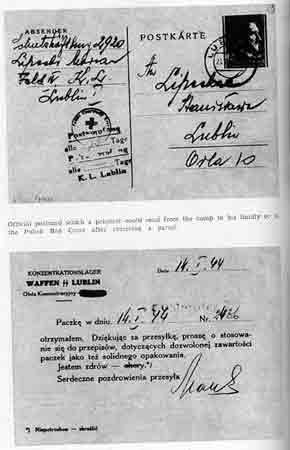
The display includes photographs of the former inmates, which look
like prison mug shots, taken with a good quality German camera. Along
with each photograph is an explanation of what happened to the prisoner.
The majority of them look Slavic and have Polish names. According to
this exhibit, 18,000 prisoners were released, but the guidebook says
20,000 were released. Those who were released were mostly women and
children who were held as hostages in an attempt to stop partisan activity or hostages who were taken as punishment for the civilians
in the area not meeting their quote of agricultural products which they
had been ordered to supply to the German occupation. The hostages wore
the red triangle of political prisoners.
One of the pictures on display shows Hitler on a visit to the concentration camp at Sachsenhausen near Berlin. The Sachsenhausen
camp opened in 1936, and the picture appears to have been taken very
early in its existence, as it shows Hitler when he was still in relatively
good health, before he became afflicted with Parkinson's disease. Hitler's
closest associate, his architect Albert
Speer, wrote in his autobiography that Hitler had never visited
any of the camps.
One of the most shocking pictures on display shows Russian POWs from
a camp in Chelm living in shallow holes in the ground, covered by a
piece of canvas propped up on short poles. These were soldiers who were
captured soon after the invasion of the Soviet Union on June 22, 1941
before POW camps had been built to accommodate them. They had to live
in these crude shelters while the Majdanek camp was hastily built for
them. Like the camp at Birkenau, Majdanek began as a POW camp for captured
Russian soldiers.
The brick pathway in front of the exhibit buildings, shown in the picture
below, was probably added for the convenience of tourists. According
to survivors of Majdanek, it was very muddy in the camp in the Summer
and had frozen mud in the Winter.