Constantin Von Neurath
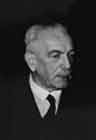
A. POSITIONS AND HONORS HELD BY VON NEURATH.
He was a member of the Nazi Party from 30 January 1937 until 1945,
and vas awarded the Golden Party Badge on 30 January 1937.
He was General in the SS. He was personally appointed Gruppenfuehrer
by Hitler in September 1937, and was promoted to Obergruppenfuehrer
on 21 June 1943.
He was Reich Minister of Foreign Affairs under the Chancellorship of
von Papen from 2 June 1932, and under the Chancellorship of Hitler from
30 January 1933 until he was replaced by von Ribbentrop on 4 February
1938.
He was Reich Minister from 4 February 1938 until May 1945.
He was President of the Secret Cabinet Council, to which he was appointed
on 4 February 1938.
He was a member of the Reich Defense Council.
He was Reichs Protector for Bohemia and Moravia from 18 March 1939
until he was replaced by Frick on 25 August 1943.
He was awarded the Adlerorden by Hitler at the time of his appointment
as Reich Protector. Ribbentrop was the only other German to receive
this decoration.
These facts are collected in a document signed by von Neurath and his
counsel (2972-PS). Von Neurath comments on certain of these matters.
He says that the award of the Golden Party Badge was made on 30 January
1937 against his will and without his being asked. Yet he not only refrained
from repudiating
[Page 1015]
the allegedly unwanted honor, but after receiving it attended meetings
at which wars of aggression were planned, actively participated in the
forcible annexation of Austria, and tyrannized over Bohemia and Moravia.
He also contends that his appointment as SS Gruppenfuehrer was also
against his will and without his being asked. But in this connection,
his wearing of the SS uniform, his receipt of the further promotion
to Obergruppenfuehrer, and the actions against Bohemia and Moravia must
be considered. In addition, von Neurath says that his appointment as
Foreign Minister was by Reichspresident von Hindenburg. Yet President
von Hindenburg died in 1934, and von Neurath continued as Foreign Minister
until 1938, under the chancellorship first of von Papen and then of
Hitler. He further claims that he was an inactive Minister from 4 February
1938 until May 1945. His activities in this connection will be mentioned
below, particularly with regard to Bohemia and Moravia.
Von Neurath next alleges that the Secret Cabinet Council never sat
or conferred. This Council, of which von Neurath was president, has
been authoritatively described as a select committee of the Cabinet
for the deliberation of foreign affairs, directly subordinated to the
Fuehrer for counsel and assistance (1774-PS):
"A Privy Cabinet Council, to advise the Fuehrer in the basic problems
of foreign policy, has been created by the decree of 4 February 1938
*** This Privy Cabinet Council is under the direction of Reich-Minister
v. Neurath, and includes the Foreign Minister, the Air Minister, the
Deputy Commander for the Fuehrer, the Propaganda Minister, the Chief
of the Reich- Chancellery, the Commanders-in-Chief of the Army and Navy
and the Chief of the Supreme Command of the Armed Forces. The Privy
Cabinet Council constitutes a select staff of collaborators of the Fuehrer
which consists exclusively of members of the Government of the Reich;
thus, it represents a select committee of the Reich Government for the
deliberation on foreign affairs." (1774-PS)
The formal composition of this body is shown in 201-PS. Von Neurath
held himself out as a member of this body by communicating with the
British Ambassador on Secret Cabinet Council stationery. (3287-PS)
Von Neurath, finally, objects that he was not a member of the Reich
Defense Council. This Council was set up soon after Hitler's accession
to power, on 4 April 1933 (2261- PS). In an affidavit by Frick (2986-PS),
this Council is described as follows:
"We were also members of the Reich Defense Council, which was
supposed to plan preparations in case of war which later on were published
by the Ministerial Council for the Defense of the Reich." (2986-PS)
The membership of this Council included the Minister for Foreign Affairs,
who was then von Neurath. This is shown by a document giving the composition
of the Reich Defense Council, and including among permanent members
the Minister for Foreign Affairs (EC-177). That document is dated "Berlin,
22 May 1933," which was during von Neurath's tenure of that office.
The functioning of the Reich Defense Council, with a representative
of von Neurath's ministry, von Beulow, present, is shown by the minutes
of the 12th meeting on 14 May 1936 (EC-407). Under the secret law of
4 September 1938 von Neurath was a member of the Reich Defense Council
by virtue of his presidency of the Secret Cabinet Council. This fact
is shown by the enclosure of a copy of that law in a letter addressed
to von Neurath as Reich Protector for Bohemia and Moravia on 6 September
1939 (2194-PS). It is curious that the Reich Protector for Bohemia and
Moravia denies his membership in the Council when the letter enclosing
the law is one addressed to him. This law describes the tasks of the
Council as follows:
"The task of the Reich Defense Council consists, in peacetime,
of the decision on all measures for the preparation of Reich defense,
and the gathering together of all forces and means of the nation according
to the- directions of the Leaders and Reich Chancellor. The tasks
of the Council in wartime will be especially determined by the Leader
and Reich Chancellor." (2194-PS)
The law also lists the permanent members of the Council, and the seventh
one is the President of the Secret Cabinet Council, who was von Neurath.
B. VON NEURATH'S PART, AS FOREIGN MINISTER, IN THE CONSPIRACY
FOR THE BREACH OF TREATY OBLIGATIONS.
In assuming the position of Minister of Foreign Affairs in Hitler's
Cabinet, von Neurath assumed charge of a foreign policy committed to
breach of treaties.
The Nazi Party had repeatedly and for many years made known its intention
to overthrow Germany's international commitments, even at the risk of
war. Sections 1 and 2 of the Party Program (1708-PS), which was published
year after year, declared:
"1. We demand the unification of all Germans in the Greater
Germany on the basis of the right of self- determination of peoples.
"2. We demand equality of rights for the German people in respect
to the other nations; abrogation of the peace treaties of Versailles
and St. Germain." (1708- PS)
An even clearer statement of these goals is contained in Hitler's speech
at Munich on 15 March 1939, in which he said:
"My foreign policy had identical aims. My program was to abolish
the Treaty of Versailles. It is futile nonsense for the rest of the
world to pretend today that I did not reveal this program until 1933
or 1935 or 1937. Instead of listening to this foolish chatter of emigres,
these gentlemen would have been wiser to read what I have written
thousands of times." (2771-PS)
If it is "futile nonsense" for foreigners to raise that point,
it would be still more futile for Hitler's Foreign Minister to suggest
that he was ignorant of the aggressive designs of Nazi policy. The acceptance
of force as a means of solving international problems and achieving
the objectives of Hitler's foreign policy must have been known to anyone
as closely in touch with Hitler as was von Neurath. This doctrine, for
example, is constantly reiterated in Mein Kampf (D-660). (See Section
6 of Chapter IX on Aggression as a Basic Nazi Idea.)
Hence, by the acceptance and implementation of this foreign policy,
von-Neurath assisted and promoted the realization of the illegal aims
of the Nazi Party.
C. VON NEURATH'S PART, AS FOREIGN MINISTER, IN THE CONSPIRACY
TO CONSOLIDATE NAZI CONTROL OVER GERMANY IN PREPARATION FOR AGGRESSIVE
WAR.
In his capacity as Minister of Foreign Affairs von Neurath directed
the international aspects of the first phase of the Nazi conspiracy,
the consolidation of control in preparation for war.
From his close connection with Hitler von Neurath must have known the
cardinal points of Hitler's policy leading up to the outbreak of World
War II, as outlined in retrospect by Hitler in his speech to his military
leaders on 23 November 1939 (789-PS). This policy had two facets: internally,
the establishment of rigid control; externally, the program to release
Germany from its international commitments. The external program had
four points:
1. Secession from the disarmament conference;
2. The order to re-arm Germany;
3. The introduction of compulsory military service; and
4. The remilitarization of the Rhineland.
These points were set out in Hitler's address of 23 November 1939,
after the invasion of Poland:
" *** I had to reorganize everything beginning with the mass
of the people and extending it to the armed forces. First, reorganization
of the interior, abolishment of appearance of decay and defeatist
ideas, education to heroism. While reorganizing the interior, I undertook
the second task, to release Germany from its international ties. Two
particular characteristics are to be pointed out: secession from the
League of Nations and denunciation of the disarmament conference.
It was a hard decision. The number of prophets who predicted that
it would lead to the occupation of the Rhineland was large, the number
of believers was very small. I was supported by the nation, which
stood firmly behind me, when I carried out my intentions. After that,
the order for rearmament. Here again there were numerous prophets
who predicted misfortunes, and only a few believers. In 1935 the introduction
of compulsory armed service. After that, militarization of the Rhineland,
again a process believed to be impossible at that time. The number
of people who would trust in me were very small. Then the beginning
of the fortification of the whole country, especially in the West."
(789-PS)
Hitler thus summarized his pre-war foreign policy in four points. Von
Neurath participated directly and personally in accomplishing each of
these four points, at the same time officially proclaiming that these
measures did not constitute steps toward aggression. The first is a
matter of history. When Germany left the disarmament conference von
Neurath sent telegrams, dated 14 October 1933, to the President of the
Conference announcing Germany's withdrawal (Documents of German Politics,
1933, vol. I, p. 94). Similarly, von Neurath made the announcement of
Germany's withdrawal from the League of Nations on 21 October 1933.
(Documents of German Politics, 1933, vol. I). At the same time, the
German government was undertaking far-reaching military preparation
(C-140; C-153).
The second point regarding German rearmament: When von Neurath was
Foreign Minister, on 10 March 1935, the German Government officially
announced the establishment of the German air force (TC-44). On 21 May
1935, Hitler announced a purported unilateral repudiation of the Naval,
Military, and Air clauses of the Treaty of Versailles and the Treaty
for the Restoration of Friendly Relations with the United States (2288-PS).
On the same day the Reich Cabinet, of which von Neurath was a member,
enacted the secret Reich Defense Law creating the office of Plenipotentiary
General for War Economy (2261-PS), afterwards described by the Wehrmacht
armament expert as "the cornerstone of German rearmament"
(2353-PS):
"The latter orders were decreed in the Reich defense law of
21 May 1935, which was supposed to be published only in case of war,
and was already declared valid for carrying out war preparations.
As this law fixed the duties of the armed forces and the other Reich
authorities in case of war, it was also the fundamental ruling for
the development and activity of the war economy organization."
(2353-PS)
The third point is the introduction of compulsory military service.
On 16 March 1935 von Neurath signed the law for the organization of
the armed forces, which provided for universal military service and
anticipated a vastly expanded German army (Reichsgesetzblatt, 1935,
I, p. 369) (1654-PS). This was described by Keitel as the real start
of the large- scale rearmament program which followed.
The fourth point was the remilitarization of the Rhineland. The Rhineland
was reoccupied on 7 March 1936. This action was announced by Hitler
(2289-PS), who had also previously given the order for "Operation
Schulung," directing the military action which was to be taken
if necessary (C-139). These were acts for which von Neurath shared responsibility
from his position and from the steps which he took. Some time later
he summed up his views on the actions detailed above in a speech to
Germans abroad, on 29 August 1937:
"The unity of the racial and national will created through Nazism
with unprecedented elan has made possible a foreign policy through
which the bonds of the Versailles Treaty were slashed, freedom to
arm regained, and the sovereignty of the whole nation reestablished.
We have again become master in our own home, and we have produced
the means of power to remain henceforth that way for all times. The
world should notice from Hitler's deeds and words that his aims are
not aggressive war." (D-449)
D. VON NEURATH'S PART, AS FOREIGN MINISTER AND ADVISOR TO THE
FUEHRER, IN THE PLANNING OF WARS OF AGGRESSION.
Both as Minister of Foreign Affairs and as one of the inner circle
of the Fuehrer's advisors on foreign political matters, von Neurath
participated in the political planning and preparation for acts of aggression
against Austria, Czechoslovakia, and other nations.
(1) The von Neurath technique. If von Neurath's policy may be
described in a sentence it may be summarized as breaking one treaty
only at a time. He himself put it slightly more pompously but to the
same effect in a speech before the Academy of German Law on 30 October
1937:
" *** Out of the acknowledgment of these elementary facts the
Reich Cabinet has always interceded in favor of treating every concrete
international problem within methods especially suited for it, not
to complicate it unnecessarily by amalgamation with other problems,
and as long as problems between only two powers are concerned to choose
the way for an immediate understanding between these two powers. We
are in a position to state that this method has fully proved itself
good not only in the German interest, but also in the general interest."
The only countries whose interests von Neurath failed to mention in
that speech are the other parties to the various treaties that were
dealt with in that way. The working out of that policy can be seen from
a brief summary of the actions of von Neurath when he was Foreign Minister,
and those of his immediate-successor when von Neurath still purported
to have influence.
In 1935 action was directed against the Western Powers, in the form
of the rearmament of Germany. When that was going on another country
had to be reassured. At that time it was Austria, which still had --
up to 1935 -- the support of Italy. Hence, the fraudulent and clearly
false assurance, the essence of the technique in that case, given by
Hitler, on 21 May 1935. (TC-26)
Then, in 1936, action was again taken against the Western Powers in
the occupation of the Rhineland. Another fraudulent assurance was made
to Austria in the Treaty of 11 July of that year, (TC-22) the deceitful
nature of which is shown by letters from von Papen. (2246-PS;
Then, in 1937 and 1938, the Nazis moved on a step and action was directed
against Austria. That action was absorption, finally planned, at the
latest, at the meeting on 5 November 1937 (386-PS). The action was taken
on 11 March 1938. Reassurance had to be given to the Western Powers;
hence the assurance to Belgium on 13 October 1937. (TC-34)
Less than a year later the object of the aggressive action was Czechoslovakia.
The Sudetenland was obtained in September 1938, and the whole of Bohemia
and Moravia was absorbed on 15 March 1939. At that time it was necessary
to reassure Poland; so an assurance to Poland was given by Hitler on
20 February 1938 (2357-PS), and repeated up to 26 September 1938 (2358-PS).
The falsity of that assurance is shown in Section 8 of Chapter IX on
Aggression Against Poland.
Finally, when the Nazis decided to take action for the conquest of
Poland in the next year, assurance had to be given to Russia. Hence,
a non-aggression pact was entered into with the USSR. on 23 August 1939.
(TC-25)
With regard to the foregoing summary, the Latin tag, res ipsa loquitur
is apposite. But a frank statement from von Neurath with regard to the
earlier part of it is found in the account of his conversation with
the United States Ambassador, Mr. Bullitt, on 18 May 1936 (L-150):
"Von Neurath said that it was the policy of the German Government
to do nothing active in foreign affairs until 'the Rhineland had been
digested.' He explained that he meant that, until the German fortifications
had been constructed on the French and Belgian frontiers, the German
Government would do everything possible to prevent rather than encourage
an outbreak by the Nazis in Austria and would pursue a quiet line
with regard to Czechoslovakia. 'As soon as our fortifications are
constructed and the countries of Central Europe realize that France
cannot enter German territory at will, all those countries will begin
to feel very differently about their foreign policies and a new constellation
will develop,' he said."
The conversation between von Papen as Ambassador and Mr. Messersmith
is much to the same effect. (1760-PS)
(2) Austria. At the time of the aggression against Austria von
Neurath was Foreign Minister. This included the preliminary stages,
during the early Nazi plottings against Austria in 1934. In this period
occurred the Nazi murder of Chancellor Dolfuss and the ancillary acts
which were afterwards so strongly approved by the German Government.
(See Section 3 of Chapter IX on Aggression Against Austria.) Von Neurath
was also Foreign Minister when the false assurance was given to Austria
on 21 May 1935 (TC-26) and the fraudulent treaty was made on 11 July
1936 (TC-22). And von Neurath was Foreign Minister when his ambassador
to Austria, von Papen, was carrying on his subterranean intrigue in
the period from 1935 to 1937. (2247-PS; 2246-PS)
Von Neurath was present when Hitler declared, in a highly confidential
circle, on 5 November 1937, that the German question could only be solved
by force, and that his plans were to conquer Austria and Czechoslovakia
(386-PS). Hitler expressed his designs on Austria as follows:
" For the improvement of our military political position, it
must be our first aim in every case of entanglement by war to conquer
Czechoslovakia and Austria simultaneously, in order to remove any
threat from the flanks in case of a possible advance westwards."
(386-PS)
It is impossible for von Neurath, after that meeting, to say that he
was not acting except with his eyes completely open and with complete
comprehension as to what was intended.
During the Anschluss von Neurath received a note from the British Ambassador
dated 11 March 1938 (045-PS). In reply von Neurath uttered two obvious
untruths. The first:
" It is untrue that the Reich used forceful pressure to bring
about this development, especially the assertion, which was spread
later by the former Chancellor Schuschnigg, that the German Government
had presented the Federal President with a conditional ultimatum.
It is a pure invention." (3287-PS)
According to the German ultimatum, Schuschnigg had to appoint a proposed
candidate as Chancellor and form a Cabinet conforming to the proposals
of the German Government. Otherwise the invasion of Austria by German
troops was held in prospect. (See Section 3 of Chapter IX on Aggression
Against Austria.) The second untruth:
"The truth of the matter is that the question of sending military
or police forces from the Reich was only brought up when the newly
formed Austrian Cabinet addressed a telegram, already published by
the press, to the German Government, urgently asking for the dispatch
of German troops as soon as possible, in order to restore peace and
order and to avoid bloodshed. Faced with the immediately threatening
danger of a bloody civil war in Austria the German Government then
decided to comply with the appeal addressed to it." (3287-PS)
As to the inspired nature of the Austrian telegram, see Section 3 of
Chapter IX on Aggression Against Austria.)
All that can be said is that it must have given von Neurath a certain
macabre sort of humor to write that note (3287-PS) when the truth was
the opposite, as shown by the report of Gauleiter Rainer to Buerckel
(812-PS), the transcripts of Goering's telephone conversations with
Austria (2949-PS), and the entries in Jodl's diary for 11, 13, and 14
February. (1780-PS)
According to Jodl's diary -- the entry for 10 March:
"At 13.00 hours General Keitel informs Chief of Operational
Staff and Admiral Canaris. Ribbentrop is being detained in London.
Neurath takes over the Foreign Office." (1780-PS)
It is inconceivable when von Neurath had taken over the Foreign Office,
was dealing with the matter and was co- operating with Goering to suit
the susceptibilities of the Czechs, that he should have been so ignorant
of the truth of events as to write that letter (3287-PS) in good faith.
Von Neurath's position is shown equally clearly by the account which
is given of him in the affidavit of Messersmith (2385-PS). Von Neurath's
style of activity at this crisis is described as follows:
"I should emphasize here in this statement that the men who
made these promises were not only the dyed-in-the- wool Nazis, but
more conservative Germans who already had begun to willingly lend
themselves to the Nazi program.
"In an official dispatch to the Department of State from Vienna,
dated 10 October 1935, I wrote as follows:
" 'Europe will not get away from the myth that Neurath, Papen,
and Mackensen are not dangerous people and that they are diplomats
of the old school. They are in fact servile instruments of the regime,
and just because the outside world looks upon them as harmless they
are able to work more effectively. They are able to sow discord just
because they propagate the myth that they are not in sympathy with
the regime'." (2385-PS)
(3) Czechoslovakia. At the time of the occupation of Austria,
von Neurath gave the assurance to M. Mastny, the Ambassador of Czechoslovakia
to Berlin, regarding the continued independence of Czechoslovakia (TC-27).
M. Jan Masaryk, Czechoslovakian Foreign Minister, describes the circumstances
as follows:
"I have in consequence been instructed by my Government to bring
to the official knowledge of His Majesty's Government the following
facts: Yesterday evening (the 11th March) Field-Marshal Goering made
two separate statements to M. Mastny, the Czechoslovak Minister in
Berlin, assuring him that the developments in Austria will in no way
have any detrimental influence on the relations between the German
Reich and Czechoslovakia, and emphasizing the continued earnest endeavor
on the part of Germany to improve those mutual relations."
*******
"M. Mastny was in a position to give him [Goering] definite
and binding assurances on this subject [Czech mobilization] and today
spoke with Baron von Neurath, who, among other things, assured him
on behalf of Herr Hitler that Germany still considers herself bound
by the German-Czechoslovak Arbitration Convention concluded at Locarno
in October 1925." ( TC-27) .
In view of von Neurath's presence at the meeting on 5 November 1937,
four months previously, where he had heard Hitler's views on Czechoslovakia
(386-PS), and that it was only six months before the treaty was disregarded,
von Neurath's assurance is an excellent example of the technique of
diplomacy developed by von Neurath.
On 28 May 1938 Hitler held a conference of important leaders, including
Beck, von Brauchitsch, Raeder, Keitel, Goering, and Ribbentrop, at which
Hitler affirmed that preparations should be made for military action
against Czechoslovakia by October (388-PS; 2360-PS). It is believed,
although not confirmed, that von Neurath attended.
On 4 September 1938 the Government of which von Neurath was a member
enacted a new Secret Reich Defense Law which defined various official
responsibilities, in clear anticipation of war. This law provided, as
did the previous Secret Reich Defense Law, for a Reich Defense Council
as a supreme policy board for war preparations (2194-PS). Then came
the Munich agreement of 29 September 1938, in spite of which, on 14
March 1939, German troops marched into Czechoslovakia. (TC-50)
On 16 March 1939 the German Government, of which von Neurath was still
a member, promulgated the Decree of the Fuehrer and Reich Chancellor
on the Establishment of the Protectorate of Bohemia and Moravia. (TC-51)
During the following week, von Ribbentrop signed a treaty with Slovakia
(1439-PS), Article 2 of which reads as follows:
"For the purpose of making effective the protection undertaken
by the German Reich, the German armed forces shall have the right
at all times to construct military installations and to keep them
garrisoned in the strength they deem necessary, in an area delimited
on its western side by the frontiers of the State of Slovakia, and
on its eastern side by a line formed by the eastern rims of the Lower
Carpathians, the White Carpathians, and the Javornik Mountains.
"The Government of Slovakia will take the necessary steps to
assure that the land required for these installations shall be conveyed
to the German armed forces. Furthermore, the Government of Slovakia
will agree to grant exemption from custom duties for imports from
the Reich for the maintenance of the German troops and the supply
of military installations." (1439-PS)
The ultimate objective of Hitler's policies, disclosed at the meeting
at which von Neurath was present on 5 November 1937 (86-PS), is obvious
from the terms of this treaty. It was the resumption of the drang for
lebensraum in the East.
E. VON NEURATH'S PART, AS PROTECTOR FOR BOHEMIA AND MORAVIA,
IN THE CONSPIRACY TO COMMIT WAR CRIMES AND CRIMES AGAINST HUMANITY.
By accepting and occupying the position of Reich Protector of Bohemia
and Moravia, von Neurath personally adhered to the aggression against
Czechoslovakia. As Protector he further actively participated in the
conspiracy for world aggression, and assumed a position of leadership
in the execution of policies involving violations of the laws of war
and the commission of crimes against humanity.
Von Neurath's responsibility for these crimes derives from the legal
position which he assumed. Von Neurath assumed the position of Protector
under a sweeping grant of powers. Article V of the act creating the
Protectorate provided:
"1. As trustee of Reich interests, the Leader and Chancellor
of the Reich shall nominate a Reich Protector in Bohemia and Moravia.
His seat of office will be Prague.
"2. The Reich Protector, as representative of the Leader and
Chancellor of the Reich and as Commissioner of the Reich Government,
is charged with the duty of seeing to the observance of the political
principles laid down by the Leader and Chancellor of the Reich.
"3. The members of the Government of the Protectorate shall
be confirmed by the Reich Protector. The confirmation may be withdrawn.
"4. The Reich Protector is entitled to inform himself of all
measures taken by the Government of the protectorate and to give advice.
He can object to measures calculated to harm the Reich and, in case
of danger, issue ordinances required for the common interest.
"5. The promulgation of laws, ordinances and other legal announcements
and the execution of administrative measures and legal judgments shall
be annulled if the Reich Protector enters an objection." (2119-PS)
At the very outset of the Protectorate, von Neurath's supreme authority
was implemented by a series of basic decrees. These established the
alleged legal foundation for the policy and program which resulted,
all aimed toward the systematic destruction of the national integrity
of the Czechs. Among these decrees were:
(1) The decree granting "Racial Germans" in Czechoslovakia
a supreme order of citizenship (2119-PS);
(2) An act concerning the representation in the Reichstag of Greater
Germany of German Nationals Resident in the Protectorate (13 April 1939);
(3) An order concerning the acquisition of German citizenship by former
Czechoslovakian citizens of German origin (20 April 1939)
Another series of decrees granted "Racial Germans" in Czechoslovakia
a preferred status at law and in the courts:
(1) An order concerning the Exercise of Criminal Jurisdiction in the
Protectorate of Bohemia and Moravia (14 April 1939);
(2) An order concerning the Exercise of Jurisdiction in Civil Proceedings
(14 April 1939);
(3) An order concerning the Exercise of Military Jurisdiction (8 May
1939).
The Ordinance on Legislation in the Protectorate (7 June 1939) also
granted to the Protector broad powers to change by decree the autonomous
law of the Protectorate.
Finally, the Protector was authorized, with the Reich Leader SS and
the Chief of the German Police (Himmler) "to take, if necessary,
such (police) measures which go beyond the limits usually valid for
police measures." It is difficult to imagine what can be police
measures "beyond the limits usually valid for police measures"
in view of the police measures in Germany between 1933 and 1939. (See
Section 4 of Chapter VII on Purge of Political Opponents and Section
6 of Chapter XV on the Gestapo and SD.) But presumably such increase
was believed to be possible, and was given to von Neurath to use for
coercion of the Czechs.
The declared basic policy of the Protectorate was to destroy the identity
of the Czechs as a nation and to absorb their territory into the Reich.
This is borne out by a memorandum signed by Lt. Gen. of Infantry Frederici
(86-PS), which is headed "The Deputy General of the Armed Forces
with the Reich Protector in Bohemia and Moravia" It is marked Top
Secret and dated 15 October 1940. That was practically a year before
von Neurath went on leave, as he puts it, on 27 September 1941. The
memorandum discusses "Basic Political Principles in the Protectorate,"
and copies went to Keitel and Jodl. The memorandum states:
"On 9 October of this year [1940] the office of the Reich protector
held an official conference in which State Secretary SS Lt. General
K. H. Frank spoke about the following:
"Since creation of the Protectorate of Bohemia and Moravia,
party agencies, industrial circles, as well as agencies of the central
authorities of Berlin, have had difficulties about the solution of
the Czech problem.
"After ample deliberation, the Reich Protector expressed his
view about the various plans in a memorandum. In this, three ways
of solution were indicated:
"A. German infiltration of Moravia and reduction of the Czech
nationality to a residual Bohemia.
"This solution is considered as unsatisfactory, because the
Czech problem, even if in a diminished form, will continue to exist.
"B. Many arguments can be brought up against the most radical
solution, namely, the deportation of all Czechs. Therefore the memorandum
comes to the conclusion that it can not be carried out within a reasonable
space of time.
"C. Assimilation of the Czechs, i.e. absorption of about half
of the Czech nationality by the Germans, insofar as this is of importance
by being valuable from a racial or other standpoint. This will take
place among other things, also by increasing the Arbeitseinsatz of
the Czechs in the Reich territory, with the exception of the Sudeten
German border district; in other words, by dispersing the closed Czech
nationality. The other half of the Czech nationality must be deprived
of its power, eliminated and shipped out of the country by all sorts
of methods. This applies particularly to the racially mongoloid part,
and to the major part of the intellectual class. The latter can scarcely
be converted ideologically, and would represent a burden by constantly
making claims for leadership over the other Czech classes, and thus
interfering with a rapid assimilation.
"Elements which counteract the planned Germanization are to
be handled roughly and should be eliminated.
"The above development naturally presupposes an increased influx
of Germans from the Reich territory into the Protectorate.
"After a discussion, the Fuehrer has chosen Solution C (assimilation)
as a directive for the solution of the Czech problem, and decided
that while keeping up the autonomy of the Protectorate on the surface,
the Germanization will have to be carried out in a centralized way
by the office of the Reich Protector for years to come. From the above
no particular conclusions are drawn by the Armed Forces. This is the
direction which has always been represented from here.
"In this connection, I refer to my memorandum which was sent
to the Chief of the Supreme Command of the Armed Forces, dated 12
July 1939, entitled 'The Czech Problem'." (862-PS)
That view of the Reich Protector was accepted and formed a basis of
his policy. The result was a program of consolidating German control
over Bohemia and Moravia by the systematic oppression of the Czechs
through the abolishment of civil liberties, and the systematic undermining
of the native political, economic, and cultural structure by a regime
of terror. The only protection given by von Neurath was a protection
to the perpetrators of innumerable crimes against the Czechs. (Proof
of this aspect of von Neurath's responsibility was left for development
by the Soviet prosecuting staff.)
F. CONCLUSION.
Von Neurath received many honors and rewards as his worth. It even
appears that Hitler showered more honors on von Neurath than on some
of the leading Nazis who had been with the Party since the very beginning.
His appointments-as President of the newly created Secret Cabinet Council
in 1938 was in itself a new and singular distinction. On 22 September
1940 Hitler awarded him the War Merit Cross, First Class, as Reich Protector
for Bohemia and Moravia. He was also awarded the Golden Badge of the
Party, and was promoted by Hitler personally from the rank of Gruppenfuehrer
to Obergruppenfuehrer in the SS, on 21 June 1943. Von Neurath and Ribbentrop
were the only two Germans to be awarded the Adlerorden, a distinction
normally reserved for foreigners. Von Neurath's seventieth birthday,
2 February 1943, was made the occasion for most of the German newspapers
to praise his many years of service to the Nazi regime. This service,
in the view of the prosecution, may be summed up in two ways:
(1) He was an internal fifth columnist among Conservative political
circles in Germany. They had been anti-Nazi but were converted in part
by seeing one of themselves, in the person of von Neurath, wholeheartedly
with the Nazis.
(2) His previous reputation as a diplomat made public opinion abroad
slow to believe that he would be a member of a cabinet which did not
stand by its words and assurances. It was most important for Hitler
that his own readiness to break every treaty or commitment should be
concealed as long as possible, and for this purpose he found in von
Neurath his handiest tool.
Sources: Nizkor.
Nazi Conspiracy & Aggression, Volume II,
Chapter XVI, pp.1014-1029. Photo Harry S. Truman
Library, courtesy of the USHMM.
|