Franz Von Papen
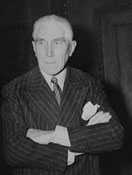
A. POSITIONS HELD BY VON PAPEN.
(1) Awarded the Golden Party Badge by Hitler, thereby becoming member
of NSDAP (2902-PS; Das Archiv vol. 48, p. 1614).
(2) Member of Reichstag, 1933-1945 (2902-PS).
(3) Reich Chancellor, 1 June 1942 to 2 December 1942, acting pro-tem
between 17 November and 2 December (2902-PS).
(4) Vice Chancellor, 30 January 1933 to August 1934 ( ?) Papen admits
holding office only to 30 June 1934; he also admits that decrees published
on 1 August 1934 and 2 August 1934 carry his signature as Vice-Chancellor,
but claims this was either mistake or forgery) (2902-PS).
(5) Special Plenipotentiary for the Saar (13 November 1933 to 30 June
1934) (2902-PS).
(6) Negotiator of Concordat with Vatican (concluded 20 July 1933) (2655-PS).
(7) German Ambassador at Vienna (26 July 1934 to 4 February 1938),
continuing thereafter to arrange Berchtesgaden meeting between Hitler
and Schuschnigg and to participate in meeting itself (2902-PS).
B. AS EX-REICH CHANCELLOR AND PROMINENT POLITICAL
LEADER, VON PAPEN USED HIS PERSONAL INFLUENCE TO PROMOTE THE ACCESSION
OF THE NAZIS TO POWER.
(1) When von Papen began these efforts he was well aware of the
Nazi program and Nazi methods. The official NSDAP program was open
and notorious. For many years it had been published and republished
in the Yearbook of the NSDAP and elsewhere. The Nazis made no secret
of their intention to make it the fundamental law of the State. The
first three points of this program forecast a foreign policy predicated
upon the absorption of "Germanic" populations outside the
boundaries of the Reich, the abrogation of Versailles treaty limitations,
and the acquisition of "Lebensraum." Points 4 to 8 foretold
the ruthless elimination of the Jews, and the 25th point demanded "unlimited
authority" of the central regime over the entire Reich as a means
"for the execution of all this" (1708-PS).
Hitler and the other leaders of the Party repeatedly reiterated these
views before 1933. Hitler himself subsequently pointed out that there
was no excuse for misinterpreting Nazi intentions:
"When I came to power in 1933, our path lay unmistakably before
us. Our internal policy had been exactly defined by our fifteen-year-old
struggle. Our program, repeated a thousand times, obligated us to
the German people. I should be a man without honor, worthy of being
stoned, had I retracted a single step of the program I then enunciated
"My foreign policy had identical aims. My program was to abolish
the Treaty of Versailles. It is futile nonsense for the rest of the
world to pretend today that I did not reveal this program until 1933
or 1935 or 1937. Instead of listening to the foolish chatter of emigres,
these gentlemen would have been wiser to read what I have written
thousands of times." (2541-PS)
Hitler and other Nazi leaders repeatedly made clear their willingness
to use force if necessary to achieve their purposes. They glorified
war. Mein Kampf is replete with early evidence of such intentions, which
subsequently were reaffirmed from time to time in the years preceding
1933 (D- 660; 2771-PS; 2512-PS).
The Nazi leaders prior to 1933 had openly declared their intentions
to subvert democratic processes as a means to achieve their purposes,
and to this end to harass and embarrass democratic forces at every turn.
Thus Hitler himself had declared that.
"We shall become members of all constitutional bodies, and in
this manner make the Party the decisive factor. Of course, when we
possess all constitutional rights we shall then mould the State into
the form we consider to be the right one." (2512-PS)
Frick, writing in the National Socialist Yearbook, declared:
"Our participation in the parliament does not indicate a support,
but rather an undermining of the parliamentarian system. It does not
indicate that we renounce our anti-parliamentarian attitude, but that
we are fighting the enemy with his own weapons and that we are fighting
for our National Socialist goal from the parliamentary platform."
(2742-PS)
The practical application of these purposes was thus subsequently described
by a leading Nazi constitutional authority, Ernst Rudolf Huber:
"It was necessary above all to make formal use of the possibilities
of the party-state system but to refuse real cooperation and thereby
to render the parliamentary system, which is by nature dependent upon
the responsibility cooperation of the opposition, incapable of action."
(2633-PS).
This practical application of Nazi purposes and methods was manifest
at the time von Papen was a member of the Reichstag and Vice Chancellor.
By this time the Nazi members of the Reichstag were engaging in tactics
of disturbance which finally culminated in physical attacks upon members
of the Reichstag and upon visitors, and were using terroristic measures
to assure their election (L-83).
Von Papen not only had the opportunity to observe early manifestations
of Nazi violence and irresponsibility. He fully understood the true
character of the Nazi menace before 1933 and publicly condemned it.
At the time of the German elections in the summer of 1932, von Papen,
President Hindenburg, and certain other German leaders were hoping that
the rising Nazi menace would be dissipated by providing for National
Socialist participation in a rightist-centrist government. Hitler refused
all overtures inviting such participation, even when suggested by President
Hindenburg himself, insisting upon assuming the chancellorship without
obligation to other parties. Hitler's refusal at this time to collaborate
with Hindenburg and Papen marked the beginning of a series of public
declarations in which von Papen revealed a clear understanding of Nazi
methods and objections. Thus, on the occasion of his Munster speech
of 28 August 1932 von Papen declared:
"The licentiousness emanating from the appeal of the leader
of the National Socialist Movement does not comply very well with
his claims to governmental power."
*******
"I do not concede him the right to regard the mere minority
following his banner solely as the German nation, and to treat all
our fellow countrymen as 'free game'."
*******
"I am advocating the constitutional state, the community of
the people, law and order in government. In doing so, it is I, and
not he, who is carrying on the struggle against the domination of
parties, against arbitrarianism and injustice, a struggle which millions
of his supporters had been wholeheartedly longing for years to fight."
*******
"I am firmly determined to stamp out the smouldering flame of
civil war, to put an end to political unrest and political violence,
which today is still such a great obstacle to the positive work representing
the sole task of the State." (3314-PS)
Writing in the September 1932 issue of the periodical
"Volk und Reich," von Papen declared:
"The present situation clearly shows that party domination and
State leadership are concepts incompatible with one another. It is
conceivable theoretically that a party might gain the majority in
parliament and claims the government (State leadership) for itself.
The NSDAP has proclaimed this theoretical possibility as its practical
goal and has come very close to attaining it. It is to be hoped that
the leaders of this movement will place the nation above the party
and will thus lend a visible expression to the faith of millions looking
for a way out of the spiritual and- material distress of the nation
provided also by the leadership of the State."
*******
" The hope in the hearts of millions of national socialists
can be fulfilled only by an authoritarian government. The problem
of forming a cabinet on the basis of a parliamentary coalition has
again been brought into the field of public political discussion.
If such negotiations, in the face of growing distress, are conducted
with the motif of destroying the political opponent by the failure
of his governmental activity, this is a dangerous game against which
one cannot warn enough. In the last analysis such plans can mean nothing
else but a tactics which counts on the possibility that matters get
worse for the people and that the faith of millions will turn into
the bitterest disappointment, if these tactics only result in the
destruction of the political adversary. It is within the nature of
such party-tactical maneuvers that they are veiled and will be disclaimed
in public. That, however, cannot prevent me from warning publicly
against such plans, about which it may be undecided who is the betrayer
and who the betrayed one; plans, though, which will certainly cheat
the German people out of their hope for improvement of their situation.
Nothing can prove more urgently the necessity for an authoritarian
government than such a prospect of maneuvers of a tactical game by
the parties." (Papen article quoted in "Frankfurter Zeitung"
2 September 1932, p.
In his Munich speech on 13 October 1932 von Papen was especially clear:
"The essence of conservative ideology is its being anchored
in the divine order of things. That too is its fundamental difference
compared with the doctrine advocated by the NSDAP. The principle of
'exclusiveness' of a political 'everything or nothing' which the latter
adheres to, its mythical Messiah- belief in the bombastic Fuehrer
who alone is destined to direct fate, gives it the character of a
political sect. And therein I see the unbridgeable cleavage between
a conservative policy born of faith and a national-socialist creed
as a matter of politics. It seems to me that today names and individuals
are unimportant when Germany's final fate is at stake. What the nation
demands is this: it expects of a movement which has written upon its
banner the internal and external national freedom that it will act,
at all times and under all circumstances, as if it were the spiritual,
social and political conscience of the nation. If it does not act
that way; if this movement follows merely tactical points of view,
democratic- parliamentarian points of view, if it engages in the soliciting
of mass support using demagogic agitation an mean. of proletarian
class struggle then it is not a movement any more, it has become a
political party. "And, indeed, the Reich was almost destroyed
by the political parties. One simply cannot, on one side, despise
mercilessly masses and majorities, as Herr Hitler is doing, and on
the other hand surrender to parliamentarian democracy; surrender to
the extent of adopting resolutions against one's own government together
with Bolshevists."
*******
"In the interest of the entire nation we decline the claim to
power by parties which want to own their followers body and soul,
and which want to put themselves, as a party or a movement, over and
above the whole nation." (3817-PS)
In a series of interviews and speeches in the fall of 1932 von Papen
castigated the Nazi party for its ambitions to achieve a total and centralized
control of Germany. He contrasted its objectives and methods to his
own "conservatism" and emphasized its incompatibility with
the preservation of the "federalistic" type of government
to which he was committed. His public pronouncements in this connection
were clearly reflected in the contemporary press:
"Von Papen claimed that it had been his aim from
the very beginning of his tenure in office to build a new Reich for
and with the various states [Laender]. The Reich government is taking
a definite federalist attitude. Its slogan is not a dreary centralism
or unitarianism."
*******
"Wherever one did hear von Papen express himself in public,
one did hear a chancellor who took special care to be regarded as
an unconditional federalist." (3318- PS)
The Vice Chancellor's campaign against the Nazis culminated finally
in a radio speech to the German public on 4 November 1932, in which
he severely criticized Nazi political methods. He damned the Nazis'
"pure party egoism" which resulted in methods described by
him as "sabotage" and as "a crime against the nation."
He accused the Nazis of wanting complete and permanent power in Germany
(Deutsche Reichsgeshichte in Dokumenten IV, p. 523 (Rundfunkrede des
Reichkanzlers von Papen)).
Nor was von Papen content merely to make speeches against the Nazis.
As late as November 1932, Papen was prepared to use all the forces at
the command of the state in a supreme effort to suppress the rising
Nazi menace. He was deterred from this purpose only by a failure to
secure the support of his cabinet. The inner struggles of the German
cabinet at this time are recounted by Otto Meissner (in a statement
made at Nurnberg, 28 November 1945), Chief of the Chancery of Reichspresident
Hindenburg.
"Papen's reappointment as Chancellor by President Hindenburg
would have been probable if he had been prepared to take up an open
fight against the National Socialists, which would have involved the
threat or use of force. Almost up to the time of his resignation,
Papen and some of the other ministers agreed on the necessity for
pressing the fight against the Nazis by employing all the resources
of the State and relying on Article 48 of the Constitution, even if
this might lead to armed conflict. Other ministers, however, believed
that such a course would lead to civil war.
"The decision was provided by Schleicher, who in earlier times
had recommended energetic action against the National Socialists --
even if this meant the use of police and army. Now, in the decisive
cabinet meeting, he abandoned this idea and declared himself for an
understanding with Hitler.
"The gist of Schleicher's report -- which was given partly by
himself, partly by Major Ott, who adduced detailed statistical material
-- was that the weakened Reichswehr, which was dispersed over the
whole Reich, even if supported by civilian volunteer formations, would
not be equal to military operations on a large scale, and was not
suited and trained for civil war. The police, in particular the Prussian
police, had been undermined by propaganda and could not be considered
as absolutely reliable. If the Nazis began an armed revolt, one must
anticipate a revolt of the Communists and a general strike at the
same time. The forces of these two adversaries were very strong. If
such a 'war against two fronts' should take place, the forces of the
State would undoubtedly be disrupted. The outcome of a civil war would
be at the least most uncertain.
"In his, Schleicher's view, it was impossible to take the risks
implied in such a policy. In case of failure, which he believed likely,
the consequences for Germany would be terrible. All present in the
cabinet meeting were deeply impressed bySchleicher's statement, and
even those who had been in favor of energetic action against the National
Socialists now changed their mind, so that Papen was isolated and
felt himself to be isolated.
"In the interview which Papen had with Hindenburg after this
meeting, on 17 November 1932 Papen did not conceal his deep disappointment
over Schleicher's altered position. Although Hindenburg asked him
to make a new attempt to form a government, Papen stood on his decision
to resign and Hindenburg gave in."
(2) Despite his appreciation of the Nazi menace, von Papen rigorously
proceeded to conduct negotiations which resulted in placing Hitler and
the Nazi regime in power. Following his resignation as Chancellor
on 17 November 1932 von Papen continued as Chancellor pro-tem until
2 December 1932, when General Schleicher was appointed to replace him
(2902-PS).
Almost as soon as he vacated the Chancery, von Papen began plotting
to unseat his arch-rival Schleicher. On about 10 December 1932 -- less
than a month after he was willing to use force to suppress the Nazis
-- von Papen requested Kurt von Schroeder, the Cologne banker, to arrange
a meeting between Hitler and von Papen (according to the statement of
Schroeder, made at Nurnberg, 5 December 1945). Schroeder was one of
a group of rightist industrial and financial leaders who had previously
been organized by Hitler's man, Wilhelm Keppler, to provide means of
bolstering Nazi economic power.
Hitler himself at this time understood von Papen. He knew that Papen's
ideas were not too different from his own to preclude agreement. He
knew that Papen's personal rivalry with Schleicher would make Papen
amenable to some agreement whereby Schleicher might be unhorsed and
Papen restored to a position of public prominence. He accordingly asked
Keppler to arrange for a meeting with Papen (reported in an affidavit
of Wilhelm Keppler, executed at Nurnberg, 26 November 1945).
The result of these maneuvers was the now-famous meeting between Hitler
and Papen at banker Schroeder's Cologne home in January 1933. It was
at this meeting that Hitler and Papen reached an understanding, subject
only to the ironing out of minor details. It was at this meeting that
Papen completely committed himself to go along with Nazi policy.
The events of this day have been described by Kurt von Schroeder (in
a statement referred to above):
"On 4 January 1933,Hitler, von Papen, Hess, Himmler and Keppler
came to my house in Cologne. Hitler, von Papen and I went to my den
where we were closeted in a discussion lasting about two hours. Hess,
Himmler and Keppler did not participate in this discussion but were
in the next room. Keppler, who had helped arrange this meeting, came
from Berlin; von Papen came alone from his home in the Saar; and Hitler
brought Hess and Himmler with him, as they were traveling with him
to Lippe in connection with the election campaign. The discussion
was only between Hitler and Papen; I personally had nothing to say
in the discussion. The meeting started about 11:30 A. M. and the first
question was raised by Hitler as to why it was necessary to punish
the two Nazis who had killed the Communist in Silesia. Von Papen explained
to Hitler that it had been necessary to punish these two Nazis, although
they had not been put to death, because the law was on the books and
all political offenders under the law must have some punishment. He
further explained to Hitler that it might be possible to get a pardon
from President Hindenburg to give serious consideration to making
Hitler the Chancellor at the time that Hindenburg met with Hitler
and von Papen and that he had understood that Hindenburg was perfectly
willing to discuss this matter with Hitler at that time. He said that
it came as a great surprise and shock to him when Hindenburg was unwilling
to do so and he felt that someone, probably von Schleicher, was responsible
for the change in Hindenburg's point of view. Next, von Papen told
Hitler that it seemed to him the best thing to have the conservatives
and nationalists who had supported him join with the Nazis to form
a government. He proposed that this new government should, if possible,
be headed by Hitler and von Papen on the same level. Then Hitler made
a long speech in which he said if he were made Chancellor, it would
be necessary for him to be head of the government but that supporters
of Papen could go into his (Hitler's) government as ministers when
they were willing to go along with him in his policy of changing many
things. These changes he outlined at this time included elimination
of Social Democrats, Communists and Jews from leading positions in
Germany and the restoration of order in public life. Von Papen and
Hitler reached an agreement in principle so that many of the points
which had brought them in conflict could be eliminated and they could
find a way to get together. They agreed that further details would
have to be worked out and that this could be done in Berlin or some
other convenient place.
"I understand they met later with von Ribbentrop and worked
out further details.
"The meeting broke up about 1:30 and the three of us joined
Hess, Himmler and Keppler at lunch, during which there was general
conversation which lasted until about four o'clock when they, all
the guests, departed."
Having reached an understanding with Hitler, von Papen directed his
energy toward convincing President Hindenburg to allow Hitler to form
a new government. In this task he had to overcome Hindenburg's fears
that this appointment would lead to domestic oppressions and risk of
war (according to a statement of Otto Meissner, Nurnberg, 28 November
1945).
Von Papen himself subsequently admitted the important role he played
in bringing Hitler to power. At Berchtesgaden on 12 February 1938, immediately
after Hitler had forced Schuschnigg to sign the document which led to
the Austrian Anschluss, Hitler turned to Papen and remarked:
"Herr von Papen, through your assistance I was appointed Chancellor
of Germany and thus the Reich was saved from the abyss of communism.
I will never forget that."
Papen replied: "Ja, wohl, Mein Fuehrer." (2995-PS)
C. AS VICE-CHANCELLOR, VON PAPEN USED HIS POSITION AND PERSONAL
INFLUENCE TO FACILITATE THE CONSOLIDATION OF NAZI CONTROL OVER GERMANY.
(1) In the first critical year and a half of Nazi consolidation
of control over Germany, von Papen was second only to Hitler in the
Cabinet which established the legal basis for furtherance of the Nazi
program. As Vice- Chancellor, van Papen was the only member of the
government empowered to act for the Fuehrer in his absence.
(2) Von Papen actively participated in the general abolition of
civil liberties by promoting legislation which paved the way for the
Nazi police state. At the first meeting of Hitler's Cabinet, there
was intensive discussion concerning the possibility of securing passage
of an Enabling Law which in practical effect would liquidate the Reichstag
and make the Nazi Cabinet the supreme law-making power of the Reich.
The conspirators, including von Papen, at this meeting clearly indicated
that they did not at the time hold sufficient power to achieve this
measure by normal constitutional methods (351-PS).
Seizing the Reichstag fire as a pretext, the Cabinet forthwith arranged
for the suspension of those fundamental civil liberties (including freedom
of speech, press, assembly and association) which would protect citizens
who dared to oppose the plans of the conspirators. The suspension of
civil liberties was accomplished by issuance of a Presidential decree,
which presumably, according to German usage, was proposed to the Reich
President by the Cabinet and-countersigned by those Ministers whose
departments were involved (1390-PS;
This basic law was only the first of a series which placed the individual
dissenter at the mercy of the Nazi state. As if to underscore explicitly
the basic policy behind this legislation, von Papen personally signed
the decree which implemented this legislation by creating Special Courts
to enforce its provisions. This decree abolished rights, including the
right of appeal, which had previously characterized the administration
of justice by the German judicial system. It thus constituted also the
first legislative measure for the Nazification of the German judiciary
(2076-PS).
The subsequent creation of the dreaded Volksgericht and the wholesale
Nazification of the German system of criminal law was merely the logical
development of these earlier steps. This too was achieved by decree
of the Cabinet in which von Papen was Vice-Chancellor
(3) Von Papen actively participated in substitution of the Nazi
Cabinet for the Reichstag as Germany's supreme law- giving authority,
notwithstanding his doubts as to the advisability of giving Hitler such
extensive power. Von Papen actively participated in the Cabinet
deliberations concerning the proposed so-called Enabling Act, and concerning
the means by which it might be made law (351-PS; 2962-PS; 2963-PS).
The enactment of this law deprived the Reichstag of its legislative
functions, so that legislative as well as executive powers were concentrated
in Hitler and his Cabinet (2001-PS). Enactment of the law was made possible
only by the application of Nazi pressure and terror against the potential
opponents of this legislation, and by taking advantage of the Presidential
decree of 28 February 1933, suspending constitutional guarantees of
freedom. (See section 2 of Chapter VII on the Acquisition of Totalitarian
Political Control.)
As if to indorse the methods by which this legislation was enacted,
von Papen personally signed the Amnesty Decree of 21 March 1933, liberating
all persons who had committed murder between 30 January 1933 and 21
March 1933 against anti-Nazi politicians, writers, and Reichstag Deputies
(2059-PS).
Von Papen participated in this program notwithstanding the fact that
he foresaw at that time the implications of granting to Hitler the complete
powers conferred by the Enabling Act. He has so testified (in an interrogation
at Nurnberg, 3 September 1945):
"Q. After Hitler became Chancellor, when for the first time
did you have any doubts about the wisdom of having allowed him to
become Chancellor?
"A. Well, that's difficult to say. I mean the first doubt certainly
I had when the Reichstag gave in to his request for the law, to enable
him to rule the country without parliament."
(4) Von Papen not only participated in the seizure by the cabinet
of supreme power for the Nazis, but as a member of the cabinet participated
in the systematic elimination of all potential enemies of the Nazi conspiracy.
The Reichstag fire and the ensuing suppression of civil liberties marked
the beginning of the destruction of all rival political parties. The
immediate elimination of the legally elected Communist members from
the Reichstag was merely the forerunner of the rapid and complete liquidation
of all political parties other than the National Socialists (2403- PS;
1396-PS; 2058-PS; 1388-PS). By these measures the suppression of all
democratic opposition became complete, within one year of the time when
von Papen was warning his countrymen of the dangers of authoritarianism.
Having substituted the autocracy of the Hitler cabinet for the democratic
force of the Reichstag, the cabinet proceeded immediately to enact a
series of laws abolishing the states and coordinating them with the
Reich (2004-PS; 2005-PS; 2006- PS). The enactment of these laws, which
had been clearly indicated by point 25 of the Party program, removed
all possible retarding influences which the German federal State might
have exerted against the overwhelming centralization of power in Hitler'
Reich Cabinet.
The importance of this step, as well as the role played by Papen, is
reflected in an exchange of letters between Reichs President Hindenburg,
von Papen in his capacity as Reichskommissar for Prussia, and Reichs
Minister Goering. The exchange occurred in connection with the recall
of the Reichskommissar and the appointment of Goering to the post of
Minister President of Prussia. In tendering his resignation, on 7 April
1933, von Papen wrote to Hitler:
"With the draft of the law for the coordination of the states
with the Reich, passed today by the Reich Chancellor, legislative
work has begun which will be of historical significance for the political
development of the German state. The step taken by the Reich Government,
which I headed at the time, is now crowned by this new inter-locking
of the Reich. You, Herr Reich Chancellor, will now, as once Bismarck,
be able to coordinate in all points the policy of the greatest of
German states with that of the Reich. Now that the new law enables
you to appoint a Prussian Prime Minister I ask you to inform the Reich
President that I return to his hands my post of Reichs Commissar for
Prussia."
In transmitting this resignation request to President Hindenburg, Hitler
stated:
"Vice-Chancellor von Papen has sent a letter to me which I enclose
for your information. Herr von Papen already informed me within the
last few days that he agreed with Minister Goering to resign on his
own volition, as soon as the unified conduct of the governmental affairs
in the Reich and in Prussia would be assured by the new law on coordination
of policy in the Reich and the states [Laender].
"On the eve of the day when the new law on the institution of
Reich governors [Reich-Statthalter] was adopted, Herr von Papen considered
this aim as having been attained and he requested of me to undertake
the appointment of the Prussian Prime Minister, when at the same time
he would offer his full time services in the Reich
"Herr von Papen, in accepting the commission for the Government
of Prussia in these difficult times since 30 January, has rendered
a very meritorious service to the realization of the idea of coordinating
the policy in the Reich and the States. His collaboration in the Reich
cabinet, for which he now offers all his strength, is infinitely valuable;
my relationship to him is such a heartily friendly one, that I sincerely
rejoice at the great help I shall thus receive.
"For profound reverence,
"A.H." (357-PS)
The enactment of this legislation followed repeated declarations in
which Papen had warned his countrymen of the dangers of the exaggerated
degree of centralized authority which would result from abolition of
the federal system. These warnings began before Hitler's accession to
power and continued by implication in the reassurances which Papen gave
in February 1933 to Bavarian political leaders who expressed their fears
of Nazi centralized authority (Cuno Horkenbach, Das Deutsche Reich von
1918 bis Heute. (The German Reich from 1918 until today) (Berlin 1933),
p. 44). As late as 3 March 1933, in an election speech at Stuttgart,
von Papen warned that:
"Federalism saves us from centralism, that organizational form
which concentrically draws all the vital forces of a people to one
point, as a mirror will do with the rays of the sun. No people is
less suited for being governed centralistically than the German people."
Less than one month after its seizure of the legislative power, the
cabinet of which von Papen was a member enacted the first of a series
of laws aimed at establishing firm Nazi control over the entire civil
service and judiciary (2012-PS; 1400-PS; 1398-PS). Having been a public
servant himself, von Papen was aware of the far-reaching effect of these
first legislative and administrative steps in attaining full totalitarian
control over the entire governmental machinery of Germany.
The cabinet of which von Papen was a member embarked upon a state policy
of persecution of the Jews. The first organized act in this program
was the boycott of Jewish enterprises on 1 April 1933, which was approved
by the entire cabinet. This was followed by a series of laws beginning
the systematic elimination of the- Jews from public and professional
life in Germany. (See Section 7 of Chapter VII on the Program for Persecution
of Jews.)
All these suppressive measures were in line with long- standing basic
objectives of the NSDAP to which von Papen had agreed in hisJanuary
conference with Hitler and von Schroeder.
(5) To complete its suppression of all rival influences, the Cabinet
of which von Papen was a member enacted a series of decrees which strengthened
the Nazi movement by conferring upon it a para-governmental status.
Followers of the Party, through a decree signed personally by von Papen,
were granted amnesty "for penal acts committed in the material
revolution of the German People, in its preparation of the fight for
the German soil" (2059-PS). The perpetrators of Nazi terrorism
were thereby placed above the law, and a pattern was established for
the subsequent handling of Nazi excesses.
This cabinet enacted measures which gave legal protection to the status
and symbols of the Party and its formations (1652- PS;
This cabinet enacted a series of measures to assure the Nazi movement's
spiritual control over Germany (2029-PS; 2030-PS; 2415-PS; 2083-PS;
2078-PS; 2088-PS).
Having first outlawed all political parties other than the NSDAP, the
cabinet of which von Papen was-a member formally decreed that:
"1. After the victory of the National Socialistic Revolution,
the National Socialistic German Labor Party is the bearer of the concept
of the German State and is inseparably the state.
"2. It will be a part of the public law. Its organization will
be determined by the Fuehrer." (1395- PS).
Having granted para-governmental status to the Nazi party, and having
assured legal unity of the Party's Fuehrer and the Reich's Chancellor,
the Nazis next step was to combine in the same person the Presidency
of the German Reich. This was accomplished by merging the offices of
President and Chancellor, by means of a decree signed by von Papen (2003-
PS). An important consequence of this law was to give to Hitler the
supreme command of the German armed forces, always a perquisite of the
Presidency (2050-PS).
(6) Despite disagreements as to detail, von Papen fundamentally
agreed with basic Nazi objectives and publicly endorsed the regime for
which he shared responsibility as Vice Chancellor. Von Papen's basic
political philosophy was not so divergent from Nazism as to preclude
an easy bridging of the gap. In 1932, while still Chancellor, von Papen
had been willing to head a government in which Nazism would be strongly
represented. By January 1933 he found it possible - - as a price for
his restoration to a position of public prominence -- to submerge his
differences with Hitler and to direct his energies to the installation
of a Nazi regime (see B above).
In addition to his participation as a cabinet member in the process
of Nazifying Germany, von Papen's devotion to the Nazi cause was repeatedly
demonstrated throughout this period by public statements and acts both
by himself and by Hitler. Thus, as noted above in connection with his
role in the elimination of the Laender as a political force, von Papen
wrote Hitler in April 1933, that
"You, Herr Reich Chancellor, will now, as once Bismarck, be
able to coordinate in all points the policy of the greatest of German
states with that of the Reich,"
And Hitler on that occasion took notice of Papen's services by declaring
that
"His collaboration in the Reich cabinet, for which he now offers
all his strength, is infinitely valuable; my relationship to him is
such a heartily friendly one, that I sincerely rejoice at the great
help I shall thus receive." (3357-PS).
And again on 2 November 1933, speaking from the same platform with
Hitler and Gauleiter Terboven, in the course of the campaign for Reichstag
election and the referendum on Germany's withdrawal from the League
of Nations, von Papen declared:
"Ever since Providence called upon me to become the pioneer
of national resurrection and the rebirth of our homeland, I have tried
to support with all my strength the work of the national socialist
movement and its leader; and just as I at the time of taking over
the chancellorship have advocated to pave the way to power for the
young fighting liberation movement, just as I on January 30 was selected
by a gracious fate to put the hands of our chancellor and Fuehrer
into the hand of our beloved field marshal, so do I today again feel
the obligation to say to the German people and all those who have
kept confidence in me:
"The kind Lord has blessed Germany by giving it in times of
deep distress a leader who will lead it, through all distresses and
weaknesses, through all crisis and moment of danger, with the sure
instinct of the statesman into a happy future."
********
"Let us in this hour say to the Fuehrer of the new Germany that
we believe in him and his work." (3375- PS).
By this time as noted above, the cabinet of which Papen was a member
had abolished the civil liberties which were a condition to any effective
protest against Nazism, had sanctioned political murder committed in
aid of Nazism's seizure of power, had substituted itself for the Reichstag
as Germany's supreme law-making authority, had destroyed all rival political
parties, had enacted the basic laws for abolition of the political influence
of the Laender, had provided the legislative basis for purging the civil
service and judiciary of anti-Nazi elements, had embarked upon a state
policy of persecution of the Jews, had legislated Nazi influence into
the cultural life of the German nation, and had taken its first steps
toward conferring a para- governmental status upon the Nazi party and
its principal formations.
Even after von Papen's Marburg speech of June 1934, in which he again
showed some understanding of the dangers of Nazism, he remained a pillar
of Nazi policy and influence. Thus Hitler himself, in attempting to
justify the Blood Purge of 30 June 1934, tacitly admitted that Papen
was still considered a loyal member of the regime:
"The allegations [of foreign newspapers] that Vice- Chancellor
von Papen, Reichsminister Seldte, or other gentlemen of the Reich
Cabinet had entertained connections with the rebels is refuted by
the fact that one of the first intentions of the rebels was to assassinate
these men." (Hitler Reichstag address, 18 July 1934, as quoted
in Das Archiv, Vol. IV, pp. 495, 507.)
The Fuehrer thus made-a tacit bid for the continuing loyalty of von
Papen. Von Papen's subsequent career demonstrated that this was not
a vain expectation. He left the vice- chancellorship only to assume
the new task of special emissary of the Fuehrer to Austria. But before
leaving, while still Vice Chancellor, von Papen signed the decree combining
the positions of President and Reichs Chancellor on 1 August 1934, and
on 5 August 1934 he delivered the document -- the so-called Hindenburg
Testament which purported to confer the revered president's dying blessing
upon Hitler and the Nazi regime (Notice concerning delivery of Hindenburg's
testament by Vice Chancellor von Papen, Das Archiv, Vol. V, page 648).
D. AS GERMANY'S MOST FAMOUS CATHOLIC LAYMAN AND AS NEGOTIATOR
OF THE VATICAN CONCORDAT, VON PAPEN USED HIS POSITION AND PERSONAL INFLUENCE
TO PARTICIPATE IN THE CONSOLIDATION OF NAZI CONTROL OVER GERMANY AND
IN NAZI PREPARATION FOR AGGRESSION.
(1) Immediately upon Nazi seizure of power within Germany, von Papen
endeavored to weld German Catholicism into a powerful body of support
for the Nazi state. When Naziism seized control of Germany in January
1933, its relations with the church were at a low ebb. The period of
the Reichstag elections of July and November 1932 was marred by certain
widely circulated anti-Nazi pronouncements of the German bishops, especially
in such Catholic papers as Germania, Koelnische Volkszeitung, and the
Rhein-Mainische Volkszeitung. These bishops discerned the fundamental
incompatibility between the Church and the Nazis' own declarations of
State policy. They accordingly publicly stigmatized the Nazi movement
as anti-Christian, forbade the Catholic clergy to participate in any
ceremonies (such as funerals) in which the Nazi Party was officially
represented, refused the sacraments to Party officials, and in several
pastorals expressly warned - the faithful against the danger to German
Catholicism created by the Party
Immediately upon seizure of power, the main concern of the new regime
was to liquidate political opposition. Achievement of this objective
was predicated upon the strategy of "divide and rule" A first
step in this strategy was to convince conservatives that the efforts
of the government were being directed primarily against the Communists
and other forces of the extreme Left, and that their own interests would
remain safe in Nazi hands as long as they would consent to refrain from
political activity. The result was a brief but active period of rapprochement
between Church and Party. Von Papen was a leader in this strategy. The
minutes of the Reich cabinet meeting of 15 March 1933 contain the following
notation in connection with discussions on the Enabling Act:
"The Vice Chancellor and Reich Commissar for the State of Prussia
said it-is of decisive importance to integrate into the new State
the masses standing behind the Parties. He said that the question
of coordination of political Catholicism into the new State is of
special importance." (2962-PS)
Eight days later, speaking at the second meeting of the Reichstag of
1933, on 23 March 1933, Hitler asked for adoption of the Enabling Act.
In this speech he declared:
"While the government is determined to carry through the political
and moral purging of our public life, it is creating and insuring
prerequisites for a truly religious life. The government sees in both
Christian confessions the factors most important for the maintenance
of our Folkdom. It will respect agreements concluded between them
and the states. However, it expects that its work will meet with a
similar appreciation. The government will treat all other denominations
with equal objective justice. However, it can never condone that belonging
to a certain denomination or to' a certain race might be regarded
as a license to commit or tolerate crimes. The Government will devote
its care to the sincere living together of Church and State."
(3387-PS).
The immediate effect of this assurance was action by the conference
of German bishop, meeting in Fulda on 28 March 1933. This conference
lifted restrictions imposed on members of the church adhering to the
Nazi movement. In a cautious statement which placed full faith and credit
in the Papen- inspired Hitler assurances, the bishops declared:
"The high shepherds of the dioceses of Germany in their dutiful
anxiety to keep the Catholic faith pure and protect the untouchable
aims and rights of the Catholic Church have adopted, for profound
reasons, during the last years, an oppositional attitude toward the
National Socialist movement, through prohibitions and warnings, which
was to be in effect as long and as far as those reasons remained valid.
"It must now be recognized that there are official and solemn
declarations issued by the highest representative of the Reich Government
-- who at the same time is the authoritarian leader of that movement
-- which acknowledge the inviolability of the teachings of Catholic
faith and the unchangeable tasks and rights of the church, and which
expressly assure the full value of the legal pacts concluded between
the various German States and the Church.
"Without lifting the condemnation of certain religious and ethical
errors implied in our previous measures, the Episcopate now believes
it can entertain the confidence that those prescribed general prohibitions
and warnings may not be regarded as necessary any more." (3389-PS)
This action opened the door for mass Party adherence by practicing
Catholics. All those German Catholics who were inclined to adopt Nazi
political views and had hesitated only because of the anti-Nazi attitude
of the hierarchy hastened now to join the victorious party of the "National
Revolution" This tendency was marked by a tremendous and sudden
burst of activity by the so-called "bridge-builders," who
rushed to close the gap between the Church and the Nazi State. Von Papen,
who only a short time before had been willing to use armed force to
suppress the Nazis, was foremost among these "bridge-builders"
who not only claimed an ideological affinity between the Nazi system
and the alleged anti-liberal character of Catholic politics, but affirmatively
apologized for excesses of the State which even then had begun to shock
the world.
Existing agencies were used for this purpose. Thus, the Union of Catholic
Germans (Arbeitsgemeinschaft Katholischer Deutscher), of which von Papen
was president, insisted in its program that the church, like the Nazi
movement itself, was guided by the leadership principle (Cuno Horkenbach,
Das Deutsche Reich von 1918 bis Heute (The German Reich from 1918 Until
Today) (Berlin 1935), pp. 436, 504). The same organization, in the course
of the election campaign which preceded adoption of the Enabling Act,
had bitterly criticized the Catholic political opposition to Marxism
and urged that Catholics "by all means vote unanimously the National
Socialist ticket" because "We Catholics do not wish to be
denied to march in the lead in this election campaign" (Election
Appeal, Voelkischer Beobachter, 23 February 1933, p. 2). Later, on the
eve of the Nazis' first anti-Jewish boycott, this same organization
played its part in the extensive campaign replying to foreign newspaper
reports concerning atrocities committed against German Jews. On 1 April
1933 it published through the Prussian News Service, an "Appeal
to all Christians" viewing "with great indignation" this
"irresponsible campaign against Germany" which "continues
in spite of official German declarations and corrections" This
"Appeal" characterized the foreign reports as "intentional
lies and falsifications" and "a reckless, crafty campaign
of destruction conducted by the Jewish world alliance and moneyed powers
against the right of self-determination of all peoples and against the
entire Christian civilization" It called upon "the Christians
of all countries, irrespective of denominations, to form a world-wide
front of defense against that Jewish conspiracy disturbing the true
peace" ("Appeal to All Christians" Voelkischer Beobachter
(People's Observer), 30 March 1933, p. 2).
Notwithstanding the force of these activities, this Nazification by
existing agencies was not deemed adequate to the task of organizing
Catholic lay support. The result was the creation, in early April 1933,
under the sponsorship of von Papen, of a new "Bund" of Catholic
Germans called "Cross and Eagle" ("Kreuz und Adler"
which made it its task "to contribute enthusiastic devotion to
the upbuilding of the future Reich" (Gerd Ruehle, Das Dritte Reich
(The Third Reich), p. 250).
This whole program of rapprochement between Church and Party manifests
the Papen "touch" -- the same quality of handiwork which had
manifested itself in Hitler's accession to power and which later was
to reappear in Austria: First, gentle hints by Papen a to strategy,
followed within eight days by reassurances in Hitler's Reichstag speech.
Next, again following merely by days, the formal lifting of the restrictions
on Nazi membership by the leaders of the Church of which von Papen was
the most famous lay member. Finally, again within a few days, the open
campaign by which Papen- sponsored organizations endeavored to align
Church and Party. The close timing of these events was not a coincidence.
(2) Having achieved initial successes in consolidating Catholic
support within Germany, von Papen undertook international consolidation
of Nazi-Church relationships by negotiation of a Concordat with the
Vatican. The program of rapprochement and the public declarations
bridging the gap between the Church and the Nazi movement were merely
advertising media by which Nazi-minded Catholics were herded into the
movement, and slogans by which the conspirators might placate the Catholic
hierarchy. Throughout this period there continued an undercurrent of
anti-Catholic activity. A thorough job was done in purging Reich, state,
and municipal administrations of officials appointed for their adherence
to the Centre or Bavarian People's parties. Former leaders of those
parties, including priests, joined Communists and Social Democrats in
the concentration camps, and the campaign of hatred against the "black"
was resumed. By April 1933 the bishops were making appeals for clemency
toward former civil servants, who, they pointed out, were not able to
join the celebration of national awakening because they had been dismissed
from positions in which they had given their best to the community of
the German people. And on 31 May 1933, a meeting of the Bavarian bishops
adopted a solemn statement directed against the tendency of attributing
to the State alone the right of educating, organizing, and leading ideologically
the German youth (Dismissal of Catholics, Excerpts from Voelkischer
Beobachter, February-March 1933; Excerpt, Voelkischer Beobachter, 19
April 1933 (Munich ed.), p. 2).
By this maintenance of a certain amount of pressure against Catholic
interests, the hierarchy was reminded of the dangers of not coming to
a definite agreement with the Nazi State. The stage was thus set for
von Papen's negotiation of a Concordat with the Vatican.
At the time of these activities, the government of which von Papen
was Vice Chancellor had already launched its program to mold the state
machinery into the Nazi image. The Enabling Act had become law, and
the general outlines of the Nazi State were already manifest. Notwithstanding
the doubts created in his mind by Hitler's insistence upon the Enabling
Act, von Papen undertook negotiations with the Vatican. In fact, he
since has claimed that these fears gave rise to the negotiation of the
Concordat (Interrogation at Nurnberg,
"I became alarmed, you remember, somewhere in June when I went
to Rome to negotiate a concordat because I certainly feared that the
particular powers of the Hitler Party would create difficulties on
the religious side. So that with the consent of Hitler I went to Rome
to make that concordat."
It is clear, however, that these alleged fears of the Enabling Act
were not fears at all. They were merely an understanding of the threat
they carried to all persons and instrumentalities antagonistic to the
Nazi system. Von Papen understood the significance of these developments.
What he actually feared was that the rest of the world would also understand
Nazi methods and would erect barriers to the consummation of the plans
of the conspirators. The situation plainly called for a neutralizing
of these potential barriers to Nazi plans. One method of achieving this
result at that time was the negotiation of solemn agreements whereby
other powers would commit themselves to a policy of non-intervention
by either armed or moral force.
When von Papen concluded the Concordat with the Vatican, the political
objectives of furthering the purposes of the Nazi conspiracy were thus
foremost in his mind. Even at that time, in the first half of 1933,
von Papen had in mind, in concluding this Concordat, not only the consolidation
of Catholicism behind the Nazi regime within Germany, but also the psychological
build-up of the Austrians in preparation for Anschluss. Von Papen's
own words eloquently characterize these manoeuvres (monograph entitled
"Austria" written at Nurnberg,
"Although the 'Heimwehr' movement [in Austria] had brought these
patriotic elements together before this, and had fought with them
to free the country from strong Socialistic pressure, yet they were
armed only from the standpoint of domestic politics and remained aloof
from all ambitions for a greater Germany. The cause lay mostly in
the Catholic nature of the country, and in the strong influence of
the clergy in political leadership. The Reich was considered a bulwark
of Protestantism, despite its twenty million Catholics. The anti-clerical
wave, which was dominant in the Reich under the leadership of Prussia,
itself led by Socialists, appeared to have verified the fears of the
Austrian clergy. For in spite of Catholics at the head of the Reich
-- Wirth, Marx, Bruening -- the Centre Party had always put through
its cultural demands by logrolling with the Socialists. There were
at least two Socialist officials, university professors or teachers
for every Catholic appointee. In contrast to the obviously badly functioning
Weimar Constitution, there was an effort in Austria, under clerical
leadership and with the strong support of the Vatican, to develop
into a corporate state.
"Those were serious obstacles on both sides. When, after the
seizure of power of the NSDAP in 1933, as the first remedy against
a new 'Kulturkampf', I safely concluded the Concordat of the New Reich
with the Holy See, my thoughts at the time were not focused only of
the Reich. For a peaceful evolution of the German-Austrian question
it was of the greatest importance that the doubts of the clergy on
the Austrian side be completely eliminated."
*******
"It was my first purpose in the diplomatic field to deprive
the Austrian problem of its European character, and to develop it
gradually into an exclusively internal problem between the Reich and
Austria.
"It therefore had to be my primary aim to convince the Vatican
that a union could not endanger the Vatican's interests. A Concordat
of the Reich with the Vatican had been my first attempt to prevent
religious difficulties arising from Nazism's revolutionary doctrine;
the attempt had obviously failed. Under the growing influence of his
Party, Hitler sabotaged the Concordat. Rome was deeply disappointed
and in the greatest excitement."
On 20 July 1933 the Reich Concordat with the Vatican was signed by
von Papen as representative of the Nazi Government of Germany. This
instrument was an international treaty which purported to give the church
an official guarantee of all the church rights it had sought. In addition
it purported to confer freedom for Catholic organizations, maintenance
of parochial schools, and preservation of the general influence of the
church on the education of the German Catholic youth. Among the 33 articles
of the Concordat, 21 treated exclusively the rights and prerogatives
accorded to the church. Reciprocation consisted only in a pledge of
loyalty by the clergy to the Reich Government and a promise that Catholic
religious instruction would emphasize the patriotic duties of the Christian
citizen and insist on a loyal attitude toward the Fatherland. Since
it had always been the practice of the Catholic church to abide by established
governments and to promote patriotic convictions among the faithful,
these stipulations of the Concordat were no more than legalizations
of an existing custom. They were no more than a guarantee of goodwill
betokening harmonious Church-State relations (2655-PS).
(3) The signing of the Concordat was only an interlude in the church
policy of the Nazi Conspirators, which was a policy of reassurances
and repression. The signing of the Concordat merely marked the beginning
of evasions and violations of both its spirit and letter. The ink was
hardly dry before it became necessary for the Vatican to complain about
a false interpretation of the text, made by the Nazi government in it
own favour. (See Section 6 of Chapter VII on Suppression of the Christian
Churches.)
By action taken only ten days after the signing of the Concordat, and
despite its provision for the continuance of the Catholic Youth Association,
simultaneous membership in the Hitler Jugend and the Catholic Youth
Association was forbidden, and the campaign to smash the latter organization
thereby commenced (2456-PS).
These first steps were merely a foretaste of a long series of violations
which were to commence almost immediately and eventually to result in
papal denunciation and serious excesses committed against the clergy
(3280-PS).
The continuing character of the conspirators' church policy -- and
of von Papen's participation in it -- is further revealed by von Papen's
action of 19 September 1934, when, as president of the Union of Catholic
Germans (Arbeitsgemeinschaft Katholischer Deutscher), he ordered dissolution
of this organization. By this time the Nazis were dropping all pretext
that rival organizations might be permitted to exist, and were well
along in their plans for the integration of all German institutions
into the Nazi system. The official published announcement of dissolution
is a revealing document:
"Since the Reich Party Leadership through its department for
spiritual peace increasingly and immediately administers all cultural
problems and those concerning the relationship of State and Churches,
the tasks at first delegated to the Union of Catholic Germans are
now included in those of the Reich Party Leadership in the interest
of a stronger coordination.
"Vice-Chancellor von Papen, up to now the Leader of the Union
of Catholic Germans, declared about the Dissolution of this organization
that it was done upon his suggestion, since the attitude of the national
socialist State toward the Christian and Catholic Church had been
explained often and inequivocally through the leader and chancellor
himself." (3376-PS).
E. AS ENVOY AT VIENNA, VON PAPEN USED HIS POSITION AND INFLUENCE
DELIBERATELY TO WEAKEN THE AUSTRIAN GOVERNMENT, AND PARTICIPATED IN
THE POLITICAL PLANNING AND PREPARATION FOR MILITARY AGGRESSION, AGAINST
AUSTRIA.
(1) Von Papen accepted appointment a envoy at Vienna knowing he
would "front" for a Nazi fifth column in Austria. In July
1934, the Austrian policy of the Nazi government of Germany was in bad
odor throughout the civilized world. The historical record of this period
was written in the newspaper headlines of the day. A period of Nazi
pressure and terror culminated on 25 July 1934 in an attempted revolutionary
putsch, the murder of the Austrian Chancellor Dollfuss, in which the
German Minister, Reith, was implicated. (See Section 3 of Chapter IX
on Aggression Against Austria.) The situation was such as to call for
removal of the German Minister, Reith, and for the prompt substitution
of a man who was an enthusiast for Anschluss with Germany, who could
be tolerant of Nazi objectives and methods, but who could lend an aura
of respectability to official German representation in Vienna. Hitler's
reaction was immediate. He chose von Papen as quickly as he heard the
news of the Dollfuss murder. Writing of this event in 1945 after his
arrest by Allied authorities, von Papen dramatically describes the Fuehrer's
response to the situation (monograph on "Austria" referred
to above):
"Suddenly, at three o'clock in the morning, there was a loud
ringing of my doorbell. SS men demanded admission. My son and I were
of the opinion that I-was going to be imprisoned. We went to the front
door armed with pistols. Our suspicions were unfounded. The SS men
declared that they had come from the Chancellery with the order to
put through a telephone connection between Hitler and myself. "Hitler
was in Bayreuth and had been trying for hours without success to get
in touch with me. The connection was made.
"Hitler started, 'You know of course what has happened in Vienna.
You must go there immediately and try to set things in order.'
"I replied, 'I have no idea what has happened in Vienna. I have
just returned from the country and I don't understand what you want
with me in Vienna. I am in the act of packing my trunk to leave Berlin
once and for all.'
"Hitler, highly excited, gave thereupon a short description
of the dramatic events in Vienna which led to the murder of Dollfuss,
and continued, 'You are the only person who can save the situation.
I implore you to carry out my request.'"
As a result of this telephone call, von Papen flew immediately to join
Hitler at Bayreuth. There it was clear that the Nazi leadership feared
international repercussions from their Austrian policy and felt themselves
in dire need of a respectable "front" man. Von Papen has described
this meeting:
"There I found Hitler and his entire entourage, excited as an
ant-hill. It was difficult to get anything approaching an exact picture
of the Vienna 'Putsch' and the role of Hitler's promoters. Even if
one had come into this gathering in complete ignorance of the different
circumstances involved, one could have gathered with one look that
they had a very bad conscience and now were fearing the consequences.
From the very first moment I was certain that the immoderate policy
of the Austrian NSDAP under the leadership of Hitler's condottiere,
Habig, had led to this coup d'etat.
"This was, then, a few days after the 30 June, the second bloody
excess of the Party which had promised to bring Germany by peaceful
means to social tranquility, welfare, and respect. It was obvious
that both events had made a deep impression on the entire world, and
that the governmental methods of the Party must damage most seriously
the political credit of the Reich"
At this meeting it was Papen himself who drafted the letter of appointment.
This letter was a masterpiece of deceit, calculated to conceal completely
Hitler and Papen's goal of annexation. It stated:
"As a result of the events in Vienna I am compelled to suggest
to the Reichs-President the removal of the German Minister to Vienna,
Dr. Reith, from his post, because he, at the suggestion of Austrian
Federal Ministers and the Austrian rebels respectively consented to
an agreement made by both these parties concerning the safe conduct
and retreat of the rebels to Germany without making inquiry of the
German Reich Government. Thus the Minister has dragged the German
Reich into an internal Austrian affair without any reason.
"The assassination of the Austrian Federal Chancellor which
was strictly condemned and regretted by the German Government has
made the situation in Europe, already fluid, more acute, without any
fault of ours. Therefore, it is my desire to bring about if possible
an easing of the general situation, and especially to direct the relations
with the German Austrian State, which have been so strained for a
long time, again into normal and friendly channels.
"For this reason, I request you, dear Mr. von Papen, to take
over this important task, just because you have possessed and continue
to possess my most complete and unlimited confidence ever since we
have worked together in the Cabinet.
"Therefore, I have suggested to the Reichs-President that you,
upon leaving the Reich-Cabinet and upon release from the office of
Commissioner for the Saar, be called on special mission to the post
of the German Minister in Vienna for a limited period of time. In
this position you will be directly subordinated to me.
"Thanking once more for all that you have at a time done for
the coordination of the Government of the National Revolution and
since then together with us for Germany, I remain." (2799-PS).
The actual mission of von Papen was stated more frankly, shortly after
his arrival in Vienna, in the course of a private conversation with
the American Minister, George S. Messersmith. Mr. Messersmith has described
this meeting:
"When I did call on von Papen in the German Legation, he greeted
me with 'Now you are in my Legation and I can control the conversation'.
In the baldest and most cynical manner he then proceeded to tell me
that all of Southeastern Europe, to the borders of Turkey, was Germany's
natural hinterland, and that he had been charged with the mission
of facilitating German economic and political control over all this
region for Germany. He blandly and directly said that getting control
of Austria was to be the first step. He definitely stated that he
was in Austria to undermine and weaken the Austrian Government and
from Vienna to work towards the weakening of the Governments in the
other states to the South and South East. He said that he intended
to use his reputation as a good Catholic to gain influence with certain
Austrians, such as Cardinal Innitzer, towards that end. He said that
he was telling me this because the German Government was bound on
this objective of getting this control of Southeastern Europe and
there was nothing which could stop it and that our own policy and
that of France and England was not realistic.
"The circumstances were such, as I was calling on him in the
German Legation, that I had to listen to what he had to say and of
course I was prepared to hear what he had to say although I already
knew what his instructions were. I was nevertheless shocked to have
him speak so baldly to me and when he finished I got up and told him
how shocked I was to hear the accredited representative of a supposedly
friendly state to Austria admit that he was proposing to engage in
activities to undermine and destroy that Government to which he was
accredited. He merely smiled and said, of course this conversation
was between us and that he would, of course, not be talking to others
so clearly about his objectives. I have gone into this detail with
regard to this conversation as it is characteristic of the absolute
frankness and directness with which high Nazi officials spoke of their
objectives." (1760-PS)
(2) Von Papen proceeded forthwith to accomplish his mission -- the
maintenance of an outward appearance of non- intervention while keeping
appropriate contacts useful in the eventual overthrow of the Austrian
Government. Throughout the earlier period of his mission to Austria,
von Papen's activity was characterized by the assiduous avoidance of
any appearance of intervention. His true mission was reaffirmed with
clarity, several months after its commencement, when he was instructed
by Berlin that "during the next two years nothing can be undertaken
which will give Germany external political difficulties" Every
"appearance" of German interference in Austrian affairs "must
be avoided" (1760-PS). As von Papen himself stated to Berger-Waldenegg,
the Austrian Foreign Minister:
"Yes, you have your French and English friends now and you can
have your independence a little longer." (1760- PS).
Throughout this period, the Nazi movement was gaining strength in Austria
without openly-admitted German intervention, and Germany needed more
time to consolidate its diplomatic position. These reasons for German
policy were frankly expressed by the German Foreign Minister von Neurath
in conversation with the American Ambassador to France
Von Papen accordingly restricted his public activity to the normal
ambassadorial function of cultivating all respectable elements in Austria
and ingratiating himself in these circle particularly if they were well-disposed
(but not too obviously) to notions of Pan-Germanism. In these efforts
he was particularly careful to exploit his background as a former professional
officer and a Catholic (1760-PS).
Meanwhile, however, the Austrian Nazis continued illegal organization
in anticipation of he possibility of securing their objectives by force
if necessary. In these efforts they were aided by Germany, which permitted
the outlawed Austrian Nazis to meet and perfect their plots within Germany
and with German Nazi assistance; which harbored the Austrian Legion;
which made funds-available to National Socialists in Austria; and which
established appropriate contact with them through the Reich Propaganda
Ministry and through "respectable" Austrian "front"
personalities (1760-PS; 812- PS). (See also Section 3 of Chapter IX
on Aggression Against Austria.)
Von Papen was fully aware of the existence and activities of these
groups, and of their potentialities in effecting an Anschluss. Thus,
in a report to Hitler dated 27 July 1935, entitled "Reflections
on the Anniversary of Dollfuss' Death" he reviewed the activities
of these illegal groups and concluded that National Socialism could
"certainly become the rallying point of all racially German units
beyond the borders" In this report he declared:
"The Third Reich will be with Austria, or it will not be at
all. National Socialism must win it or it will perish, if it is unable
to solve this task." (2248-PS).
These sentiments concerning the role of National Socialism were something
more than idle speculation. Von Papen knew that the presence of the
Austrian Legion in Germany in itself produced incidents, and that the
Austrian Nazi movement was dependent on German support. He has so testified
(at an interrogation in Nurnberg, 13 October 1945). In fact, despite
his facade of strict non- intervention, he remained in contact with
subversive and potentially subversive elements within Austria. Thus,
in a report to Hitler dated 17 May 1935 he advised concerning the Austrian
Nazi strategy as proposed by Captain Leopold, leader of the illegal
Austrian Nazis (2247-PS). In subsequent statements he has revealed his
modus operandi in the use of his embassy staff. This method provided
him with an opportunity to disclaim responsibility if these activities
should be questioned. Thus, his military attache, Mutz, "maintained
good relations with the Army circles which were inclined towards National
Socialism" Von Papen's all- around contact man with the Austrian
Nazis was a member of his staff, Baron von Kettler, who "had always
maintained intimate contact with a group of young Austrian National
Socialists who, as we both agreed, had a conservative coating and fought
for a healthy development within the Party" The practical effect
of these contacts has been clarified in questioning of von Papen (at
Nurnberg, 8 October 1945):
" *** A. As I told you, I charged one of my younger people of
the Embassy, von Kettler -- he was made the go-between with these
Nazi people, to smooth them down and talk with them. Personally I
had not very much to do with them.
"Q. Well, I know that. That is what you always said. But the
result of your time in Austria was that their interests were furthered
through your office. Whether you did it personally or somebody working
for you did it, I don't think it is too important for what we have
in mind here tonight; do you?
"Q. Now, isn't it a fact that their interests were furthered
through your office, if not through you as an individual during those
years that you were there?
"A. Yes, I wanted to know about their doings, you see. I must
have been informed what was going on."
(3) Conclusion of the Agreement of 11 July 1936 merely constituted
another step towards Anschluss. Prior to 1936, sponsorship of political
subversion was not the only pressure applied by Germany in its efforts
to gain control of Austria. The German Government in addition had placed
certain economic barriers against trade between German and Austrian
subjects, the most serious of which was the 1000 mark law, which crippled
the Austrian tourist traffic by levying a 1000 RM tax on any German
citizen crossing the border into Austria. The effect of these pressures
was to induce the Austrian Chancellor, Kurt von Schuschnigg, to seek
from Hitler an agreement to "lift the 1000 Mark barrier he had
levied against Austria and reassure Austria that he had no political
designs concerning our state, Austria"
The result was the agreement of 11 July 1936 between Germany and Austria,
which was negotiated by von Papen as Hitler's representative. The published
form of this agreement provided:
"Being convinced that they are making a valuable contribution
towards the whole European development in the direction of maintaining
peace, and in the belief that they are thereby best serving the manifold
mutual interests of both German States, the Governments of the Federal
State of Austria and of Germany have resolved to return to relations
of a normal and friendly character. In this connection it is
"1) The German Government recognizes the full sovereignty of
the Federal State of Austria in the spirit of the pronouncements of
the German Fuehrer and Chancellor of 21 May 1935.
"2) Each of the two Governments regards the inner political
order (including the question of Austrian National Socialism) obtaining
in the other country as an internal concern of that country, upon
which it will exercise neither direct nor indirect influence.
"3) The Austrian Federal Government will constantly follow in
its policy in general, and in particular towards Germany, a line in
conformity with leading principles corresponding to the fact that
Austria regards herself as a German State.
"By such a decision neither the Rome Protocols of 1934 and their
additions of 1936, nor the relationships of Austria to Italy and Hungary
as partners in these protocols, are affected. Considering that the
detente desired by both sides cannot become a reality unless certain
preliminary conditions are fulfilled by the Governments of both countries,
the Austrian Federal Government and the German Government will pass
a number of special measures to bring about the requisite preliminary
state of affairs." (TC-22).
More interesting was the secret part of this agreement, the most important
provisions of which have been summarized by Mr. Messersmith:
"Austria would (1) appoint a number of individuals enjoying
the Chancellor's confidence but friendly to Germany to positions in
the Cabinet; (2) would devise means to give the 'National opposition'
a role in the political life of Austria and within the framework of
the Patriotic Front, and (3) would amnesty all Nazis save those convicted
of the most serious offenses." (1760-PS)
Especially interesting was the manner in which this agreement contained
German economic concessions and further solemn assurances regarding
Austrian independence and integrity, on the one hand, alongside far-reaching
political concessions to the Nazi movement (2994-PS). The effect was
to place Austria completely at the mercy of German good faith. Von Papen
has correctly described it (in an interrogation at Nurnberg, 8 October
1945) as "the first step" toward preparation for Anschluss,
notwithstanding his clear understanding at the time that the Austrian
government desired and intended to retain its independence.
The Germans lost no time in making the most of their new opportunities,
solemn assurances notwithstanding, The agreement merely heralded a new
era in "legitimizing" the German fifth column in Austria.
Thus, the immediate amnesty to political prisoners in itself presented
serious police problems. The freedom granted to political demonstrations
and organization by German Nazis made it difficult to police the propagandizing
of Austrians. And the agreement specifically gave the German Nazis an
opening wedge to representation in the Austrian government. The terroristic
activities and pressure of the illegal Nazis continued without interruption
under German sponsorship, until their hand was strengthened to the point
of openly asking for official recognition (812-PS; 1760-PS; 2994-PS).
The importance of this agreement to the Germans was underscored by
the promotion of its negotiator from Gesandter to Botschafter, at the
time of its signing (Announcement, Das Archiv, XXVIII, p. 571).
Von Papen himself participated in this pressure game by maintaining
contact with the illegal Nazis, by trying to influence appointments
to strategic cabinet positions, and by attempting to secure official
recognition of Nazi "front" organizations. Reporting to Hitler
shortly after conclusion of the 11 July 1936 agreement, he succinctly
summarized his program for "normalizing" Austro-German relations
under the regime of the new agreement:
"The progress of normalizing relations with Germany at the present
time is obstructed by the continued persistence of the Ministry of
Security, occupied by the old anti-National Socialistic officials.
Changes in personnel are therefore of utmost importance. But they
are definitely not to be expected prior to the conference on the abolishing
of the Control of Finances [Finanzkontrolle] at Geneva. The Chancellor
of the League has informed Minister de Glaise-Horstenau, of his intention,
to offer him the portfolio of the Ministry of the Interior. As a guiding
principle [Marschroute] I recommend on the tactical side, continued,
patient psychological manipulations, with slowly intensified pressure
directed at changing the regime. The proposed conference on economic
relations, taking place at the end of October will be a very useful
tool for the realization of some of our project. Discussion with government
officials as well as with leaders of the illegal party (Leopold and
Schattenfreh) who conform completely with the concordat of July 11,
I am trying to direct the next developments in such a manner to aim
at corporative representation of the movement in the fatherland front
[Vaterlaendischen Front] but nevertheless refraining from putting
National- Socialists in important positions for the time being. However
such positions are to be occupied only by personalities, having the
support and the confidence of the movement. I have a willing collaborator
in this respect in Minister Glaise-Horstenau."
This activity continued through 1937. In fact, by 14 January 1937 the
negotiations with the Austrian Minister of Security and the development
of "front" organizations had proceeded so far that "a
very intensive crisis has arisen for the illegal party" with respect
to its future program. In urging a patient attitude toward these problems,
von Papen appeared less concerned with the legitimacy of their position
under the 11 July 1936 agreement than with his fear that
"a too strong and far-reaching connection (with a proposed conservative
'German Action' front organization) would be understood neither in
our own ranks nor could it be of use to the action itself." (2831-PS)
On the other hand when an Austrian cabinet minister failed to show
sufficient energy to suit von Papen's purpose, he showed no hesitancy,
under the terms of his 11 July 1936 agreement, to urge replacement by
a more cooperative individual. Thus, von Papen has summarized his efforts
to remove the Austrian Minister of the Interior (monograph
"I had tried to persuade Schuschnigg to appoint another minister
to his cabinet beside Herr von Glaise, who was not very active. The
new minister was to act as trusted liaison man between the two governments,
able to work on innumerable problems directly without diplomatic intervention.
This simplification would also bring the men on both sides of the
fence closer together."
By the beginning of 1938, the Nazi hand had been so strengthened in
Austria, and the differences and misunderstandings regarding the agreement
of 11 July had become so serious and frequent, that Chancellor Schuschnigg
found it expedient to accept von Papen's invitation to meet Hitler at
Berchtesgaden, notwithstanding serious misgivings on the part of Schuschnigg
(2995-PS). Von Papen showed no hesitancy in extending this invitation
despite the fact that he knew Hitler's "idea to swallow Austria"
despite his knowledge of Schuschnigg's distrust of Hitler, and despite
his own doubts concerning the value of Hitler's word. Notwithstanding
the situation, he found it possible even to urge Schuschnigg that Hitler
was a man upon whom Schuschnigg could rely. And in making these representations,
he was fully aware of the extent of German rearmament and of its possible
use as a diplomatic pressure device (according to interrogations, Nurnberg,
19 September 1945 and 8 October 1945).
On 11 February 1938, Schuschnigg left for Berchtesgaden to meet Hitler.
At this meeting the severest pressure was exerted to extort far-reaching
concessions from Austria, including reorganization of the cabinet, appointment
of Seyss-Inquart as Minister of Security and the Interior, and a general
amnesty to Nazis convicted of crimes (2995-PS; 2461-PS; 1544-PS; 1780-PS).
It was at this meeting that
Papen urged upon Hitler the appointment of
Seyss-Inquart as Minister of Security and
the Interior (according to monograph "Austria."
Thoroughly entrenched in the government, the Nazis were now able to
seize upon Schuschnigg's plebiscite as an excuse to seize power, and
to call for military intervention by Germany (812-PS; 2996-PS). (See
also Section 3 of Chapter IX on Aggression Against Austria.)
Thereafter it was only a
matter of hours before Austria became a province
of the Reich -- by a law signed by von Papen's
man, Seyss-Inquart (2307-PS).
Sources: Nizkor.
Nazi Conspiracy & Aggression, Volume II,
Chapter XVI, pp.915-948. Photo Harry S. Truman
Library, courtesy of the USHMM.
Photo Harry S. Truman Library, courtesy of the USHMM.
|