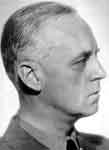
(1) The Austrian Anschluss. Ribbentrop was present at a meeting at
Berchtesgaden on 12 February 1938, at which Hitler and von Papen met
the Austrian Chancellor von Schuschnigg and his foreign minister, Guido
Schmidt. The official German account of that interview is contained
in 2461-PS. What appears to be the truthful account of that interview
is contained in Jodl's diary, the entries for 11 and 12 February 1938
(1780-PS).
On 11 February Jodl wrote:
"In the evening, and on 12 February, General Keitel with General
von Reichenau and Sperrle at Obersalzburg. Schuschnigg, together with
R. G. Schmidt, are again being put under the heaviest political and
military pressure. At 2300 hours Schuschnigg signs protocol."
(1780-PS)
The 13 February entry reads:
"In the afternoon, General Keitel asks Admiral Canaris and myself
to come to his apartment. He tells us that the Fuehrer's order is
to the effect that military pressure by shamming military action should
be kept up until the 15th. Proposals for these deceptive maneuvers
are drafted and submitted to the Fuehrer by telephone for approval.
"14 February:
"At 2:40 o'clock the agreement of the Fuehrer arrived. Canaris
went to Munich to the Counter-Intelligence Office VII and initiates
the different measures.
"The effect is quick and strong. In Austria the impression is
created that Germany is undertaking serious military preparations."
The next step was the telephone conversation which took place between
Goering and Ribbentrop on 13 March 1938, when Ribbentrop was still in
London. Goering was passing on the false statement that there was no
ultimatum to Austria. The facts of the ultimatum were explained by the
earlier telephone conversations between Goering and Vienna. But Goering
then passed the falsehood on to Ribbentrop in London in order that he
might placate and reassure political circles in London (2949-PS).
The third step was taken by Ribbentrop after his return from London.
Although he had been appointed Foreign Minister in February, he had
gone back to London to clear up his business at the embassy. Although
he was still in London until after the Anschluss had actually occurred,
his name appears as a signatory of the law making Austria a province
of the German Reich (2307-PS).
(2) Czechoslovakia. Czechoslovakia furnishes a typical example
of aggression in its various aspects. To summarize the outstanding features
briefly: First, there was the necessity of stirring up trouble inside
the country against which aggression was planned.
Ribbentrop, as Foreign Minister, helped in the stirring up of the Sudeten
Germans under Henlein, who was in frequent contact with the German Foreign
Office (3060-PS; 2789-PS; 5059-PS). These documents demonstrate how
the Foreign Office stirred up the Sudeten-German movement so that it
would act in accordance with the Government of the Reich.
Later on, Ribbentrop was present on 5/28/1938 at the conference at
which Hitler gave instructions to prepare the attack on Czechoslovakia
(388-PS; 2360-PS). In a speech in January 1939 Hitler proclaimed that
aggression was to take place against Czechoslovakia (2360-PS):
"On the basis of this unbearable provocation, which was still
further emphasized by a truly infamous persecution and terrorizing
of our Germans there, I have now decided to solve the Sudeten-German
question in a final and radical manner."
*******
"On 28 May I gave the order for the preparation of military
steps against this state, to be concluded by 2 October." (2360-PS)
The important point is that 28 May was the date when the Fall Gruen
for Czechoslovakia was the subject of orders, and that it was thereafter
put into effect, to come to fruition at the beginning of October.
That was the second stage: To lay well in advance the plans of aggression.
The third stage was to see that neighboring states were not likely
to cause trouble. Hence, on 18 July 1938, Ribbentrop had a conversation
with the Italian Ambassador, Attolico, at which the attack on Czechoslovakia
was discussed (2800-PS). Further discussions along the same lines followed
(2791-PS; 2792-PS).
The effect of these documents is, that it was made clear to the Italian
Government that the German Government was going to move against Czechoslovakia.
The other interested country was Hungary, for Hungary had certain territorial
desires with regard to parts of the Czechoslovakian Republic. Accordingly
on 23 and 25 August Ribbentrop as present at the discussions and had
discussions himself with the Hungarian politicians Imredi and Kanya
(2796-PS; 2797-PS). These documents indicate that Ribbentrop endeavored
to the assurances of Hungarian help, and that the Hungarian Government
at the time was not too ready to commit itself to action, although it
was ready enough with sympathy.
Contacts had been established with the Sudeten Germans, for heirs was
the long-term grievance that had to be exploited. But the next stage
was to have a short-term grievance and to stir up trouble, preferably
at the fountainhead. Therefore, between 16 and 24 September, the German
Foreign Office, of which Ribbentrop was the head, was engaged in stirring
up trouble in Prague (2858-PS; 2855-PS; 2854-PS; 2853-PS; and 2856-PS).
An example of the type of these activities is the communication of 19
September from the Foreign Office to the German Embassy in Prague (2858-PS):
"Please inform Deputy Kundt at Konrad Henlein's request, to
get in touch with the Slovaks at once and induce them to start their
demands for autonomy tomorrow." (2858-PS)
Another of these documents deals with questions of arrest and action
to be taken against any Czechs in Germany in order to make the position
more difficult (2855-PS).
That was the contribution which Ribbentrop made to the pre- Munich
crisis, which culminated in the Munich agreement of 29 September 1938
A significant aspect of Nazi plotting with regard to Czechoslovakia,
which shows the sort of action and advice which the Wehrmacht expected
from the Foreign Office, is contained in a long document putting forward
an almost infinite variety of breaches of International Law, which were
likely to arise or might have arisen from the action in regard to Czechoslovakia
(C-2). On all these points the opinion of the Foreign Office was sought,
with a view to explanation and justification. That, of course, remained
a hypothetical question because at that time no war resulted.
The second stage of the acquisition of Czechoslovakia occurred when,
having obtained the Sudetenland, the Nazis arranged a crisis in Czechoslovakia
which would be an excuse for taking the rest. This action is important
as constituting the first time that the German Government disregarded
its own commitment that its desires did not go beyond the return of
German blood to the Reich. On that point, again, Ribbentrop was active.
On 13 March, as events were moving to a climax, he sent a telegram to
the German Minister in Prague, his subordinate, telling him to
"make a point of not being available if the Czech Government
wants to get in touch with you in the next few days." (2815-PS).
At the same time Ribbentrop attended a conference in Berlin with Hitler
and a delegation of pro-Nazi Slovaks. Tiso, one of the heads of the
pro-Nazi Slovaks, was directed to declare an independent Slovak State
in order to assist in the disintegration of Czechoslovakia (2802-PS).
A previous meeting along the same lines had been held a month before
(2790-PS). Thus, Ribbentrop was assisting in the task, again, of fomenting
internal trouble.
On 14 March 1939, the following day, Hacha, the President of Czechoslovakia,
was called to Berlin. Ribbentrop was at this meeting, at which pressure
and threats were used to obtain the aged President's consent to hand
over the Czechoslovak State to Hitler (2798-PS; 3061-PS).
That was the end of the Czech part of Czechoslovakia. The following
week Ribbentrop signed a treaty with Slovakia, Article II of which granted
the German Government the right to construct military posts and installations,
and to keep them garrisoned within Slovakia (1439-PS). Thus, after swallowing
Bohemia and Moravia as an independent state, Ribbentrop obtained military
control over Slovakia.
(3) Lithuania. An interesting point concerning the Northern
Baltic shows how difficult it was for Ribbentrop to keep his hands out
of the internal affairs of other countries, even when it did not seem
a very important matter. On 3 April 1939 Germany had occupied the Memeland
(TC-5-A). It would have appeared, as far as the Baltic States were concerned,
that the position was satisfactory to the Nazis but in fact Ribbentrop
was acting in close concert with Heydrich, in stirring up trouble in
Lithuania with a group of pro-Nazi people called the Woldemaras Supporters
(2953-PS; 2952-PS). Heydrich was passing to Ribbentrop a request for
financial support for this group:
"Dear Party Comrade v. Ribbentrop,
"Enclosed please find a further report about the 'Woldemaras
Supporters.' As already mentioned in the previous report, the 'Woldemaras
Supporters' are still asking for help from the Reich. I therefore
ask you to examine the question of financial support, brought up again
by the 'Woldemaras Supporters' set forth on page 4, para 2 of the
enclosed report and to make a definite decision.
"The request of the 'Woldemaras Supporters' for financial support
could, in my opinion, be granted. Deliveries of arms should not, however,
be made, under any circumstances." (2953-PS)
At the end of a fuller report on the same matter (2952-PS) there is
added in handwriting,
"I support small regular payments, e.g. 2,000 to 3,000 marks
quarterly." (2952-PS).
It is signed "W" who was the Secretary of State. Such was
the extraordinary interference, even with comparatively unimportant
countries.
(4) Poland. In the aggression against Poland, there were several
periods. The first was what might be called the Munich period, up to
the end of September 1938, and at that time no language the Nazis could
use was too good for Poland. Examples of German assurances and reassurances
to Poland during this period are Hitler's Reichstag speech on 20 February
1938 (2357-PS), the secret Foreign Office memorandum of 26 August 1938
(TC-76), and the conversation between M. Lipski, the Polish ambassador,
and Ribbentrop (TC- 73, No. 40). A final illustration of this technique
is Hitler's speech at the Sportzpalast on 26 September 1938, in which
he said that this was the end of his territorial problems in Europe
and expressed an almost violent affection for the Poles (TC-7, No. 42).
The next stage occupied the period between Munich and the rape of Prague.
With part of the German plan for Czechoslovakia having been accomplished
and parts still remaining to be done, there was a slight change towards
Poland but still a friendly atmosphere. In a conversation with M. Lipski,
the Polish Ambassador to Berlin, on 24 October 1938, Ribbentrop put
forward very peaceful suggestions for the settlement of the Danzig issue
(TC-73, No. 44). The Polish reply, of 10/31/1938, stated that it was
unacceptable that Danzig should return to the Reich, but made suggestions
of a bilateral agreement (TC-73, No. 45). Between these dates the German
Government had made its preparations to occupy Danzig by surprise (C-137).
But although these preparations were made, still some two months later,
on 5 January 1939, Hitler was suggesting to M. Beck, the Polish Foreign
Minister, a new solution (TC-73, No. 8).
Ribbentrop saw M. Beck on the next day and said that there was to be
no violent solution of the Danzig issue, but a further building up of
friendly relations (TC-73, No. 49). Not content with that, Ribbentrop
went to Warsaw on 25 January to talk of the continued progress and consolidation
of friendly relations (2530-PS), That was capped by Hitler's Reichstag
speech on 30 January 1939, in the same tone (TC- 73, No. 57). That was
the second stage -- the mention of Danzig in honeyed words, because
the rape of Prague had not yet been attained.
Then, in the meeting at the Reichschancellery on 23 May 1939, Hitler
made it quite clear, and so stated, that Danzig had nothing to do with
the real Polish question (L-79). "I have to deal with Poland because
I want lebensraum in the East" -- that is the effect of Hitler's
words at that time: that Danzig was merely an excuse.
The extent to which Ribbentrop had adopted this attitude of mind of
Hitler at this time is shown in the introduction to- Count Ciano's Diary
(2987-PS):
"In the Summer of 1939 Germany advanced her claim against Poland,
naturally without our knowledge; indeed, Ribbentrop had several times
denied to our Ambassador that Germany had any intentions of carrying
the controversy to extremes. Despite these denials I remained in doubt;
I wanted to make sure for myself, and on August 11th I went to Salzburg.
It was in his residence at Fuschl that Ribbentrop informed me, while
we were waiting to sit down at the table, of the decision to start
the fireworks, just as he might have told me about the most unimportant
and commonplace administrative matter. 'Well, Ribbentrop,' I asked
him, while we were walking in the garden, 'What do you want ? The
Corridor, or Danzig ?' 'Not any more', and he stared at me through
those cold Musee Grevin eyes, 'We want war.' " (2987-PS).
That extraordinary declaration closely corroborates Hitler's statement
at his Chancellery conference on 23 May -- that it was no longer a question
of Danzig or the Corridor, but a question of war to achieve lebensraum
in the East (L-79).
It should be recalled in this connection that "Fall Weiss"
the plan for operations against Poland, is dated 3 and 11 April 1939,
thus showing that preparations were already in hand (C-120). Another
entry in Count Ciano's Diary during the summer of 1939 makes this point
quite clear:
"I have collected in the conference records verbal transcripts
of my conversations with Ribbentrop and Hitler. I shall only note
some impressions of a general nature. Ribbentrop is evasive every
time I ask him for particulars-of the forthcoming German action. He
has a guilty conscience. He has lied too many times about German intentions
toward Poland not to feel embarrassment now over what he must tell
me and what he is preparing to do.
"The will to fight is unalterable. He rejects any solution which
might satisfy Germany and prevent the struggle. I am certain that
even if the Germans were given everything they demanded, they would
attack just the same, because 'they are possessed by the demon of
destruction."
"Our conversation sometimes takes a dramatic turn. I do not
hesitate to speak my mind in the most brutal manner. But this doesn't
shake him in the least. I realize how little weight this view carries
in German opinion.
"The atmosphere is icy. And the cold feeling between us is reflected
in our followers. During dinner we do not exchange a word. We distrust
each other. But I at least have a clear conscience. He has not."
(2987-PS)
The next stage in the German plan consisted of sharp pressure over
the claim for Danzig, commencing immediately after Czechoslovakia had
been formally dealt with on 15 March 1939. The first sharp raising of
the claim was on 21 March (TC-73, No. 61)
An interesting sidelight during the last days before the war concerns
the return of Herr von Dirksen, the German Ambassador to the Court of
St. James, to Berlin on 18 August 1939. When interrogated (after capture)
regarding the significance of this event Ribbentrop expressed a complete
absence of recollection ever having seen the German Ambassador to England
after his return. Ribbentrop thought he would have remembered him if
he had seen him, and therefore he accepted the probability that he did
not see him (D-490). Thus when it was well known that war with Poland
would involve England and France, either Ribbentrop was not sufficiently
interested in opinion in London to take the trouble to see his ambassador,
or else, as he rather suggests, he had appointed so weak and ordinary
a career diplomat to London that his opinion was not taken into account,
either by himself or by Hitler. In either case, Ribbentrop was completely
uninterested in anything which his Ambassador might have to tell him
as to opinion in London or the possibility of war. It is putting the
matter with great moderation to say that in the last days before 1 September
1939, Ribbentrop did whatever he could to avoid peace with Poland and
to avoid anything which might hinder the encouraging of the war which
he and the Nazis wanted. He did that, well knowing that war with Poland
would involve Great Britain and France. (See also Section 8 of Chapter
IX on Aggression Against Poland.)
M. Lipski, the Polish Ambassador at Berlin, summarized all these events
leading up to the war in his report of 10 October 1939 (TC-73, No. 147).
(6) Norway and Denmark. On 31 May 1939, Ribbentrop, on behalf
of Germany, signed a non-aggression pact with Denmark which provided
that:
"The German Reich and the Kingdom of Denmark will under no circumstances
go to war or employ force of any other kind against one another."
(TC-24)
And on 7 April 1940 the German armed forces invaded Denmark at the
same time they invaded Norway.
Ribbentrop was fully involved in the earlier preparations for the aggression
against Norway. Along with Rosenberg, Ribbentrop assisted Quisling in
his early activities. A letter from Rosenberg to Ribbentrop on 24 February
states:
"Dear Party Comrade von Ribbentrop:
"Party Comrade Scheidt has returned and has made a detailed
report to Privy Councillor von Gruendherr who will address you on
this subject. We agreed the other day that 2-300,000 RM would be made
immediately available for the said purpose. Now it turns out that
Privy Councillor Gruendherr states that the second instalment can
be made available only after eight days. But as it is necessary for
Scheidt to go back immediately, I request you to make it possible
that this second instalment is given to him at once. With a longer
absence of Reichsamtsleiter P. M. Scheidt-also the connection with
your representatives would be broken up, which just now, under certain
circumstances, could be very unfavorable. "Therefore I trust
that it is in everybody's interest, if P. M. Scheidt goes back immediately."
(957-PS)
In a report to Hitler on the Quisling activities, Rosenberg outlined
Ribbentrop's part in the preparation of the Norwegian operation:
"Apart from financial support which was forthcoming from the
Reich in currency, Quisling had also been promised a shipment of material
for immediate use in Norway, such as coal and sugar. Additional help
was promised, These shipments were to be conducted under cover of
a new trade company, to be established in Germany or through especially
selected existing firms, while Hagelin was to act as consignee in
Norway. Hagelin had already conferred with the respective Ministers
of the Nygardsvold Government, as for instance, the Minister of Supply
and Commerce, and had been assured permission for the import of coal.
At the same time, the coal transports were to serve possibly to supply
the technical means necessary to launch Quisling's political action
in Oslo with German help. It was Quisling's plan to send a number
of selected, particularly reliable men to Germany for a brief military
training course in a completely isolated camp. They were then to be
detailed as area and language specialists to German Special Troops,
who were to be taken to Oslo on the coal barges to accomplish a political
action. Thus Quisling planned to get hold of his leading opponents
in Norway, including the King, and to prevent all military resistance
from the very beginning. Immediately following this political action
and upon official request of Quisling to the Government of the German
Reich, the military occupation of Norway was to take place. All military
preparations were to be completed previously. Though this plan contained
the great advantage of surprise, it also contained a great number
of dangers which could possibly cause its failure. For this reason
it received a quite dilatory treatment, while at the same time, it
was not disapproved as far as the Norwegians were concerned.
"In February, after a conference with General Field Marshal
Goering, Reichsleiter Rosenberg informed the Secretary in the Office
of the Four Year Plan, only of the intention to prepare coal shipments
to Norway to the named confidant Hagelin. Further details were discussed
in a conference between Secretary Wohlthat, Staff Director Schickedanz,
and Hagelin. Since Wohlthat received no further instructions from
the General Field Marshal, Foreign Minister von Ribbentrop -- after
a consultation with Reichsleiter Rosenberg -- consented to expedite
these shipments through his office. Based on a report of Reichsleiter
Rosenberg to the Fuehrer it was also arranged to pay Quisling ten
thousand English pounds per month for three months, commencing on
the 1 of March, to support his work" (004-PS)
This sum was paid through Scheidt.
In a letter to Ribbentrop dated 3 April 1940, Keitel wrote:
"Dear Herr von Ribbentrop:
"The military occupation of Denmark and Norway has been, by
command of the Fuehrer, long in preparation by the High Command of
the Wehrmacht. The High Command of the Wehrmacht has therefore had
ample time to occupy itself with all the questions connected with
the carrying out of this operation. The time at your disposal for
the political preparation of this operation, is on the contrary, very
much shorter. I believe myself therefore to be acting in accordance
with your own ideas in transmitting to you herewith, not only these
wishes of the Wehrmacht which would have to be fulfilled by the Governments
in Oslo, Copenhagen and Stockholm for purely military reasons, but
also if I include a series of requests which certainly concern the
Wehrmacht only indirectly but which are, however, of the greatest
importance for the fulfillment of its task ***." (D-629)
Keitel then proceeds to ask that the Foreign Office get in touch with
certain commanders. The important point is Keitel's clear admission
to Ribbentrop that the military occupation of Denmark and Norway had
been long in preparation. It is interesting to connect this letter with
the official Biography of Ribbentrop, in the Archives, which makes a
point of mentioning the invasion of Norway and Denmark (D-472):
"With the occupation of Denmark and Norway on 9 April 1940,
only a few hours before the landing of British troops in these territories,
the battle began against the Western Powers." (D-472)
It is clear that whoever else had knowledge or whoever else was ignorant,
Ribbentrop had been thoroughly involved in the Quisling plottings and
knew at least a week before the invasion started that the Wehrmacht
and Keitel had been long in preparation for this act of aggression.
(See also Section 9 of Chapter IX on Aggression against Norway and Denmark.)
(6) The Low Countries: Belgium, The Netherlands, and Luxembourg. The facts as to the aggression against these countries, during the
period when Ribbentrop was Foreign Minister, are discussed in Section
10 of Chapter IX. Special attention should be called, however, to the
statement made by Ribbentrop 10 May 1940 to representatives of the foreign
press with regard to the reasons for the German invasion of the Low
Countries. These reasons demonstrated to be false in Section 10 of Chapter
IX on Aggression Against The Low Countries.
(7) Greece and Yugoslavia. At a meeting in Salzburg in August
1939, at which von Ribbentrop participated, Hitler announced that the
Axis had decided to liquidate certain neutrals (1871-PS):
" Generally speaking, it would be best to liquidate the pseudo-neutrals
one after the other. This is fairly easily done, if one Axis partner
protects the rear of the other, who is just finishing off one of the
uncertain neutrals, and vice-versa. Italy may consider Yugoslavia
such an uncertain neutral. At the visit of Prince Regent Paul he [the
Fuehrer] suggested, 'particularly in consideration of Italy, that
Prince Paul clarify his political attitude towards the Axis by a gesture.
He had thought of a closer connection with the Axis and Yugoslavia's
leaving the League of Nations. Prince Paul agreed to the latter. Recently
the Prince Regent was in London and sought reassurance from the Western
Powers. The same thing was repeated that happened in the case of Gafencu,
who was also very reasonable during his visit to Germany and who denied
any interest in the aims of the western democracies. Afterwards it
was learned that he had later assumed a contrary standpoint in England.
Among the Balkan countries the Axis can completely rely only on Bulgaria,
which is in a sense a natural ally of Italy and Germany. *** At the
moment when there would be a turn to the-worse for Germany and Italy,
however, Yugoslavia would join the other side openly, hoping thereby
to give matters a final turn to the disadvantage of the Axis."
(1871-PS)
That demonstrates the policy with regard to uncertain neutrals.
Then, as early as September 1940 Ribbentrop reviewed the war situation
with Mussolini. Ribbentrop emphasized the heavy revenge bombing raids
in England and the fact that London would soon be in ruins. It was agreed
between the parties that only Italian interests were involved in Greece
and Yugoslavia, and that Italy could count on German support. Ribbentrop
went on further to explain to Mussolini the Spanish plan for the attack
on Gibraltar and Germany's participation therein. He added that he was
expecting to sign the Protocol with Spain, bringing the latter country
into the war, on his return to Berlin (1842-PS). Ribbentrop then gave
Mussolini a free hand with Greece and Yugoslavia:
"With regard to Greece and Yugoslavia, the Foreign Minister
stressed that it was exclusively a question of Italian interests,
the settling of which was a matter for Italy alone, and in which Italy
could be certain of Germany's sympathetic assistance.
"But it seemed to us to be better not to touch on these problems
for the time being, but to concentrate on the destruction of England
with all our forces instead. Where Germany was concerned, she was
interested in the northern German districts (Norway, etc.), and this
was acknowledged by the Duce." (1842-PS).
Several months later, in January 1941, at the meeting between Hitler
and Mussolini in which Ribbentrop participated, the Greek operation
was discussed. Hitler stated that the German troops in Rumania were
for use in the planned campaign against Greece (C-134). Count Ciano,
who attended that meeting as Italian Foreign Minister, recalls his impression
of that meeting in his diary entry for 20/21 January:
"The Duce is pleased with the conversation on the whole. I am
less pleased, particularly as Ribbentrop, who had always been so boastful
in the past, told me, when I asked him outright how long the war would
last, that he saw no possibility of its ending before 1942."
Despite that somewhat pessimistic statement to Count Ciano, three weeks
later, when it was a question of encouraging the Japanese to enter the
war, Ribbentrop took a more optimistic line. On 13 February 1941 he
saw Oshima, the Japanese Ambassador. In the course of their conversation
Ribbentrop gave an optimistic account of the military situation and
the position of Bulgaria and Turkey (1834-PS).
In the course of his efforts to get Yugoslavia to join the Axis, Ribbentrop
addressed a note, (2450-PS) on 25 March 1941, to Prime Minister Cvetkovitch,
which contained this assurance:
"The Axis-Power Governments during this war will not direct
a demand to Yugoslavia to permit the march or transportation of troops
through the Yugoslav state or territory." (2450-PS)
Shortly thereafter, there occurred the coup d'etat in Yugoslavia, when
General Simovitch took over the Government. Two days after Ribbentrop's
assurance (2450-PS), at a meeting on 27 March 1941 at which Ribbentrop
was present, Hitler outlined the military campaign against Yugoslavia
and promised the destruction of Yugoslavia and the demolition of Belgrade
by the German Air Force (1746-PS).
After the invasion of Yugoslavia Ribbentrop was one of the persons
directed by Hitler with the drawing of the boundaries or the partition
and division of Yugoslavia. The preliminary directive for that action
provided:
"If the drawing up of boundaries has not been laid down in the
above Part I, it will be carried out by the Supreme Command of the
Armed forces in agreement with the Foreign Office Ribbentrop], the
Plenipotentiary for the Four Year Plan [Goering], and the Reich Minister
of the Interior [Frick]." (1195-PS)
8) The U.S.S.R. On 23 August 1939 Ribbentrop signed The German-Soviet
non-aggression Pact (TC-25). The first point at which Ribbentrop seems
to have considered special problems of aggression against the Soviet
Union was just after 20 April 1941, when Rosenberg and Ribbentrop met
or communicated to consider problems expected to arise in the Eastern
occupied territory. Ribbentrop appointed his Counsellor, Grosskopf,
to be his liaison man with Rosenberg and also assigned a Consul General,
Brauetigam, who had many years experience in USSR, as a collaborator
with Rosenberg (1039-PS) .
The following month, on 18 May 1941, the German Foreign Office prepared
a declaration setting forth operational zones in the Arctic Ocean and
the Baltic and Black Seas to be used by the German Navy and Air Force
in the coming invasion of the Soviet Union:
"The Foreign Office has prepared for use in Barbarossa the attached
draft of a declaration of operational zones. The Foreign Office has,
however, reserved its decision as to the date when the declaration
will be issued, as well as discussion of particulars." (C-77)
Thus, it is clear that Ribbentrop was again fully involved in the preparation
for this act of aggression. Finally, on 22 June 1941, Ribbentrop announced
to the world that the German armies were invading the USSR (3054-PS).
How untrue were the reasons given by Ribbentrop is shown by the report
of his own Ambassador in Moscow on 7 June 1941, who said that everything
was being done by the Russians to avoid a conflict.
(9) Instigation of Japanese Aggression. On 25 November 1936,
as a result of negotiations of Ribbentrop as Ambassador at Large, Germany
and Japan signed the Anti-Comintern Pact (2508-PS). The recital states
the purpose of the agreement as follows:
"The Government of the German Reich and the Imperial Japanese
Government, recognizing that the aim of the Communist Internationale
known as the Comintern is to disintegrate and subdue existing States
by all the means at its command; convinced that the toleration of
interference by the Communist Internationale in the internal affairs
of the nations not only endangers their internal peace and social
well-being, but is also a menace to the peace of the world; desirous
of cooperating in the defense against Communist subversive activities;
having agreed as follows **" (2508-PS)
There then follow the effective terms of the agreement under which
Germany and Japan are to act together for five years. It is signed on
behalf of Germany by Ribbentrop (2508-PS).
On 27 September 1940 Ribbentrop, as Foreign Minister, signed the Tripartite
Pact with Japan and Italy, thereby bringing about a full-scale military
and economic alliance for the creation of a new order in Europe and
East Asia (2643-PS).
On 13 February 1941 -- some four months later -- Ribbentrop was urging
the Japanese to attack British possessions in the Far East (183-PS).
Then, in April 1941, at a meeting between Hitler and Matsuoka, representing
Japan, at which Ribbentrop was present, Hitler promised that Germany
would declare war on the United States in the event of war occurring
between Japan and the United States as a result of Japanese aggression
in the Pacific (1881-PS);
The development of Ribbentrop's views is indicated by the minutes of
another conversation with the Japanese Foreign Minister (1882-PS):
" Matsuoka then spoke of the general high morale in Germany,
referring to the happy faces he had seen everywhere among the workers
during his recent visit to the Borsig Works. He expressed his regret
that developments in Japan had not as yet advanced as far as in Germany
and that in his country the intellectuals still exercised considerable
influence.
"The Reich Foreign Minister replied that at best a nation which
had realized its every ambition could afford the luxury of intellectuals,
most of whom are parasites, anyway. A nation, however, which has to
fight for a place in the sun must give them up. The intellectuals
ruined France; in Germany they had already started their pernicious
activities when National Socialism put a stop to these doings; they
will surely be the cause of the downfall of Britain, which is to be
expected with certainty ***." (1882-PS)
That was on April 1941.
Within a month after the German armies invaded the Soviet Union on
22 June 1941, Ribbentrop was urging Ott, his ambassador in Tokyo, to
do his utmost to cause the Japanese Government to attack the Soviet
in Siberia .(2896-PS; 2897- PS).
A message, intercepted, which was sent by the Japanese Ambassador in
Berlin on 29 November 1941, a week before the attack on the United States
at Pearl Harbor, reports the coaxings of Ribbentrop:
"Ribbentrop opened our meeting by again inquiring whether I
had received any reports regarding the Japanese-United States negotiations.
I replied that I had received no official word.
"Ribbentrop: 'It is essential that Japan effect the New Order
in East Asia without losing this opportunity. There never has been
and probably never will be a time when loser cooperation under the
Tripartite Pact is so important. If Japan hesitates at this time,
and Germany goes ahead and establishes her European New Order, all
the military might of Britain and the United States will be concentrated
against Japan.
" 'As Fuehrer Hitler said today, -there are fundamental differences
in the very right to exist between Germany and Japan, and the United
States. We have received advice to the effect that there is practically
no hope of the Japanese-United States negotiations being concluded
successfully because of the fact that the United States is putting
up a stiff front.
" 'If this is indeed the fact of the case, and if Japan reaches
a decision to fight Britain and the United States, I am confident
that that will not only be to the interest of Germany and Japan jointly,
but would bring about favorable results for Japan and herself.'"
Then the Japanese Ambassador replied:
" 'I can make no definite statement as I am not aware of any
concrete intentions of Japan. Is Your Excellency indicating that a
state of actual war is to be established between Germany and the United
States
"Ribbentrop: 'Roosevelt's a fanatic, so it is impossible to
tell what he would do.' " (D-656).
The Japanese Ambassador thereupon concludes:
"Concerning this point, in view of the fact that Ribbentrop
has said in the past that the United States would undoubtedly try
to avoid meeting German troops, and from the tone of Hitler's recent
speech, as well as that of Ribbentrop's, I feel that German attitude
toward the United States is being considerably stiffened. There are
indications at present that Germany would not refuse to fight the
United States if necessary." (D-656).
Part 3 of the Japanese message quotes Ribbentrop as follows:
"In any event, Germany has absolutely no intention of entering
into any peace with England. We are determined to remove all British
influence from Europe. Therefore, at the end of this war, England
will have no influence whatsoever in international affairs. The Island
Empire of Britain may remain, but all of her other possessions throughout
the world will probably be divided three ways by Germany, the United
States, and Japan. In Africa, Germany will be satisfied with, roughly,
those parts which were formerly German colonies. Italy will be given
the greater share of the African Colonies. Germany desires, above
all else, to control European Russia." (D-656)
In reply the Japanese Ambassador said:
" 'I am fully aware of the fact that Germany's war campaign
is progressing according to schedule smoothly. However, suppose that
Germany is faced with the situation of having not only Great Britain
as an actual enemy, but also having all of those areas in which Britain
has influence and those countries which have been aiding Britain as
actual enemies as well. Under such circumstances, the war area will
undergo considerable expansion, of course. What is your opinion of
the outcome of the war under such an eventuality?'
"Ribbentrop: 'We would like to end this war during next year
[1942]. However, under certain circumstances, it is possible that
it will have to be continued on to the following year.
'Should Japan become engaged in war against the United States, Germany,
of course, would join the war immediately. There is absolutely no
possibility of Germany's entering into a separate peace with the United
States under such circumstances. The Fuehrer is determined on that
point.' " (I-656)
Ribbentrop was thus associated in the closest possible way, with the
aggression by Japan against the United States.
Another intercepted diplomatic message from the Japanese Ambassador
in Berlin states (D-657):
"At 1 p.m. today [8 December 1941] I called on Foreign Minister
Ribbentrop and told him our wish was to have Germany and Italy issue
formal declarations of war on America at once. Ribbentrop replied
that Hitler was then in the midst of a conference at general headquarters
discussing how the formalities of declaring war could be carried out
so as to make a good impression on the German people, and that he
would transmit your wish to him at once and do whatever he was able
to have it carried out promptly. At that time Ribbentrop told me that
on the morning of the 8th Hitler issued orders to the entire German
Navy to attack American ships whenever and wherever they might meet
them.
"It goes without saying that this is only for your secret information.''
(D-657)
Thus, Hitler ordered attacks on American ships before the German declaration
of war.
Then on 11 December 1941 Ribbentrop, in the name of the German Government,
announced a state of war between Germany and United States.
Ribbentrop also made attempts to get Japan to attack the Soviet Union.
In his conversations with Oshima, the Japanese Ambassador, in July 1942
and in March and April 1943, Ribbentrop continued to urge Japanese participation
and aggression against the Soviet Union (2911-PS; 2954-PS). The report
of discussion between Ribbentrop and Ambassador Oshima reads:
"Ambassador Oshima declared that he has received a telegram from
Tokyo, and he is to report, by order of his Government to the Reich
Minister for Foreign Affairs the following:
"The suggestion of the German Government to attack Russia was
the object of a common conference between the Japanese Government and
the Imperial headquarters, during which the question was discussed in
detail and investigated exactly. The result is the following: The Japanese
Government absolutely recognizes the danger which threatens from Russia
and completely understands the desire of its German ally that Japan
on her part will also enter the war against Russia. However, it is not
possible for the Japanese Government, considering the present war situation,
to enter into the war. It is rather of the conviction that it would
be in the common interest not to start the war against Russia now. On
the other hand, the Japanese Government would never disregard the Russian
question." (2954-PS)
Whereupon Ribbentrop returned to the attack:
"However, it would be more correct that all powers allied in
the Three Power Pact would combine their forces to defeat England
and America, but also Russia, together. It is not good when one part
must fight alone." (2954-PS)
Ribbentrop's pressure on Japan to attack Russia is shown in an other
report of Japanese-German discussions on 4/18/1943 (2929-PS):
"The Reichsminister for Foreign Affairs then stressed again
that without any doubt this year presented the most favorable opportunity
for Japan, if she felt strong enough and had sufficient anti-tank
weapons at her disposal, to attack Russia, which certainly would never
again be as weak as she is at the moment ***." (2929-PS)
(The following discussion concerns only the planning of these crimes.
The execution of the crimes was left to the French and Soviet prosecuting
staffs for proof.)
(1) The Killing of Allied Aviators. With the increasing air
raids on German cities in 1944 by the Allied Air Forces, the German
Government proposed to undertake a plan to deter Anglo-American fliers
from further raids on Reich cities. In a report of a meeting at which
a definite policy was to be established, there is stated the point of
view that Ribbentrop had been urging (735-PS). The meeting took place
at the Fuehrer's headquarters on 6 June 1944, and proceeded in part
as follows:
"Obergruppenfuehrer Kaltenbrunner informed the Deputy Chief
of WFST in Klessheim, on the afternoon of the 6th of June, that a
conference on this question had been held shortly before between the
Reich Marshal [Goering], the Reich Foreign Minister [Ribbentrop],
and the Reichsfuehrer SS [Himmler]. Contrary to the original suggestion
made by the Reich Foreign Minister, who wished to include every type
of terror attack on the German civilian population, that is, also
bombing attacks on cities, it was agreed in the above conference that
merely those attacks carried out with aircraft armament, aimed directly
at the civilian population and their property, should be taken as
the standard for the evidence of a criminal action in this sense.
Lynch law would have to be the rule. On the contrary, there has been
no question of court martial sentence or handing over to the police."
(735-PS)
That is, Ribbentrop was pressing that even where there was an attack
on a German city, the airmen who crash-landed should be handed over
to be lynched by the crowd.
The minutes of the conference report further as follows:
"Deputy Chief of the WFST mentioned that apart from lynch law,
a procedure must be worked out for segregating those enemy aviators
who are suspected of criminal action of this kind until they 'are
received into the reception camp for aviators at Oberursel; if the
suspicion was confirmed, they would be handed over to the SD for special
treatment." (735-PS)
The sense of this seems to be that if they were-not lynched under the
first scheme, by the crowd, then they were to be kept from prisoners
of war, where they would be subject to the protecting power's intervention.
And if the suspicion was confirmed, they would be handed over to the
SD to be killed.
The conference reached a decision on what would be regarded as justifying
lynch law:
"At a conference with Colonel von Brauchitsch, representing
the C-in-C, Air Force, on the 6th of June, it was settled that the
following actions were to be regarded as terror actions justifying
lynch law:
"Low-level attacks with aircraft armament on the civilian population,
single persons as well as crowds.
"Shooting our own men in the air who had bailed out.
"Attacks with aircraft armament on passenger trains in the public
service.
"Attacks with aircraft armament on military hospitals, hospitals,
and hospital trains, which are clearly marked with the Red Cross."
These were to be the subject of lynching and not, as Ribbentrop had
suggested, the case of the bombing of a city.
In the latter part of this report there occurs a somewhat curious comment
from Keitel:
"If one allows the people to carry out lynch law, it is difficult
to enforce rules!
"Minister Director Berndt got out and shot the enemy aviator
on the road. I am against legal procedure. It doesn't work out."
That is signed by Keitel.
The remarks of Jodl then appear:
"This conference is insufficient. The following points must
be decided quite definitely in conjunction with the Foreign Office:
"1. What do we consider as murder?
"Is RR in agreement with point 3b?
"2. How should the procedure be carried out?
"a. By the people?
"b. By the authorities?
"3. How can we guarantee that the procedure be not also carried
out against other enemy aviators?
"4. Should some legal procedure be arranged or not?
"Signed) Jodl" (735-PS) .
It is important to note that Ribbentrop and the Foreign Office were
fully involved in these breaches of the laws and usages of war. The
clarity with which the Foreign Office perceived that there were such
violations is indicated by a document from the Foreign Office, approved
of by Ribbentrop and transmitted by one of his officials, Ritter (728-PS).
The approval of Ribbentrop is specifically stated in a memorandum of
30 June 1944 (740-PS). The Foreign Office document
"In spite of the obvious objections, founded on international
law and foreign politics, the Foreign Office is basically in agreement
with the proposed measures.
"In the examination of the individual cases, a distinction must
be made between the cases of lynching and the cases of special treatment
by the Security Service, SD.
"1. In the cases of lynching, the precise establishment of the
circumstances deserving punishment, according to points of the communication
of 15 June, is not very essential. First, the German authorities are
not directly responsible, since death had occurred before a German
official became concerned with the case. Furthermore, the accompanying
circumstances will be such that it will not be difficult to depict
the case in an appropriate manner upon publication. Hence, in cases
of lynching, it will be of primary importance correctly to handle
the individual case upon publication.
"2. The suggested procedure for special treatment by the S.D.,
including subsequent publication, would be tenable only if Germany,
on this occasion, simultaneously would openly repudiate the commitment
of International Law, presently in force, and still recognized by
Germany. When an enemy aviator is seized by the Army or by the Police,
and is delivered to the Air Forces (P.W.) Reception Camp Oberursel,
he has received, by this very fact, the legal status of a prisoner
of war.
"The Prisoner of War Treaty of 27 July 1929 establishes definite
rules on the prosecution and sentencing of the Prisoner of War, and
the execution of the death penalty, as for example in Article 66:
Death sentences may be carried out only three months after the protective
power has been notified of the sentence; in Article 63: a prisoner
of war will be tried only by the same courts and under the same procedure
as members of the German Armed Forces. These rules are so specific,
that it would be futile to try to cover up any violation of them by
clever wording of the publication of an individual incident. On the
other hand the Foreign Office cannot recommend on this occasion a
formal repudiation of the Prisoner of War Treaty.
"An emergency solution would be to prevent suspected fliers
from ever attaining a legal Prisoner of War status, that is, that
immediately upon seizure they be told that they are not considered
Prisoners of War but criminals; that they would not be turned over
to the agencies having jurisdiction over Prisoners of War; hence not
go to a Prisoner of War Camp, but that they would be delivered to
the authorities in charge of the prosecution of criminal acts and
that they would be tried in a summary proceeding. If the evidence
at the trial should reveal that the special procedure is not applicable
to a particular case, the fliers concerned may subsequently be given
the status of Prisoner of War by transfer to the Air Forces (P.W.)
Reception Camp Oberursel.
"Naturally, not even this expedient will prevent the possibility
that Germany will be accused of the violation of existing treaties,
and maybe not even the adoption of reprisals upon German prisoners
of war. At any rate this solution would enable us clearly to define
our attitude, thus relieving us of the necessity of openly having
to renounce the present agreements or of the need of having to use
excuses, which no one would believe, upon the publication of each
individual case."
*******
"It follows from the above, that the main weight of the action
will have to be placed on lynchings. Should the campaign be carried
out to such an extent that the purpose, to wit 'the deterrence of
enemy aviators', is actually achieved, which goal is favored by the
Foreign Office, then the strafing attacks by enemy fliers upon the
civilian populations must be stressed in a completely different propagandist
manner than heretofore." (728-PS).
Those words show clearly Ribbentrop's point of view:
"Ambassador Ritter has advised us by telephone on 29 June that
the Minister for Foreign Affairs has approved this draft." (740-PS)
Thus, on the treatment of aviators, Ribbentrop furthered the deliberate
adoption of a procedure evading International Law.
(2) The Destruction of the Peoples in Europe. With regard to Poland,
the affidavit of Lahousen reports Ribbentrop participation in a discussion
on 12 September 1939 on the Fuehrer's train concerning the extermination
of Poles and Jews (Affidavit A).
With regard to Bohemia and Moravia, on 16 March 1939 there was promulgated
the decree of the Fuehrer and Reichschancellor, signed by Ribbentrop,
establishing the protectorate (T-51). The effect of that decree was
to place the Reich Protector in a position of supreme power over Bohemia
and Moravia, subordinate only to the Fuehrer. Article 5 of that decree
provides:
" 2. The Reich Protector, as representative of the Fuehrer and
Chancellor of the Reich, and as commissioner of the Reich Government,
is charged with the duty of seeing to the observance of the political
principles laid down by the Fuehrer and Chancellor of the Reich.
"3. The members of the government of the Protectorate shall
be confirmed by the Reich Protector. The confirmation may be
"4. The Reich Protector is entitled to inform himself of all
measures taken by the government of the Protectorate and to give advice.
He can object to measures calculated-to harm the Reich, and, in case
of danger, issue ordinances required for the common interest."
It is further provided that the promulgation of laws and the execution
of certain judgments shall- be annulled if the Reich Protector enters
an objection (TC-51).
In part as a result of the sweeping terms of this law, the two Reich
Protectors of Bohemia and Moravia and their various deputies were able
to commit numerous violations of the laws of war, and crimes against
humanity. (Discussion of these matters was assumed as the responsibility
of the Soviet prosecuting staff.)
Similarly, with regard to the Netherlands, on 18 May 1940 a decree
of the Fuehrer concerning the exercise of governmental authority in
the Netherlands was signed by Ribbentrop. Section 1 of that-decree provided
(D-639):
"The occupied Netherlands territories shall be administered
by the Reich Commissioner for the Occupied Netherlands territories
*** the Reich Commissioner is guardian of the interests of the Reich
and vested with supreme civil authority.
"Dr. Arthur Seyss-Inquart is hereby appointed Reich Commissioner
for the Occupied Netherlands Territories." (D-639 )
On the basis of this decree, the Reich Commissioner, Seyss- Inquart,
promulgated such orders as that of 4 July 1940, confiscating the property
of those who had, or might have, furthered activities hostile to the
German Reich (2921-PS). Tentative arrangements were also made for the
resettlement of the Dutch population (1520-PS). (This part of the proof
was assumed as the responsibility of the French prosecuting staff.)
With regard to Bohemia and the Netherlands, the charge against Ribbentrop
is laying the basis and erecting the governmental structure under which
the war crimes and crimes against humanity were directed-and facilitated.
(3) Persecution of the Jews. In December 1938 Ribbentrop, in
a conversation with M. Bonnet, who was then Foreign Minister of France,
expressed his opinion of the Jews. That was reported by the United States
Ambassador, Mr. Kennedy, to the State Department as follows (L-205):
"During the day we had a telephone call from Berenger's office
in Paris. We were told that the matter of refugees had been raised
by Bonnet in his conversation with von Ribbentrop. The result was
very bad. Ribbentrop, when pressed, had said to Bonnet that the Jews
in Germany without except ion were pickpockets, murderers and thieves.
The property they possessed had been acquired illegally. The German
Government had therefore decided to assimilate them with the criminal
elements of the population. The property which they had acquired illegally
would be taken from them. They would be forced to live in districts
frequented by the criminal classes. They would be under police observation
like other criminals. They would be forced to report to the police
as other criminals were obliged to do. The German Government could
not help it if some of these criminals escaped to other countries
which seemed so anxious to have them. It was not, however, willing
for them to take the property which had resulted from their illegal
operations with them. There was in fact nothing that it could or would
do." (L-205)
That succinct statement of Ribbentrop's views on Jews is elaborated
in a long document which he had sent out by the Foreign Office (3358-PS).
This document, entitled "The Jewish Question As A Factor In German
Foreign Policy in the year 1938" contains the following:
"It is certainly no coincidence that the fateful year 1938 has
brought nearer the solution of the Jewish question simultaneously
with the realization of the 'idea of Greater Germany', since the Jewish
policy was both the basis and consequence of the events of the year
*******
"The final goal of German Jewish policy is the emigration of
all Jews living in Reich territory."
*******
"These examples from reports from authorities abroad can, if
desired, be amplified. They confirm the correctness of the expectation
that criticism of the measures for excluding Jews from German lebensraum,
which were misunderstood in many countries for lack of evidence, would
only be temporary and would wing in the other direction the moment
the population saw with its own eyes and thus learned what the Jewish
danger was to them. The poorer and therefore the more burdensome the
immigrant Jew to the country absorbing him, the stronger this country
will react and the more desirable is this effect in the interest of
German propaganda. The object of this German action is to be the future
international solution of the Jewish question, dictated not by false
compassion for the 'United Religious Jewish minority' but by the full
consciousness of all peoples of the danger which it represents to
the racial composition of the nations." (3358-PS)
This document was widely circulated by Ribbentrop's ministry, to all
senior Reich authorities and to numerous other people on 25 January
1939, just after the statement to M. Bonnet. Apparently Ribbentrop's
anti-Semitic incitements grew stronger, for in June 1944 Rosenberg made
arrangements for an international anti-Jewish Congress to be held in
Krakow on 11 July 1944. The honorary members were to be Ribbentrop,
Himmler, Goebbels, and Frank. The Foreign Office was to take over the
mission of inviting prominent foreigners from Italy, France, Hungary,
Holland, Arabia, Iraq, Norway etc. in order to give an international
aspect to the Congress. However, the military events of June 1944 prompted
Hitler to call off the Congress, which had lost its significance by
virtue of the Allied landing in Normandy (1752-PS).
It is clear that Ribbentrop supported and encouraged the Nazi program
against the Jews, which resulted in their transportation to concentration
camps, where things went on which he, as a minister in special touch
with the head of the government must have known about. As one who preached
this doctrine and was a position of authority, Ribbentrop cannot suggest
that he was ignorant of how the policy was carried out.