Alfred Rosenberg
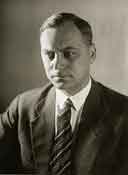
A. THE POLITICAL CAREER OF ROSENBERG.
I. The political career of Alfred
Rosenberg embraced the entire history
of National Socialism and permeated nearly
every phase of the conspiracy. In order to
obtain a full conception of his Influence
upon and participation in the conspiracy,
it is necessary to review his political history
and to consider each of his political activities
in their relation to the thread of the conspiracy,
which stretches from the inception of the
party in 1919 to the defeat of Germany in
1945.
It is interesting to note that for Rosenberg 30 November 1918 marked
the
"Beginning of political activities with a lecture about the
'Jewish Problem' " (2886-PS)
An official German pamphlet entitled, "Dates in the History of
the NSDAP" discloses that Rosenberg was a member of the German
Labor Party (afterwards the National Socialist German Workers Party)
in January 1919, and that Hitler joined forces with Rosenberg and his
colleagues in October of the same year (3557-PS). Thus, Rosenberg was
a member of the National Socialist movement even before Hitler himself.
An extract from "Das Deutsch Fuehrer Lexikon" 1934/35 (3530-
PS) completes the biographical data on Rosenberg:
"From 1921 until the present, editor of the Voelkische Beobachter;
editor of the 'N.S. Monatshefte'; 1930, Reichstag deputy and representative
of the foreign policy of the movement; since April 1933, leader of
the foreign political office of the NSDAP; then designated as Reichsleiter;
January 1934, deputized by the Fuehrer for the spiritual and philosophical
education of the NSDAP, the German labor front -and all related organizations"
(350-PS).
In July 1941 Rosenberg was appointed Reichsminister for the Occupied
Eastern Territories. (2886-PS)
B. ROSENBERG'S PART, AS OFFICIAL NAZI IDEOLOGIST, IN PREPARING
FOR THE SEIZURE OF POWER AND THE LAUNCHING OF AGGRESSIVE WAR.
Rosenberg was the official National Socialist ideologist. Through the
ideological tenets which he expounded he exerted an influence upon the
unification of German thought, a unification which was an essential
part of the conspirator's program for seizure of power and preparation
for aggressive war.
Rosenberg wrote extensively on, and actively participated in, virtually
every aspect of the National Socialist program. His first publication
was the "Nature, Basic Principles, and Aims of the NSDAP"
which appeared in 1922. Rosenberg spoke of this book in the following
"During this time (that is, during the early phase of the party)
a short thesis was written, which nevertheless is significant in the
history of the NSDAP. It was always being asked what points of program
the NSDAP had and how they each were to be interpreted. Therefore,
I wrote the principal program and aims of the NSDAP, and this writing
made the first permanent connection between Munich and local organizations
being organized and friends within the Reich."
Thus, the original draftsman of and spokesman for the party program
was Rosenberg.
Without attempting to survey the entire ideological program advanced
by Rosenberg in his various writings and speeches, certain of his statements
may be considered as indicating the nature and scope of the ideological
program which he championed. There was not a single basic tenet of the
Nazi philosophy which was not given authoritative expression by Rosenberg.
(1) The theory of racism. Rosenberg wrote the "Myth of
the Twentieth Century" published in 1930. At page 479 of this work
(3553-PS), Rosenberg expressed the following views on the race question:
"The essence of the contemporary world revolution lies in the
awakening of the racial types, not in Europe alone but on the whole
planet. This awakening is the organic counter movement against the
last chaotic remnants of liberal economic imperialism, whose object
of exploitation out of desperation has fallen into the snare of Bolshevik
Marxism, in order to complete what democracy had begun, the extirpation
of the racial and national consciousness." (3553-PS)
(2) "Lebensraum." Rosenberg expounded the "Lebensraum"
idea, which was utilized as the dynamic impulse behind Germany's waging
of aggressive war. In his journal, the "National Socialist Monatshefte"
for May 1932, he wrote:
"The understanding that the German nation, if it is not to perish
in the truest sense of the word, needs ground and soil for itself
and its future generations, and the second sober perception that this
soil can no more be conquered in Africa, but in Europe and first of
all in the East -- these organically determine the German foreign
policy for centuries." (2777-PS)
(3) Persecution of Christian Churches. Rosenberg expressed his
theory as to the place of religion in the National Socialist State in
the "Myth of the Twentieth Century" additional excerpts from
which are cited in (2891-PS):
"We now realize that the central supreme values of the Roman
and the Protestant Churches, being a negative Christianity, do not
respond to our soul, that they hinder the organic powers of the peoples
determined by their Nordic race, that they must give way to them,
that they will have to be remodeled to conform to a Germanic Christendom.
Therein lies the meaning of the present religious search." (2891-PS)
In the place of traditional Christianity, Rosenberg sought to implant
the neo-pagan myth of the blood. At page 114 in the "Myth of the
Twentieth Century" (2891-PS) he stated:
"Today, a new faith is awakening -- the Myth of the Blood, the
belief that the divine being of mankind generally is to be defended
with the blood. The faith embodied by the fullest realization, that
the Nordic blood constitutes that mystery which has supplanted and
overwhelmed the old sacraments."
Rosenberg's attitudes on religion were accepted as the only philosophy
compatible with National Socialism. In 1940 Bormann, in writing to Rosenberg,
made this statement:
"The churches cannot be conquered by a compromise between National
Socialism and Christian teachings, but only through a new ideology
whose coming you yourself have announced in your writings."
Rosenberg actively participated in the program for elimination of church
influence. Bormann frequently wrote Rosenberg in this regard, furnishing
him information as to proposed action to be instituted against the churches
and, where necessary, requesting that action be taken by Rosenberg's
department. See 070-PS dealing with the abolition of religious services
in the schools; 072-PS dealing with the confiscation of religious property;
064-PS dealing with the inadequacy of anti-religious material circulated
to the soldiers; 089-PS dealing with the curtailment of the publication
of Protestant periodicals; and 122-PS dealing with the closing of theological
faculties.
(4) Persecution of the Jews. Rosenberg was particularly zealous
in his pursuit of the "Jewish Question" On 28 March 1941,
on the occasion of the opening of the Institute for the Exploration
of the Jewish Question, he set the keynote for its activities and indicated
the direction which the exploration was to take. He spoke in part as
follows:
"For Germany the Jewish Question is only then solved when the
Last Jew has left the Greater German space.
"Since Germany with its blood and its nationalism has now broken
for always this Jewish dictatorship for all Europe and has seen to
it that Europe as a whole will become free from the Jewish parasitism
once more, we may, I believe, also say for all Europeans: For Europe
the Jewish question is only then solved when the last Jew has left
the European continent." (2889-PS)
Rosenberg had called an Anti-Jewish Congress in June 1944, but the
Congress was cancelled due to military events. (1752- PS)
Rosenberg did not overlook any opportunity to put these anti- Semitic
beliefs into practice. He recommended for instance that instead of executing
100 Frenchmen as retaliation for attempts on lives of members of the
Wehrmacht, there be executed 100 Jewish bankers, lawyers, etc. (001-PS).
The recommendation was made with the avowed purpose of awakening the
anti-jewish sentiment.
(5) Abolition of Versailles Treaty. In the realm of foreign
policy, in addition to demanding "lebensraum," Rosenberg called
for elimination of the Treaty of Versailles, and cast aside any thought
of revision of that treaty. In his book, "Nature, Principles and
Aims of the NSDAP" Rosenberg wrote:
"The National Socialists reject the popular phrase of the 'Revision
of the Peace of Versailles' as such a revision might perhaps bring
a few numerical reductions in the so-called 'obligations,' but the
entire German people would still be, just as before, the slave of
other nations."
*******
" 'We demand equality for the German people with other nations,
the cancellation of the peace treaties of Versailles and St. Germain.'
" (2433-PS)
(6) Foreign Nazi Penetration. Rosenberg conceived of the spread
of National Socialism throughout the world and, as will be subsequently
shown, took an active part in promoting the infection of other nations
with his creed. In the "Nature, Principles and Aims of the NSDAP"
he stated:
"But National Socialism still believes that its principles and
ideology though in individually different suitable ways of fight according
to racial-national conditions -- will be directives far beyond the
borders of Germany for the inevitable fights for power in other countries
of Europe and America. There too a decision of ideas must take place,
and the racial-nationalistic fight against the ever similar loan-capitalistic
and Marxist internationalism must be taken up. National Socialism
believes that once the great world battle is concluded, after the
defeat of the present epoch, there will be a time when the swastika
will be woven into the different banners of the Germanic peoples as
the Aryan symbol of rejuvenation." (2455-PS)
Thus, Rosenberg gave authoritative expression to the basic tenets upon
which National Socialism was founded, and through exploitation of which
the conspiracy was crystallized in action.
(7) Ideological training and education. Rosenberg's value to
the conspiratorial program found official recognition in his appointment
in 1934 as the Fuehrer's Delegate for the Entire Spiritual and Philosophical
Education and Supervision of the NSDAP. is activities in this capacity
were many and varied. The National Socialist Year Book for the year
1938, at page 180 describes as follows the functions of Rosenberg's
office a the Fuehrer's delegate:
"The sphere of activity of the Fuehrer's Commissioner for all
spiritual and ideological instruction and education of the movement,
its organization, including the 'Strength through Joy', extends to
the detailed execution of all the educational work of the Party and
of the affiliated bodies. The office, set up by Reichsleiter Rosenberg,
has the task of preparing the ideological educational material, of
carrying out the teaching programme, and is responsible for the education
of those teachers suited to this educational and instructional work."
(3531-PS)
As the Fuehrer's delegate, Rosenberg thus supervised all ideological
education and training in the Party.
It was Rosenberg'. belief that upon the performance of his new functions
as ideological delegate depended the future of National Socialism. An
excerpt from an article by Rosenberg appearing on page 9 of the March
1934 issue of "The Educational Letter" states:
"The focus of all our educational work from now on is the service
for this ideology, and it depends on the result of these efforts,
whether National socialism will be buried with our fighting ancestors
or whether, as we believe, it really represents the beginning of a
new era." (3552-PS)
In his capacity as the Fuehrer's Delegate for Spiritual and Ideological
Training, Rosenberg assisted in the preparation of the curriculum for
the Adolf Hitler schools. These schools selected the most suitable candidates
from the Hitler Jugend and trained them for leadership within the Party.
They were the elite schools of National Socialism. An excerpt from "Documents
of German Politics" reads as follows:
"Voelkischer Beobachter, 19 January 1937. -- 'As stated by Dr.
Ley, Reichsorganisationsleiter, on 23 November 1937 at Ordensburg
Sonthofen, these Adolf Hitler Schools, as the first step of the principle
of selecting a special elite, form an important branch in the educational
system of the National Socialist training of future leaders [Fuehrernachwuchs]
"Voelkischer Beobachter dated 24 November 1937. ***
The curriculum has been laid down by Reichsleiter Rosenberg, together
with the Reichsorganisationsleiter and the Reich Youth Leader."
(3529-PS)
Rosenberg exercised further influence in the education. of Party members
through the establishment of community school for all organizations
of the Party. The following statement is taken from the 1934 edition
of "Das Dritte Reich"
"We support the request of the Fuehrer's Commissioner for the
supervision of the whole spiritual and ideological training and instruction
of- the NSDAP, Party member Alfred Rosenberg, to organize community
schools of all organizations of the NSDAP twice a year, in order to-show
by this common effort the ideological and political unity of the NSDAP
and the steadfastness of the National Socialist will." (3528-PS)
Rosenberg's program was endorsed by Schirach as well as by Himmler,
Ley, and others.
Virtually every phase of National Socialist training came under Rosenberg's
influence, and unified ideological concepts were inculcated in every
echelon of the party due to his influence. The 1936 edition of "Das
Dritte Reich" under the heading "Education in the Ordensburg"
states:
"Those Party members, selected for training in leadership in
accordance with such points of view (who must have completed their
labor service and their military service satisfactorily) are to be
taught in the Ordensburgen by the best teachers in history and science
of race, philosophy and culture, economics and specialized training,
etc. To determine the ideological direction of this education, to
choose suitable teachers and to train them, is one of the tasks of
the Senior School of the Party [Hoche Schule der Partei] which is
to be established in the near future and will be placed under the
direction of the Reich Leader Party member Alfred Rosenberg in his
capacity as Delegate of the Fuehrer for the Supervision of the Entire
Spiritual and Ideological Teaching and Education of the NSDAP."
(3552-PS)
(8) Plunder of art treasures. In his capacity as the Fuehrer's
delegate, Rosenberg established the Institute for the Exploration of
the Jewish Question, in Frankfort on Main. (This institute, commonly
known as the "Hohe Schule" has been referred to in the discussion
of the Plunder of Art Treasures in Chapter XIV.) Into its library there
flowed books, documents, and manuscripts which were looted from virtually
every country of occupied Europe. As Ideological Delegate Rosenberg
conducted the fabulous art looting activities of the Einsatzstab Rosenberg,
activities which extended to France, Belgium, the Netherlands, Luxembourg,
Norway, Denmark, the Occupied Eastern Territories, Hungary, and Greece.
The extent of the plunder is indicated in document 1015-B-PS which contains
a detailed account of the seizure of over 21,000 valuable objects of
art, and in document 188 in which the looting of the contents of over
71,000 Jewish homes is described.
The importance of Rosenberg's activities as official ideologist of
the Nazi party was not overlooked. The Hart biography of Rosenberg,
entitled, "The Man and His Work" (3559-PS), states that Rosenberg
won the German National prize in 1937. The creation of this prize was
the Nazis' petulant reply to the award of the Nobel prize to Carlin
Assietsky, an inmate of a German concentration camp. The citation which
accompanied the award to Rosenberg read as follows:
"Alfred Rosenberg has helped with his publications to lay the
scientific and intuitive foundation and to strengthen the philosophy
of the National Socialist in the most excellent way. His indefatigable
struggle to keep National Socialist philosophy clean was especially
meritorious. Only future times will be able to fully estimate the
depth of the influence of this man on the philosophical foundation
of the National Socialist Reich. The National Socialist movement,
and beyond that, the entire German people, will be deeply gratified
that the Fuehrer has distinguished Alfred Rosenberg as one of his
oldest and most faithful fighting comrades by awarding him the German
National Prize." (3559-PS)
The contribution which Rosenberg's book, "The Myth of the Twentieth
Century," made to Nazi ideological propaganda was appraised in
the November 1942 edition of the official National Socialist book review
publication, "Bucher Kunde" as follows:
"Next to the Fuehrer's book it has contributed to a unique extent
to the rise and the spiritual and physical development of this people.
Twelve years after Alfred Rosenberg's 'Mythus' first appeared, a million
copies of the book have been published and circulated."
*******
"It must therefore be stated that the phrases coined by Alfred
Rosenberg have passed into the consciousness of the whole people,
and it is just today that they are proving pillars of an ideological
building whose completion is the purpose of the fight being waged
not least today." (3554-PS)
The significance of ideological training in promoting the aims of the
conspiracy is emphasized in a brief statement which Hitler made to his
supreme commanders on 23 November 1939. On that occasion, Hitler said:
"The building up of our armed forces was only possible in connection
with the ideological education of the German people by the Party."
(789-PS)
The contribution which Rosenberg made through formulation and dissemination
of National Socialist ideology was fundamental to the conspiracy. As
apostle of neo-paganism, exponent of the drive for "Lebensraum,"
glorifier of the myth of nordic superiority, and as one of the oldest
and most energetic Nazi proponents of anti-Semitism, he contributed
materially to unification of the German people behind the swastika.
He provided the impetus and philosophy of National Socialism.
C. ROSENBERG'S ACTIVITIES ABROAD THROUGH THE APA, IN PREPARATION
FOR AGGRESSIVE WAR.
Rosenberg also actively contributed toward the preparation for aggressive
war through the international activities of the APA (The Foreign Policy
Office of the NSDAP). Rosenberg became a Reichsleiter, the highest level
of rank in the Leadership Corps, and was made chief of the Foreign Political
Office of the NSDAP in April 1933 (3530-PS). The Organizational Manual
of the NSDAP (2319-PS) describes the functions of the APA as including
the influencing of public opinion abroad so as to convince foreign nations
that Nazi Germany desires peace. The following excerpt indicates the
far-flung activities of the APA:
" II. 1. The APA is divided into three main offices
"A. Office for Foreign Referats with the Main Offices
a. England and Far East
b. Near East
c. South East
d. North
e. Old Orient
f. Controls, personnel questions, etc.
"B. Office of the German Academic Exchange Service.
"C. Office of Foreign Commerce.
"2. Moreover, there is in the APA a main office for the press
service and an educational office." (2319-PS)
The Press activities of the APA, designed to influence world opinion
in such a manner as to conceal the conspirators' true purposes and thus
facilitate the preparation for waging aggressive war, were conducted
on an ambitious scale. "A short Report on the Activities of the
APA of the NSDAP" describes the press activities as follows:
"The Press The Press Division of the APA is comprised of persons
who together master all the languages that are in use. Daily they
examine approximately 300 newspapers and deliver to the Fuehrer, the
deputy Fuehrer, and all other interested offices the condensations
of the important trends of the entire world press. I know that these
press reports are highly praised by all who constantly follow them.
The Press Division furthermore conducts an exact archive on the attitudes
of the most important papers of the world and-an exact archives on
the most important journalists of the world. Many embarrassments during
conferences in Germany could have been avoided had one consulted these
archives (case of Leumas, Nurnberg, 1934; case of Dorothy Thompson;
and others). Further, the Press Division was able to arrange a host
of interviews as well as conducting a great number of friendly foreign
journalists to the various official representatives of Germany."
(003-PS)
The nature and extent of the activities of the APA are amply disclosed
in a "Report on the Activities of the Foreign Affairs Bureau of
the Party from 1933 to 1943," signed by Rosenberg (007-PS). This
report contains a recital of widespread activities -in foreign countries.
These activities range from the promotion of economic penetration, to
fomentation of anti-Semitism; from cultural and political infiltration
to the instigation of treason. Activities were carried on throughout
the world and extended to such widely separated points as the Middle
East and Brazil. (007-PS)
(1) Activities in Hungary, Belgium, Holland, and Luxembourg. Much of the APA's achievements were brought about through the subtle
exploitation of personal relationship. Activities in Hungary proceeded
as follows:
"The first foreign state visit after the seizure of power took
place through the mediation of the Foreign Affairs Bureau. Julius
Gombos, who in former years had himself pursued anti-Semitic and racial
tendencies, had reached the Hungarian Premier's chair. The Bureau
maintained a personal connection with him." (007-PS)
The APA endeavored to strengthen the War Economy by shifting the source
of food imports to the Balkans:
"Motivated by reasons of War Economy, the Bureau advocated the
transfer of raw material purchases from overseas to the areas accessible
by overland traffic routes, i. e., primarily in the Balkans, naturally
insofar as practicable. At first little heed was paid to the Bureau
in these endeavors, but it later secured the active support especially
of the Food Estate [Naeurstand]. Through its cooperation, e. g., on
the subject of fruit and vegetable imports, a very substantial shift
in the source of imports was attained, particularly through the currently
initiated cooperation with Croatian and Hungarian cooperatives as
well as with commercial associations all over the Balkans." (007-PS)
Activities in Belgium, Holland, and Luxembourg were confined to "observation
of existing conditions" and "to the establishment of relations,
especially of a commercial nature." (007-PS)
(2) Activities in Iran, Afghanistan, and Iraq. In Iran the APA
achieved a high degree of economic penetration, in addition to promoting
cultural relations:
"The Bureau's initiative in developing, with the help of commercial
circles, entirely new methods for the economic penetration of Iran
found expression, in an extraordinarily favorable way, in reciprocal
trade relations.
"Naturally in Germany, too, this initiative at first encountered
a completely negative attitude and resistance on the part of the competent
state authorities, an attitude that had first to be overcome.
"In the course of a few years the volume of trade with Iran
was multiplied five-fold, and in 1939 Iran's trade turnover with Germany
had attained first place. Even Soviet Russia, the competitor who had
been biggest and most dreaded previously, had been eliminated from
the running. Concurrently with activation of commercial relations,
the Bureau had also intensified cultural relations and had, in conjunction
with growing commercial influence and in closest collaboration with
the Iranian Government, created a series of cultural institutions
headed and directed by Germans."
(Signed) Rosenberg (007-PS)
Rosenberg further reports on APA activities in other parts of the
"Afghanistan's neutral position today is largely due to the
Bureau's activity."
"The Arab question, too, became part of the work of the Bureau.
In spite of England's tutelage of Iraq the Bureau established a series
of connections to a number of leading personalities of the Arab world,
smoothing the way for strong bonds to Germany. In this connection,
the growing influence of the Reich in Iran and Afghanistan did not
fail to have repercussions in Arabia." (007-PS)
In view of the numerous "personal connections" maintained
by the Bureau in many different countries, it is not difficult to surmise
what Rosenberg meant when he stated at the conclusion of his report:
"The Bureau has carried out the initiating of all politically
feasible projects. With the outbreak of war it [the APA] was entitled
to consider its task as terminated. The exploitation of the many personal
connections in many lands can be resumed under a different guise.
"Signed) Rosenberg" (007-PS)
(3) Activities in Rumania. Annex Two of the report
deals with activities in Rumania. Here the APA's intrigue was more insidious,
its interference in the internal affairs of a foreign nation more pronounced.
After describing the failure of what Rosenberg terms a "basically
sound anti-Semitic tendency" due to dynastic squabbles and party
fights, Rosenberg describes the APA's influence in the unification of
conflicting elements:
"What was lacking was the guiding leadership of a political
personality. After manifold groping trials the Bureau believed to
have found such a personality -- the former Minister and poet, Octavian
Goga. It was not difficult to convince this poet, pervaded by instinctive
inspiration, that a Greater Romania, though it had to be created in
opposition to Vienna, could be maintained only together with Berlin.
Nor was it difficult to create in him the desire to link the fate
of Rumania with the future of the National-Socialist German Reich
in good time. By bringing continuing influence to bear, the Bureau
succeeded in inducing Octavian Goga as well as Professor Cuza to amalgamate
the parties under their leadership on an Anti-Semitic basis. Thus
they could carry on with united strength the struggle for Rumania's
renascence internally, and her Anschluss with Germany externally.
Through the Bureau's initiative both parties, which had heretofore
been known by distinct names, were merged as the National-Christian
Party, under Goga's leadership and with Cuza as Honorary President."
(007-PS, Annex II)
Rosenberg's man, Goga, was supported by two "splinter parties"
which had not joined the anti-Semitic trend of these two parties. Rosenberg
has this to say:
"Through intermediaries, the Bureau maintained constant contact
with both tendencies, just as it constantly consulted with Goga, through
Staff Director [Stabsleiter] Schickendanz, about tactics to be followed."
(007-PS, Annex II)
Goga was appointed Prime Minister by the King in December 1937. The
influence of Rosenberg's ideology had achieved a major triumph, for
he states:
"Thus a second government on racial and anti-Semitic foundations
had appeared in Europe, in a country in which such an event had been
considered completely impossible." (007-PS, Annex II)
Rosenberg's intrigues made a significant contribution to Nazi preparations
for aggressive war, and the benefit to Germany's position in the Balkans
was great. Rosenberg reports that upon Goga's resignation he left a
personal heir in Marshal Antonescu, who was appointed by Goga as Minister
of War against the wishes of the King. Of Antonescu Rosenberg says:
"After Goga' resignation, Antonescu still remained in the king's
cabinet at Goga's wish. He also maintained continued relations with
the Iron Guard. Thereby the possibility of eliminating the king was
at hand -- and was exploited. Antonescu today appears in practice
as executor of the heritage bequested to him by Goga, who had led
him from political insignificance into the political arena. Thereby
a change to Germany's liking had become possible in Rumania.
"(Signed) Rosenberg." (007-PS)
It will be recalled that on 9/5/1940 Antonescu became President of
the Rumanian Council of Ministers and immediately suspended the Rumanian
constitution. King Carol abdicated on the following day, and Rumania
existed as a German satellite throughout the war. Rosenberg's aims had
been achieved.
The substantial contribution which Rosenberg had thus made to Germany's
strategic plans for aggressive war is evident from a brief review of
the military action which followed in the wake of his political maneuvers.
Shortly after King Carol's abdication Antonescu "invited"
German troops to "protect" the Rumanian oil fields. When Hungary
subscribed to the Axis pact a few weeks later, Germany acquired a continuous
land bridge to the Black Sea, through Austria, Hungary, and Rumania.
When Bulgaria subscribed to the Pact in March 1941, a German thrust
southward through Yugoslavia and Greece became feasible, for with Hungary,
Rumania, and Bulgaria secure, the entire German eastern flank was safe
from attack. A month later, Yugoslavia and Greece were invaded. Only
when they were overcome was Germany free to attack the Soviet Union.
Seven weeks after the fall of Crete, Germany launched her war on the
U.S.S.R. Thus, Rosenberg's intrigue in Rumania provided a vital link
in the chain of the German strategy of aggression.
(4) Relations with Quisling in Norway. Rosenberg also played
a leading role in the development of fifth-column activities in Norway.
He fostered the development of close relations between Germany and Quisling,
procured financial backing for Quisling's activities, and brought him
into contact with Raeder and Hitler. Rosenberg kept the Reich informed
as to internal developments in Norway through his contacts with Hagelin,
Quisling's deputy, and took an active part in the development of plans
for a Quisling coup in Norway. The record is clear that Rosenberg provided
the inspiration and the means for the betrayal of Norway by Quisling
and Hagelin -- treason for which the Norwegian Government has tried,
condemned, and executed them. (007-PS; C-64; C-65; C-66; 004- PS; 957-PS)
D. ROSENBERG'S PARTICIPATION IN THE CONSPIRACY TO COMMIT WAR
CRIMES AND CRIMES AGAINST HUMANITY IN THE OCCUPIED EASTERN TERRITORIES.
Rosenberg participated in the conspiracy to commit war crimes and crimes
against humanity in the areas of the Occupied East which he administered
for over three years. This area included the Baltic States, White Ruthenia
and the Ukraine, and the Eastern portion of Poland.
(The mass murder and mistreatment of the Eastern peoples, and the spoliation
of their territories is discussed in Chapter X on Forced Labor, Chapter
XIII on Germanization and Spoliation, Chapter XI on Concentration Camps,
Chapter XII on Persecution of the Jews, Section 5 of Chapter XV on the
SS, and Section 6 of Chapter XV on the Gestapo and SD.) Rosenberg bears
personal responsibility for these crimes.
Rosenberg may contend that some of these crimes were committed against
his wishes. There is, indeed, some evidence that he protested on occasion,
not out of humanitarian reasons, but on the ground of political expediency.
Rosenberg may also attempt to place the blame for these crimes on other
agencies and other defendants. The documents prove, however, that he
himself formulated the harsh policies in the execution of which the
rimes were committed; that the crimes were committed for the most part
by persons and agencies within his jurisdiction and control; that the
other agencies which participated in the commission of these crimes
were invited by him to cooperate in the administration of the East,
although the brutal methods customarily employed by them were common
knowledge; and that his Ministry lent full cooperation to their activities
despite the criminal methods that were employed.
(1) Activities as "Commissioner for the Central Control of
Questions Connected with the East European Region." Rosenberg
was actively participating in the affairs of the East as early as 20
April 1941, two months prior to the German attack upon the Soviet Union.
On that date he was designated by Hitler as "Commissioner for the
Central Control of Questions connected with the East European Region"
(865-PS). The initial preparations undertaken by Rosenberg for fulfillment
of his new task indicate the extent to which he cooperated in promoting
the military plans for aggression. They also show that he understood
his task as requiring the assistance of a multitude of Reich agencies
and that he invited their cooperation.
Shortly after his appointment by Hitler, Rosenberg conducted a series
of conferences with representatives of various Reich agencies (1039-PS).
Cooperation of the following agencies in the administration of the Eastern
Territories was contemplated and solicited by
OKW
OKH
OKM
Ministry of Economy
Commissioner for the Four Year Plan
Ministry of the Interior
Reich Youth Leadership
German Labor Front
Ministry of Labor
and the SA -- (as well as several others). (1039-PS)
These arrangements, it should be noted, were made by Rosenberg in his
capacity as Commissioner on Eastern Questions before the attack on the
Soviet Union, before Rosenberg was appointed Minister of the Occupied
East, and before there was any Occupied Eastern Territory for Germany
to administer.
(a) "Solution" of the Jewish Problem. Emphasis must
be placed on Rosenberg's basic attitudes regarding his new task, and
the directives he knew he would be expected to follow. On 29 April 1941
he stated:
"A general treatment is required for the Jewish problem for
which a temporary solution will have to be determined (forced labor
for the Jews, creation of Ghettos, etc.) " (1024-PS)
On 8 May 1941, instructions were prepared for all Reich Commissars
in the Occupied Eastern Territories (1030-PS). The last paragraph of
these instructions reads as follows:
"From the point of view of cultural policy, the German Reich
is in a position to promote and direct national culture and science
in many fields. It will be necessary that in some territories an uprooting
and resettlement of various racial stocks [Voelkerschaften] will have
to be effected." (1030-PS)
In his "Instructions for a Reich Commissar in the Baltic Countries
and White Russia" (officially referred to together as the "Ostland"
Rosenberg directs that the Ostland be transformed into a part of the
Greater German Reich by Germanizing racially possible elements, colonizing
Germanic races, and banishing undesirable elements. (1029-PS)
In a speech delivered by Rosenberg on 20 June 1941 he stated that the
job of feeding Germans was the top of Germany's claim on the East; that
there was no obligation to feed also the Russian peoples; that this
was a harsh necessity bare of any feeling; that a very extensive evacuation
would be necessary; and that the future would hold many hard years in
store for the Russians. (1058-PS)
On 22 June 1941 the German armies invaded the U.S.S.R.
(b) Deportation of Prisoners of War for Labor in the Reich.
On 4 July 1941 a representative of the Rosenberg Bureau attended a conference
on the subject of mobilization of labor and utilization of Soviet prisoners
of war. A memorandum of this conference (1199-PS) states that among
the participants were representatives of the Commissioner for the Four-Year
Plan, of the Reich Labor Ministry, of the Reich Food Ministry, and of
the Rosenberg Bureau. The conference proceeded as follows:
"After an introduction by Lt. Col. Dr. Krull, Lt. Col. Breyer
of the P.W. department explained that actually there was in effect
a prohibition by the Fuehrer against bringing Russian P.W.'s into
the Reich for mobilization of labor [Arbeitseinsatz]; but that one
might count on this prohibition being relaxed a little."
*******
"The chairman summarized the results of the discussion as indicating
that all the interested bureaus unqualifiedly advocated and supported
the demand for utilization of P.W.'s because of manpower needs [Arbeitseinsatz]
in the Reich. The War Economy and Armament office will approach the
Commissioner for the Four-Year Plan with a request for relaxation
of the restrictive regulations and express to the Chief of Operational
Staff of the Armed Forces its point of view, accordingly." (1199-PS)
(c) Germanization. On 16 July 1941, the day before Rosenberg's appointment
as Minister of the Occupied East, he attended a conference at the Fuehrer's
Headquarters. At that time Hitler stated that
"The Crimea has to be evacuated by all foreigners and to be
settled by Germans alone." (L-221)
Hitler further stated that Germany's objectives in the East were three-fold,
first, to dominate it; second, to administer it; third, to exploit it.
(L-221)
Thus, the character of the administration contemplated for the Occupied
East was well established before Rosenberg took office as Minister of
the Occupied East. He knew of these plans and was in accord with them.
Persecution of the Jews, forced labor of prisoners of war, Germanization
and exploitation were basic points of policy at the time he assumed
office.
2) Activities as Minister for the Occupied Eastern Territories.
On 17 July 1941 Hitler appointed Rosenberg as Reichsminister for the
Occupied Eastern Territories, territories which included nearly all
the area seized by Germany from the U. S. S. R. (1997-PS)
(a) Rosenberg's complete control over, knowledge of, and responsibility
for all non-military German activities and policies in the occupied
Eastern Territories. The organizational structure and chain of responsibility
within the Ministry for the Occupied East emphasizes Rosenberg's responsibility.
A treatise entitled "The Organization of the Administration of
the Occupied Eastern Territories" (1056-PS) is undated and unsigned,
but further information regarding it may be obtained by reference to
document EC-347, Goering's "Green Folder." Part II, subsection
of EC-347 is entitled,
"Excerpts from the Directives of the Reich Minister for the
Occupied Eastern Territories for the Civilian Administration. (Brown
Folder, Pt. I, pp. 25-30)." (EC- 347)
The two paragraphs which follow are identical to two paragraphs found
in document 1056-PS. Thus, 1056-PS is identified as being a reproduction
of Part I of the Brown Folder which was mentioned in the "Green
Folder," and was issued by the Reich Minister for the Occupied
Eastern Territories.
The directives issued by the Rosenberg Ministry itself (1056- PS) prove
the extent of Rosenberg's authority: he was the Supreme civilian authority
in the Eastern Territories. There was a continuous chain of command
from Rosenberg down to regional administrative officials, extending
even to the local prison warden (1056-PS). The relationship which existed
between the Rosenberg Ministry and other German agencies varied from
full control by Rosenberg, to close cooperation with them made mandatory
by his directives and by Hitler's orders. Finally, the various subdivisions
of the Ministry were required to submit period-reports of the situation
within their jurisdiction -- so that the numerous reports of brutality
which Rosenberg received were submitted to him pursuant to his orders.
(1056-PS)
The treatise on the organization of Rosenberg's ministry states as
follows:
"The newly occupied Eastern Territories are subordinated to
the Reich Minister for the Occupied Eastern Territories. By directions
of the Fuehrer he establishes a civil administration there upon withdrawal
of the military administration. He heads and supervises the entire
administration of this area and represents the sovereignty of the
Reich in the occupied Eastern Territories."
*******
"To the Reich Ministry is assigned a deputy of the Reich Leader
SS and Chief of the German Police in the Reich Ministry of the Interior."
(1056-PS)
The responsibility of the Reich Commissars is described as follows:
"In the Reich Commissariats, Reich Commissars are responsible
for the entire civil administration under the supreme authority of
the Reich Ministry for the Occupied Eastern Territories. According
to the instructions of the Reich Minister for the Occupied Eastern
Territories the Reich Commissar, as a functionary of the Reich, heads
and supervises, within his precincts, the entire civil administration.
Within the scope of these instructions he acts on his own responsibility.
"Subordinate offices of the Reich Commissar are:
"General Commissariats,
"Main Commissariats,
"District Commissariats." (1056-PS)
The SS was placed under Rosenberg's jurisdiction and control
"The Higher SS- and Police Leader is directly subordinated
to the Reich Commissar. However, the Chief of Staff has the
general right to secure information from him also. His official
title is:
'The Reich Commissar for the Eastern Territory
The Higher SS- and Police Leader.'
"Great stress is to be placed on close cooperation between
him, the Chief of Staff, and the other Main Department Heads
of the office of the Reich Commissar, particularly with the
one for Policies."
The scope of Rosenberg's control over the SS in the Occupied Eastern
Territories is revealed in a decree signed by Rosenberg, dated 17
July 1941, and found in the Verordnungsblatt of the Reich Minister
for the Occupied East, 1942 #2, pages 7 and 8. This decree provides
for the creation of summary courts-martial to punish crimes committed
by non-Germans in the East, as determined by the Reich Commissar.
The courts are to be presided over by a police officer or an SS leader,
who have authority to order the death sentence and confiscation of
property, and whose decisions are not subject to appeal. The General
Commissar is given the right to reject a summary Courts' decision.
Thus, the determination of the SS is subordinated to the authority
of Rosenberg's Ministry.
The position of the General Commissar is defined as follows in the
organizational treatise:
"The General Commissar forms the administrative office of intermediate
appeal. Within his jurisdiction he heads the administration according
to the general directives of the Reich Minister for the Occupied Eastern
Territories and the prescriptions of the Reich Commissar."
*******
"The SS- and Police Leader assigned to the General Commissar
is directly subordinated to him; however, the Chief of Staff has the
general right of requiring information from him." (1056-PS)
Regional Commissars are described as follows:
"The Regional Commissar heads the entire administration of the
lower administrative office in the Circuit District [Kreisgebiet]
in accordance with the instructions of the Genera] Commissar and the
superior offices *** The leader of the police unit assigned to him
is directly subordinated to him." (1056-PS)
Main Commissars are described in these terms:
"Upon recommendation by the Reich Commissar the Reich Minister
for the Occupied Eastern Territories appoints Main Commissars for
Main Districts formed by the consolidation of several Circuit Districts."
(1056-PS)
The order of superiority in the service among these various officials
is stated as follows:
"The Reich Minister for the Occupied Eastern Territories is
the service superior of the Reich Commissar and the officials and
the employees subordinate to them. The Reich Commissar is the superior
of all officials and employees of his office and of the offices subordinate
to him. The General Commissar is the superior of the officials and
employees of his office and of the officials and employees of the
offices of the Main and Regional Commissars. The Main Commissar and
the Regional Commissar are the superior of the officials and employees
of their offices." (1056-PS)
Thus, there is a continuous chain of command and of accountability
from the Reich Minister, Rosenberg, down through each subdivision of
the Ministry.
Furthermore, Rosenberg had authority to legislate for the entire area,
and the jurisdiction of his Ministry was exclusive, aside from that
of the military. The organizational treatise states:
"The Reich Commissars, General Commissars, Main Commissars and
Regional Commissars (City Commissars) are aside from the military
agenciesthe only Reich authorities [Reichshehoerden] in the Occupied
Eastern Territories. Other Reich authorities may not be established
alongside them. They handle all questions of administration of the
area which is subordinate to their sovereignty and all affairs which
concern the organization and activity of the administration including
those of the Police in the supervision of the native [landeseigenen]
agencies and organizations, and of the population.
"The Reich Minister governs the occupied Eastern Territories
by order of the Fuehrer. He can make the law for all the territories."
The following passage shows that the economic exploitation of the territory
was undertaken in fullest cooperation with the Commissioner of the Four-Year
Plan:
"The Fuehrer has entrusted Reich Marshal Hermann Goering, as
Commissioner for the Four Year Plan, with the supervision of the tasks
of the war economy in the Occupied Eastern Territories. The economic
inspectorates and economic commands are active there as his representatives
[Organe] [see Green Folio]. These economic inspectorates and economic
commands will be substantially absorbed in the agencies of the civil
administration after the establishment of the civil administration."
(1056-PS)
Careful provision was made for channeling to Rosenberg complete and
accurate information as to the situation throughout the territory governed
by him:
"The Reich and General Commissars will determine the periods
at which the subordinate agencies are to report regularly about the
general situation without prejudice to the duty to provide individual
reports and special delivery reports (at first, at short intervals
which can be later lengthened). At first the Reich Commissars will
give the Reich Minister for the Occupied Eastern Territories a comprehensive
report on the situation in brief form twice a month, on the first
and fifteenth of each month. The Reich Minister is to be given a report
by the Reich Commissar immediately about incidents of an especially
important nature. The General Commissars and Regional Commissars must
report directly to the Reich Minister for the Occupied Eastern Territories
by the quickest means particularly important incidents, as, for example,
widespread unrest, more important acts of sabotage and strikes, great
natural catastrophes and the like, and at the same time report them
to the next superior agency." (1056-PS)
The Second Section of this organizational treatise, entitled "Working
directives for the Civil Administration," contains this
" the Hague Rules of Land Warfare which deal with the administration
of a country occupied by a foreign armed power are not valid."
(1056-PS; EC-347)
The document continues as follows:
"The handling of cases of sabotage is the concern of the Senior
SS- and Police Leader, of the SS- and Police Leader and/or the police
leaders of the lower echelon. Insofar, however, as collective measures
against the population of a definite region appear appropriate, the
decision about them rests with the competent Commissar on the proposal
of the Police Leader. The calling of the population for the tasks
of guarding can be ordered by the Regional Commissar.
"The assessment of fines of money or goods, as well as the ordering
of the seizure of hostages and the shooting of inhabitants of the
territory in which the acts of sabotage have taken place, can only
be by the General Commissar, insofar as the Reich Commissar himself
does not intervene."
"The District Commissar is responsible for the supervision of
all prisons, insofar as the Reich Commissar does not decree otherwise."
(1056-PS; EC-347)
(b) Rosenberg's Use of His Authority and Power for Criminal Purposes. The manner in which Rosenberg's authority and power were wielded is
illustrated in other sections of this volume, which show that in the
Eastern Territories millions of Jews were exterminated; that millions
of slave laborers were pressed into service under indescribable conditions;
that the populace was degraded, starved, beaten, and murdered; and that
the country was stripped of its resources. However, in order to illustrate
the manner in which Rosenberg participated in the criminal activities
conducted within his jurisdiction, four examples may be mentioned.
1. Seizure of Jewish Property. The first illustration is
contained in the decree signed by Lohse, Reichscommissar for the Ostland,
which is published in the Verordnungsblatt of the Reichscommissar
for the Ostland, 1942, No. 38, pages 158 and 159. This decree provides
for the seizure of the entire property of the Jewish population in
the Ostland, including the claims of Jews against third parties. The
seizure was made retroactive to the day of the occupation of the territory
by the German troops. This sweeping decree was issued and published
by Rosenberg's immediate subordinate, and it must be assumed that
Rosenberg knew of it and acquiesced in it. The power to enact such
a decree, as previously outlined, arose by virtue of delegation of
that power by Rosenberg to the Reichscommissar.
2. Extermination of Jews. The second illustration is the report
of the prison warden of Minsk that 516 German and Russian Jews had
been killed. The warden called attention to the fact that valuable
gold had been lost due to the failure to knock out the tooth- fillings
of the victims before they were done away with (R-135).
3. Deportations for Forced Labor. The third illustration is
a letter which Rosenberg wrote to Sauckel on 21 December 1942 in the
following terms:
"I thank you very much for your report on the execution of
the great task given to you, and I am glad to hear that in carrying
out your mission you have always found the necessary support, even
on the part of the civilian authorities in the occupied Eastern
territories. For myself and the officials under my command this
collaboration was and is self-evident, especially since both you
and I have, with regard to the solution of the labor problem in
the East, represented the same view- points from the beginning."
(018-PS)
As late as 11 July 1944 the Rosenberg Ministry was actively concerned
with the continuation of the forced labor program in spite of the
retreat from the East. A letter from Alfred Meyer, Rosenberg's deputy,
addressed to Sauckel, dated 11 July 1944 shows that this time it is
Rosenberg's Ministry that is urging action:
"1. *** The war employment command [Kriegseinsatzkommando]
formerly stationed in Minsk must continue under all circumstances
the calling in of your white Ruthenian and Russian manpower for
military employment in the Reich. In addition, the command has the
mission to bring young boys of 10-14 years of age to the Reich."
(199-PS)
4. Economic Exploitation. The final illustration of Rosenberg's
criminal responsibility is contained in a secret letter from Rosenberg
to Bormann dated 17 October 1944 (327-PS). It furnishes a graphic
account of Rosenberg's activities in the economic exploitation of
the Occupied East. The first paragraph reads:
"In order not to delay the liquidation of companies under
my supervision, I beg to point out that the companies concerned
are not private firms but business enterprises of the Reich, so
that also actions with regard to them, just as with regard to government
offices, are reserved to the highest authorities of the Reich. I
supervise the following companies ***." (327-PS)
There follows a list of nine companies -- a trading company, an agricultural
development company, a supply company, a pharmaceutical company, and
five banking concerns. The mission of the trading company is stated
to be:
"Collection of all agricultural products as well as commercial
marketing and transportation thereof. (Delivery to armed forces
and the Reich.) " (327-PS)
The letter continues as follows:
"During this period, the Z.O. (Central Trading Corporation),
together with its subsidiaries, has collected:
Grain 9,200,000 tons
Meat and meat 622,000 tons
products
Linseed 950,000 tons
Butter 208,000 tons
Sugar 400,000 tons
Fodder 2,500,000 tons
Potatoes 3,200,000 tons
Seeds 141,000 tons
Other 1,200,000 tons
agricultural
products
and 1,075,000,000 eggs
"The following was required for transportation:
"1,418,000 railroad
box cars and 472,000 tons of boat shipping
space." (327-PS)
Sources: Nizkor.
Nazi Conspiracy & Aggression, Volume II,
Chapter XVI, pp.593-615. Photo: William Gallagher,
courtesy of USHMM
Photo Archives.
|