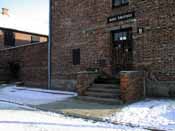
Block No. 11 was known by the prisoners [of Auschwitz]
as "the death block." It filled several roles, of which the
most important was that of central camp jail. Here, the SS placed
male and female prisoners from all over the camp who were suspected
by the camp Gestapo of belonging to the underground, planning escapes
or mutinies, or maintaining contact with the outside world. Poles from outside the camp were also held here after being arrested for
such offenses as offering aid to prisoners. They were subjected to
brutal interrogation that usually ended in a sentence of death by
being shot or hanged.
 In
the first years of the camp, the penal company (Strafkompanie)
and corrective company (Erziehungskompanie), assigned to the
harshest labor, were quartered here. Almost all newly arrived Jewish
prisoners and Polish priests were initially placed in the penal
company, where the number of victims was highest. The special group
of prisoners assigned to burn corpses in the crematorium (Sonderkommando)
was temporarily quartered in this block.
In
the first years of the camp, the penal company (Strafkompanie)
and corrective company (Erziehungskompanie), assigned to the
harshest labor, were quartered here. Almost all newly arrived Jewish
prisoners and Polish priests were initially placed in the penal
company, where the number of victims was highest. The special group
of prisoners assigned to burn corpses in the crematorium (Sonderkommando)
was temporarily quartered in this block.
So-called police prisoners (Polizeihäftlinge) were
imprisoned here after 1943. These were Poles, suspected of resistance
activity and held at the disposition of the Katowice Judicial
District Gestapo. They waited in this block for the verdict of the
German summary court, which usually sentenced them to death.
The SS incarcerated prisoners guilty of violating the camp
regulations in the punishment cells located in the basement.
Prisoners sentenced to death by starvation were also placed here in
1941. Among those who died in cell no. 18 in the basement of this
block was St. Maksymilian Maria
Kolbe.
In connection with SS operational plans for beginning the total
extermination of the Jews, a trial of the use of Zyklon
B gas for mass killing was carried out in the basement on
September 3-5, 1941. In this test, 600 Soviet prisoners of war and
250 Polish patients selected from the camp
"hospital" were murdered.
From 1941-1943, the SS shot several thousand people at the Death
Wall in the courtyard between Blocks No. 10 and 11. Those who died
here were mostly Polish political prisoners, and above all leaders
and members of the underground organization, people involved in
planning escapes and aiding escapers, and those maintaining contacts
with the outside world. Poles brought from outside the camp were also
shot here. They included hostages arrested in reprisal for Polish
resistance movement operations against the German occupation
authorities.
 Men,
women, and even children died here. Cases are also known in which
prisoners of other nationalities were shot here: Jews and Soviet
prisoners of war. The SS administered floggings in the courtyard, as
well as the punishment known as "the post," in which
prisoners were hung by their wrists, which were twisted behind their
backs. The Death Wall was dismantled in 1944 on orders from the camp
authorities, and the SS carried out most executions by shooting in
the gas chambers and crematoria of Auschwitz II-Birkenau.
Men,
women, and even children died here. Cases are also known in which
prisoners of other nationalities were shot here: Jews and Soviet
prisoners of war. The SS administered floggings in the courtyard, as
well as the punishment known as "the post," in which
prisoners were hung by their wrists, which were twisted behind their
backs. The Death Wall was dismantled in 1944 on orders from the camp
authorities, and the SS carried out most executions by shooting in
the gas chambers and crematoria of Auschwitz II-Birkenau.
The Museum reconstructed the Death Wall after the war.