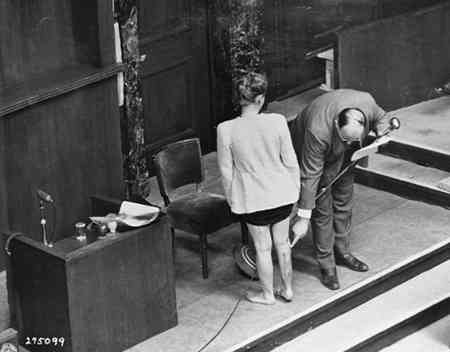
Above is a war crimes investigation photo of Jadwiga
Dzido, a member of the Polish underground, who was deported to Ravensbrueck in March 1941. There, she was subjected to medical
experiments with sulphonamide drugs in 1942. The experiments were conducted by Dr. Fritz Fischer,
Prof. Karl Gebhardt, Dr. Stumpfegger and Ravensbrueck camp doctor,
Herta Oberheuser. This photograph was entered as evidence for the
prosecution at the Medical
Trial in Nuremberg.
The disfiguring scars on the woman's right leg
resulted from incisions made by medical personnel that were purposely
infected with bacteria, dirt and slivers of glass, in order to simulate
the combat wounds of German soldiers fighting in the war. The inflamed
area was then treated with sulphonamide drugs. Many of the prisoners
subjected to these treatments died from their wounds.
On 25 October 1946, the US Military Government for
Germany established the Military Tribunal I, which conducted the first
of the subsequent Nuremberg
trials, that against Nazi Physicians. On 5 November indictments were served to twenty-three defendants, most of them former Nazi
doctors. The photo above is from that trial.
The
indictment listed four charges, the first being participation in the Common
Design or Conspiracy. The second and third charges were War Crimes and
Crimes against Humanity, which alleged that the defendants committed "murders,
brutalities, cruelties, tortures, atrocities, and other inhuman acts"
on German civilians and nationals of other countries through a series
of specific medical experiments dealing with the effects of high-altitude, malaria, and sterilization,
among other things. The final count charged ten of the defendants with
membership in the SS, which had earlier been ruled a criminal organization
by the IMT.
The Tribunal arraigned the defendants on 21 November, with
all pleading not guilty, and the trial began with US Chief of Counsel
Brigadier General Telford Taylor's opening statement on 9 December. After
all the evidence had been introduced and the arguments made for both sides,
the defendants made their personal statements and the trial ended on 19
July 1947. The trial had lasted one hundred and thirty-nine days, with
eighty-five witnesses called, and one thousand, four hundred and seventy-one
documents used as evidence.
On 20 August, the Tribunal announced it had found
fifteen of the defendants guilty, seven not guilty, and one (Helmut
Poppendick) guilty of membership in the SS but not of participating in
the medical experiments. The next day, sentences were handed down, with
seven sentenced to hang, five to life in prison, two to twenty years in
prison, one to fifteen, and Poppendick to ten for his membership in the
SS. Those sentenced to death were hanged 2 June 1948 in the Landsberg
prison.