The Warsaw Ghetto Uprising
(April 19 - May 19, 1943)
In 1942, Hitler decided to liquidate the ghettos and, within 18 months, had the more than two million Jews who’d
survived the ghettos deported to death
camps.
The Germans ordered the Jewish “police”
in the Warsaw ghetto to round up people for deportation. Approximately 300,000 men, women,
and children were packed in cattle cars and transported to the Treblinka death camp where they were murdered. This left a Jewish population of
between 55,000 and 60,000 in the ghetto.
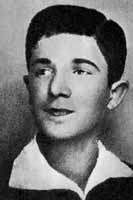 Mordecai Anielewicz
 |
In
April 1943, the Jews learned the Germans planned to deport all the people
who remained in the Warsaw ghetto to Treblinka.
A group of mostly young people formed an organization called the Z.O.B.
(for the Polish name, Zydowska Organizacja Bojowa, which means Jewish
Fighting Organization). The Z.O.B., led by 23-year-old Mordecai Anielewicz, issued a proclamation calling for the Jewish
people to resist going to the railroad cars.
In January 1943, Warsaw ghetto fighters fired upon
German troops as they tried to round up another group of ghetto inhabitants
for deportation. Fighters used a small supply of weapons that had been
smuggled into the ghetto. After a few days, the troops retreated. This
small victory inspired the ghetto fighters to prepare for future resistance.
The impact on the ghetto residents is described in
the Encyclopedia of the Holocaust:
The Jews in the ghetto believed that what had happened
in January was proof that by offering resistance it was possible to
force the Germans to desist from their plans. Many thought that the
Germans would persist in unrestrained mass deportations only so long
as the Jews were passive, but that in the face of resistance and armed
confrontation they would think twice before embarking upon yet another
Aktion. The Germans would also have to take into account the possibility
that the outbreak of fighting in the ghetto might lead to the rebellion
spreading to the Polish population and might create a state of insecurity
in all of occupied Poland. These considerations led the civilian population
of the ghetto, in the final phase of its existence, to approve of
resistance and give its support to the preparations for the uprising.
The population also used the interval to prepare and equip a network
of subterranean refuges and hiding places, where they could hold out
for an extended period even if they were cut off from one another.
In the end, every Jew in the ghetto had his own spot in one of the
shelters set up in the central part of the ghetto. The civilian population
and the fighters now shared a common interest based on the hope that,
under the existing circumstances, fighting the Germans might be a
way to rescue.
After the January battle, the Jews spent the following
weeks training, acquiring weapons, and making plans to defend of the
ghetto. The Germans also prepared for the possibility of a fight. On
the eve of the final deportation, Heinrich
Himmler replaced the chief of the SS and police in the Warsaw district,
Obergruppenfuhrer Ferdinand von Sammern-Frankenegg, with SS und Polizeifuhrer
(SS and Police Leader) Jurgen Stroop, an officer who had experience
fighting partisans.
 SS Major General
Jürgen Stroop (center) watches houses burn
SS Major General
Jürgen Stroop (center) watches houses burn |
The ghetto fighters were warned of the timing of the
final deportation and the entire Jewish population went into hiding.
On the morning of April 19, 1943, the Warsaw ghetto uprising began after
German troops and police entered the ghetto to deport its surviving
inhabitants. Seven hundred and fifty fighters armed with a handful of
pistols, 17 rifles, and Molotov cocktails faced more than 2,000 heavily
armed and well-trained German troops supported by tanks and flamethrowers..
After the Germans were forced to withdraw from the
ghetto, they returned with more and more firepower. After several days
without quelling the uprising, the German commander, General Jürgen
Stroop, ordered the ghetto burned to the ground building by building.
Still, the Jews held out against the overwhelming force for 27 days.
On May 8, the headquarters bunker of the ZOB at 18 Mila Street was captured.
Mordecai Anielewicz and a large number of his colleagues were killed
in the fighting, but several dozen fighters escaped through the sewers.
On May 16, Stroop announced the fighting was over.
He said his forces had captured 56,065 Jews and announced that he was
going to blow up the Great Synagogue on Tlomack Street (which was outside
the ghetto) as a symbol of victory and of the fact that “the Jewish
quarter of Warsaw no longer exists.”
Approximately 300 Germans and 7,000 Jews were killed
in the uprising, and another 7,000 Jews were deported to Treblinka.
The outcome was preordained, but the dramatic act of resistance helped raise the morale of Jews everywhere, if only briefly.
Sources:Mitchell G. Bard, The
Complete Idiot's Guide to World War II. 2nd Edition. NY: Alpha
Books, 2004; United
States Holocaust Memorial Museum; Israel Gutman, ed. Encyclopedia
of the Holocaust. Vols. 1-4. NY: Macmillan, 1995. USHMM Photo of Stroop.
|