The Bedouin
by Dr. Yosef Ben-David
(Updated 2016)
Israel’s Bedouin citizens – a minority within the
Arab minority – have in recent years received increased attention, both
from the media and from government institutions.
The process of integrating the Bedouin into Israeli
society takes place on two levels – the formal or by government
policy; and the informal, by changing relationships with Israeli
society in general and Jewish society in particular.
The process, as may be expected, is fraught with
"natural" difficulties experienced by this cultural group:
- the transition from a traditional, conservative
society which only two generations ago was nomadic, entails relinquishing
values, customs and a traditional economy;
- the Bedouin have to cope with the process of
urbanization – the very antithesis of their nomadic tradition –
and the attending poverty and crime rate;
- the Bedouin to some extent fail to distinguish
between objective difficulties and those connected with their changing
sub-culture and thus feel an exaggerated sense of deprivation.
Yet a comparison of the situation of the Bedouin in
Israel to that in Arab countries will show that Israeli Bedouin enjoy
conditions that their brethren lack, mainly in two areas: welfare and land
ownership.
Israel’s attitude towards its Bedouin citizens has
generally always been positive. Well aware of the difficulties of the Bedouin and
based on a thorough knowledge of the subject, recent governments
have begun taking steps to solve the problems with unprecedented
determination and allocation of the necessary funds.
In January 2013, the Israeli government created a policy designed to solve a range of problems affecting Israel's Bedouin population. This January 2013 plan, named after then-minister Ze'ev Binyamin Begin, was created to enhance and expand technological and adult education, develop industrial centers, establish employment guidance centers, assist in bolstering Bedouin local governments, and improve transportation systems, centers of excellence for students and support for Bedouin women who want to work or even begin their own businesses.
The first Bedouin high-tech company in Israel, Sadel Technologies, was cofounded by Ibrahim Sana, a Bedouion, and his two Arab-Israeli business partners. Sadeltech provides their clients with services including but not limited to: mobile app development, web application development and software quality assurance. Most of the employees at Sadeltech are Bedouins who have graduated from computer science programs at Israeli universities and have a tough time finding work; their first Jewish employee was hired in early 2016.
- Demography
- Education
- Health Services
- IDF Service
- Bedouin in the Negev
- Bedouin in Central Israel
- Bedouin in Northern Israel
- Conclusion
Demography
The Bedouin population in Israel currently numbers
210,000 persons who live in all regions of the State, most notably in the Negev.
The Bedouin population has increased tenfold since the
establishment of the State (1948), due to a high natural increase –
about 5% – which is unparalleled in Israel, or elsewhere in the Middle
East. A high fertility rate related to traditional social values regarding
size of family and/or tribe as a political advantage, as well as modern
health and medical services with easy access, which reduced infant
mortality and increased life expectancy, are responsible for this figure.
Education
More than anything else, education can contribute to
the integration of the Bedouin into Israeli society. Under the Compulsory
Education Law, every Bedouin child is entitled to twelve years of free
education and the law is very strictly enforced, at least at the
elementary school level. Three factors enhanced implementation: an
awareness of the necessity and the benefits of an education as an economic
and social-mobility tool; the idleness of children and youngsters in the
wake of moving to permanent settlements (they had been the main labor
force tending the fields and the livestock); and the establishment of a
relatively large number of schools in the scattered locations of the
Bedouin.
Within a single generation, the Bedouin of Israel have
succeeded in reducing illiteracy from 95% to 25%; those still illiterate
are aged 55 and above.
Thirty to fifty percent of the students in elementary
schools (depending on location) go on to high school, a ratio similar to
that elsewhere in the country’s Arab sector. They attend Bedouin high
schools in the Negev and Arab high schools in the central and northern
regions of the country.
Some 650 Bedouin – 30% of the Bedouin high school
graduates of 1998 – were enrolled as of 2002 in post-secondary education.
About 60 percent of them attended teacher training colleges and 40 percent
studied at the universities (including the Technological College of Be’er
Sheva). In addition, 35 students enrolled in universities abroad,
since they did not qualify for admission to Israeli institutions; the
universities now tend to ease admission standards for Bedouin students.
Health Services
The National Health Insurance Law (NHIL) which took
effect on January 1, 1996 considerably improved health services for about 30% of the
Bedouin population who had not belonged to a sick fund. According to the
NHIL, every resident is entitled to a basket of health services provided
by clinics, specialists and hospitals.
Mother-and-child care centers provide health education,
check-ups monitoring development and immunization. Today, hardly any
Bedouin women give birth at home; going to hospital makes the mother
eligible for a grant from the National Insurance Institute and provides
unaccustomed pampering.
Israel Defense Forces Service
Since 1948, Bedouins have served in the Israel Defense Forces (IDF) in large numbers, mostly in scouting or tracking units. A Bedouin scouting unit was established in 1970 in the IDF's Southern Command, and similar units are now in other regions. In 1986 a desert-scouting unit was formed and has been stationed near the Gaza Strip more recently. There is a monument honoring Bedouin soldiers' contribution to Israel and its army in the Galilee. In 2003, the IDF formed several specialized "search & rescue" units to serve the residents of the Arab, Bedouin and Druze communities in Israel. Despite their integration into the IDF, Israel's Bedouin population remains largely unintegrated into the rest of Israeli society, something the Begin Plan aims to change.
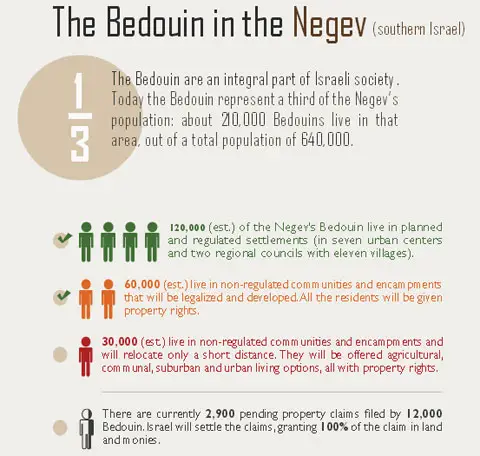
The Bedouin in the Negev
Ninety percent of the Bedouin tribes in the Negev hail from the
Hejaz, a region in the north of the Arabian peninsula. Ninety percent of the Negev's Bedouin population is located in the area between the cities of Beer Sheva, Arad, Dimona and Rahat.
Education: There are about 33 elementary
schools, three high schools and three vocational schools for the Bedouin
community in the Negev. At the elementary level, with an enrollment of
95%, the school population is made up of equal proportions of boys and
girls. But because Bedouin society regards females as inferior and does
not encourage them to study, girls make up no more than 10% of the pupils
in high schools. At first many teachers had to be brought in from outside
the community, today 60 percent of the teaching staff is Bedouin.
All the Bedouin high schools and 60% of the elementary
schools in the Negev, are located in the seven Bedouin towns there. Over
the past five years, extensive resources have been invested in schools,
especially in buildings, services, water pipes, heating and more.
Computers and laboratories have also been introduced.
Health: There are clinics in all seven Bedouin
towns in the Negev (in Rahat, proclaimed a city in 1994, there are four
clinics and a day-hospital). The medical staff includes Jews and Arabs;
fifteen of them are Bedouin doctors. Most of the Bedouin living outside
the towns can reach the clinics easily; in the more outlying areas,
several mobile clinics provide services in the mornings.
A total of 12 clinics provide services in the Negev at
present (one clinic per 6000 persons); another 10 clinics are in various
stages of establishment. Hospital facilities are available in Be’er
Sheva. If a gap still exists between health services in the rest of the
country and in the Bedouin towns, it relates more to the physical domain
than to the level of medicine.
Land Rights: In most countries in the Middle East the Bedouin have no land rights, only users’ privileges. Israeli Law is
derived largely from Mandatory (British) law which in turn incorporated
much Ottoman law. Under Israeli law, a person who has not registered
his/her land in the Land Registry cannot claim ownership; but in the mid
1970s Israel let the Negev Bedouin register their land claims and issued
certificates as to the size of the tracts claimed. These certificates
served as the basis for the "right of possession" later granted
by the government. Following the signing of the Treaty of Peace with
Egypt, it became necessary to move an airport to a locality inhabited by
5000 Bedouin. The government, recognizing these land claim certificates,
negotiated with the certificate holders and paid compensation to them.
Most moved to Bedouin townships, built houses and established businesses.
In recent years the Ministerial Committee for the
Advancement of Bedouin Affairs has undertaken to solve the problem of land
ownership and has been assured of the necessary funds. The government is
willing to leave some 20% of the land claimed in Bedouin possession and to
compensate them for the remainder. In the past, tensions relating to land
ownership have led to violence. A solution is now possible, but it
requires the willingness and goodwill of both partners.
Two kinds of land offenses make media headlines:
illegal building and grazing in protected areas:
Illegal building: Tents and light structures
(shacks and huts) built illegally are treated forgivingly. But
construction of houses of stone or concrete without a building permit is
considered an offense, since adequate infrastructure and services cannot
be provided. Some 2,000 such locations with buildings already exist,
scattered over an area of about 1,000 square kilometers.
Grazing in protected areas: Most of the livestock
of the Bedouin in the Negev who keep flocks of sheep and goats are
registered and approved by the Ministry of Agriculture, which provides
pasture land outside the Negev for six to seven months of the year, since
the carrying capacity of the Negev is limited. Owners who, for reasons of
tax evasion, have not registered their livestock and do not receive
Ministry of Agriculture services, frequently trespass on nature reserves
or populated areas. They are liable to be punished under the law.
Permanent locations: The establishment of
permanent towns did not begin until the Bedouin themselves constructed
buildings to replace tents. But the urbanization process is by no means
simple, as the planners have to deal with issues involving tradition and
social structure and the Bedouin themselves have difficulty in
articulating their wishes in planning terms.
The first Bedouin town, Tel Sheva, was founded in 1967.
Here all possible mistakes were made, both by the planners and by
government officials. Since then another six towns have been established
in the Negev and an effort was made to learn from each previous
experience. But the planning concept focused on urban settlement, while
many Bedouin wanted to live in rural localities. Today there are plans to
found such rural localities and it is hoped that they will satisfy the
traditional aspirations of the Bedouin.
The Bedouin urban population in the Negev (1998) |
| Rahat |
28,000 |
| Tel Sheva |
7,000 |
| Aro’er |
6,200 |
| Keseifa |
5,500 |
| Segev Shalom |
2,600 |
| Hura |
2,400 |
| Lakiya |
1,500 |
| Total |
53,200 |
The total Bedouin population of the Negev is over
110,000, which means that about 57,000 are still scattered in outlying
areas. It will be Israel’s task in the near future, to solve, together
with the Bedouin, the problems of their settlement in towns and rural
communities.
Livelihood: The desire of about 30% of the Bedouin in
the Negev to retain traditional occupations – the raising of livestock and
dry farming – as a source of primary or additional income, causes them to
seek pasture land, the supply of which is decreasing due to development and
increased quantities of livestock. Given the arid conditions of the Negev,
the government, though increasing quotas from time to time, providing
veterinary services and refraining from the importation of mutton, must
limit pasture land. This is at times depicted in the media as cruel, and the
Bedouin as victims of high-handedness.
Other sources of livelihood are:
1. Thirty percent of the Bedouin in the Negev have
permanent jobs (in factories, government services etc.).
2. A similar percentage of unskilled workers cannot
obtain permanent jobs and they are the immediate victims when recession and
unemployment strike. The National Insurance Law guarantees minimal income to
the unemployed, the elderly, the disabled or ill and to orphans and widows.
3. In private enterprise: they have succeeded to capture
three niches in which neither Jews nor Arabs compete (providing income to an
estimated 25% of the population): as agricultural contractors with modern
mechanical equipment; as owners of trucks, utility vehicles, buses and cabs,
or as salaried employees of transportation companies; and as contractors for
development work, involving the use of heavy mechanical equipment.
The Bedouin in Central Israel
No Bedouin lived in central Israel in 1948. The fact that
10,000 currently live in this region is the result of migration from the
Negev, due to two main factors:
Pasture migration: In 1957 the Negev was struck by
drought which lasted for six years. The military administration, responsible
for the Negev Bedouin localities at the time, came to the aid of the owners
of large herds who requested permission to move to State-owned pasture land
in central Israel. This migration led to the establishment of dozens of
Bedouin settlements from Kiryat Gat to Mount Carmel, which developed
pleasant social and political relations with their Jewish neighbors. In 1977
the government decided that the Bedouin should return to the Negev. Those
who had land in the Negev returned there, but the majority remained in
Central Israel, because they had abundant pasture land and some of the
family members had found jobs, especially in and around the major Jewish
cities. In 1992 a new policy, under which they were offered additional rural
localities, was adopted; but the process of settlement will undoubtedly last
many years.
Labor migration: The second factor that led to the
migration of Bedouin to central Israel was the search for work, especially
by families that lacked land and livestock. This migration process, which
lasted from 1954 to 1970, created Bedouin centers in the cities of Ramle and
Lod and the villages of Taibe and Kafr Kassem; lesser numbers settled in
other Arab villages. The migrants belonged to two socio-economic groups:
those who had left behind land in the Negev and those (the majority) who had
not. The latter obtained permanent jobs and income and had no intention of
leaving. Most of those who had left land in the Negev returned there in
1980, when the government recognized land claim certificates (see above -
Land rights).
In the cities: The Bedouin who moved to
Central Israel adapted quickly to urban life, free as they were of the
social and political pressure of the Negev Bedouin who opposed moving to the
townships set up for them by the government. They moved into houses
abandoned by Arabs who had fled the country during the War of Independence,
or built shacks (such as the train-station section of Lod). The government
is now planning housing projects, taking their traditional needs into
consideration. Having become permanent residents and enjoying better
national and municipal services, the Bedouin show much interest in both
general and municipal politics. in these cities they have also developed
special relations with the two dominant communities, the Arabs and new
Jewish immigrants.
In the villages: Paradoxically, the Bedouin
who migrated from the Negev to Arab villages were not able to create
positive relations with the villagers, despite a common religion and
language; they are, instead, considered foreign implants. In 1997 the Kafr
Kassem Local Council published a leaflet criticizing their Bedouin
neighbors, even demanding their eviction. The incompatibility between the
Bedouin, who bought small plots of land for agriculture, and the villagers
seems to be linked to the cultural-historical difference between farmers and
desert dwellers. But like all Israeli citizens they enjoy education, health
and welfare services, despite their claims of being discriminated against by
the local authorities, especially in the separate neighborhoods that they
have built for themselves in each village.
The Bedouin in Northern Israel
The Bedouin in Galilee and the Jezreel valley, numbering
about 50,000, unlike those in the Negev and in the Central region, hail from
the Syrian desert. At the beginning of the century their nomadic way of life
and militancy put them in a position to harass villages and demand tribute,
giving them a sense of superiority over the fellahin (farmers). During the
British Mandate the Galilee Bedouin were encouraged to purchase small plots
of land and such purchases were recorded in the Land Registry as legal
possession.
Towards the end of the British Mandate and during the
struggle for the establishment of the State of Israel, many Bedouin joined
the Jewish forces, believing that the Jewish state would be generous to
them. This also explains the continued good relations after the
establishment of the State, as manifested, first and foremost, in
volunteering for the security forces and serving on the front lines;
volunteering is considered by the Bedouin to be part of their blood-pact
with the State of Israel.
One example of the good relations between the State and
the Bedouin in the North is the tolerance displayed by the government
regarding violations of building laws, non-expropriation of land and the
establishment of the townships of Beit Zarzir and Ka’abiya.
Conclusion
Whereas the Negev Bedouin are ambivalent in their
attitude toward the State of Israel and their identification with it, the northern
Bedouin identify with it almost fully. This is manifested, first and
foremost, in the extent of volunteering for the security services. As a
result, the Bedouin in the North are rewarded with a friendly attitude, both
from the establishment and from Jewish society at large.
Sources: Israeli
Foreign Ministry, Embassy of Israel. Dr. Ben-David is an associate researcher at the
Jerusalem Institute of Israel Studies.
|