Ma'ale Adumim
Ma’ale Adumim is a suburb of Israel’s capital, barely
three miles outside Jerusalem’s city
limits, a ten-minute drive away. It was established
by 23 families on a hilltop about 1,500 feet
above sea level overlooking the Judean desert,
the Jerusalem Hills, Mt.
Scopus and the Mount
of Olives in 1975. The name refers to the
reddish hues of the rock formations along
the route from the Jordan Valley to Jerusalem.
Ma’ale Adumim is described in the Book
of Joshua (15:6-18) as a border area between
the tribes of Judah and Benjamin.
Launched by 23 pioneer families on the seventh night
of Chanukah in 1975, Ma'aleh
Adumim became a local council in 1979. As a result, the settlement received
official recognition and now operates within the framework of a municipality.
From fewer than two dozen families, the
outpost grew to 20,000 just 20 years later.
In 1991, the government declared Ma’ale Adumim
the first official city in Judea
and Samaria, and
today it is the largest Jewish city in the
territories, with a population of 40,000.
Most of the city’s residents
are middle class and traditional; approximately
20 percent are religious (and are served
by 28 synagogues). About 15 percent come
from the United
States, another 15 percent
are from the former
Soviet Union.
The city is attractive because
it is clean, safe, and close to where many
residents work. In 2003, a 1.8 mile road
was finished that connected the city with Jerusalem,
making it even easier to commute to Israel’s
capital. The city has also twice won the
national prize for environmental quality
and features 275 acres of green space, dozens
of playgrounds, and outdoor sculptures. Housing
prices are also significantly lower than
in Jerusalem itself.
The area doesn’t have
much in the way of tourist attractions besides
the Martyrius Monastery. During the Byzantine period,
the monk Martyrius built a monastery overlooking
river beds, the Judean Dessert and the Dead
Dea. The city does have a swimming
pool, a country club, a library and a shopping
mall, as well as one of Israel’s largest
industrial zones, home to more than 100 companies.
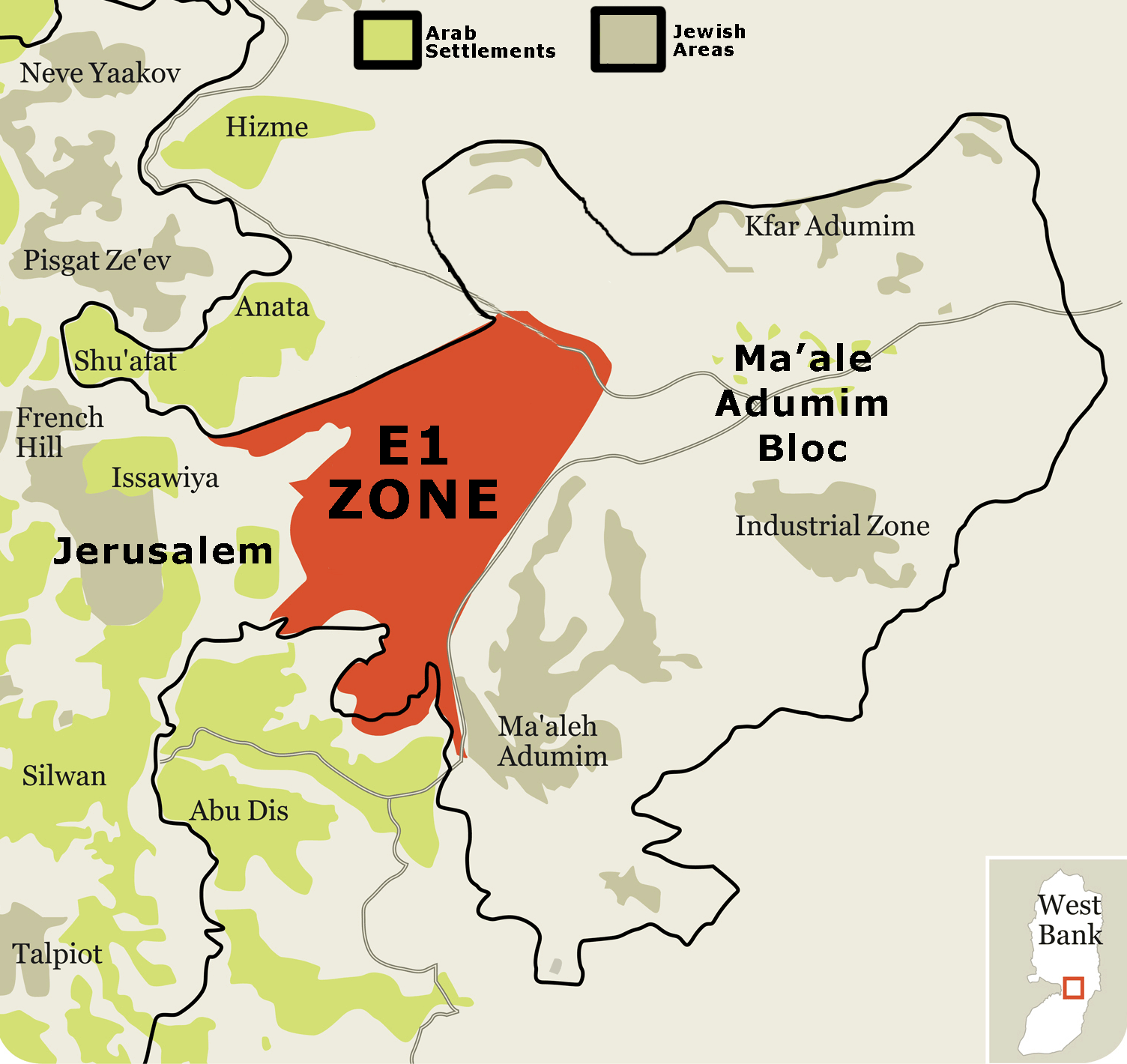
Approximately 6,000 people live in surrounding settlements that are included in the Ma’ale
Adumim settlement bloc, the largest of which is Kfar Adumim.
According
to the Clinton
peace plan, Ma’ale Adumim was to
be part of Israel - a point agreed upon by the Palestinian Authority - and the city no lies within the Israeli side of the security fence. For many years, the Israeli government has planned to fill in
the gap between Jerusalem and Ma'ale Adumim - referred to as the E1
project - by building in the East-1 (E1) corridor that lies between the two cities. Comprising approximately 3,250
mostly uninhabited acres, the E1 plan calls for the construction of residential homes, commercial, industrial, and tourism buildings, as well as a nature reserve.
Sources: Ma’ale
Adumim |