Anna Sokolow
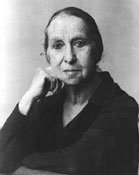
(1910 - 2000)
Anna Sokolow was a dancer
and choreographer of uncompromising integrity.
Believing strongly that dance could be more
than mere entertainment, she explored the
most pressing issues of her day - from the
Great Depression, to the Holocaust,
to the alienated youth of the 1960s - and
challenged her audiences to think deeply about
themselves and their society.
A key figure in the development of modern
dance in both Israel and Mexico,
Sokolow worked in numerous countries, from
Holland to Japan. She also worked with a variety
of theater forms; in addition to regular involvement
with both Broadway and off-Broadway stage
productions, she often experimented with combining
dance, mime and the spoken word into a single
piece.
Sokolow frequently found inspiration in Jewish
history and culture. Not only did her upbringing
amidst the left-wing movements of New York's
Jewish immigrant communities shape her interest
in social and political injustices, but Biblical
and modern Jewish figures, Jewish rituals,
and other Jewish themes formed the basis of
diverse compositions.
Sokolow's compositions were generally abstract;
rather than following a narrative structure,
they searched for truth in movement and examined
a broad range of human emotions. Exploring
as they did many of the social, political,
and human conflicts that characterize life
in the modern world, they often left viewers
feeling shaken and disturbed. But even when
dealing with the darkest of subjects, Sokolow's
appreciation of the dignity of the human spirit
and its resilience in the face of trouble
and despair was evident. As a reviewer wrote
in 1967, "Miss Sokolow cares - if
only to the extent of pointing out that the
world is bleeding. I find hope in such pessimism."
Early
Years
Anna Sokolow was born on February 9, 1910,
in Hartford, CT, to Sarah (Kagan) and Samuel
Sokolow. Recent immigrants from Pinsk, the
Sokolows had difficulty adjusting to life
in America. As Anna later recalled, "In
the European Jewish tradition, the man was
really the scholar, and the woman he married
and her family took care of him and their
children. When they came here, a lot of them
had to change.... They learned to cope with
the system and realized that they had to earn
a living. Well, my father was totally bewildered
by it.... Eventually my mother, with her great
energy, stepped in and took over."
In the early 1910s, the Sokolows, now with
four children, moved to New York City. Sarah
found work in the garment industry, but Samuel
soon became ill with Parkinson's disease,
and Sarah had to place him in a charity hospital.
She also put her youngest daughter, Gertie,
in a Jewish orphanage for several years; her
son, Isidore, dropped out of school to contribute
to the family income.
Despite the hardships, Sarah retained her
strong will and high spirits. Attracted to
the Socialist Party and trade unions by their
acceptance of women as valued participants,
she attended political meetings, joined the
International Ladies Garment Workers Union,
and took part in union solidarity marches,
sometimes bringing her daughters.
Anna inherited her mother's comfort with
unconventionality and her commitment to social
and economic activism. She also soaked up
the vibrant Jewish culture that surrounded
her. Sarah regularly took her children to
Workman's Circle dances and the Yiddish theater,
in addition to keeping a kosher kitchen, observing
Jewish holidays, and lighting Shabbat candles
every Friday night. The Lower East Side environment
proved a significant influence on Sokolow's
later work.
Madly
in Love with Dancing
At about the age of ten, Anna began attending
classes sponsored by the Emanuel Sisterhood
of Personal Service, together with her older
sister Rose. Sarah Sokolow was extremely concerned
that her young children never be left alone
without supervision, and the Sisterhood provided
a safe haven for them at lunch breaks and
after school. There, in a class on interpretive
dance in the style of dance pioneer Isadora
Duncan, Anna quickly "fell madly in
love with dancing."
By the time Anna was 15, the Sisterhood dance
teachers had taught her all they could. Recognizing
her promise, they sent her to continue her
training at the Neighborhood Playhouse, one
of the first important "Off-Broadway"
theaters, then housed at the Henry Street
Settlement House. At about this time, Anna
also dropped out of school and left home.
She supported herself by taking odd jobs,
including working in a factory tying teabags.
At the Neighborhood Playhouse, Sokolow studied
with such important early modern dance figures
as Blanche Talmud and Bird Larson; she also
took classes in pantomime, diction, and voice.
When the Playhouse left the Henry Street Settlement
House in 1928 and opened a fully professional
School of the Theatre, Sokolow was given a
full scholarship and invited to join the school's
Junior Festival Players. Highly respected
performers and teachers taught the students
movement, singing, diction, and theater craft,
while dancer Martha Graham and composer Louis
Horst revolutionized the Playhouse's dance
training. Sokolow's later attempts to bring
together various theater forms grew out of
her early training at the Neighborhood Playhouse.
Martha
Graham & Louis Horst
After finishing her training at the Neighborhood
Playhouse, Sokolow joined Martha Graham's
new professional dance company in late 1929.
For much of the next decade, she studied and
danced with Graham, participating in such
notable works as Primitive Mysteries (1931)
and Celebration (1934) and in Graham's first
tour. "It was staggering,"
Sokolow later recalled. "I just knew
I was in the presence of something great."
The relationship between Sokolow and Graham,
however, was often difficult. Graham demanded
unquestioning loyalty from her dancers, who
worked nonstop for no pay, praise, or encouragement,
and Sokolow, as she herself said, did not "have the temperament of a disciple."
Sokolow's interest in exploring her own Russian-Jewish
background clashed with Graham's focus on
Americana, and her efforts to strike out in
her own direction found little support from
Graham. Sokolow left the company with some
bitterness in approximately 1938. Only much
later was she fully able to acknowledge Graham's
abilities: "Now, at my age, and with
everything I've done," she wrote
in the 1990s, "I [have] begun to realize
what a great artist Martha Graham was."
Sokolow always insisted that Louis Horst,
Graham's accompanist and composer, was a far
greater influence on her development than
Graham herself. Horst taught choreography
at the Neighborhood Playhouse, and Sokolow
was his most promising student. For several
years, she earned $25 a week as his assistant,
becoming known as "Louis' Whip."
Horst not only imbued in her a thorough appreciation
of both music and dance forms, he also encouraged
her to explore her own ideas in her compositions.
"The way I found out [who I was] was
not with Martha Graham," she remarked
later, "but with Louis Horst."
For decades, Sokolow looked to Horst for approval.
Radical
Dance
In the early 1930s, while still dancing for
Graham, Sokolow began to work with other groups
and to choreograph pieces of her own. As did
many other Jewish women dancers, she became
associated with a loose coalition known as
the "radical dance" movement.
Although modern dancers had always believed
dance should be more than mere entertainment,
Sokolow and her contemporaries searched for
a new, revolutionary approach. Unlike early
modern dance pioneers, who often looked to
ancient myths and timeless legends, the "radical
dancers" saw their art as a potential
agent of societal change and found inspiration
in events around them. Disturbed by the upheavals
of the Depression at home and the rising threat
of fascism abroad, they tried to raise consciousness
by dramatizing the economic, social, and political
crises of their time. Audience members, they
hoped, would in turn be inspired to help resolve
these crises.
Sokolow's first major composition for a group, Anti-War Trilogy, was performed at
the 1933 First Anti-War Congress, sponsored
by the American League Against War and Fascism.
She continued to portray the dangers of war
and fascism in such works as Inquisition
'36, Excerpts from a War Poem,
and Slaughter of the Innocents. She
also examined the oppression of industrial
workers (Strange American Funeral),
analyzed juvenile deliquency (Case History
No.--), and satirized modern society (Roantic
Dances, Histrionics).
 From "I had a Garden"
- 1939 (Barbara Morgan)
From "I had a Garden"
- 1939 (Barbara Morgan) |
By the mid-1930s, Sokolow was the youngest
American choreographer to lead her own professional
dance group, "Dance Unit." In 1936,
she staged the first full-evening concert
of her own works at New York's 92nd Street
Y.
In 1934, Sokolow traveled
to the Soviet Union, where she hoped to find
a truly revolutionary dance movement. She
was disappointed to discover that Soviet dance
was in fact less avant-garde than the American
"radical dance" movement.
Mexico
In the spring of 1939, Mexican painter Carlos
Mérida saw Sokolow and her "Dance
Unit" perform in New York. Deeply impressed,
he immediately invited them to Mexico.
Despite the fact that little modern dance
existed in Mexico, Sokolow's work was an immediate
success. People of all classes - from peasants
to professionals - flocked to the performances,
the number of which was increased from six
to twenty-three. Asked to work toward the
creation of a government-sponsored modern
dance company, Sokolow remained in Mexico
when her dancers returned to New York. After
eight months of intense work, the members
of the Ballet Bellas Artes (Fine Arts
Ballet) debuted in March 1940. Shortly thereafter,
Sokolow helped to form La Paloma Azul (The
Blue Dove), a group that brought together
dancers, artists and musicians.
Despite critical acclaim, La Paloma Azul did not survive beyond its first season. Yet
Sokolow's work laid the foundations for an
indigenous Mexican modern dance movement.
For decades, her original dancers were referred
to as "Las Sokolovas," while she
herself became known as "la fundadora
de la danza moderna de Mexico," or
"the founder of Mexican modern dance."
Mexico also had a profound effect on Sokolow's
artistic development. Deeply moved by the
Mexican people's reverence for art, she also
felt a strong affinity for Mexico's artistic
community, including Diego Rivera, José
Clemente Orozco, and Silvestre Revueltas.
"For the first time in my life," she said, "I knew what it felt like
to be an artist." Sokolow created
a number of pieces on Mexican and Spanish
themes, and a new lyricism appeared in her
work. For nine years, she commuted between
Mexico City and New York, acknowledging with
reluctance that her true creative roots lay
in New York.
Jewish
Dance
Prior to her stay in Mexico, Sokolow created
only one piece with clear Jewish content,
the 1939 The Exile. In part influenced
by the strong role of religion in Mexican
culture, she began to draw more frequently
on Jewish history, religion, culture, and
society in her work.
Many of Sokolow's Jewish compositions explored
themes of exile and suffering, as did her
work as a whole. Her 1945 Kaddish,
choreographed just as the Holocaust ended,
drew upon traditional Jewish elements to express
her intense pain and sorrow. Beating her breast
and invoking tefillin by wrapping a leather
strap around her arm, Sokolow created a heartwrenching
manifestation of mourning. Her Dreams,
premiered in 1961, was the first serious dance
exploration of the Holocaust.
Yet Sokolow did not simply mourn for a lost
culture and a lost population. Many of her
pieces explored the Jewish people's strength
and courage in the face of great adversity;
others commented upon Jewish religious and
social traditions. Sokolow based a number
of works specifically on Jewish female figures,
from the Biblical Ruth, Miriam, and Deborah to the modern Hannah Senesh and Golda Meir.
Her 1943 Songs of a Semite, named after a
book of poems by Emma
Lazarus, presented a lonely Jewish woman
who gained strength from remembering the courage
of several Biblical women.
The Jewish community provided Sokolow with
opportunity as well as inspiration. Not only
did Jewish unions and fraternal organizations
form many of her first audiences, but she
premiered a number of pieces at New York's
92nd Street Young Men's Hebrew Association.
Sokolow also staged festivals and pageants
in support of State of Israel bonds and directed
a synagogue service combining poetry and dance.
Broadway
& Other Venues
Influenced by her wide-ranging training at
the Neighborhood Playhouse, Sokolow never
limited herself strictly to dance. In 1935,
her Anti-War Cycle appeared on the
program with Clifford Odets' play, Waiting
for Lefty, strengthening her pre-existing
connection to the theater. Soon after, she
directed the dances for a Broadway production
of André Obey's Noah.
 In "Slaughter of the Innocents" - 1939 (Barbara Morgan)
 |
In
the late 1930s, Sokolow did the choreography
for Sing for Your Supper, a revue staged
by the WPA's Federal Theatre Project to put
unemployed singers, actors and dancers to
work. In 1947, she choreographed the musical
version of Elmer Rice's play Street Scene,
with a score by Kurt Weill and lyrics by Langston
Hughes. Her dances - particularly a duet based
on the jitterbug - dramatically heightened
the story's effect and broke new ground on
Broadway. Asked how she managed to capture
so effectively the flavor of the Lower East
Side streets, Sokolow replied, "It's
simple, when you've been part of them."
Over the next several years, Sokolow staged
dances and movement for plays on and off Broadway.
Her work ranged from Leonard
Bernstein's version of Candide to her own dramatization of Kafka's Metamorphosis.
She also choreographed a season for the New
York City Center Opera.
In 1967, Sokolow was invited to choreograph
the dances for the rock musical Hair.
With the director and writers clashing over
the staging, Sokolow gradually took on more
and more responsibility; by the end of rehearsals,
she was serving as director. When the original
director returned at the last minute, however,
Sokolow was dismissed and much of her staging
reworked. Yet she still had a significant
impact on the cast and the performance, and
consequently on the future of Broadway.
Israel
In 1951, the America-Israel Cultural Foundation
asked choreographer Jerome Robbins to select
an Israeli dance group to represent Israeli
dance abroad. Robbins chose the Inbal Dance
Theatre, a promising Yemenite Jewish ensemble.
He realized, however, that the group needed
help in raising itself to fully professional
standards. Sokolow, who had worked in similar
situations in Mexico and displayed a strong
interest in Jewish themes, seemed the perfect
candidate to take on this task.
Arriving in Israel in 1953, Sokolow was deeply
impressed by the Inbal dancers' Yemenite movements
and rhythms, their creativity and their dedication.
Her challenge, she felt, was to teach them
useful techniques and professional habits
without meddling with the core of their dancing.
Dancers in the new nation struggled with poor
working conditions, often using improvised
stages as they toured cities and kibbutzim,
but Sokolow, having faced similar problems
in the early years of her career, was undaunted.
After three years of hard work, Inbal made
a triumphant European debut.
Recalling her first visit to Israel, Sokolow
commented, "I certainly didn't expect
to be affected so deeply, but the minute the
plane landed I was overwhelmed with an indescribable
feeling about being there. I didn't have any
kind of strong Zionist background, but going
there changed my point of view. [Israel] is
now one of the deepest things in my life."
Sokolow returned to Israel virtually every
summer for decades, teaching countless groups
of dancers and actors. In the early 1960s,
she created a new company, the Lyric Theatre,
designed to bring theater, music and dance
together. Although the company survived only
a few years, it helped Israeli modern dancers
achieve professional standing and recognition.
Choreographic
Innovations
In 1951, Sokolow staged and performed in
a theater-dance production of S. Ansky's play, The Dybbuk. The dramatization represented
one of Sokolow's first major attempts to combine
dance with mime and the spoken word, a process
that had long intrigued her. Following The
Dybbuk, Sokolow largely ceased to perform
in public, preferring to focus instead on
choreography.
Two years later, Sokolow premiered Lyric
Suite. Set to a complex, atonal score,
the 1953 piece followed neither meter nor
melodic line, but rather responded to the
music's cumulative effect. Sokolow saw the
composition as a personal artistic turning
point, commenting that "[i]n working
on Lyric Suite I feel as though I began
to find...my vocabulary of movement."
After viewing the piece, Sokolow's mentor
Louis Horst told her, "Now, Anna,
you are a choreographer!" It was
the highest compliment he could have paid
her.
Over the next decades, Sokolow continued
to experiment with combinations of music,
dance and theater. In such works as Act
Without Words (1969), Magritte, Magritte (1970), and From the Diaries of Franz Kafka (1980), she freely mixed mime, acting, dance
and music to create a unique and powerful
art form. In 1969, she created a new company
- called Lyric Theatre, like her short-lived
Israeli group - devoted specifically to compositions
of this type. As she said, "I prefer
to work with people who can dance and act
rather than dancers who act or actors who
dance." A few years later, the group
was reconstituted as The Players' Project.
Sokolow's choice of music for her pieces
was also highly innovative. Working with such
composers as Teo Macero and Kenyon Hopkins,
she was one of the first choreographers to
set her compositions to serious, edgy jazz
music. One of these works, Opus '65,
became the prototype for countless later "rock
ballets."
Prophet
of Doom?
From her early treatment of problems such
as juvenile crime, industrial oppression and
the horrors of war, Sokolow moved later to
more internal conflicts, examining the full
range of human emotions engendered by life
in contemporary society. As one critic commented, "[I]t is her depictions of the brutal
loneliness and despair of urban life that
have defined her."
In 1955, Sokolow premiered Rooms,
a powerful portrayal of the terrifying loneliness
that afflicts even people living in the closest
proximity to each other. Unsettled by the
work, critic John Martin wrote, "Its
ultimate aim seems to be to induce you to
jump as inconspicuously as possible into the
nearest river." Ten years later,
Sokolow completed Opus '65, a vivid
depiction of the era's alienated youth culture.
The withdrawn sufferers of Rooms now
stood as an angry, disaffected group, tired
of feeling isolated and disconnected. Yet
their efforts at connecting were frightening
and left audiences feeling shaken and disturbed.
Critics began to refer to Sokolow as a "prophet
of doom." Yet Sokolow's choreography
was rarely wholly disheartening or depressing.
Rather, she retained a faith in the dignity
of the human spirit and the human capacity
for endurance that tempered the discomfort
her work caused. As Clive Barnes wrote, "No
one would go to Miss Sokolow for a good laugh
- yet far more importantly no one would go
to her for a good cry.... Sokolow's belief
in humanity shines through her pessimism.
Her pity and her compassion give her taut
and tortured dances a justification."
Sokolow, moreover, had a lighter side, and
her work could be humorous or lyrical as well
as disturbing. A Short Lecture and Demonstration on the Evolution of Ragtime was a delightful spoof of lecture-demonstrations,
while pieces such as Ballade displayed
a graceful lyricism that contrasted with many
of her darker works.
Teaching
& Rehearsing
When Sokolow began her career in the 1930s,
it was virtually impossible to earn a living
as a modern dancer. Like most of her colleagues,
she supplemented her income by teaching. Joining
some of the era's best-known dancers, she
taught classes in the Graham technique at
New York's 92nd Street Y and the Neighborhood
Playhouse. This work did more to support her
than did most of her concert appearances.
Sokolow later taught extensively in New York
City and around the United States. She also
gave workshops and classes and staged works
in many countries, including England, the
Netherlands, and Japan, as well as in her
beloved Mexico and Israel.
In the 1930s, Sokolow began giving classes
to the Group Theatre, and she continued to
work with actors as well as dancers until
the very last years of her life. In the 1940s
and '50s, she worked with Elia Kazan at the
Actors Studio, and in 1958, she began decades
of teaching actors and dancers at the Juilliard
Dance Division. "My first aim is to
free the actor from his self-consciousness," she once commented. "I make him
forget about the cliches about having to smoke,
to touch or handle something.... It may seem
to the actor that he is learning how to move
and how to use his body, but what he really
learns is to be simple, honest and human."
A demanding teacher, Sokolow had no patience
with dancers she suspected of insincere dramatic
projection. Caring little about a particular
style or technique, she believed students
needed to find their own way and to draw from
true emotions. She was often difficult, but
students who responded with the passion, intensity,
and vulnerabilty she sought earned her respect
and became intensely loyal to her. Dancer
José Coronado reflected, "I
fell in love with the woman, and I followed
her like a dog - because of her integrity."
Recognitions
At the age of only 27, Sokolow, together
with José Límon and Esther Junger,
received one of the first fellowships from
the Bennington School of the Dance. At a time
when most dancers and choreographers subsisted
on a shoestring budget, the support provided
an important lift to the young choreographer's
career.
Over the next decades, Sokolow was often
recognized as one of her era's most gifted
and innovative choreographers. The citation
for a 1961 Dance Magazine award read: "To Anna Sokolow, whose career as
concert dancer, choreographer, and teacher
in this country and on the international scene
has been distinguished by integrity [and]
creative boldness, and whose recent concert
works have opened the road to a penetratingly
human approach to the jazz idiom." In
1967, Sokolow was one of six American choreographers
to receive $10,000 grants from the National
Council on the Arts (soon to become the National
Endowment for the Arts), and in 1988 she was
awarded Mexico's highest civilian honor given
to a foreigner.
On several occasions, Sokolow's strong interest
in Jewish dance and Jewish themes earned her
special recognition. In 1975, New York's 92nd
Street Y presented her with an award for her
contributions to the world of dance and to
the Jewish people. Eleven years later, a gala
evening in Sokolow's honor opened a three-day
conference on "Jews and Judaism in Dance."
In 1991, Sokolow received the Samuel H.
Scripps American Dance Festival Award, given
to those who have made a significant lifetime
contribution to American modern dance. In
1995, a star-studded group of dancers, actors
and musicians gathered to celebrate Sokolow's
85th birthday with a grand gala of speeches,
memories and performances. In 1998, two years
before her death, Sokolow was inducted into
the National Museum of Dance's Dance Hall
of Fame.
Legacy
Sokolow never shrank from confronting her
audiences with difficult realities. She searched
for truth in movement, using dance to explore
the broad range of human emotions and encouraging
her audiences to think for themselves. "[M]y works never have real endings," she said. "[T]hey just stop and fade
out, because I don't believe there is any
final solution to the problems of today. All
I can do is provoke the audience into an awareness
of them."
The conviction that "[a]rt should
be a reflection and a comment on contemporary
life" shaped Sokolow's entire career.
Always animated by an intense social consciousness,
Sokolow believed strongly in the necessity
of involvement with the world around her. "The artist should belong to his society," she wrote, "yet without feeling
that he has to conform to it.... Then, although
he belongs to his society, he can change it,
presenting it with fresh feelings, fresh ideas."
Sokolow died on March 29, 2000, at the age
of 90. Her unique and powerful approach to
her art left its mark on students and colleagues,
from Robin Williams to Alvin Ailey, and countless
amateurs and actors as well as professional
dancers remember her lessons with gratitude
and admiration. Gerald Arpino, artistic director
of the Joffrey Ballet, spoke for many when
he paid tribute to Sokolow at her 85th birthday: "I became a dancer because of the pure
joy and spirit of dance. I remained in the
field ever since because such pioneers as
Anna Sokolow showed me the deep commitment
and intense humanism that dance is capable
of expressing. Her indomitable spirit, her
courage, her uncompromising truths are beacons
not only for the dance world but for all humankind."
Sources: Jewish Women's Archive. Photos
courtesy of Anna
Sokolow's Player's Project |