Abie Nathan
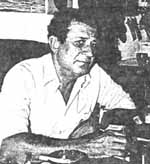
(1927 - 2008)
In 1927, Abie Nathan was
born to a Jewish family in Iran. He was later
educated by Jesuit priests in India. He served
as a fighter pilot with British forces during
World War II and emigrated to Israel in the
middle of its War
of Independence in 1948. He immediately
found himself back in the air defending the
creation of the new state. He served the Israeli
Air Force until 1951 then settled down
in Tel-Aviv. He opened a soon to be popular
and profitable American-style restaurant
in downtown Tel-Aviv. Then, suddenly he started
to make headlines.
In 1966 he flew his single
engine plane called
"Shalom One" from Tel Aviv to Port
Said. He was promptly arrested and sent back
to Israel. The flight made world headlines
and a few weeks later he carried his campaign
to Europe, the United States and even the
Soviet Union. He met with politicians and
intellectuals including Pope John Paul VI,
Jean Paul Sartre, Francois Mauriac, Bertrand
Russell, and Senator Robert Kennedy among
others. He appealed to them to help end Arab-Israeli
hostilities.
In 1967, he tried again,
this time with the clear intention of meeting
Gamal Abdul Nasser, President of Egypt. Egyptian
forces again intercepted him upon his arrival.
Back in Israel he was charged with "unauthorized
contact with the enemy" and received
a 40-day jail sentence, the first of many.
In 1969, Nathan decided
to change his tactics. With the help of supporters
from Holland he bought a 188-foot coastal
freighter which he named: "The Peace
Ship". He sailed it to New York City
for refitting. What followed was three and
a half years of extensive fund-raising attempts
including a donation party at "21",
a popular night-club, which a total of two
people attended and a benefit concert at
Carnegie Hall that netted $150. Abie persisted
until he was at last able to have the ship
refitted and installed with expensive broadcasting
equipment. However, the bills mounted and
when the last $40,000 could not be found
he went on a hunger strike, the first of
many.
The ship-turned-pirate-radio-station
left the New York City port in October 1972.
The mostly volunteer ragtag crew consisted
of a French captain, 3 Americans, 2 Filipinos,
a Yugoslav, a Canadian and British DJ had
to survive a harrowing voyage across the
Atlantic in gale-force winds to the coast
of Israel. In 1973 the radio station called
"The Voice of Peace" started it's
regular broadcasting with the popular tune: "Give
Peace a Chance" from "somewhere
in the Mediterranean...." to the surrounding
30 million Arab and Israeli listeners.
In its twenty years of existence, "The
Voice of Peace" gained much popularity
mainly amongst young people. It was the only
radio station in the Middle East which broadcasted
mainstream music from the world's "Top
40" charts and used English as its primary
language yet combined both Israeli and Arabic
news.
During the Yom
Kippur War in 1973 Abie sailed the
Peace Ship as close as possible to the
fighting sides and broadcasted appeals
for both to lay down their arms.
The year 1977 brought Abie
world-wide recognition when, following many
unsuccessful attempts, he managed to sail
through the Suez Canal with a cargo of chocolates
and toys for children. By the end of the
year, for the first time, he became recognized
as a major
"Player" in the Middle East and
became member of an Israeli team to meet
with then Egyptian President Sadat.
The "Cairo Talks" were marked as
one of his biggest successes. The dialogue,
which he instigated over ten years before,
was now a reality.
In
1978, Nathan begun an indefinite hunger-strike
protesting the building of Jewish settlements in
the occupied West Bank and the Gaza Strip.
The fast ended 45 days later after the Israeli
Parliament, under media pressure, met in
the Knesset, specifically to come to a resolution
on the matter. The only thing resolved was
an appeal by the government to Mr. Nathan
to end his strike.
In the 1980's, Nathan began
regular meetings with the PLO and
its infamous leader Yasir
Arafat. Again, this activity only won
him more jail sentences. Abie has said that
hundreds of Israelis, including members of
the ruling Likud Party, had contacts with
the PLO but that only he and several other
peace activists have ever had to face trial. "Someone
has to pay the price..." He said. In
handing down the sentence, the Magistrate's
Court Judge said "Mr. Nathan had knowingly
broken the law and that leniency in such
a case could lead to the destruction of the
rule of law in Israel."
Nathan said in an interview
that he "did not envy the judge" and
would not appeal the sentence.
"But I have to be true
to myself," he said.
"This is not a law that I must abide
by. This is not a law from heaven."
In 1993 the Israeli Government
proved him right again by repealing the law
making it illegal for Israelis to have direct
contact with members of the PLO. Abie, who
had worn nothing but black clothing for the
previous 12 years in protest of the law,
was at last able to change his style of dress.
He immediately flew to Tunis to meet openly
with the Palestinian leader.
Soon after, the Prime Minister
of Israel met with the PLO leader to sign
a peace agreement.
In 1993, after $300,000
in losses due to operating costs of the almost
ancient ship and declining advertising revenues,
Abie Nathan announced that he would close
down the radio station. After failing to
attract investment to turn the ship into
a floating peace museum he scuttles it.
The Peace Ship now lies
at the bottom of the Mediterranean for all
time to come.
Abie Nathan died on August
27, 2008. In 2005, Nathan was voted the 44th-greatest Israeli of all time in a poll conducted by Yediot Ahronoth.
Sources: Abie
Nathan and the Peace Ship |