Henri-Louis Bergson
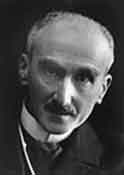
(1859 - 1941)
French philosopher who was
awarded the Nobel
Prize for Literature in 1927. Bergson
argued that the intuition is deeper than
the intellect. His Creative Evolution (1907)
and Matter and Memory (1896) attempted
to integrate the findings of biological science
with a theory of consciousness. Bergson's
work was considered the main challenge to
the mechanistic view of nature. He is sometimes
claimed to have anticipated features of relativity
theory and modern scientific theories of
the mind.
“In reality, the past is
preserved by itself automatically. In its
entirety, probably, it follows us at every
instant; all that we have felt, thought
and willed from our earliest infancy is
there, leaning over the present which is
about to join it, pressing against the
portals of consciousness that would fain
leave it outside.” (from Creative
Evolution)
Henri Bergson was born in Paris as
the son of a prosperous Jewish musician from Poland and
an Anglo-Irish mother. At the age of 17,
he won an open prize for an original solution
to a mathematical problem, and in the same
year he solved a problem Pascal claimed to
have solved but left unpublished. Bergson
studied at the Ecole Normale Supérieure
from 1877 to 1881. The following 16 years
he spent as a philosophy teacher in a succession
of lycées. Among his pupils
was the journalist Charles Péguy,
who established the journal Cahiers de
la quinzaine in 1900. Bergson's graduation
thesis (in Latin) was on Aristotle's theory
on Lucretius. In 1900, he became a professor
at the Collège de France. His lectures
were highly popular, drawing students, academics,
general public and tourists and, by 1911,
students referred to the collège as "the
house of Bergson." From 1914 until 1921, Édouard
Le Roy functioned as Bergson's "permanent
substitute" while the philosopher served
on French diplomatic missions. Bergson resigned
in 1921 in order to dedicate himself to his
writing and to his work on behalf of the
League of Nations. From 1921 to 1926, he
acted as president of the committee on international
cooperation of the League of Nations.
Bergson enjoyed the status
of a cult figure in the years between World
Wars. Although not a practicing Jew, Bergson
refused the Vichy government's offers to
excuse him from the scope of their anti-Semitic laws.
A few weeks before his death, despite being
offered an exemption, Berson, 81 and seriously
ill, got out of his sickbed to registered
himself at the end of 1940 as
a Jew. He also renounced all honors to demonstrate
his disapproval of the government. In his
will, Bergson explained his position:
My reflections have led
me closer and closer to Catholicism, in
which I see the complete fulfillment of Judaism.
I would have become a convert, had I not
foreseen for years a formidable wave of
anti-Semitism about to break upon the world.
I wanted to remain among those who tomorrow
were to be persecuted (Daniel Boorstin, The
Seekers, p. 293) .
Bergson died of bronchitis
on January 3, 1941. For the last seventeen
years of his life he had suffered from crippling
arthritis. The popularity of Bergson's philosophy
faded in the 1920s.
"There is nothing in philosophy
which could not be said in everyday language," Bergson
told once in an interview. In spite of his
good intentions, his ideas were often high-flown
and difficult to follow. In his first major
work, Time and Free Will (1889),
Bergson aimed to show how pseudoproblems
about the will and its freedom have arisen
from a false phenomenology of mental states
- essentially, a tendency to conceive and
describe them in spatial terms. Human experience
does not perceive real life as a succession
of demarcated conscious states, progressing
along some imaginary line, but rather a continuous
flow. Bergson made the distinction between
the concept and experience of time. While
the physicist observes objects and events
in succession, time is presented to consciousness
as duration - an endlessly flowing
process, which resists simple mathematization.
Bergson argued that the 'real time' is experienced
as duration and apprehended by intuition,
not through separate operations of instinct
and the intellect.
In An Introduction to
Metaphysics (1903), Bergson saw that
the intuition, the direct apprehension
of process, as the discoverer of truth
- intuition, not analysis, reveals the
real world. Sometimes intuition in Bergson
referred to getting bright ideas, sometimes
it was the method of philosophy like intellect
is of mathematics. His concept of élan
vital, "creative impulse" or "living
energy," was developed in Creative Evolution,
his most famous book. Élan vital is
an immaterial force, whose existence cannot
be scientifically verified, but it provides
the vital impulse that continuously shapes
all life. Bergson questioned the Darwinist
theories that evolution occurs in great
leaps or alternatively through the gradual
accumulation of slight mutations and explained
by élan vital the creative
course of evolution.
In 1914, all of Bergson's
writings, but most especially Creative
Evolution, were placed upon the list
of books devout Catholics were forbidden
to read. After its appearance twenty-five
years elapsed before Bergson published another
major work, The Two Sources of Morality
and Religion (1932), his final statement
of his philosophy which also reflected the
threats of nationalist-racist politics and
hinted at the coming of mechanized warfare. The
Creative Mind, published two years later,
was a collection of essays and other writings.
"In laughter we always find
an unavowed intention to humiliate and consequently
to correct our neighbour," Bergson stated
in Laughter (1900). It is not among
Bergson's best-known studies, but Arthur
Koestler considered it as important for his
book The Act of Creation as (1964)
Freud's classic Wit and its Relations
to the Unconscious. Bergson defined the
comic as the result of the sense of relief
we feel when we feel ourselves from the mechanistic
and materialistic - his examples were the
man-automaton, the puppet on strings, Jack-in-the
Box, etc. "A situation is always comic," he
wrote, "if it participates simultaneously
in two series of events which are absolutely
independent of each other, and if it can
be interpreted in two quite different meanings." He
saw laughter as the corrective punishment
inflicted by society upon the unsocial individual. "It
seems that laughter needs an echo. Our laughter
is always the laughter of a group."
Bergson had been interested
in Spencerian evolutionism in his youth,
but he later abandoned Spencer's view placing
intuition as the highest human faculty. In Creative
Evolution Bergson argued that the creative
urge, not the Darwinian concept of natural
selection, is at the heart of evolution.
Man's intellect has developed in the course
of evolution as an instrument of survival.
It comes to think inevitably in geometrical
or 'spatializing' terms that are inadequate
to lay hold of the ultimate living process.
But intuition goes to the heart of reality,
and enables us to find philosophic truth.
Bergson's thinking and concept
of time has influenced greatly Arnold Hauser,
Claude Simon, William James, Alfred North
Whitehead, Santayana, and such authors as
Péguy, Valéry, and John Dos
Passos. Whitehead expanded Bergson's notions
of duration and evolution from their applications
to organic life into the phycial realm. It
is said that for Marcel Proust, whose cousin
Bergson married in 1891, the philosopher
gave the idea for the great novel of reminiscence, À la
recherche de temps perdu (1913-27). Sartre
also paid tribute to Bergson, and Martin
Heidegger, whose ontology is echoed in existentialist
writing, used some of Bergson's concepts,
such as "no-being". However, Bergson's influence
on existentialism is not straight forward
and in his own time the philosopher was considered
an empiricist. On the other hand, Bergson's
argumentation frustrated such philosophers
as the empiricist Bertrand Russell, who criticized
his thoughts in 1914 and later returned to
them in History of Western Philosophy. Philosophers
have pointed out that Bergson did not satisfactorily
show how intuition could work apart from
intellect. Albert Einstein found serious
mistakes from Bergson's DURÉE ET SIMULTANÉITÉ À PROPOS
DE LA THÉORIE D'EINSTEIN (1921), dealing
with Einstein's theory of relativity. Bergson
had opposed in 1911 Einstein's ideas, but
then his view had changed and he introduced
the concept of non-linear time. Bergson is
generally regarded as having lost his public
debate with Einstein, but some of the leading
physicists have devoted articles to his work.
For further reading: The
Philosophy of Bergson by
B. Russell (1914); Un Romantisme
utilitaire by R. Berthelot (1938); L'Intellectualisme
de Bergson by L. Husson (1947); Bergson by I.W. Alexander (1957); Henri
Bergson by
H.W. Carr (1970); Bergson by J. Solomon
(1970); Bergson and Modern Physics by
M. Capec (1971); Bergson by
L. Kolakowski (1985); Henri
Bergson by
P.A.Y Gunter (1986); Bergson
and Modern Thought, ed. by A.C. Papanicolaou (1987); Bergsonism by
G. Deleuze (1988); Inventing
Bergson: Cultural Politics and the
Parisian Avant-Garde by
Mark Antliff (1993); The
New Bergson, ed. by John Mullarkey (1999); Philosophy
and the Adventure of the Virtual: Bergson
and the Time of Life by Keith Ansell-Pearson
(2001) -
Selected bibliography:
- ESSAI SUR LES DONNÉES IMMÉDIATES
DE CONSCINCE, 1889 - Time and Free Will:
An Essay on the Immediate Data of Consciousness
(trans. by F.L. Pogson)
- MATIÈRE ET MÉMOIRE, 1896
- Matter and Memory (trans. by N. M.
Paul and W. S. Palmer)
- LE RIRE: ESSAI SUR LA SIGNIFICANCE
DU COMIQUE, 1900 - Laughter: An Essay
on the Meaning of the Comic (trans. by
C. Brereton and F. Rothwell) - Nauru
- tutkimus komiikan merkityksestä
- INTRODUCTION À LA MÉTAPHYSIQUE,
1903 - An Introduction to Metaphysics
(trans. by Mabelle L. Andison)
- L'EVOLUTION CRÉATRICE, 1907
- Creative Evolution (trans. by Arthur
Mitchell) - suom. Henkinen tarmo
- L'ÉNERGIE SPIRITUELLE, 1919
- Mind-Energy (trans. by H. Wildon Carr)
- DURÉE ET SIMULTANÉITÉ À PROPOS
DE LA THÉORIE D'EINSTEIN, 1921
- LES DEUX SOURCES DE LA MORALE ET DE
LA RELIGION, 1932 - The Two Sources of
Morality and Religion (trans. by R.A.
Audra and C. Brereton)
- LA PENSÉE ET LE MOUVANT: ESSAIS
ET CONFERENCES, 1934 - The Creative Mind
- ÉCRITS ET PAROLES, 1957-59 (3
vols.) - partial. trans., The Philosophy
of Poetry; The Genius of Lucretius
- ŒUVRES, 1959
- MÉLANGES, 1972
Sources: Pegasos |