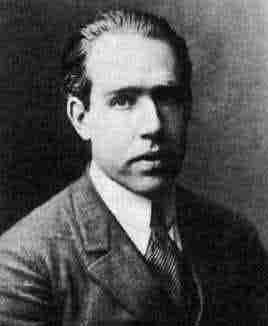
Niels Bohr's father was Christian Bohr and his mother
was Ellen Adler. Christian Bohr was awarded a doctorate in physiology
from the University of Copenhagen in 1880 and in 1881 he became a Privatdozent
at the university. Late in the same year he married Ellen, who was the
daughter of David Adler, a Jewish politician with a high standing in
Danish political and commercial life. Christian and Ellen had three
children. The eldest was Jenny born in 1883 in the mansion which David
Adler had owned opposite Christiansborg Castle where the Danish Parliament
sat. Ellen's mother had continued to live in this house after her husband
David Adler died in 1878 and Ellen had gone back to her mother' home
to have her child. Two years later Niels was born on his mother's 25th
birthday in the same stately home, Ellen again having returned to her
mother's house for the birth of her child. The third child of the family,
who went on to become a famous mathematician, was Harald Bohr who was
two years younger than Niels.
When Niels was only a few months old his father Christian
had been appointed as a lecturer to fill a post left vacant by the death
of Peter Panum, the professor of physiology at the University of Copenhagen,
and a short while later the family moved into the Panum's professorial
house in Copenhagen.
In October 1891 Niels entered the Grammelholms school.
He attended this school, as did his brother Harald, for his complete
secondary education taking his Studenterexamen in 1903. He did well
at school without ever being brilliant, usually coming third or fourth
in a class of about 20 students. If he really excelled at a subject
it was, perhaps surprisingly, physical education. He was an excellent
soccer player, yet not as good as his brother Harald who won a silver
medal playing soccer for Denmark. Niels made some good friends while
at school but his best friend throughout his life was his brother Harald.
During his last two years at school Niels specialised
in mathematics and physics. There is certainly some evidence that he
soon realised that the mathematics teacher did not have as good a grasp
of the topic as he should have had and that he became somewhat frightened
of his exceptional pupil Bohr. In physics too Bohr studied texts ahead
of the class finding errors in them. It was his father, more than his
school teachers, who inspired him in his studies of mathematics and
physics. He wrote in 1922:-
Bohr studied at the University of Copenhagen which
he entered in 1903. He studied physics as his main subject but took
mathematics, astronomy and chemistry as minor subjects. He was taught
physics by Christian Christiansen and philosophy by Harald Hoffding.
He had known both of them for many years since they were close friends
with his father and had met as pert of a regular discussion group with
both brothers Niels and Harald Bohr taking part as soon as they were
old enough to contribute. Bohr was taught mathematics at university
by Thorvald Thiele.
At university Bohr could not carry out physics experiments
since there was no physics laboratory. However his father had a physiology
laboratory and his first paper describes experimental work in physics
which he carried out in that laboratory. He dictated the paper to his
brother Harald. A fellow student wrote of Niels and Harald:-
The two are inseparable. I have never known people
to be as close as they are.
This paper is the only one that Bohr wrote describing
experiments which he had carried out. With it he won the Gold Medal
for 1906 from the Royal Danish Academy of Sciences for his analysis
of vibrations of water jets as a means of determining surface tension.
He received his Master's degree from the University of Copenhagen in
1909 and his doctorate in May 1911 for a thesis entitled Studies on
the electron theory of metals. It was a thesis based on classical physics
and as such necessarily failed to explain certain effects. Bohr wrote
in this work:-
It does not seem possible at the present stage
of the development of the electron theory to explain the magnetic properties
of bodies from this theory.
Bohr dedicated his thesis to the memory of his father
who had died from a heart attack a few months earlier in February 1911.
By this time Bohr was engaged to Margrethe Norlund. The pair married
on 1 August 1912 and Richard Courant, speaking after Bohr's death, had
this to say of his marriage:-
Some people have speculated about the lucky
circumstances which combined to make Niels so successful. I think the
ingredients of his life were by no means matters of chance but deeply
ingrained in the structure of his personality ... It was not luck, rather
deep insight, which led him to find in young years his wife, who, as
we all know, had such a decisive role in making his whole scientific
and personal activity possible and harmonious.
Bohr applied to the Carlsberg Foundation for a travel
grant in May 1911 and, after the award was made, went to England in
September 1911 to study with Sir J J Thomson at Cambridge. He had intended
to spend his entire study period in Cambridge but he did not get on
well with Thomson so, after a meeting with Ernest Rutherford in Cambridge
in December 1911, Bohr moved to the Victoria University, Manchester
(now the University of Manchester) in March 1912. The timing was very
fortuitious since shortly before Bohr and Rutherford met, Rutherford
had published a major work showing that the bulk of the mass of an atom
resided in the nucleus.
In Manchester Bohr worked with Rutherford's group
on the structure of the atom. Rutherford became Bohr's role model both
for his personal and scientific qualities. Using quantum ideas due to
Planck and Einstein,
Bohr conjectured that an atom could exist only in a discrete set of
stable energy states. Remarkable evidence exists today of Bohr's scientific
progress since he corresponded frequently with his brother Harald. He
wrote to Harald on 12 June 1912:-
You can imagine it is fine to be here, where there
are so many people to talk with ... and this with those who know most
about these things; and Professor Rutherford takes such a lively interest
in all that he believes there is something in. In the last years he
has worked out a theory of the structure of atoms, which seems to be
quite a bit more firmly founded than anything which has existed up to
now.
A week after writing this letter, on 19 June, Bohr
was reporting progress to Harald:-
Perhaps I have found out a little about the structure
of atoms. Don't talk about it to anyone, for otherwise I couldn't
write to you about it so soon. ... You understand that I may yet be
wrong; for it hasn't been worked out fully yet (but I don't think
its wrong). ... Believe me, I am eager to finish it in a hurry, and
to do so I have taken a couple of days off from the laboratory (this
is also a secret).
By the 13 July he wrote:-
Things are going rather well, for I believe I have
found out a few things; but, to be sure, I have not been so quick to
work them out as I was stupid to think. I hope to have a little paper
ready and to show it to Rutherford before I leave, and I therefore am
so busy, so busy.
Although Rutherford and Bohr had completely different
personalities, they shared an enormous enthusiasm for physics and they
also liked each other personally. However the relationship was never
quite that of close friends since Bohr always saw Rutherford as his
teacher. They corresponded from the time they met in 1911 until 1937,
the year of Rutherford's death.
On 24 July 1912, with his paper still unfinished,
Bohr left Rutherford's group in Manchester and returned to Copenhagen
to continue to develop his new theory of the atom, completing the work
in 1913. The same year he published three papers of fundamental importance
on the theory of the atom. The first paper was on the hydrogen atom,
the next two on the structure of atoms heavier than hydrogen. In these
papers Bohr [4]:-
... set out his startling attempt to combine aspects
of classical physics with the concept of Planck's quantum of action.
... The three famous papers ... formed the foundation of Bohr's early
reputation. His work, although not immediately accepted by everyone,
intrigued his contemporaries and made them aware of the need for a new
way of describing events at atomic level. The Bohr atom, although it
has been superseded scientifically, persists even today in the minds
of many people as a vivid image of what atoms look like and a symbol
of physics.
In July 1913 Bohr was appointed as a docent in Copenhagen.
However it was not a situation which pleased him since he could not
pursue the style of mathematical physics which he was developing. On
10 March 1914 he wrote to the Department of Educational Affairs:-
The undersigned takes the liberty of petitioning
the department to bring about the founding of a professorship in theoretical
physics at the university and in addition to possibly entrust me with
that position.
It was a bold move but Bohr's already high reputation
meant that he would be taken seriously. The Faculty of the University
recommended him for a chair of theoretical physics but the Department
of Educational Affairs decided to delay confirming the post. Of course
in 1914 times were uncertain and Bohr realised that no quick decision
was likely. He therefore was delighted to accept an offer by Rutherford
to join his Manchester group as Schuster Reader. He expected to be in
Manchester for a year, anticipating that his chair of theoretical physics
in Copenhagen would be confirmed by then. The outbreak of World War
I while he was on holiday in the Tyrol before travelling to Manchester
made his journey extremely difficult, but he and his wife arrived in
Manchester in October 1914 having sailed round the north of Scotland
through severe storms on their way.
Bohr was in Manchester longer than he expected since
his chair was not confirmed until April 1916. However, it was a very
productive and happy period. Pais writes in [12]:-
In the early summer of 1916 the Bohrs returned
to Denmark. Four years earlier Bohr had left Manchester full of exciting
but undigested ideas about the atom. Now he departed as the master of
that field, professor in Copenhagen, his wife who was expecting their
first child at his side.
In 1917 Bohr was elected to the Danish Academy of
Sciences and he began to plan for an Institute of Theoretical Physics
in Copenhagen. This was created for him and, from its opening in 1921,
he became its director, a position he held for the rest of his life.
Bohr is best known for the investigations of atomic
structure referred to above and also for work on radiation, which won
him the 1922 Nobel Prize for physics. He gave a lecture on the work for which he was awarded
the Prize on 11 December 1922 in Stockholm. He talked of atomic stability
and electrodynamic theory giving an account of the origins of quantum
theory, the hydrogen spectrum, explaining the relationships between
the elements. His explanation covered the absorbsion and excitation
of spectral lines and the correspondence principle which he had set
out in three papers On the quantum theory of spectra between 1918 and
1922.
In 1923 Bohr summed up the ideas:-
Notwithstanding the fundamental departure from
the ideas of the classical theories of mechanics and electrodynamics
involved in these postulates, it has been possible to trace a connection
between the radiation emitted by the atom and the motion of the particles
which exhibits a far-reaching analogy to that claimed by the classical
ideas of the origin of radiation.
Quantum mechanics may be said to have arrived in 1925
and two years later Heisenberg stated his uncertainty principle. In
a meeting at Como in north Italy in September 1927 Bohr put forward
his principle of complementarity which gave a physical interpretation
of Heisenberg's uncertainty relations. He proposed complementarity of
perceptions and pictures, particle-wave, conjugate variables, quantum
evolution - classical measurements etc. as a fundamentally new interpretation
of the foundations of quantum theory. Bohr's ideas on complementarity
are fully explored in [29].
Bohr thought that his idea of complementarity could
play an important role in fields other than quantum physics and he worked
on these ideas throughout the ret of his life. He considered applications
to biology, psychology and epistemology. It has been suggested that
the idea of complementarity came from outside physics, some arguing
that the roots of the idea came from the discussions with his father,
Christiansen and the philosopher Hoffding when he was still at school.
Others, such as Pais in [12], give convincing arguments to show that
Bohr was not knowingly influenced by Hoffding's philosophy.
It was Bohr's view of quantum theory which was eventually
to become accepted. Einstein expressed grave doubts about Bohr's interpretation
and Bohr, Einstein and Ehrenfest spent many hours in deep discussion,
but Bohr's view prevailed. Bohr expressed this view saying:-
Evidence obtained under different experimental conditions
cannot be comprehended within a single picture, but must be regarded
as complementary in the sense that only the totality of the phenomena
exhausts the possible information about the objects.
H B G Casimir wrote describing what it was like working
with Bohr in his Institute:-
Even Bohr who concentrated more intensely and had
more staying power than any of us, looked for relaxation in crossword
puzzles, in sports, and in facetious discussions.
Bohr's other major contributions, in addition to quantum
theory, include his theoretical description of the periodic table of
elements around 1920, his theory of the atomic nucleus being a compound
structure in 1936, and his understanding of uranium fission in terms
of the isotope 235 in 1939.
In 1937 Bohr, his wife and their son Hans made a world
tour. They travelled to the United States, Japan, China and the USSR.
In the same year he attended Rutherford's funeral in Westminster Abbey
in London, giving a moving speech:-
When I first had the privilege of working under
his personal inspiration he was already a physicist of the greatest
renown, but nevertheless he was then, and always remained, open to listen
to what a young man had on his mind. ... The thought of him will always
be to us an invaluable source of encouragement and fortitude.
Bohr, although he had been christened in the Christian
Church, had Jewish origins on his mother's side and so, when the Nazis occupied Denmark in 1940,
his life became exceeding difficult. He had to escape in 1943 by being
taken to Sweden by fishing boat.
From there he was flown to England where he began to work on the project to make a nuclear fission bomb.
After a few months he went with the British research team to Los Alamos
in the United States where they continued work on the project.
However Bohr was deeply concerned about the control
of nuclear weapons and from 1944 he tried to persuade Churchill and
Roosevelt for the need to have international cooperation. He wrote a
public letter to the United Nations in 1950 arguing for rational, peaceful
atomic policies:-
Humanity will be confronted with dangers of unprecedented
character unless, in due time, measures can be taken to forestall a
disastrous competition in such formidable armaments and to establish
an international control of the manufacture and use of powerful materials.
Bohr received the first U.S. Atoms for Peace Award
in 1957. He died from a heart attack in his home in 1962 and following
this scientists and leading figures world-wide joined in paying tributes
to him. President Kennedy wrote (see for example [52]):-
American scientists, indeed all American citizens
who knew doctor Bohr's name and his great contributions, have respected
and venerated him for more than two generations ...
Sources: Written by J J O'Connor and E F Robertson. School of Mathematics and Statistics at the University
of St. Andrews, Scotland