|
[By: Rebecca Weiner]
Sweden, a kingdom located on the Scandinavian peninsula of northern Europe, has a short Jewish history dating back to the mid-17th century. Today, the Jewish populatin of Sweden is approximately 15,000 - the twelfth largest Jewish community in modern Europe.
- Early History
- World War II & Holocaust
- Post-Holocaust Period
- Modern Jewish Community
Early History
While a number of Jews lived in Sweden, practicing
their rituals in secret, a Jewish community was not officially established
until the 1770s. Samson Efraim and his son visited Goteborg and Stockholm
on business in 1702. More Jewish businessman came to Sweden because
of the demands of the East Indian Company and, in 1733, Jews were
allowed to visit auctions in Goteborg and a small Jewish community
of eight individuals lived in Stockholm until 1734.
Aron Isak, a seal engraver from Germany, was the
first Jew granted permission to live as a Jew in Sweden. He was first
offered citizenship if he accepted Christianity; his response,
"I would not change my religion for all the gold in the
world" impressed the Lord Mayor of Stockholm, who advised Isak
to make a legal protest to King Gustav III. The King subsequently
granted him citizenship as the first Swedish Jew. He was allowed to
bring some Jewish families, so there would be at least a 10 Jewish
men (the number needed to hold prayer services).
In 1775, the island of Marstrand, off the coast of
the Goteborg, all foreigners were allowed to live on the island
,including Jews. Five years later, the first Jewish family settled in
Goteborg. In 1782, legislation was adopted allowing Jews to settle in
Sweden without converting to Christianity.
Until 1860, Jews were only allowed to live in
Stockholm, Goteborg, Norrkoping, Karlskorna and Marstrand (although
only from 1775-1794). The first Jewish cemetery was consecrated in
1776. In 1782, in the designated cities of residence, Jews were given
permission to build synagogues, perform communal services and engage
in business and crafts that were not subject to guilds. In 1840,
about 900 Jews lived in Sweden.
The process of Jewish emancipation began in 1838
when King Charles XIV removed some of the restrictions placed on
Jews, which gave them many civil rights and legal protection. Until
the 1840's, only wealthy Jews were allowed to intermarry. More
prohibitions were removed by 1870. One of the last prohibitions was
not removed until 1951, which stated that Jews could not hold
political office. Once becoming full citizens, Jews were treated as
peers and anti-Semitism was rare.
Lithograph from 1860 showing the Goteborg
synagogue
built in 1855, which stands on a water front site.
 |
The Jewish population increased tremendously
between 1850 and 1920 due to immigration from Russia and Poland. The
population reached nearly 6,500 in 1920.
Immigration was regulated following World War I
and the inter-war period. Small groups of German, Austrian, and Czech
Jews were allowed to immigrate to Sweden during the 1930's. Fear of
large-scale Jewish immigration led to student demonstration at
Uppsala and Lund universities, in 1938. A law prohibiting the Jewish
ritual slaughter of meat was introduced and is still in affect today.
From 1933-1939, only 3,000 Jews were allowed to
immigrate to Sweden and another 1,000 were permitted to use Sweden as
a transit stop to other locations. Once the brutalities of the Nazi
regime were known, Sweden opened her doors to immigration and
short-term stays.
World War II & the Holocaust
Sweden
was involved in many efforts to save Jews from Nazi brutality and
murder.
In 1942, Sweden allowed the immigration of 900 Norwegian
Jews. In October 1943, Sweden gave asylum to more than 8,000 Danish
Jews, the whole Danish Jewish community, which came to Sweden via
small fishing boats. Swedish diplomat Raoul
Wallenberg is famous for having saved thousands of Hungarian Jews in Budapest.
Also, Count Folke Bernadotte helped bring Jews and non-Jews out of
concentration camps.
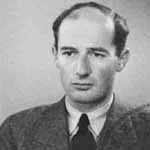 Raoul Wallenberg
 |
Sweden also profited from the Holocaust.
It is known that Wallenberg’s relatives made money converting Nazi
gold into Swedish crowns and that Sweden provided iron ore and ball bearings
to the Nazis. Swedish documents reveal that some Swedes actually sided
with the Nazis and volunteered to fight for Hitler. Some Swedes were members
of the Waffen SS and served in police batallions.
A committee was established by the Swedish
government in 1997 to investigate the transfer of Nazi gold to Sweden
during the war. It is reported that Sweden received 38 tons of gold
from Nazi Germany (worth today US $430 million). Many Swedish
companies, such as Ericsson, AGA and Hasselblad Cameras, as well as
the country’s paper and wood industries traded with Nazi Germany.
Swedish jewelers bought stolen diamonds, which were smuggled into
Sweden by civil servants working at the German legation in Stockholm.
Post-Holocaust Period
In the post-war period, many Holocaust survivors were brought to Sweden for rehabilitation. Sweden also
accepted refugees from the Baltic countries, Lithuania, Estonia and
Lithuania, whom were later to be discovered as Nazi collaborators.
Due to the activities of Swedish anti-Semite,
Einar Aberg, a law was passed in Sweden, in the 1950's, prohibiting
the incitement against ethnic groups.
In 1956, Sweden accepted hundreds of Hungarian
Jewish refugees fleeing the Communists and in 1968, Sweden accepted
thousands more fleeing from Communist-led witch hunts. Jews from
Czechoslovakia and Poland also immigrated to Sweden, including many
intellectuals, university students and young professionals. Between
1945-1970, the Jewish population of Sweden doubled.
In 1987, Radio Islam, run by a Swedish-Moroccan,
Ahmed Rami, began broadcasting anti-Semitic messages to the greater
Stockholm area. Rami served time in jail for a number of years and,
in 1996, he began broadcasting once again in Sweden and over the
Internet.
An amendment to the criminal code was passed in
1994 making racist motivations for a crime an aggravated
circumstance. In 1996, Sweden’s supreme court ruled that a person
wearing Nazi symbols could be charged with incitement against an
ethnic group. Also in 1996, one of the major producers of neo-Nazi
music, Tomas Lindvist, was sentenced to one month imprisonment for
incitement against an ethnic group. It was the first case against the
White Power music scene prevalent in Sweden. In 1997 the first
complaint against an internet site in Sweden, was lodged for Ahmed
Rami’s website.
Sweden is considered a pioneer in Holocaust education. In November 1997, the Swedish government introduced a
large-scale educational program, called the Living History Project,
to educate Swedes about anti-Semitism.
For this project, a free book was distributed about the Holocaust to every household in Sweden and minority communities were given the
book in their own language. A website devoted to the Holocaust was designed and Uppsala University opened an institute dedicated to the study of the Holocaust and
other genocides. Uppsala University also hosted an international
conference on Holocaust education,
in 1998. In January 2000 Sweden hosted an international gathering to
promote awareness of the Holocaust,
which was attended by heads of state from numerous countries
throughout the world.
Modern Community
In Sweden today there is a Jewish population of
approximately 18,000 out of a population of 9 million. Stockholm,
Sweden’s capital, boasts the largest Jewish community. There are
also Jewish communities in Malmo, Goteborg, Boras, Helsingborg, Lund
and Uppsala. The Jewish community is composed of mainly pre-war
refugees and Holocaust survivors and their descendants.
All of the denominations and Jewish communities
are linked to the Official Council of Jewish Communities in Sweden.
Swedish Jewry is active in international Jewish welfare activities.
There are branches of the WIZO, General Organization of Jewish Women,
Emunah, B’nai Brith and B’nai Akiva in Sweden.
There are synagogues in Stockholm (2 Orthodox and
1 Conservative), Goteborg (1 Orthodox and 1 conservative) and in
Malmo (1 Orthodox synagogue). Jewish cemeteries can be found in
Goteborg, Gotand, Kalmar, Karlskrona, Karlstad, Larbro, Malmo,
Norrkoeping, Stockholm and Sundsvall.
The Jewish community of Stockholm has a primary school,
kindergarten, Judaica House, communal library, a bi-monthly publication
(Judisk Kronika) and a weekly Jewish radio program.
In recent years there has been an uptick of anti-Semitism
in Sweden, most notably in Malmo. The torching of a Jewish chapel,
defacement of Jewish cemeteries, and incidents of "Heil Hitler!"
are among what has been reported since Israel's Operation
Cast Lead in 2009. Most of the anti-Semitic incidents have come
from Malmo's Rosengard slum, home to a large proportion of the city's
Muslim population, which comprises 15% of the country's total population.
Rosengard's unemployment rate was 80% in October 2010, which may also
contribute to the restlessness that breeds ideological prejudice against
Jewish Swedes. Due to this sharp rise in anti-Semitism and hate crimes
in Malmo, many of the city's Jewish residents are emigrating to Israel,
among other places known for more tolerant attitudes toward Jews.
By 2010, 30 families had left for the Swedish capital of Stockholm,
England or the Jewish homeland.
In 2012, several alarming steps point to the heightened
security situation in Malmo. For instance, the Simon Weisenthal Center
issued an advisory against travel to Malmo because its controversial
left-wing mayor Ilmar Reepalu has been influenced heavily by Islamist
sentiment, which in turn has forced Malmo's Jews to flee in great
numbers. President Obama's special advisor on anti-Semitism, Hannah
Rosenthal, was sent to Malmo to meet with its city's mayor in April
2012. That same month, the Social Democrat made headlines when he
said that Sweden Democrats, an anti-immigrant party originally aligned
with the Swedish neo-Nazi movement, had "infiltrated" Malmo's
Jewish community to turn it against Muslims.
Sweden made international headlines in October 2014 when their newly elected left-leaning government pledged to be the first European Union country to recognize the state of Palestine. Iceland is the only Eastern European nation to recognize Palestine, and they are not members of the European Union. Over 100 countries currently recognize Palestinian statehood. Swedish Prime Minister Stefan Lofven stated that the announcement was made in an attempt to spur negotiations to reconvene, and come to a 2 state solution to the conflict. Lofven stated that "A two-state solution requires mutual recognition and a will to peaceful co-existence. Sweden will therefore recognise the state of Palestine". The move was made on Lofven's first day in office, and was immediately criticized by international actors including the US State Department, which issued a statement stating that the recognition of a Palestinian state as the situation currently stands is premature. This possible recognition of Palestinian statehood was met with protests from Israeli officials, who claimed that Lofven did not "study the issue in depth" and made a knee-jerk decision.
In response to these criticisms, Swedish officials including Lofven backtracked their steps. Instead of boldly making the outright claim that they would recognize the Palestinian state, on October 5 Swedish officials stated that no date has been set for the recognition, and that the announcement was meant to engage a dialogue between Sweden and Israel. Retracing his words, Lofven was quoted saying that Sweden "wasn’t going to recognize a Palestinian state tomorrow morning” and that he “wants to speak first with all the relevant parties, including Israel, the Palestinians, the United States and other EU states".
On October 30, 2014 Sweden officially recognized the state of Palestine, making good on their promise made earlier in the month. Although the move was met with protests and criticism from Israel, Sweden issued a statement affirming their history of "excellent cooperation with Israel". In response to this recognition of a Palestinian state, Israel temporarily recalled their ambassador to Sweden, Isac Bachman. Insider sources claimed that Israeli Foreign Minister Avigdor Lieberman was even considering permanently removing the ambassador to Sweden, which would significantly downgrade Israeli-Swedish relations.
In light of these recent votes to recognize a Palestinian state, EU Foreign Policy Chief Federica Mogherini expressed doubts as to whether the movement to unilaterally recognize Palestine is beneficial to the peace process. Mogherini explained that "The recognition of the state and even the negotiations are not a goal in itself, the goal in itself is having a Palestinian state in place and having Israel living next to it." She encouraged European countries to become actively involved and push for a jump start to the peace process, instead of simply recognizing the state of Palestine. Mogherini said that the correct steps to finding resolution to the Israeli-Palestinian conflict might involve Egypt, Jordan, and other Arab countries forming a regional initiative and putting their differences aside at the negotiation table. She warned her counterparts in the European Union about getting "trapped in the false illusion of us needing to take one side" and stated that the European Union "could not make a worse mistake" than pledging to recognize Palestine without a solid peace process in place. (Bloomberg, November 26 2014)
The Palestinian Authority opened an embassy in Sweden on February 9, 2015, further straining ties between Sweden and Israel. Speaking in Sweden, Mahmoud Abbas said that he was hopeful that Sweden's recognition of a Palestinian state will move the negotiations and peace process forward. Abbas and Swedish Prime Minister Stefan Lofven signed a deal which will see Sweden raise their aid to the Palestinian Authority by $180 million by 2020. In other Western European countries the Palestinians have a “diplomatic mission” and not a full embassy.
Relations between Sweden and Israel continued to degrade in December 2015, as Sweden's Foreign Minister Margot Wallstrom accused Israel of unlawful, extrajudicial killings of Palestinians during the wave of street violence incited by Palestinian leaders late in the year. In response to the comments made by Foreign Minister Wallstrom, Israeli Prime Minister Netanyahu asked whether, “she expects Israel's citizens to bare their throats to those trying to stab them.” (Yahoo, December 7, 2015) Wallstrom continued to call for “thorough and credible” investigations into the deaths, demands which Netanyahu responded were “Outrageous, immoral, and stupid.” (BBC, January 15, 2016)
Swedish Foreign Minister Margot Wallstrom was denied meetings with Israeli officials, including Prime Minister Benjamin Netanyahu, during a visit to the area in December 2016. Publicly, Israeli leaders stated they could not meet with Wallstrom due to scheduling conflicts, but the real reason behind the snub was allegedly the government's unhappiness with Sweden's policys on the Israeli-Palestinian conflict.
The Swedish National Council for Crime Prevention reported a 38% increase in the frequency of anti-Semitic attacks in 2014 compared to 2013. Many Jews living in Sweden's major cities constantly watch their backs and do not feel safe, wary of the rise in anti-Semitic and anti-Israel attacks.
For more information:
Official Council of Jewish Communities in Sweden
Wahrendorffsgatan 3 B
10391 Stockholm
Tel: 08 587 858 00
Sources: Ravid, Barak. “Israel Turns Cold Shoulder to Visiting Swedish Foreign Minister,” Haaretz (December 13, 2016);
Williams, Dan. “Sweden-Israel rift deepens over comments on Palestinian deaths,” Yahoo News (December 6, 2015);
Neuger, James. “Palestine Recognition Not ‘Goal in Itself,’ EU’s Mogherini Says,” Bloomberg (November 26, 2014);
The Aryan Cradle. Chapter 2: The Jews in the North;
From
Sweden with hatred. By Ilya Meyer;
The
History of the Jews of Sweden;
Jewish
Immigration to Sweden: A brief history. By Carl Henrik Carlsson;
Jews
leave Swedish city after sharp rise in anti-Semitic hate crimes.
By Nick Meo;
Malmo
Syndrome. By Marc Tracy;
Stockholm conference puts spotlight on Swedish Jews. By Mordecai Spektor.
Jews
of Sweden;
Sweden;
Sweden.
World Jewish Congress- Machon - Forum;
Sweden. Jewish
Communities of the World;
Sweden. Cemetery
Project Sweden;
Sweden
and Jews: History, Tensions, and Changing Relationships. A Research
Project Proposal;
By Prof. Tom R. Burns, Prof. Ron Eyerman, Dr. Julian Illicki,
and Prof. Jim Kemeny;
Sweden's
'Damn Jew' Problem. By Paulina Neuding;
Photo credits:
Picture of Aron Isak courtesy of Institute
for Jewish Culture.
Goteborg synagogue courtesy of Edward Victor's Judaica
Philatelic Resources.
|