Raoul Wallenberg
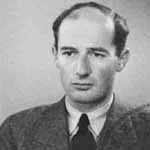
(1921 - ?)
Raoul Wallenberg was a Swedish diplomat in Nazi-occupied Hungary who led an extensive and successful mission to save the lives of nearly 100,000 Hungarian Jews. Though his efforts to save Jews from the Holocaust is one of the most treasured aspects of that time, his fate and ultimate death is unknown still to this day.
- Early Life & Education
- Professional Life During Hitler's Rise
- The Holocaust Hits Hungary
- Swedish Efforts to Save Jews
- Wallenberg's Arrival in Hungary
- Wallenberg's Diplomacy
- "Swedish Houses" & Other Saving Efforts
- "Death Marches," Deportation, & Last-Ditch Efforts
- Russian Liberation of Hungary
- Wallenberg's Arrest & Disappearance
- Investigations into Wallenberg's Fate
Early Life & Education
Raoul
Wallenberg was born August 4, 1912, three months after
his father's death and six years before his mother, Maj Wising
Wallenberg, became remarried to Fredrik von Dardel
in 1918. Raoul belonged to one of the most famous
families in Sweden,
the large Wallenberg family. It was a family
that contributed to Sweden bankers, diplomats
and politicians during several generations in the country.
Raoul's father, Raoul Oscar Wallenberg, was
an officer in the navy, and his cousins Jacob
and Marcus Wallenberg were two of Sweden's most
famous bankers and industrialists.
Raoul's grandfather, Gustav
Wallenberg, took care of Raoul's education.
The plan was for him to continue the family
tradition and become a banker, but he was
more interested in architecture and trade.
In 1930, Wallenberg
graduated with top grades in Russian and
drawing. After his army service he traveled
to the USA in 1931 to study architecture
at the University
of Michigan in Ann Arbor. Wallenberg's personal letters reveal
that he enjoyed his studies and that he
spent most of his free time in studying. Still, he thoroughly enjoyed his time in Ann Arbor - he wrote to
his grandfather, "When I now look back
upon the last school year, I find I have
had a completely wonderful time."
Wallenberg graduated with honors
in only three and a half years and won a university medal that
went to the student with the most impressive
academic record.
Professional Life During the Rise of Hitler
In
1935, he received his bachelor degree of
Science in Architecture and returned to Sweden.
But the market for architects was small in
Sweden, so his grandfather sent him to Cape
Town, South Africa, where he practiced at
a Swedish firm selling building materials.
After six months, his grandfather arranged
a new job for him at a Dutch bank office
in Haifa,
Palestine (now Israel).
It was in Palestine he first
met Jews that had escaped Hitler's Germany.
Their stories of the Nazi persecutions affected
him deeply. Perhaps because he had a very
humane attitude to life and because he owned
a drop of Jewish blood (Raoul's grandmother's
grandfather was a Jew by the name of Benedicks
whom arrived to Sweden by the end of the
18th century). Wallenberg returned to Sweden from Haifa in 1936 and resumed his old
interest for business.
Through his cousin Jacobs'
good contacts in the business world, Raoul
was eventually brought together with Koloman
Lauer, a Hungarian Jew, who was the director
of a Swedish based import and export company
specializing in food and delicacies. Thanks to Raoul's
excellent language skills and
his greater freedom of movement through Europe (Jews were not allowed to travel extensively after the rise of Hitler), he was
a perfect business partner for Lauer. Within
eight months, Wallenberg was a joint
owner and international director of the Mid-European
Trading Company.
Through his trips in Nazi-occupied France and
in Germany itself,
Raoul quickly learned how the German bureaucracy
functioned. He also made several trips
to Hungary and Budapest,
where he visited Lauer's family. At that time, Hungary
was still a relatively safe place in a hostile
surrounding.
The Holocaust Hits Hungary
During the spring of 1944
the world had mostly awoken to realize what Hitler's "final
solution to the Jewish problem" actually meant.
In May 1944, the first authentic eye
witness report of what was happening in the Auschwitz extermination camp finally reached the western world
.
It came from two Jews who had managed to escape
the gas
chambers and Nazi Germany all together.
Hitler's plans for the extermination
of European Jewry were now known. At the beginning
of 1944, there still lived
an estimated 700,000 Jews in Hungary,
a country which had joined Germany in the war against
the Soviet Union already in 1941.
When the Germans lost the
battle of Stalingrad in 1943,
Hungary wanted to follow Italy's example
and demand a separate peace. Hitler
called the Hungarian head of state, Miklós
Horthy, and demanded that he display continued solidarity
with Germany. When Horthy refused to meet
these demands, an angered Hitler had the German army invade Hungary in March 1944. Following soon thereafter, the deportations
of Hungarian Jews to the concentration camps began. For the vast majority of these Jews, the lone destination was Auschwitz-Birkenau in
southern Poland - a ride that brought with it almost certain death.
Though the Germans began by deporting
Jews from the Hungarian country side, the Jewish
citizens of Budapest knew that their hour
of fate was also soon to come. In desperation
they sought help from embassies of the
neutral countries where provisional identity passes
were issued for Jews with special connections
to these countries.
Efforts at Saving Jews from Persecution
The Swedish legation in
Budapest succeeded in negotiating with the
Germans that the bearers of these protective
passes would be treated as Swedish citizens
and exempt from wearing the yellow Star
of David on their chest. It was Per
Anger, a young diplomat at the legation
in Budapest, who initiated the first of these
Swedish protective passes. (In 1982, Per
Anger was awarded the honor of "Righteous
Among the Nations" by Yad
Vashem for
his heroic actions to save Jews during the
war.)
In a short period of time the Swedish legation issued
700 passes, though this represented a mere drop in the ocean compared to the
enormous number of Jews being threatened by Hitler. To deal with the great number of Jews looking for help, the legation
requested immediate staff reinforcements from the
foreign department in Stockholm.
In 1944, the United States established
The War
Refugee Board (WRB), an organization
created with the mission of saving Jews from Nazi
persecution. The WRB soon realized that serious
attempts were being made from the Swedish
side to rescue the Jewish population in Hungary.
The WRB's representative in Stockholm called
a committee with prominent Swedish Jews to
discuss suitable persons to lead a mission
in Budapest for an extensive rescue operation.
Among the participants was Raoul Wallenberg's
business partner Koloman Lauer, chosen as
an expert on Hungary.
The committee's first choice was Folke
Bernadotte, chairman of the Swedish
Red Cross and a relative of the Swedish king.
After Bernadotte was disapproved by the
Hungarian government, Koloman Lauer suggested
that his business partner - Raoul Wallenberg -
be asked to lead the mission, emphasizing
Wallenberg's familiarity with Hungary from the many trips he had made there while working for their joint company.
Raoul was considered too young and
inexperienced, but Lauer was persistent in his belief that Wallenberg was the right man — a
quick thinker, energetic, brave and compassionate.
And he had a famous name.
Soon the committee approved Wallenberg and by the end of June 1944, he was
appointed first secretary at the Swedish
legation in Budapest with the mission to
start a rescue operation for the Jews.
Raoul
was very excited to go to Hungary, but first
he wrote a memo to the Swedish foreign department.
He was determined not to get caught in the
protocol and paperwork bureaucracy of diplomacy.
He demanded full authorization to deal with
whom he wanted without having to contact
the ambassador first. He also wanted to have
the right to send diplomatic couriers beyond
the usual channels. The memo was so unusual
that it was sent all the way to Prime Minister
Per Albin Hansson, who consulted the king
before he announced that the demands had
been approved.
Wallenberg Arrives in Hungary
By the time Wallenberg
arrived in Budapest in July 1944, the Germans,
under the leadership of SS officer Adolf
Eichmann, had already deported more than
400,000 Jewish men, women and children from Hungary. They
had been deported on 148 freight trains between
May 14 and July 8.
Only about 230,000 Jews, out of a population that once numbered close to three-quarters of a million, were now
left.
That same July, Eichmann was preparing a plan that
in one day would exterminate the enitre
Jewish population in Budapest, the only Hungarian region remaining with large pockets of Jews intact. In a report
to Berlin, though, he wrote that "the technical
details will take a few days."
If this plan had been but
into action, Raoul Wallenberg's mission would
have been completely meaningless as the "Jewish
issue" would have been "permanently
solved" for the Jews of Budapest.
Horthy, the
head of state, meanwhile
received a letter from the Swedish King,
Gustav V, with an appeal to halt all the deportations. Horthy sent a note back to the Swedish
king saying he would do "everything in his
power to ensure that the principals of humanity
and justice would be respected." Soon after, the
Nazi's deportations in Hungary were canceled and one
train with 1,600 Jews was even stopped at the
border and sent back to Budapest.
Oddly enough, the German
authorities approved the cancellation of
the deportations. The explanation may have
been that Heinrich Himmler, one of the top
Nazi officials during this time, played a
high level game for peace. He thought he
could negotiate a separate peace with the
western allies and might have thought he'd
stand a better chance if the pressure on
the Jews was decreased. Eichmann could do nothing but wait and sit on his plan.
During this time, minister Carl
Ivar Danielsson was head of the Swedish legation.
His closest aide was secretary Per Anger.
Raoul Wallenberg now headed the department
responsible for helping the Jews. Before
Wallenber even started, the head of the Red Cross
in Hungary, Valdemar
Langlet, was already helping the Swedish legation by renting buildings for the Red Cross
and putting signs like "The Swedish Library" or "The
Swedish Research Institute" on their doors.
The buildings were then used as hiding
places for Jews.
Wallenberg's Diplomacy
Raoul Wallenberg did not
use traditional diplomacy. He more or less
shocked the diplomats at the Swedish legation
with his unconventional methods. Everything
from bribes to extortion threats were used
with success. But when the rest of the staff
of the legation saw how Wallenberg's tactics got results,
he quickly got their unreserved support.
 A copy of Wallenberg's fake protective pass
|
Wallenberg's first
task was to design a Swedish protective pass
to help the Jews against the Germans and
their Hungarian allies. In previous experience, Wallenberg had noted that
both the German and Hungarian authorities
were weak for flashy symbols and he therefore
had the passes printed in yellow and blue
with the coat of arms of the Three Crowns
of Sweden in the middle and the appropriate
stamps and signatures throughout. Of course, Wallenberg's
protective passes had no actual value whatsoever
according to international laws, but they provoked
respect.
At the start, Wallenberg was only given
permission to issue 1,500 of his passes. Quickly,
though, he managed to negotiate another 1,000,
and through promises and empty threats to
the Hungarian foreign ministry he eventually
managed to raise the quota to 4,500 protective
passes.
In reality, Wallenberg managed to issue more than
three times as many protective passes as he was officially allowed. For instance, he controlled
a staff of several hundred co-workers -
all Jews - and due to their work with Wallenberg,
they didn't have to wear the degrading yellow star.
In August 1944, the Hungarian
head of state Horthy fired his pro-German
Prime Minister Sztójay and let General
Lakatos succeed him. The situation for the
Jews improved considerably. Through diplomatic
pressure, mediated and emphasized by
Wallenberg, the responsibility to "solve
the Jewish issue in Hungary" was taken
away from Adolf
Eichmann.
Following this decisive "victory," Wallenberg believed that his
department at the legation could be dismantled
and that he himself could return to
Sweden. He expected the invading
troops of the Soviet Union to soon take over
Budapest from the Nazi's.
On October 15, the Horthy declared
that he wanted peace with the Soviets. But
his radio speech had barely been broadcast
when the German troops took command. Horthy
was immediately overthrown and replaced by
the leader of the Hungarian Nazis, Ferenc
Szálasi. Szálasi was the leader of the
Arrow Cross organization, who was just as
feared as the German Nazis for their cruel
methods against the Jewish population. Adolf
Eichmann returned to Hungary and received a free hand
to continue the terror against the Jews.
"Swedish Houses" & Other Efforts to Save Jews
Wallenberg kept on
fighting in spite of the ruling powers of
evil and appeared often as an unwelcome witness
to the atrocities. In many cases he managed
to save Jews from the clutches of the Nazis
with firm action and courage as his only
weapon.
It was at this point that Wallenberg started to build "Swedish houses" - some
30 houses in the Pest part of the city where
Jews could seek refuge. A Swedish flag
hung in front of each door and Wallenberg
declared the houses Swedish territory. The
population of the "Swedish houses" soon
rose to 15,000. Other neutral legations
in Budapest started to follow Wallenberg's
example, issuing their own protective passes, and a number
of diplomats from other countries were even inspired
to open their own "protective houses" for
Jewish refugees.
Toward the end of the war,
when the situation became increasingly desperate,
Wallenberg issued a simplified form of his
protective pass, one copied page with his
signature alone. In the existing chaos even
that worked.
The newly instated Hungarian
Nazi government immediately let it be known
that with the change of power the protective
passes were no longer valid. Wallenberg, though, was undeterred, and soon
befriended the Baroness Elizabeth "Liesel" Kemény, wife of the foreign minister,
and with her cooperation the passes were
made valid again.
"Death Marches," Deportations & Last Ditch Efforts
During this time Eichmann
started his brutal "death marches." He
went through with his promised deportation
plan by forcing increasingly large numbers of Jews to leave
Hungary by foot. The first march started
November 20, 1944, and the conditions along
the 200 kilometer road between Budapest and the Austrian border were so horrendous
that even the Nazi soldiers accompanying the Jews complained themselves.
The marching Jews could
be counted in the thousands of never-ending
rows of starving and tortured people. Raoul
Wallenberg was in place all the time to hand
out protective passes, food and medicine.
He threatened and he bribed until he managed
to free those with Swedish passes.
When Eichmann's killers
transported the Jews in full trains, Wallenberg
intensified his rescue efforts. He even climbed
the train wagons, stood on the tracks, ran
along the wagon roofs, and stuck bunches
of protective passes down to the people inside.
At times, German soldiers were ordered to open
fire but were so impressed by Wallenberg's
courage that they deliberately aimed too
high. Wallenberg could jump down unharmed
and demand that the Jews with passes
leave the train together with him.
Toward the end of 1944,
Wallenberg moved over the Danube river from
Buda to Pest where the two Jewish ghettos
were situated. Even the once minimal level of law that existed on this side was now gone. Simultaneously, Wallenberg's department
at the Swedish legation grew constantly and
finally kept 340 persons "employed." Another 700
people also lived in their building.
Wallenberg searched desperately
for suitable people to bribe, and found a
very powerful ally in Pa'l Szalay, a high-ranking
officer in the police force and an Arrow
Cross member. (After the war, Szalay was
the only Arrow Cross member that wasn't executed.
He was set free in recognition for his cooperation
with Wallenberg.)
In the second week of January
1945, Wallenberg discovered that Eichmann
planned a total massacre in Budapest's largest ghetto.
The only one who could stop it was general
August Schmidthuber, commander-in-chief
for the German troops in Hungary.
Wallenberg's ally Szalay
was sent to deliver a note to Schmidthuber
explaining how Wallenberg would en
sure that the general be held personally
responsible for the massacre if it proceeded and that he
would be hanged as a war criminal after the
war. The massacre was stopped at the last
minute thanks to Wallenberg's action.
Russian Liberation
Two days later, the Russians
arrived and found 97,000 Jews alive in Budapest's
two Jewish ghettos. In total 120,000 Jews
survived the Nazi extermination in Hungary. According to Per
Anger, Wallenberg's friend and colleague,
Wallenberg must be honored with saving
at least 100,000 Jews.
On January 13, 1945, an
advancing Soviet army unit saw a man standing
and waiting for them in front of a house
with a large Swedish flag above the door.
In fluent Russian, this man, Raoul Wallenberg, explained
to a surprised Russian sergeant that he was
Swedish chargé d'affaires for the
Russian-liberated parts of Hungary. Wallenberg
requested, and was given permission to visit
the Soviet military headquarters in the city
of Debrecen east
of Budapest.
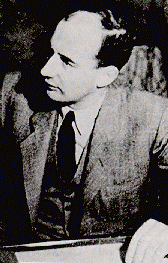 Last Known Picture of Wallenberg
 |
Wallenberg's Arrest &
Disappearance
On January 17, 1945, on his way out of the capital
with Russian escort, Wallenberg
and his driver stopped at the “Swedish
houses” to say good-bye to his friends.
To one of his colleagues, Dr. Ernö Petö,
Wallenberg said that he wasn't sure if he
was going to be the Russian's guest or their
prisoner, though he expressed hope that he'd be
back within eight days.
Raoul Wallenberg was never seen again.
Whether Wallenberg
is alive or not is uncertain. The Russians
claim that he died in Russian captivity on
July 17, 1947. A number of testimonies ,
however, indicate that he was alive after that date and that he
could have still been alive into and through the 1980's.
But, why did Wallenberg want contact with the Russians
in Debrecen? And why did the Russians
arrest him?
In November 1944, Wallenberg
had established a section in his department
that under his supervision would make a detailed
financial support plan for the surviving
Jews. The Russians did not have the same
views of Jews and, presumably,
couldn't understand that a person had devoted
his soul to save them. Therefore it was important
to Wallenberg to explain his rescue operation.
The Russians, on the other hand, probably believed
that Wallenberg had other reasons for his
rescue efforts. They probably suspected him
of being an American spy and were almost
certainly skeptical of Wallenberg's contact
with the Germans.
Wallenberg and his
driver, Vilmos Langfelder, never returned from
Debrecen. According to reliable testimonies
they were arrested and sent to Moscow. They
were arrested by the NKVD, the organization
later known as the KGB, who placed Wallenberg
and Langfelder in separate cells
in the Lubjanka prison, according to eye witnesses.
Wallenberg wasn't the only
diplomat in Budapest that aroused Soviet
suspicion. The Swiss legation had also run
extensive rescue operations for the Hungarian
Jewish population. The Russians arrested
a secretary of their legation together with
a clerk and sent them to the Soviet Union.
The Swiss succeeded, however, in getting
them extradited in exchange for Soviet citizens detained
in Switzerland.
It would take some time
before authorities in Stockholm became concerned
about Raoul Wallenberg's disappearance. In
a letter to the Swedish ambassador in Moscow,
the Russian Vice Foreign Minister Dekanosov
declared that "the Russian military
authorities had taken measures and steps
to protect Wallenberg and his belongings."
The Swedes, of course, expected
Wallenberg to be sent home soon. When
nothing happened, Raoul's mother, Maj von
Dardel, contacted the Russian ambassador
in Stockholm, Aleksandra Kollontaj, who explained to her
that she should be calm since her son was
well kept in Russia. Kollontaj also told the Swedish Foreign
Minister Christian Günther's wife that it would
be best for Wallenberg if the Swedish government
wouldn't stir things up.
On March 8, 1945, the Soviet-controlled
Hungarian radio announced that Raoul Wallenberg
had been murdered on his way to Debrecen,
probably by Hungarian Nazis or Gestapo agents.
This created a certain passiveness within the
Swedish government. Foreign Minister Östen
Undén and Sweden's ambassador in the
Soviet Union presumed that Wallenberg was
dead. In most places, however, the radio
message wasn't taken seriously.
Many people have drawn the
conclusion that Sweden had an opportunity
to negotiate for Wallenberg's release after
the war but that they missed
their chance.
Investigations into Wallenberg's Fate
From 1965 there is a speech
from Sweden's Prime Minister at the time,
Tage Erlander, which is included in a collection
of documents regarding the research around
Raoul Wallenberg. Erlander concluded that
all efforts that had been taken shortly after
the war concluded without results. In fact, the
Soviet authorities had even denied knowledge
of Wallenberg.
Between 1947 and 1951 nothing
new occurred. But, after January 1945, when foreign prisoners
started to be released from Russian jails,
many testimonies came regarding Raoul Wallenberg's
fate.
In April 1956, Prime Minister
Tage Erlander traveled with Domestic Minister
Gunnar Hedlund to Moscow where they met the
Soviet representatives Nikita Khrushchev,
Nikolai Bulganin and Vyacheslav Molotov.
These men promised to re-investigate what
had happened to Raoul Wallenberg.
On February 6, 1957, the
Russians announced that they had made extensive
investigations and found a document most
likely regarding Wallenberg. In the
hand-written document it was stated that "the
for you familiar prisoner Wallenberg passed
away this night in his cell." The document
was dated July 17, 1947, and signed Smoltsov,
head of the Lubjanka prison infirmary. The
document was addressed to Viktor Abakumov,
the minister for state security in the Soviet
Union. The Russians expressed regret
in their letter to the Swedes that Smoltsov
died in May 1953 and that Abakumov had been
executed in connection with cleansing within
the security police. The Swedes were very
distrustful toward this declaration, but
the Russians have to this day stuck to the
same statement.
Testimonies from different
prisoners who had been in Russian jails after
January 1945 tell, in contradiction to the
Russian information, that Raoul Wallenberg
was imprisoned throughout the 1950's.
In 1965, the Swedish government
published a new official report on the Wallenberg
case. An earlier white book had been released
in 1957. According to the new report, Erlander
had done everything in his power to find
out the truth about Raoul Wallenberg. Following this latest Swedish report in 1965, the Wallenberg case
went into a phase when nothing much happened.
The stream of war prisoners from the Soviet
Union decreased and the testimonies grew
weaker.
At the end of the 1970's, though, the case was
brought up yet again. According to the Swedish
foreign department, two very interesting
testimonies were the basis for a note to
Moscow requesting the case to be reexamined.
The answer from the Kremlin was the same
as earlier—Raoul Wallenberg died in
1947. On the grounds of additional material
considered reliable, Foreign Minister Ola
Ullsten sent another request in the beginning
of the 1980's regarding Wallenberg to
the Russian chief of government Aleksei Kosygin.
The reply was the same as usual — Wallenberg died in 1947.
During the 1980's, interest
in Wallenberg grew around the world. In 1981,
he became an honorary citizen of the United
States, in 1985 he received the same honor in Canada, and likewise in
Israel in 1986. In Sweden and
other countries, Raoul
Wallenberg associations worked endlessly to
find answers to what happened.
In November 2000, Alexander
Yakovlev, the head of a presidential commission
investigating Wallenberg's fate, announced
that the diplomat had been executed in 1947
in the KGB's Lubyanka Prison in Moscow. He
said Vladimir Kryuchkov, the former Soviet
secret police chief, told him of the shooting
in a private conversation. The Russians released
another statement in December admitting that
Wallenberg was wrongfully arrested on espionage
charges in 1945 and held in a Soviet prison
for 2½ years until he died. The statement
did not explain why Wallenberg was killed
or why the government lied about his death
for 55 years, claiming from 1957 to 1991
that he died of a heart attack while under
Soviet protection (Washington
Post, (December 23, 2000).
On January 12, 2001, a joint
Russian-Swedish panel released a report that
did not reach any conclusion as to Wallenberg's
fate. The Russians reverted to the claim
that he died of a heart attack in prison
in 1947, while the Swede's said they were
not sure if Wallenberg was dead or alive.
The report did unearth evidence that the
reason the Soviets arrested Wallenberg was
the suspicion that he was a spy for the United
States (Washington
Post, January 12, 2001).
Sources: c) David Metzler Raoul
Wallenberg
|