|
Located on the tip of the African continent, South
Africa is famous for its diamond and gold mines and Jews have been a part of South Africa’s
development from the very beginning. Today, South Africa's Jewish population stands at approximately 67,000 - the twelfth largest Jewish community in the world.
- Early Community
- First Half of 20th Century
- Apartheid Regime
- Post-Apartheid Regime
- Institutions
- Cape Town Community
- Johannesburg Community
- Pretoria Community
Early Jewish Community
Jews have been a part of South Africa’s
development from the very beginning. Portuguese Jewish cartographers
and scientists contributed to Vasco Da Gama’s discovery of the Cape
of Good Hope in 1497. A number of non-professing Jews were among the
first settlers of Cape Town in 1652, despite restrictions against the
immigration of non-Christians. The earliest evidence of Jews in Capetown comes from a record of the baptism of two Jewish men living in the Western Cape on Christmas day in 1669. Until the early 1800s, only a few Jews came to South Africa as a part of the Dutch East India Company, which required that all its employees and colonists be Protestant.
Religious freedom was granted by the Dutch colony in
1803 and guaranteed by the British in 1806. Among the first British
settlers to come to Cape Town were 20 Jews. The first South African
Jewish congregation was founded in 1841 when 17 men gathered to form a minyan at the home of Benjamin Norden, Helmsley Place. Eight years later, the first synagogue, Tikvat Israel
("Hope of Israel" - referring to the Cape of Good Hope) was
established in Cape Town and is still standing today. Over the next three decades, British Jewish immigrants established additional synagogues, as well as cemeteries and other philanthropic institutions.
Jewish immigrants from Germany and Holland arrived
in Cape Town in the early 19th century seeking fortune and
adventure. Some choose to join the Boers on their Great Trek into
South Africa’s hinterland and some traveled into Rhodesia (present
day Zimbabwe and Zambia). The Jews began building a commercial
infrastructure for the Boer farmers and set up trading stations in
villages and at railway sidings, which soon became local business
centers. A credit system was established by the Jews to finance new
industries. In the 1840's, Jews developed shipping, fishing and
coastal trading and sugar enterprises. Jews were also active in the
production of wine, clothing and steel.
The discovery of diamonds in 1867 in Kimberly
attracted Jewish entrepreneurs and businessman from all over the
world. Because of the extensive Jewish trade network, Jews
immediately became involved in the diamond and precious stones
industry, many moving north from Cape Town to Johannesburg. Two famous Jewish South African entrepreneurs were Barney
Barnato and Sammy Marks. Barnato founded the De Beers Consolidated
Mines for mining diamond fields. In 1897, Barnato mysteriously died
while sailing to England.
Marks became involved in diamond trading and
mining and, after amassing a huge fortune, he focused his attention
on the Witwatersrand gold fields. Next, Marks became an industrialist
and developed Transvaal; he planted fruit farms and forests,
manufactured bricks, glass, steel and leather goods, exploited
Transvaal’s coal and established the South African Breweries. He
also founded the town of Veeringing, along Transvaal’s border.
Marks openly practiced Judaism and served as a mediator between the British and the Boers during the
Boer-British Wars. Eventually Marks served as senator for the first
Parliament in South Africa.
The movement of Jews to Johannesburg caused Cape Town's Jewish community to shrink to only a few hundred families, who mostly assimilated and intermarried. However, between 1880 and 1910, the Jewish population swelled
from 4,000 to 40,000 with Yiddish speaking immigrants from Lithuania, thus revitalizing the Jewish community of Cape Town. The new arrivals were fleeing political persecution and pogroms in Europe. South Africa became known as a Lithuanian colony. Many of the
Eastern European immigrants discarded their old garb and mores and
adopted new Anglo-Jewish customs. While many started out as peddlers, they eventually became shopkeepers.
These new immigrants infused South Africa with a
love of Israel and a strong Zionist connection. They were
instrumental in the creation of the South African Zionist Federation
in 1898, responsible for coordinating all the Zionist activities
throughout the country.
First Half of the 20th Century
During the Boer War, Jews served on both sides, although
the arrival of English Jews helped out the British side. Some Boers
harbored prejudices against the Jews, while others felt a kinship toward
them. In 1902, the British defeated the Boers and, in 1910, they formed
four British South African colonies. The British gave the Jews equal
status to the other white citizens, giving British authority legitimacy
among Jews.
Barney Barnato
 |
Following the mining boom, Jews became part of the
rapid industrialization of South Africa. They became involved in food
processing; clothing, textile and furniture manufacturing; insurance;
hotel management; advertising and entertainment. Jews also
established supermarkets, department stores and discount store
chains.
The Jewish community of Cape Town formed its own
community organization, the Cape Jewish Board of Deputies, and, a
year later, a similar board was created for the Transvaal and Natal
regions. In 1912, the two boards merged and became the South African
Jewish Board of Deputies (SAJBD). Today the SAJBD represents nearly
all of the Jewish community institutions and synagogues,
works as a watchdog against anti-Semitic articles in the media, examines legislation concerning the Jewish
community and maintains contact with diaspora communities world-wide,
as well other political and religious organizations in South Africa.
In 1903, attempts were made to restrict
immigration; a strong Jewish lobby was able to influence legislation
and Eastern European Jews were allowed to enter the country. Between
1920 and 1930, 20,000 Jewish immigrants arrived in South Africa.
In 1930, increased feelings of anti-Semitism and the rise of Nazism in Germany sparked the passing of the Quota Act, which restricted immigration from Greece, Latvia, Lithuania, Poland, Russia, and Palestine. While not expressly stated, the aim of the Quota Act was to restrict Jewish immigration. Still, the quota excluded Jews from Germany and, by 1936,
another 6,000 Jews fleeing Nazi
Germany came to South Africa. The new German immigrants were
integral in starting the Reform movement in South Africa, which was
formally instituted by an American-born rabbi in 1933.
As Nazism further influenced militant and
nationalistic Afrikaners, anti-Semitic organizations began to form. Another anti-immigration law, The Aliens Act, was
passed in 1937, closing the doors to Jewish immigrants fleeing Nazi Germany.
Further fear developed after the anti-Jewish National Party came to
power in 1948.
Apartheid Regime
With the institutionalization
of apartheid agenda, anti-Semitism was no longer a major issue. Many Jewish South Africans, both individuals
and organizations, helped support the anti-apartheid movement. Most
Jews, in fact, had actually voted against the apartheid National Party,
casting their votes for either the Progressive Party or the United Party.
One organization, the Union of Jewish Women, sought to alleviate the
suffering of blacks through charitable projects and self-help schemes.
Fourteen of the 23 whites involved in the 1956 Treason Trial were Jewish and all five whites of the seventeen members of the African National Congress who were arrested for anti-apartheid activities in 1963 were Jewish. Still, the Jewish Board of Deputies refused to take a stand against apartheid until 1985, arguing that it was not a Jewish one. The rabbinate also avoided taking a stance on the issue until the late 1980's.
One of the great leaders of the anti-Apartheid movement,
Nelson Mandela, wrote this about Jews in South Africas: “I have
found Jews to be more broadminded than most whites on issues of race
and politics, perhaps because they themselves have historically been
victims of prejudice." Mandela's defence attorney, Isie Maisels, was Jewish.
Jewish university students, in particular, vehemently
opposed the apartheid movement. Jews, in fact, were largely represented
in the percentage of white citizens who were arrested for anti-apartheid
protests. A large proportion of Jews were also involved in organizations
such as The Springbrook Legion, The Torch Commando, and the Black Sash.
These anti-apartheid organizations led protests that were both active
(ie. marching through the streets with torches) and passive (ie. standing
silently in black). Other Jews sought to teach, train, and include black
citizens in South African society. Ian Bernhardt lived in Johannesburg
and led the Union of South African Artists in which he helped teach
and protect black artists. Jews could be found in the majority of anti-apartheid
organizations and protests throughout the apartheid regime.
Israel maintained diplomatic relations with South Africa
throughout the period, as did most Arab countries, Taiwan, Belgium,
and Britain. Despite the arms embargo, these countries sold arms to
South Africa during the apartheid era. There have even been reports
of nuclear cooperation. Various Israeli leaders publicly condemned the
apartheid system. During the early 1960's, Israel aligned with other
African countries against the apartheid system, straining its relationship
with South Africa. After the Six-Day War in 1967, most African countries broke diplomatic
ties with Israel, except for South Africa, and this led to increased
relations between the two.
Violence in South Africa during the 1970's led to an
exodus of many white citizens, including Jews, who were fearful of their
future in the country. Many children were sent to live and study abroad
and remained in their host countries.
Two Jewish organizations were formed in 1985: Jews
for Justice (in Cape Town) and Jews for Social Justice (in Johannesburg)
tried to reform South African society and build bridges between the
white and black communities. Also in 1985, the South African Jewish
Board passed a resolution rejecting apartheid.
Jews prospered during the apartheid era, as did many
non-Jewish white citizens. The Jewish population, however, contained
a higher than usual percentage of college graduates. More than 50 percent
of the Jews were matriculated, compared to the average 23% in the total
white population. Ten percent of the Jewish community had university
degrees, compared to only 4% of the total white population. Jews were
disproportionately represented in the commercial and financial sectors
of society. The Jewish population peaked in the early 1970's reaching
nearly 119,000 people.
Between 1970 and 1992, more than 39,000 Jews left
South Africa, during this same period approximately 10,000 Israelis
moved into the country.
Post-Apartheid Regime
The Jewish community welcomed President De Klerk’s
rise to power in 1990 and his decision to dismantle apartheid. Jews
stood firmly behind the negotiation process and the first democratic
election in 1994. The country’s new Bill of Rights gave complete
freedom of religion. While supportive of the new regime, many Jews
worry about the future of the Jewish community in South Africa.
Concerns included the freedom to practice a full Jewish life
individually and collectively, the right to pursue Zionist activities
and the continuation of relations between South Africa and Israel.
In 1995, the Truth and Reconciliation Commission
was established to investigate crimes committed under apartheid. The
first Jewish organization to contribute to the Commission was Gesher,
a Jewish social action group based in Johannesburg. In the commission’s
first report, religious communities (including the Jewish community)
were censured for their lack of action against the apartheid regime.
Individual and group efforts made by the Jews to fight for justice
were noted in the report.
A visit by former South African President Nelson Mandela
to Israel in October 1999 marked a process of reconciliation between
the two. Because of Israel’s relations with the apartheid regime,
Mandela had been critical of Israel in the past. Israelis had also been
critical of Mandela because of his relationship with Yasser
Arafat and support for the Palestinians.
Prior to the second half of 2003, the Jewish community in South Africa were in a state of
transition. Approximately 1,800 Jews left the country every year, primarily
due to concerns about crime and the economy. South Africa had the highest
violent crime rate in the world, about ten times that of the United
States; residences in the middle of cities were often surrounded by electrified
ten-foot-high walls topped with barbed wire. The prevalence of crime,
and the consequent economic woes, led to the depletion of the Jewish
"viable middle," the young and middle aged adults who are
needed to sustain the community. Many members of the disproportionately
aged population, whose children have left, face problems as they grow
ill, as government welfare subsidies have decreased sharply.
Despite the economic and demographic woes, however,
the South African communities remained mostly optimistic. The Jewish population
is very religious, 80 percent Orthodox and rising. This increase in religiosity
has been attributed to a desire for stability in an otherwise unstable
society. Anti-Semitism is negligible, and the intermarriage rate is
only 7 percent. Many of the Jews who remain in the country do so out of the
conviction that post-apartheid South Africa needs their support, and
will soon pay social and economic dividends; of course, the rest of
those who remain do so simply because they cannot afford to leave.
Since the latter half of 2003, South Africa's community of 75,000-80,000 Jews has largely stabilized.
South Africa's relations with Israel have been touchy in large part because of anger over Israel's involvement with the old regime, and because the African National Congress that has held power since the end of apartheid, had close ties to the PLO and sympathized with the Palestinian cause. More recently, South African officials have also supported the anti-Semitic boycott, divestment and sanctions (BDS) movement aimed at isolating Israel. One of those officials, Minister of Higher Education and Training Blade Nzimande, was denied a visa in April 2015 because of his support for BDS and his intention to meet only with Palestinian officials and snub the Israelis.
Leaders of the South African Jewish community heaped heavy criticism on officials from the African National Congress, the South African Communist Party, and the Cosatu trade union federation for holding meetings with Hamas officials during the third week of October, 2015. Hamas leader Khaled Meshal made his ever first visit to South Africa for these meetings, also marking the first visit between the head of Hamas's political bureau and the leader of a non-Muslim country. Israel Foreign Ministry spokespeople referred to the meetings as an “unfriendly act,” and stated that they were “furious and shocked” by Meshal's visit. The African National Congress released a statement detailing that the meetings will pertain to, “a joint vision of self-determination for the Palestinian people and an independent state, free of Israeli occupation.”
On March 11, 2016, Dore Gold, Director-General of the Israel Foreign Ministry, became the first high-ranking Israeli diplomat to visit South Africa in a decade. Gold met with South African officials, visited universities, toured the home of Nelson Mandela, and met with local religious officials during his 3-day visit. Speaking about improving relations between the countries after the trip, Gold stated that “there is potential. Now, everything is in the follow-up.” In an interview with the Jerusalem Post published on March 26, 2016, South African Ambassador to Israel Sisa Ngombane stated that “We are all serious about moving things forward.”
Institutions
South Africa’s Jewish population is mainly found
in five urban centers: Johannesburg, Cape Town, Pretoria, Durban and
Port Elisabeth. The Jewish community of South Africa is run by a
number of institutions. The South African Jewish Board of Deputies
takes care of political matters. The United Communal Fund-Israel
United Appeal (IUA-UCF), is that major fundraising body. The Union of
Orthodox Synagogues (UOS) serves as the umbrella body for all of the Orthodox synagogues across the country, maintains the office of the Chief
Rabbi, the Johannesburg and the Cape Town Bet Dins. Another
coordinating body is the South African Union for Progressive Judaism,
which organizes events for the Reform congregations of South Africa. The Jewish educational system is run
by the South African Board of Jewish Education (SABJE). Over 80 percent of Jewish children are enrolled in the Jewish day school system. The South African Zionist Federation serves as the umbrella organization to all South African Zionist organizations.
South Africa was home to many famous Jewish
personalities. Henry Gluckman served as the only Jewish cabinet
member in 1945. Harry Schwartz was South Africa’s first Jewish
ambassador to the U.S. Helen Suzman was the only women in Parliament
for many years and also the sole representative of the liberal
Progressive Party and a vigorous opponent of apartheid.
Cape Town Community
Jews have lived in Cape Town since its creation
and the population has grown from about 20 Jews in 1820 to more than
17,000 members today (down from a high of 25,000 in the 1980's), constituting more than 25 percent of the Jewish community in South Africa. In 1841, the Cape Town Hebrew Congregation was
founded a week after 17 Jewish males conducted the first Orthodox Service
in South Africa. The first services were held on September 26, 1841, at a private home, Helmsley Place,
which today forms part of the Mount Nelson Hotel complex. Eight years
later, the first Synagogue was established next to Parliament and Reverend
Isaac Pulver was the first Spiritual Leader. By 1863, the Congregation
had grown to the point where a new building was needed, it was constructed
on what is today the Jewish Museum complex. In 1905, a still larger
building was required and the present Great Synagogue (Gardens Shul)
was constructed alongside the Old Shul. Cape Town had its first Jewish
Mayor that year, who was also the president of the Congregation —
Hyman Liberman. The Rev Alfred Bender had arrived to lead the Shul in
1895, and served as their Rabbi for 42 years.
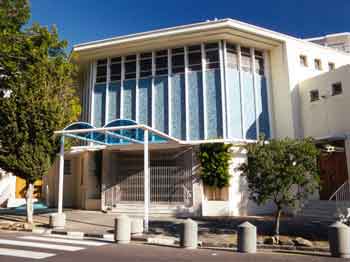 Green and Sea Point Hebrew Congregation,
Cape Town
Green and Sea Point Hebrew Congregation,
Cape Town
|
The Cape Town Jewish community is fairly homogenous. Approximately 80 percent of the Jewish community is of Lithuanian descent. The same percentage is Orthodox, while the other 20 percent are Reform. There are 12 Orthodox synagogues
in Cape Town and two Reform synagogues. The Great Synagogue, Gardens Shul, or Cape Town Hebrew Congregation, which was consecrated in 1905, is the oldest active congregation in South Africa and is located just to the right of the first synagogue and now, the Jewish museum. The Gardens Shul is an “Egyptian-revival-style house of worship” that currently seats over 1,400. In addition to the Great Shul, other Orthodox synagogues include the Green and Sea Point Hebrew Congregation, which has more than 2,000 members, and is the largest synagogue in all of Africa, and the Claremont synagogue. There are also a couple small Lubavitch and Sephardic synagogues. While the majority of Cape Town Jews belong to Orthodox synagogues, most are not strictly observant.
Nearly 80 percent of Cape Town’s Jewish children are enrolled in Jewish day schools, which run from primary school to high school. Cape Town has the Herzlia school, catering to grades first through 12th and three other primary day schools; most of which are Orthodox.
The Holocaust and Zionism are central to South African Jewish identity. The community successfully lobbied the government to require Holocaust education in all public schools and recently built the Cape Town Holocaust Centre, the only Holocaust institution in Africa. A siren was sounded from the Jewish community center on Holocaust Remembrance day last year and was broadcast throughout the country. Even the parliament observed a moment of silence. Jews express their Zionism through philanthropy. The Cape Town Jewish community donates more to Israel per capita than any other Jewish community in the world.
While the majority of the Cape Town population disapproves of Zionism, this generally does not affect attitudes towards Jews. In fact, many Jews have strong relationships with the local government. Prominent political figures often appear at Jewish events, despite their criticism of Israel.
 The
Cape Town Jewish community is not completely immune to violence and anti-Semitism. In 1997 gasoline
bombs were thrown at the home of community members and, in December
1999, a bomb was thrown at one of Cape Town’s synagogues. Fortunately
no one was injured in either attack. The
Cape Town Jewish community is not completely immune to violence and anti-Semitism. In 1997 gasoline
bombs were thrown at the home of community members and, in December
1999, a bomb was thrown at one of Cape Town’s synagogues. Fortunately
no one was injured in either attack.
* The Jewish Museum: Located in Cape Town’s oldest
synagogue, Tikvat Israel; the Museum contains a collection of ceremonial
objects belonging to the original community members.
* The Mendelsohn Library: Located in South Africa’s
Parliament’s Library, the library consists of the private
collections, books and artwork, of Sidney Mendelsohn, an English born
Jew.
* Lieberman Doors: Hyman Lieberman was Cape Town’s
first Jewish mayor. He donated these doors depicting biblical scenes
to the African National Gallery. The Gallery also houses the private
collection of de Pass family, another well-known South African Jewish
family.
* Max Michaelis Art Gallery
* Helmsley Hotel: Site of the home of Benjamin
Norden, which housed South Africa’s first Jewish congregation
in1841.
*Kaplan Center: Located in the University of Cape
Town, the Center has a collection of photographs of South African
Jewish history.
*
Cape Town Holocaust Center: It is the only Holocaust Center established
in Africa and works to combat anti-Semitism, as well as all other forms
of discrimination and prejudice. The museum compares early Nazi Germany to the apartheid government and explains the Holocaust through the framework of racial injustice.
*Gitlin Library: Housed in the Holocaust Center, the Gitlin Library holds 20,000 Jewish-themed Hebrew, Yiddish, and English books and periodicals, photographs, DVD's, CD's, videos and cassettes.
* Zaandwijk Winery, located right outside Cape
Town, is the only kosher winery in South Africa.
Johannesburg Community
Nine year’s after its establishment in 1886,
6,000 Jews lived in Johannesburg. Jewish immigrants hailed from
Britain, Germany and Eastern European Jews, mainly from the Baltics
and Russia. Many came in search of wealth in the gold fields. Both
the Witwatersrand Goldfields Jewish Association and the
Witerwatersrand Old Hebrew Congregation were founded in 1887. The
former bought two plots of land for the first synagogue in Transvaal,
which later became known as the President Streets Synagogue.
Mendelssohn served as its first president, as well as its chairman
during various periods.
Four years later, President Paul Kruger of South
Africa dedicated the Park Synagogue to the Johannesburg Hebrew
Congregation. Another synagogue, the Great Synagogue, opened in 1914;
the Great Synagogue is modeled after Istanbul’s Hagia Sophia
mosque. Johannesburg’s other major synagogue, the Mooi Street
Synagogue, founded by Lithuanian immigrants, has recently been
declared a national landmark.
During the late 1800's and early 1990's, many of
Johannesburg’s Jewish institutions were created. Charitable
organizations, such as the Hevra Kadisha (burial society), a Jewish
soup kitchen, Jewish Ambulance Corps, Bikkur Holim Society and a
Jewish Ladies Benevolent Society, were formed to take care of the new
immigrants and the poor members of the community.
A Jewish Hospital was built in 1896 to administer
to Orthodox Jews who insisted on kosher food and who felt more comfortable with Jewish doctors and nurses.
Eventually the Jewish Hospital became part of the Johannesburg
General Hospital and, today, it still offers kosher meals.
 Social
clubs were also founded in this period, including a Jewish Dramatic
Society and the Jewish Guild. Johannesburg’s first Jewish school
opened in 1890 and served as a forerunner to the National Jewish Day
School movement. Jewish education transformed over the years and is
rarely carried out by the traditional cheders (one-room classes). Social
clubs were also founded in this period, including a Jewish Dramatic
Society and the Jewish Guild. Johannesburg’s first Jewish school
opened in 1890 and served as a forerunner to the National Jewish Day
School movement. Jewish education transformed over the years and is
rarely carried out by the traditional cheders (one-room classes).
Johannesburg is home to many Jewish institutions
and organizations, including the Jewish Board of Deputies, a Jewish
library and a Jewish museum, which contains African-sculpted stones mezuzas,
two Torahs from Maputo (found in Mozambique)
and other interesting memorabilia from the South African Jewish
community.
During South Africa's dark apartheid period, a building boom crowded the city with cheap shoddy apartments and poor black people from the suburbs looking for work. These individuals were exploited by landlords and eventually grew frustrated and began to settle illegally in the more affluent areas of the city, causing an urban decline and an exodus of the European immigrants who had settled in the area during the 1960's and 70's. This exodus included most of inner city Johannesburg's Jewish population and forced many of the historic synagogues to shut their doors or move to a different location near where their congregants were moving. The Great Synagogue in downtown has moved four miles from it's original location and shut down in 1994. It now serves as a Church, but there are still remnants of the Jewish structure including a Star of David on top of the building's dome and a message etched in stone on a building across the street that reads "Hebrew High School". Temple Israel in the Hillbrow neighborhood and the Lion's Shul in Doornfontein still open their doors for prayers on a weekly basis, although they do not get nearly as many congregants as they used to and are low on funds. Temple Israel cannot afford to employ a Rabbi full time and it is in an inconvenient location for most of their worshippers, as they stayed in the city and did not move their synagogue after the white exodus in the 1980's and 90's. The Doornfontein synagogue also known as the Lion's Shul is the oldest still functioning synagogue in Johannesburg. Completed in 1905, the synagogue recieved it's informal name from the two lion statues at the front entrance. Currently the synagogue is run by Rabbi Ilan Herman and none of the congregants live in the surrounding neighborhood. Even Orthodox members of Herman's congregation drive to the synagogue for Shabbat services.
In the suburbs of Johannesburg, one can find the
Johannesburg Bet Din and the Etz Chayim Synagogue, which houses a
Holocaust memorial.
Another Holocaust-related site is a sculpture
found at the entrance to the Westpark Cemetery. Created by artist
Herman Wald, it features thee hands, each holding a shofar and the
three shofars spiral inwards.
Today, Johannesburg has a Jewish population of approximately
50,000 people, the largest in all of South Africa.
Pretoria Community
Pretoria has a small Jewish population, numbering
about 3,000 people. Jews have lived in Pretoria since the founding of
the city in 1867 and have played a major role in its industrial and
commercial development. De Vries, the first Jewish settler in
Pretoria, became a prominent member of the city; he became state
prosecutor, member of the Volksraad and was a pioneer of the
Afrikaans language. Other Jewish settlers from Lithuania were not as
educated as de Vries; many only spoke Yiddish and opened small shops.
The Jews of Pretoria tried to remain neutral during the Anglo-Boer
wars, although some volunteered for the ZAR forces.
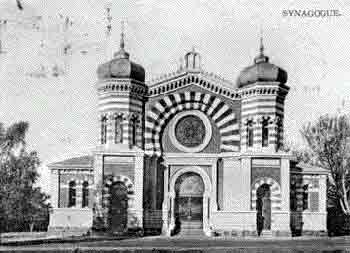 Paul Kruger Street Synagogue
 |
The Pretoria Hebrew community was founded between 1890
and 1895. The community’s first synagogue was inaugurated in 1898
on Paul Kruger Street and a second synagogue, the Great Synagogue, was
opened in 1922. Neither the old (Paul Kruger Street), nor the new (Great
Synagogue) are still in use. A Reform synagogue, Temple Menorah, opened in the early 1950's.
In 1952, the Paul Kruger synagogue was expropriated
by the government for the purpose of erecting a new Supreme Court, which
was used for security-related cases, the activities of the black opposition
movements and socialist/communist alliances. From August 1, 1958, to
March 29, 1961, the treason trial of Nelson Mandela, Walter Sisulu and
26 others was held at the Old Synagogue. On March 29, 1961, all the
accused were acquitted. From October 22 to November 7, 1962, Mandela
was again on trial in the Old Synagogue. On November 7, Mandela was
sentenced to a total of five years in prison with hard labor, three
years for incitement to strike and two for leaving the country without
travel documents. In 1963, while serving the sentence handed down in
the Old Synagogue, Mandela appeared at the Rivonia Trial. From November
14 to December 2, 1977, the inquest into the death of Steve Biko was
held in the Old Synagogue."
 Sammy Marks Museum
 |
The Miriam Marks school, established in 1905 and the
Carmel School, opened in 1959, are the two main Jewish educational institutions
in Pretoria. The Carmel School is the only one still open; the school
also serves as the only functioning synagogue. Currently, the reform
congregation shares its rabbi with Johannesburg and the synagogue is
also no longer in use; today services are held in the homes of community
members.
The Pretoria Jewish community was at its height
during the early 19th century. There were many Jewish
sporting clubs, charitable organizations and youth groups. However,
after 1948, many Jews left Pretoria for Cape Town and Johannesburg.
There are some interesting Jewish sites in Pretoria,
including the "Barnato Lions" - marble lions donated by Sammy
Marks to Paul Kruger and the home of Sammy Marks, which is currently
a museum.
Community Contacts
Cape Town:
Green and Sea Point Hebrew Congregation (Marais Road Shul)
011-27-21-439-7543
www.maraisroadshul.com
Cape Town Hebrew Congregation (Gardens Shul)
21-465-1405
www.gardensshul.org
Chabad of Cape Town
21-434-3740
www.chabad.co.za
South African Jewish Board of Deputies
21-646-4940
Union of Orthodox Synagogues
21-640-7528
South African Zionist Federation
21-464-6700
Cape Town Holocaust Centre
21-462-5553
www.ctholocaust.co.za
South African Jewish Museum
88 Hartfield Street
21-465-1546
www.sajewishmuseum.co.za
Gitlin Library
21-462-5088
Cafe Riteve
21-465-1594
Kosher Wineries:
Eshkol Winery
21-864-3356
Zandwijk Wine Farm
21-863-2368
www.kleinedraken.co.za
Sea Point:
Avron's Place
19-33 Regents Road
21-439-7610
Goldie's Deli
174 Main Road
21-434-1116
Kosher Deli in Checkers Grocery Store
St. Andrew's Road
21-430-4680
Sources: Lazaroff, Tovah. “Diplomacy: South Africa’s softening stance toward Jerusalem,” Jerusalem Post (March 26, 2016);
Ahren, Raphael. “Dore Gold: South Africa ‘ready to hear’ Israel’s arguments,” Times of Israel, (March 14, 2016);
“South Africa’s Jews Blast Ruling Party for Meeting With Hamas’ Meshal,” Haaretz, (October 20, 2015)
Ravid, Barak, “Israel refuses visa to South African cabinet minister en route to Palestinian Authority”. Haaretz, (April 24, 2015);
Lenora Brown, Ryan. "The End of Jew-hannesburg?". Forward, (December 5 2014);
Rosenberg, Rebecca Faye. "The Jewish Traveler: Cape Town." Hadassah Magazine (January 2007, p. 46-52);
“Anti-Semitic attacks erupt
in Cape Town." World
Report. Jewish Bulletin of Northern California (July
18, 1997);
Beker, Dr. Avi. (ed.) Jewish
Communities of the World. Lerner Publication Co. 1998;
Cape
Town Holocaust Centre;
"Cape Town" Travel
and Tourism to South Africa;
Clasquin, Michel. ‘I am not aware of anti-Semitism in Pretoria:
The Jewish experience of an Afrikaner city." Judaism
in Pretoria. (June 1998);
"The Jewish Community in Cape Town, South Africa." The
Database of Jewish Communities. Museum of the Jewish People;
"Mandela’s visit to Israel viewed as reconciliation." The
Dallas Morning News (October 15, 1999);
Ostroff, Maurice. "...South African Jews in the Apartheid Era""Post-Apartheid crime frightens South Africa’s Jews." Jewish Bulletin of
Northern California (Nov 27, 1998);
"Staying Put: South Africa's Remaining Jews Adapt to the New Reality."
The B'nai B'rith International Jewish Monthly. Summer 2001;
The
South African Jewish Board of Deputies;
"Survey: South African Jews divide their identities." Jewish
Bulletin of Northern California (September 10, 1999);
"Synagogue bombing unnerves South African Jews." World
Report. Jewish
Bulletin of Northern California. (January 1, 1999);
Tigay, Alan M. (ed.). The
Jewish Traveler. Jason Aronson, Inc. 1994;
Zaidner, Michael (ed.). Jewish
Travel Guide 2000. Vallentine Mitchell& Co. 2000;
Cape Town Hebrew
Congregation;
The Stephen Roth Institute for the Study of Contemporary
Anti-Semitism and Racism, Annual Report 2005, South Africa;
Photo Credits: Barnato photo courtesy of South
African War Virtual Library - Boer War. Sammy Marks Museum photo
courtesy Heléne Cilliers from the Pretoria
Onlinesite. Paul Kruger Synagogue courtesy of Judaica
Philatelic Resources. All other photos copyright Jono David. Reprinted
with permission. All rights reserved. HaChayim
HaYehudim Jewish Photo Library (Jono
David Media)
|