|
[By: Rebecca Weiner]
Jews have lived in Hungary since the time of the Roman Empire, even before the Magyar (Hungarian) tribes arrived and conquered the land in the 9th century. Today, the Jewish population of Hungary is approximately 48,200 people, the sixth largest Jewish community in Europe.
- Middle Ages to Ottoman Empire
- Ottoman & Hapsburg Empires
- 19th Century-World War I
- Inter-war Period (1919-1939)
- The Holocaust
- Post-World War II Hungary
- Communist Rule
- Hungary Today
Middle
Ages to the Ottoman Empire
Jews have lived in Hungary since the time of the Roman Empire, even before the Magyar (Hungarian)
tribes arrived and conquered the land in the 9th century. The Jewish
community grew in the second half of the 11th century due to large
numbers of immigrants from Germany, Bohemia and Moravia. Jews settled
in the towns of Buda,
Esztergom, Sopron, Tata and Old Buda.
Restrictions were placed on Jews by Christian clergy and institutions.
In 1092, the Church forbade Jews from intermarrying Christians, working
on Sundays and Christian holidays and purchasing slaves. Despite the
prohibitions placed on Jews by the church, Hungary served as a haven
for Jews. At the end of the 11th century, King Koloman protected Jews
living in his territory, in return for direct taxes to his treasury.
Memorial Jewish stone from Roman Empire
era
 |
During the 12th century, Jews held leadership positions in the economic
institutions in Hungary. In 1251, King Bela IV gave Jews legal rights
and welcomed Jewish immigration. Support for Jews by the King was
counteracted by anti-Jewish laws from the church and the nobility.
Their advancement was hindered by the nobles who proposed the "Golden
Bull" article of 1222, prohibiting Jews from holding particular
offices and receiving the title of nobility. By 1279, Jews were prohibited
from leasing land and were forced to wear badges. Many of these anti-Jewish
measures were not carried out because of the King's objections.
The church's influence grew during the reign of Louis
the Great (1342-82). In 1349, Jews were expelled from Hungary due
to the Black Death. Their expulsion was decreed officially in 1360,
though by 1364, they were allowed to return. In 1365, the office of
"judge of the Jews" was instituted and had to deal with
affairs of Jewish property and taxes, representation in the government
and protection of rights. It was also in the late 1300's that Jews
settled in Gyor, a city in northwest Hungary near the Austrian border.
The situation improved for the Jews during the reign
of Matthias Corvinus (1458-90). Also during the 15th century, Jewish
immigrants began settling in large numbers in the city of Buda. The
economic and political situation deteriorated, however, in the late
15th and 16th century. In 1494, a blood
libel broke out in Tyrnau and 16 Jews were burned at the stake.
Other riots followed in Pressburg, Buda and other towns.
King Ladislas VI (1490-1516) canceled all debts owed to Jews. During
the reign of Louis II, (1516-26), anti-Jewish feelings grew.
Ottoman & Hapsburg
Empires
The Ottoman's first conquest of Buda took place in
1526; many Jews joined the Turks in the retreat into the Ottoman
Empire. This led to the dispersion of Hungarian Jews in the Balkan
region.
In 1541, central Hungary became part of the Ottoman
Empire. The Jews were treated well under the Ottoman regime. Immigration
to Buda increased with an influx of refugees and Sephardim from Asia
Minor and Buda became one of the most important Jewish communities
in the Ottoman Empire. Jews were allowed to practice their religion
and participate in commerce. One of the cities where Jews settled
in the 16th century was Kecskemet in central Hungary.
In the late 17th century, the Hapsburgs captured
Hungary and anti-Semitism grew,
along with expulsions of Jews from the cities. Despite the anti-Jewish
feelings, migration from Poland and Moravia to Hungary continued and,
in 1735, about 11,600 Jews lived in Hungary.
The situation for Jews worsened during the reign
of Maria Theresa (1740-80). Jews were forced to pay "toleration
taxes" and were subject to persecution.
The reign of Joseph II alleviated the harsh conditions
and Jews were allowed to settle in the royal cities. By 1787, 81,000
Jews lived in Hungary. Jews were grants increased civil rights in
1830's and 1840's. Jews were officially permitted to settle in Debrecen,
Hungary's third largest city (located about 120 miles east of Budapest),
in 1840.
In 1849, many Jews participated in a failed revolution,
however, and judicial and economic restrictions were subsequently
placed on the Jews during the 1850's. These restrictions were finally
lifted in the 1860's; Jews were allowed to settle in any community
and participated in all aspects of commerce. In December 1867, Jews
were granted full emancipation. Jews began to play a vital role in
agriculture, transport, communication industries, business, finance
and the arts. The Jewish population continued to increase from 340,00
in 1850 to 542,000 in 1869.
19th Century Life, Emancipation (1867-1914), & World War I
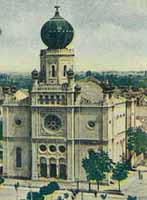
The synagogue in Debrecen was built
between 1895-97 and destroyed by fire in 1948.
 |
A trend to a strict Orthodox approach to Judaism, supported
by Moses Sofer of Pressburg, marked the early 19th century. His leadership
helped make Pressburg a spiritual center for orthodox Jews, which
had many important yeshivas. He promoted the study of Torah,
leading to the growth of yeshivas around the country. The Hungarian
Rabbinate was important at the time and produced many religious works. Hasidism also
spread to northeast Hungary and was introduced by Isaac Taub.
The Haskalah,
Jewish enlightenment, came to Hungary in the 1830's, along with the Reform Movement, both of which countered
the Orthodox trends.
The late 19th century, 1869-70, was marked by a
religious schism in the Jewish community. There were three main divisions:
Orthodox, Neolog (Reform/Conservative) and Status Quo Ante (communities
associated with neither of those two movements). Assimilation became
widespread among Hungarian Jewry; many young adults began intermarrying.
Zionism was also
prevalent in Hungary since the period of Sofer. Sofer recommended
that his disciples move to Israel and they became part of the Ashkenazi
yishuv movement. The most famous Zionist, Theodor
Herzl, was born in Budapest and lived in Hungary during his youth.
In this period, Jews became prominent in the political,
economic, and cultural spheres in Hungary. In the 1880's Jews were
active in the liberal professions and in journalism. In 1895, the
Jewish religion was officially recognized by the state and given the
same rights as Protestant and Catholics religions.
Despite the economic growth and religious empowerment,
Jews faced political anti-Semitism in this period. In the 1870's and
1880's, anti-Jewish propaganda increased and a blood libel occurred
in Tiszaeslar in 1882.
The population reached 910,000 by 1910. Jewish merchants
consisted of 55-60% of all merchants in Hungary at the time of World
War I. About 10,000 Jews lost their lives on the battlefield in World
War I.
Inter-War
period: 1919-1939
The Austro-Hungarian Empire was dissolved after
its defeat in World War. I. The communist regime gained power and
many Jews were active in the upper echelon of the government run by
Bela Kun, a Jew. In 1919, the brief Hungary-Soviet Republic ended
and was followed by a series of riots and violence against the Jews
known as the "White Terror"; more than 3,000 Jews died in
the massacres.
By 1920 the political situation stabilized and violence
abated. Anti-Jewish sentiments did not wane. Numerous anti-Jewish
laws were passed; the enrollment of Jews in higher institutions was
reduced to five percent. Zionist activities were stopped for the first couple of years after the war
but they were allowed to resume in 1927.
Anti-Jewish legislation continued in the 1930's.
In 1938, the first "Jewish Law" was passed, restricting
the number of Jews in liberal professions, administration, and commerce
to twenty percent. A second Jewish Law was passed in 1939 that further
reduced the economic participation to five percent. Due to these laws,
250,000 Hungarian Jews lost their source of income. Many converted
to Christianity, with the number reaching 5,000 converts after the
passing of the first anti-Jewish law in 1938
To combat the loss of work and poverty, the Jewish
community organization of Budapest developed a social aid program
to assist those in need. More than half of Hungary's Jewish population
had moved to Greater Budapest during the inter-war period.
The
Holocaust
Hungary joined with the Axis powers (Germany, Austria,
and Italy) and thus annexed parts of Slovakia, Transylvania, Yugoslavia
and Sub-Carpathian Ruthenia; most of these areas belonged to Hungary,
before World War I. By mid-1941, the annexation increased "Great
Hungary's" Jewish population to 800,000.
A "Third Jewish Law" was passed prohibiting
intermarriage and changing the definition of Jew to a racial definition.
Many Christians thus became "Jews" and the estimated number
of "Jews" may have actually been 850,000 in mid-1941.
The first massacre of Hungarian Jews took place
in July 1941 when 20,000 Hungarian Jews were expelled from the Galicia
region, in Kamentes-Podolski, where the SS and Hungarian troops killed
them in the autumn of 1941. Another massacre of 1,000 Jews took place
in January 1942, in Bacska region. A third set of Jews, about 50,000,
died on the battlefield against the Soviets.
Also in 1942, Hungary's Prime Minister, Miklos Kallay,
ordered that Jewish property be expropriated and he restricted the
economic and cultural life of Jews. He proposed a "final solution
of the Jewish question," calling for the resettlement of 800,000
Jews. The Arrow Cross party in Hungary was also responsible for anti-Jewish
rhetoric, as well as for persecution.
By 1943, Jews were no longer involved in Hungary's
public and cultural life; however, the Kallay government began holding
secret talks with the allies and toned down its anti-Jewish rhetoric.
Germany occupied Hungary in March 1944 because Kallay
did not deport the Jews, which was seen as cooperation with the allies.
By the time of the German occupation, 63,000 Hungarian Jews had been
killed.
In April 1944, Adolph
Eichmann ordered the removal of 400,000 Jews from the provincial
towns, cities and villages around Hungary to ghettos.
Deportation to Auschwitz began
in May 1944. All communities besides those in Budapest were put in
ghettos or concentration camps.
In June, the first group of deportees (about 7,000
of the city's 12,000 Jews) from Debrecen were sent to Austria and
about one-half of these survived the war. Most of the other
Jews were deported to Auschwitz.
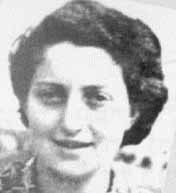
Hannah Senesh, parachutist
sent
to rescue Hungarian Jews |
About 2,000-2,500 Jews were able to escape to Romania
during the ghettoization period. Others escaped to Budapest. Relief
efforts were sponsored by the Zionists,
who helped Jews with fake passports, food, clothing and places to
hide. The Haganah was actively
involved in trying to save Hungarian Jewry. Two famous paratroopers
that attempted to save lives included Hannah
Senesh and Perez Goldstein.
Another 1,658 Jews were bought and were delivered
to Switzerland for $1,000 a person. The fate of the Hungarian Jews
was published in the Swiss press and in other neutral countries, leading
to a suspension of deportation ordered by Heinrich
Himmler. Many Hungarian Jews were placed in the protection of
neutral states, Sweden, Switzerland and Portugal.
Two well-known individuals involved in saving Hungary's
Jews were Charles Lutz, a Swiss diplomat in Hungary, and Raoul
Wallenberg, secretary of the Swedish Legation in Budapest.
The deportation process of Budapest's Jews began
in October 1944. The majority of the Budapest Jews were sent to a
central ghetto, while some managed to live in "protected ghettos"
in quarters protected by various neural states.
Death marches to Austria were ordered for the Budapest
Jews and it is estimated that about 98,000 Jews from Budapest lost
their lives in these marches by January 1945.
At the end of the war, 69,000 Jews remained in Budapest's
central ghetto and 25,000 remained in the "protected ghetto."
Approximately 25,000 Jews came out of hiding in Budapest,
a few thousand lived in Red Cross children's homes and others returned
from labor camps, from the Soviet Union and from other regions. Of
the original 825,000 Jews before the war, 260,000 Hungarian Jews survived
and 565,000 perished. About 4,000 Jews from Debrecen
survived the war. The other survivors were mainly from Budapest;
most of the Jews from the small towns were murdered.
Post-World
War II Hungary
Pecs Synagogue
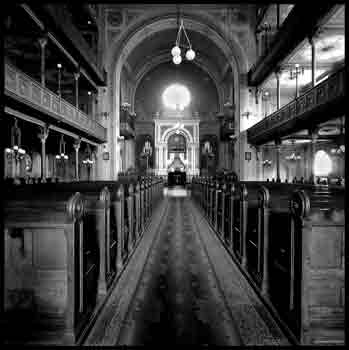 |
After the war, about 250 Jewish communities were
reestablished. Most of the communities in the small towns faltered,
however, and most Jews moved to the capital or emigrated.
The Hungarian government abolished anti-Jewish legislation
and put to trial and imprisoned those involved in the deportation
and destruction of the Jews; however, no law was passed to return
property lost or confiscated in the Holocaust. Anti-Semitism was banned, but anti-Jewish sentiments still continued. Pogroms broke
out in 1946 in Kunmadaras, Miskolc and in other communities.
The Jewish community institutions were renewed after
the war. In December 1948, the government officially recognized the
Jewish community, guaranteed freedom of religious practice and promised
financial support. One single Jewish community organization emerged
for the three main movements: Orthodox, Neolog and status quo.
The Zionist movement began building schools and youth institutions. Many Hungarian Jews immigrated to Israel. Diplomatic
relations with Israel were established in 1948.
In this period, the American Jewish Joint Distribution
Committee gave money to rebuild the Jewish community and help pay
for food, welfare and education.
In February 2014, Budapest's Unified Hungarian Jewish Congregation announced the discovery of the largest single collection of "priceless confiscared sacred property of the Hungarian Jewish community in the Holocaust." The discover was of 100 Holocaust-era Torah scrolls. Additionally, Hungary and the U.S. State Department are attempting to retrieve a Sarospatak library from Russia.
Communist
Rule
In 1949, the communists gained power and Hungary
became the people's republic. The communist rule led to the closure
of many Jewish institutions and the arrest of Jewish activists. Zionism
and mass immigration to Israel were not allowed and contact between
Hungarian Jewry and world Jewry were curtailed. Jewish educational
institutions became part of the general school system.
The synagogue in Gyor was built in 1871
and designed by Karoly Benko. The synagogue was sold in 1969 and now
used as a dance school.
 |
Expulsions from the cities to the provinces took
place in 1951, about 20,000 Jews (most from Budapest) were forced
to leave the cities. In 1953, the situation eased and Jews were allowed
to return to their homes. In the 1956 Hungarian Revolution, it is
estimated that 20,000 Jews left Hungary.
Liberalization policies were enacted in the late
1950's, however, those Jews outwardly identifying with Judaism and engaged in religious activities were restricted in economic and
social spheres. Contact with world Jewish organizations resumed in
the 1960's. In 1967, the Hungarian Jewish population numbered 80-90,000,
including those who did not participate in Jewish communal life. The
largest community was in Budapest, which has 20 synagogues.
In 1967, diplomatic ties with Israel were severed,
but commercial ties continued.
The number of Jews in Hungary continued to decrease
and, in the 1970's, declined to 60,000 (50,000 lived in Budapest),
which was still the second or third largest community in Eastern Europe.
Almost 60 percent, of the Jews, however, were over the age of 50.
The collapse of the communist government in 1989
brought the end of restrictions placed on the Jewish community and
with relations with Israel.
Hungary
Today
Assimilation is a major problem in Hungary. Anti-Semitism remains a problem, even into the twenty-first century. In recent memory,
attacks by "nationalists" and skinheads on foreign students,
gypsies, and Jews in 1992 and in 1993 stands out. More recently, the
rise of the Jobbik (political) party of Hungary in 2012 parallels
a rise in anti-Semitic attitudes among the general population. An
Anti-Defamation League poll in February 2012 found that 63 percent
of Hungarians agreed with three out of four anti-Semitic statements
about Jews and money, Jewish disloyalty to the state, and Jews and
the Holocaust. To read that survey, click
here.
Hannah Senesh' grave
 |
The leading Jewish communal organization in Hungary
is the Alliance of the Hungarian Jewish Communities. There are three
Jewish day schools in Budapest, as well as a high school, the Anne
Frank Gymnasium. There are a number of Jewish youth camps and clubs,
including chapters of B'nei Akiva, B'nei Brith Youth Organization,
Habonim Dror, Hanoar Hacioni, Hasomer Hacair and the Hungarian Union
of Jewish students. The Zionist movements began functioning again,
including the Hungarian Zionist Alliance and Women's International
Zionist Organization. There are also many cultural Jewish institutions
and organizations. The Federation to Maintain Jewish Culture in Hungary
tries to combat assimilation and preserve Jewish heritage.
There are a number of Jewish-Christian dialogue
groups, as well as welfare institutions and organizations to help
the elderly. There are Jewish nursing homes and organizations to help Holocaust survivors.
A Jewish Museum can be found in Budapest. There
is also a Jewish community center, theaters, numerous bands, choirs
and dance ensembles.
There is a Jewish newspaper produced twice a month
in Budapest, which focuses on the happenings of local Jewry, as well
as a Jewish magazine produced once a month, a Jewish literary and
an arts journal and publications from other communities, Chabad and
other Jewish organizations.
There are 12 rabbis in Hungary, most belonging to
the Neolog stream of Judaism. In Budapest, there are 20 synagogues
and prayer houses exist in the small towns. Budapest hosts Eastern
Europe's only rabbinical seminary, founded in 1887; it is Neolog in
practice and students attend from neighboring countries.
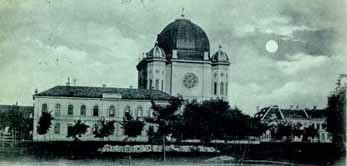
Jews who settled in Szeged at the end of the 18th
century built a synagogue in 1803 and replaced it with another in
1839. This later synagogue was used until 1903, when the Great Synagogue
was completed. The Great Synagogue depicted in the following postcard
was the result of a design competition held in 1898. The synagogue
survived the war and has been declared an architectural monument.
In 2004, the Mad Synagogue was restored. The architecht,
Peter Wirth, received a Europa Nostra award for his design. The Mad
Synagogue was originally built in 1795, but was destroyed after the Holocaust. Wirth attempted to maintain
the original structure of the synagogue as he was rebuilding.
Because there are no Jews living in Mad, the synagogue
is used as a memorial and a museum. During World War II, 800 Jews
from the village were deported to Auschwitz. They synagogue contains
plaques memorializing these Jews. Wirth has plans to rebuild the yeshiva
that was originally attached to the building. He also hopes that the
synagogue's rebuilding will bring back Jews and Jewish traditions
to Mad. Wirth has also helped to restore over 10 other synagogues
throughout Hungary.
The synagogue is technically owned by the Hungarian
government because they funded ninety percent of the project. The
other ten percent was donated by the World Monuments Fund.
There are 10 kosher butchers, a kosher bakery and a restaurant in Budapest. Hungary also
exports matzah, kosher wine and meat.
European Union nations voted in November 2015 to label all products produced on Israeli land seized following the 1967 War as “made in settlements,” a move that prompted harsh criticism from Israeli officials. , “The EU decision is hypocritical and constitutes a double standard,” said Israeli Prime Minister Benjamin Netanyahu. “It singles out Israel and not the 200 other conflicts around the world. The EU has decided to label only Israel, and we are not prepared to accept the fact that Europe is labeling the side that is being attacked by terrorism. The Israeli economy is strong and will withstand this; those who will be hurt will be those Palestinians who work in Israeli factories. The EU should be ashamed.” To read the letter penned by the European Union nations expressing their support for the labelling of these goods, please click here. During the week following the E.U.'s decision to label these products, the Israeli Foreign Ministry suspended all Diplomatic contacts with European Union on matters related to Israeli-Palestinian peace. A statement released by the Israeli Foreign Ministry on November 29, 2015, clarified that Israel would continue diplomatic relations with individual countries, but the ban applies to E.U. institutions and officials. A European Union spokesperson responded, stating that they would continue to work towards peace in the Middle East with the quartet and their other partners, despite being shut out by Israel.
The President of German Parliament came out during the week following the EU's decision, stating that Germany did not support the decision to label the goods, and in fact rejected the idea when it was presented. German Bundestag (Parliament) President Norbert Lammert said during a joint press conference with Knesset speaker Yuli Edelstein, that “Germany can imagine a better law, if it were to apply to everyone, on principle, to all occupied land. Because it's specifically against Israel, I repeat that it is unnecessary and not very smart.” The Czech and Hungarian governments rejected the EU decision as well, with the Czech parliament calling on the government to ignore the labelling rules on December 17, 2015.
Relations with Israel have improved and there is increased trade and tourism between the
two nations.
Sources: The
Jewish Telegraphic Agency;
The
New York Times (April 25, 2012);
Haaretz (July 22, 2012);
Algemeiner (February 17, 2014);
Shamee, Maureen. “Germany rejects EU's labeling of Israeli settlement products, says Bundestag President,” European Jewish Press, (December 3, 2015);
“Czech parliament rejects labelling goods from Israeli settlements,”YNet News (December 17, 2015).
Photo credits:
Memorial stone courtesy of History
of the Jews in Hungary.
Synagogue photos courtesy of Judaica
Philatelic Resources.
Budapest photos courtesy of the Tourism
Office of Budapest.
Map from the CIA
World Fact Book 2000.
Pecs Synagogue © Edward Serotta.
|