Dietrich Bonhoeffer
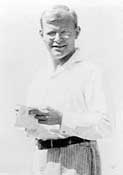
(1906 - 1945)
Who stands firm? Only the one for whom
the final standard is not his reason, his principles, his
conscience, his freedom, his virtue, but who is ready to
sacrifice all these, when in faith and sole allegiance
to God he is called to obedient and responsible action:
the responsible person, whose life will be nothing but
an answer to God's question and call.
— Dietrich Bonhoeffer1
Protestant theologian Dietrich Bonhoeffer
stands out among the Christian leaders during the Nazi era,
for he was one of the few to actively resist the racist actions
of the Nazi regime. In addition to his legacy of courageous
opposition to Nazism, Bonhoeffer's theological writings are
still widely read in Christian communities throughout the
world.
- Education
- Hitler Rises to Power
- Resistance
- Arrest
- Selected Bibliography
for Dietrich Bonhoeffer
Education
Dietrich Bonhoeffer was the sixth child
of Karl and Paula Bonhoeffer, born in Breslau, Germany,
on February 4, 1906. He completed his studies in Tübingen
and Berlin. In 1928,
he served as vicar in the German parish in Barcelona; and
in 1930, he completed his theological examinations at Union
Seminary in New York. During this period, he became active
in the ecumenical movement and accumulated international
contacts that would later aid his efforts in the resistance.
In 1931, Bonhoeffer took a teaching position
with the theological faculty in Berlin. There he produced
many of his theological writings, in which he took a traditional
viewpoint in Jewish-Christian
relations, believing that the Jewish people must ultimately
accept Jesus as the Messiah. This theological
work greatly increased his prominence in the Christian German
community.
Hitler
Rises to Power
After years of political instability under
the Weimar republic, most Christian institutions were relieved
with the ascent of the nationalistic Nazi dictatorship. The
German Evangelical Church, the foremost Protestant church
in Germany, welcomed Hitler's
government in 1933. Dietrich Bonhoeffer, however, although
a member of the German Evangelical Church, was not complacent.
In his April 1933 essay, The Church and the Jewish Question,
he assailed Nazi state persecution.
Bonhoeffer's defense of the Jews, however,
was based on Christian supersessionism - the Christian belief
that Christianity had superseded Judaism as the new chosen people of God. Despite his outspoken defense
of victims of Nazi persecution, Bonhoeffer still maintained,
on a religious level, that the "Jewish question"
would ultimately be solved through Jewish conversion to Christianity.
The Church strongly advocated this view, as did the ecumenical
movements most responsible for aiding Jewish refugees fleeing
Nazism.
In The Church and the Jewish Question (1933),
Bonhoeffer pledged to fight political injustice. The Nazi
injustice must not go unquestioned, and the victims of this
injustice must not go unaided, regardless of their religion,
Bonhoeffer wrote.
With Hitler's
ascent, non-Aryans were prohibited from taking parish posts,
and when Bonhoeffer was offered such a post in the fall of
1933, he refused it in protest of the racist policy. Disheartened
by the German Church's complacency with the Nazi regime,
he decided to accept a position at a German-speaking congregation
in London.
The opponents of Nazi interference in Church
affairs formed the "Confessing Church," and some
members, including Bonhoeffer, advocated open resistance
against Nazism. The more moderate Protestants made what they
saw as necessary compromises to retain their clerical authority
despite expanding Nazi control. But under increasing Gestapo scrutiny, the Confessing Church was soon immobilized.
Bonhoeffer returned to Germany to teach
at Finkenwalde, a Confessing Church seminary, where he continued
to train clergy for the Confessing Church. But the official
church barred his students from taking its clerical posts.
In August 1937, the regime announced the Himmler Decree,
which declared the training and examination of Confessing
ministry candidates illegal. Finkenwalde was closed in September
1937; some of Bonhoeffer's students were arrested.
Resistance
Bonhoeffer went into hiding for the next
two years; he traveled secretly from one eastern German village
to another to help his students in their small illegal parishes.
In January 1938, he was banned from Berlin, and in September
1940, he was forbidden to speak in public.
In the midst of political turmoil, Bonhoeffer
continued to question the proper role of a Christian in Nazi
Germany. When German
synagogues and Jewish businesses were burned and demolished
on Kristallnacht,
November 9, 1938, Bonhoeffer immediately left for Berlin,
despite having been banned by the Gestapo,
to investigate the destruction. After his return, when his
students were discussing the theological significance of
Kristallnacht, Bonhoeffer rejected the theory that Kristallnacht
had resulted from "the curse which had haunted the Jews
since Jesus' death on the cross." Instead, Bonhoeffer
called the pogrom an example of the "sheer violence"
of Nazism's "godless face."2
The Confessing Church resistance expanded
its efforts to help "non-Aryan" refugees leave
the country. One member of the resistance movement was the
passionate anti-Nazi, Hans von Dohnanyi, a lawyer married
to Bonhoeffer's sister. In early 1939, Dohnanyi was transferred
from the Justice Department to the Armed Forces High Command
Office of Military Intelligence, and used his new post to
inform Bonhoeffer that war was imminent. Bonhoeffer, knowing
that he would never fight in Hitler's army, left the country
in June 1939 for a teaching position at Union Seminary in
New York.
But upon arrival in the United States, Bonhoeffer
realized that he had been mistaken, that if he did not lead
his people during the difficult years of war and turmoil,
then he could not partake in the postwar revival of German
Christan life. His place, he decided, was in Germany; he
returned only a month after his departure, in July 1939.
He undertook a more active effort to undermine the regime.
With international contacts in the ecumenical movement, he
became a crucial leader in the German underground movement.
In October 1940, despite previous Gestapo tracking, Bonhoeffer gained employment as an agent for Hans
von Dohnanyi's Office of Military Intelligence, supposedly
working for the expansion of Nazism. In reality, he worked
for the expansion of the anti-Nazi resistance. During his
1941 and 1942 visits to Italy,
Switzerland, and the Scandinavian countries, he attempted
to gain foreign support for the resistance movement.
Arrest
While plans to topple Hitler progressed only slowly, the need to evacuate more Jewish
refugees became increasingly urgent. In early 1943, however,
the Gestapo, which had traced Bonhoeffer and Dohnanyi's large
monetary sums intended for Jewish immigrants, foiled plans
for a new refugee rescue mission. Bonhoeffer and Dohnanyi
were arrested in April 1943.
Initially, the Gestapo believed that Bonhoeffer and Dohnanyi were embezzling money
for their own interests. Then the truth began to leak out,
and Bonhoeffer was subsequently charged with conspiring to
rescue Jews, using official travel for other interests, and
abusing his intelligence position to keep Confessing Church
pastors out of the military. But the extent of Bonhoeffer's
resistance activities was not fully realized for months.
In October 1944, Bonhoeffer was moved to
the Gestapo prison in Berlin. In February 1945, he was taken
to the Buchenwald concentration camp, and then to the Flossenbürg concentration
camp, where he was hanged on April 9, 1945. Hans von Dohnanyi
was executed soonthereafter.
Sources: United
States Holocaust Memorial Museum
1 Bonhoeffer,
Dietrich. "After Ten Years." Letters
and Papers from Prison. Enlarged Edition, Eberhard
Bethge, ed. New York: The Macmillan Company, 1971, p. 5.
2 W. D. Zimmermann, ed. I Knew
Dietrich Bonhoeffer. New York: Harper and Row, 1966,
p. 150.
|