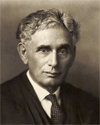
Louis Dembitz Brandeis was an American lawyer and Associate Justice on the U.S. Supreme Court from 1916 to 1939.
Brandeis was born in Louisville, Kentucky in
1856 to a family tolerant of Jewish and Christian rituals. In later
life Brandeis might be best described as a secularhumanist.
Although he completed his secondary education in Germany, he returned
to the United States where he studied law at Harvard. After settling
in Boston, Brandeis became a successful lawyer spending a good deal
of his time pursuing cases with a political bent. In particular, he
enjoyed representing small companies against giant corporations, and
aiding the cause of the minimum wage against companies opposed to
this principle. In 1912, he supported Woodrow Wilson's nomination for
Presidency and in 1916, was appointed a Supreme Court judge, the
first Jew ever to be appointed to this position. At the time of his nomination to the Supreme Court by Woodrow Wilson on January 28, 1916, the Senate had never before held a public hearing on a President's Supreme Court Nominee; they had all been confirmed on the day of their nomination. However, it took four months of Senate Judiciary Committee hearings until the Senate brought the nomination of Brandeis to a vote. Brandeis was confirmed as the first Jewish Supreme Court Justice in a Senate vote of 47 - 22 on June 1, 1916.
Brandeis showed little interest in Jewish affairs
until the turn of the century when a combination of his professional
work and a changing political climate brought about an alteration. He
was introduced to Zionism by Jacob
de Haas, an English Zionist, and later still by Aaron
Aaronsohn, the Palestinian botanist and founder of Nili.
Brandeis became active in Zionist affairs during
the First World War, when he accepted the role of Chairperson of the
Provisional Executive Committee for General Zionist Affairs. Brandeis
had a major impact on the American branch of the Zionist movement,
drawing to it a number of sympathizers, improving its organization
and its finance.
Whilst he resigned his official position on
joining the Supreme Court, he nonetheless worked behind the scenes to
influence President Woodrow Wilson to support the Zionist cause.
After the war, Brandeis headed a delegation of American Zionists to
London where at a conference differences emerged between Chaim
Weizmann and himself. These arguments over the role of the
organization and its pursuit of political activities caused a rift
between the two leaders with Weizmann gaining the upper hand.
Brandeis withdrew from Zionist activity although he continued to take
part in EretzIsrael economic affairs. Brandeis did intervene from
time to time in political matters for example he appealed to
Roosevelt to oppose the British partition scheme of 1937 calling
instead for the whole area of EretzIsrael to become a Jewish
National Home.
Brandeis represented a rather different genre of
Zionism, one born out of the American context that affirmed Zionism
as part of American ethnic identity. It was Brandeis who coined the
term that "to be a good American meant that local Jews should be
Zionists."
He died in Washington, D.C. in 1941.