Joyce Brothers
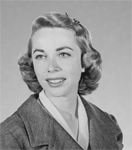
(1927 - 2013)
Dr. Joyce Brothers was an American psychologist, television personality and famed newspaper columnist.
Brothers (born October 20, 1927; died May 13, 2013) was born Joyce Diane Bauer in Brooklyn, New York to Jewish, middle-class parents Estelle and Morris, both attorneys. Brothers
later credited her parents with instilling
a desire for achievement
and respect for hard work while their
faith imparted a sense of ethics
and a belief in God.
After graduating
from Far Rockaway High School in 1943,
Brothers entered Cornell University, double majoring
in home economics and psychology and graduated with her bachelors degree,
with honors, in 1947. She then enrolled
at Columbia University, where she did
graduate work in behavior and personality and earned her Masters in July 1949 and later her Ph.D. in 1953, with a doctoral dissertation
on anxiety avoidance and escape behavior
measured by the action potential in muscle.
While attending Columbia, she was an
assistant in psychology as well as a
teaching fellow and instructor at Hunter
College.
Shortly
after receiving her masters degree, Joyce married Milton Brothers,
a medical student. Their first, and only, child Lisa was born n 1953 and at that time Brothers chose to remain at home to raise
her daughter according to her own beliefs
about child rearing. However, this decision
reduced the couple’s income to
the fifty dollars a month her husband
received for his medical residency.
In
late 1955, to relieve the financial strain,
Brothers decided to try out for the popular
television show The $64,000 Question,
which frequently selected contestants
with novel areas of specialization. The
attractive psychologist, who had become
an expert on boxing to please her husband,
as she explained it, was an instant favorite.
With the determination that has characterized
her entire career, Brothers studied volumes
of a boxing encyclopedia to enhance her
already considerable knowledge. After
seven weeks on the show she became the second
person, and only woman, to win the $64,000
top prize. Two years later, Brothers
appeared on a successor program, The $64,000
Challenge, which matched the contestant
against experts in the field. Again,
Brothers walked off with the maximum
prize.
“I had enough to promise
myself I’d never do things I didn’t
want to do again,” she recalled.
Whhen hearings were held in 1959 about
corruption on The $64,000 Question,
Brothers’s honesty was documented.
She later revealed that the producers
had wanted her off the show, but she
had frustrated their intentions by answering
the difficult questions they had expected
would defeat her.
After
her victory on The $64,000 Question,
Brothers remained in the public eye,
first as cohost on Sports Showcase, and
as a popular guest on many television
shows. Then, in 1958, NBC offered Brothers
her own afternoon talk show, initially
called The Dr. Joyce Brothers Show, devoted
to counseling viewers on child rearing,
love, marriage, and sex. It was an instant
success; when Brothers began receiving
more than a thousand letters a week,
the show was syndicated nationally. In
less than a year, she added a late-night
show on which she was one of the first
to discuss such previously taboo subjects
as sexual satisfaction, frigidity, menopause,
and impotence. Within a short time, she
had a live call-in program on WMCA and
was appearing on programs of other networks.
A syndicated column ran in 350 newspapers,
and a monthly column in Good Housekeeping,
initiated in 1963, is still a feature
of the magazine. Several of her books,
including What Every Woman Should
Know About Men (1982), sold well.
Brothers
clearly filled a need. Conforming in
many ways to the dominant image of women
in the 1950s and early 1960s, Brothers
described herself as a mother, wife,
and psychologist last. Yet her apparent
observance of the status quo permitted
her to delve into some of the issues
that many Americans were concerned about
without seeming to threaten the established
order. While some psychologists criticized
her for giving advice without having
adequate knowledge of the patients, others
believed she helped people by showing
them that their problems were shared
by others. Brothers herself claimed that
she only linked her viewers with the
information available in psychological
literature.
Brothers’s
world was shaken in 1989 by the death
from cancer of her husband of thirty-nine
years. “I had never really experienced
grief before,” she explained, “and
although the pain was enormous, I became
much more sensitive to others.” After
her initial reaction, she recovered by
returning to the habits of a lifetime
and using what she had learned to help
other women surmount their own grief.
Buoyed by the support of her daughter
(an ophthalmologist), son-in-law, and
four grandchildren, Brothers wrote of
her gradual return from suicidal thoughts
to a satisfying, productive life. The
book she wrote describing this journey, Widow (1990),
would be the most personal and the most
popular of her ten books. It was excerpted
in many journals, and Brothers again
became a sought-after speaker on television
and radio talk shows. The thousands of
letters she received from grateful women,
she explained, “made my own pain
not only bearable but worthwhile.”
Brothers was a long-standing member of the
Federation of Jewish Philanthropies,
and in 1964 was named a Woman of Achievement
by the Federation of Jewish Women’s
Organizations. In 1968, she received
a merit award from Bar-Ilan University in Tel Aviv, Israel.
On May 13, 2013, Joyce Brothers died at her home in Fort Lee due to respiratory failure. She was 85 years old and is survived by her sister Elaine Goldsmith, her daughter Lisa Brothers Arbisser, four grandchildren and two great-grandchildren.
Sources: Paula Hyman and Deborah Dash Moore
eds. Jewish Women in America. NY: Routledge,
1997. Reprinted with permission of the American
Jewish Historical Society; ContemporaryAuthors 15
(1984): 120-121; Current Biography (1971):
62-68; Rodgers, J.E. “Psychologists
at Home: How They Live.” Psychology
Today 26 (July-August 1993): 48-53; Who’s
Who in America (1991); Wikipedia; Washington Post (May 13, 2013) |