From the creation of Israel through the present day, Syria has been one, if not
the most, implacable of Israel's enemies. From 1948 until 1967, Syria
was in more of a position to express her dislike and wish to put an end
to the Jewish state by firing mortar shells from the Syrian occupied Golan Heights into the Jewish settlements of the Upper Galilee below.
For 19 years, Jewish settlements in the north were under constant threat
of Syrian guns.
Today, one can see the former Syrian bunkers that remain on
the Golan
Heights from 1967 (as well as the tanks from 1973). Israel has had a
quiet northern border on the Golan side for 32 years. The Syrians have used
Israel's northern border with Lebanon to harass Israel the way they used to from
the Golan
Heights. Since 1992, the Golan has been up for discussion in the peace
talks, but
it strikes a very emotional chord among Israelis due to its historic and
strategic significance, in addition to its wild beauty.
When the Golan was captured in 1967, at almost the end of the Six-Day War, settlers in the north could finally breathe a sigh of relief. And
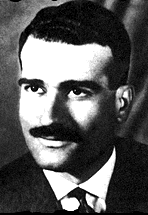
much of the credit for Israel's ability to capture the Golan was due to Eli
Cohen, Israel's greatest spy.
The Golan is not only important for its military
significance. It also provides 30% of Israel's water
sources. The three major
tributaries of the upper Jordan River - the Dan, the Baniyas, and the Hatzbani -
all originate in the Golan. The melting winter snows produce a huge run-off of
water which make the Golan itself a beautifully verdant area in the late winter
and spring, and irrigate the Hula and Jordan Valleys below. Its waters flow into
the Sea of Galilee (the Kinneret) and south to the Dead Sea.
The Kinneret supplies Israel with most of its water needs. In
the 1960's, Israel developed a national water carrier which diverted water from
the Kinneret into a pipeline that irrigated much of the country - and especially
Israel's arid south.
Israel tried to obtain the cooperation of her Arab neighbors
for the plan but the Arabs would not agree, even when the United States tried to
use its diplomatic leverage for the furtherance of the plan. The Arabs would
have none of it, and decided to "divert the sources of the Jordan River
which originated in Arab-held territory." In this way, the Arabs hoped to
deprive Israel of the waters she would need for her national growth.
Syria brought hydraulic engineers and diversion equipment to
actualize the scheme. This coincided with the continuance of Palestinian
terrorist infiltrators arriving from the Syrian border, along with a continual
flow of Soviet technical assistance to Syria. "Israel's defense planners
urgently needed reliable intelligence on the scope of the water diversion
project - engineering plans, diagrams, maps, and other data - and
up-to-the-minute assessments of Soviet influence in the Syrian capital, as well
as detailed information on plans for the modernization, equipping, and
retraining of Syrian forces." Eli Cohen was the man for the job.
Eli Cohen was born in Alexandria, Egypt, on December 26, 1928
[sic 1924]. "His parents, Syrian Jews from the thriving town of Aleppo, had
always instilled in their educationally minded son the traditions of the Jewish
people, of Zionism, and of the culture of Syria's Jewish community, in
particular." In 1949 his parents and three brothers moved to Israel while
Eli remained in Egypt to coordinate Jewish and Zionist activities there. We may
recall the Egyptian-Jewish spies from the Operation Susannah fiasco.. They were caught spying for Israel
in 1953 and some of them were hanged. A number were only released 14 years
later, after the 1967 War. While Eli was not directly involved with the
Operation Susannah spies, he was involved with pro-Israel activity, and he was
brutally questioned by Egypt's Intelligence Services.
Even after the blown operation led to the demise of the
Operation Susannah spies, Eli Cohen left Egypt for Israel in order to undergo
intensive espionage training in the summer of 1955. He even trained at the same
facility "that had served as home to his doomed Susannah compatriots in
1953." He returned to Egypt in 1956, but was suspected immediately and was
placed under surveillance. At the beginning of the 1956
War, when Israel
occupied the Sinai, Eli Cohen was detained by the Egyptian authorities, and was
expelled from Egypt along with the remainder of Alexandrian Jews at the end of
the war. He arrived in Israel on February 8, 1957.
Eli Cohen, at 29, offered his services to the Israeli
Intelligence Services but was rebuked twice. He wasn't even drafted into regular
service, but was "placed in a reserve Israeli Air Force formation as a
logistics clerk." Perhaps he wasn't allowed into the security service due
to his Military Intelligence evaluation some years before. "The agency
concluded that Cohen had a high IQ, great bravery, a phenomenal memory, and the
ability to keep a secret; but the tests also showed that 'in spite of his modest
appearance, he has an exaggerated sense of self-importance,' and 'a lot of
internal tension.' Cohen, the results indicated, 'does not always evaluate
danger correctly, and is liable to assume risks beyond those which are
necessary.'"
On August 31, 1959, he married a beautiful Iraqi-born Jew,
Nadia Majald. He worked as an accountant. Employment was not always steady, and
he soon had to rely more on Nadia to help support their marriage, which would
quickly lead to children.
By 1960, however, Israeli Intelligence was ready to take
another look at Eli Cohen. Eli, after all, was born in an Arab country, had
oriental features, was known to be selfless and fearless in pursuit of a cause,
and had knowledge of Arabic, English, and French. The border with Syria was
heating up as well.
One day in 1960 Israeli Intelligence approached him about
working for them again. At first he refused. But within a month he had lost his
Tel Aviv-based accountancy job. When Intelligence came by a second time, he
jumped at it. "His training was extensive and exhaustive. He was taught
high-speed evasive driving techniques, Weapons proficiency (especially with a
wide variety of small arms), topography, map reading, sabotage, and, most
importantly, radio transmissions and cryptography. These skills were
instrumental in ensuring the safety and survival of one Kamal Amin Ta'abet: Eli
Cohen's new identity. One of the most difficult tasks for Eli Cohen was to learn
the intricate and unmistakable phonetic tune of Syrian Arabic; prior to his
intelligence training, his Egyptian accent was undeniable." His trainer was
an Iraqi-born Jew who had trained operatives in Arabic language and traditions
and Moslem customs for along time.
Intelligence created a completely new identity for him. Kamal
Amin Ta'abet (also called Tabas in some sources) was born in Beirut, Lebanon, to
Syrian Muslim parents. His father's name was Amin Ta'bet, and his mother's
Sa'adia Ibrahim. According to his fictional biography, in 1948 "the family
moved to Argentina, where they opened a successful textile business." Kamal
Amin Ta'abet's (Eli Cohen) return to Syria would ostensibly be the fulfillment
of a lifelong patriotic dream.
In early 1961, Chaim
Herzog, Chief of Military Intelligence
and later president of Israel, signed the document authorizing Cohen's use as a
spy. He was driven to the airport, where his wife Nadia saw him off. She
understood from him that he would be working for the Ministry of Defense, but
she didn't know where or in what capacity. She was told he would be completely
safe and she believed that until his capture in 1965.
Eli Cohen was first sent to Buenos Aires, Argentina, to
establish his cover as a Syrian emigre. He soon established himself in the
social and cultural life of the Syrian community of Buenos Aires and was known
as a wealthy businessman who was generous, tipped well, and loved the night
life. He soon became accepted, well-liked and respected, and made contacts with
politicians, diplomats and military officials working out of the Syrian Embassy.
One of them was Colonel Amin al-Hafaz, a supporter of the secular-leftist Ba'ath
party.
Cohen's contacts, nurtured through a string of lavish dinner
parties, social occasions, and friendships with those in high places, led to
invitations to visit Damascus and to set up a business venture there. He was
promised support in any venture he might wish to undertake, and the generous
sums of cash which he appeared to possess appealed to the unscrupulous who
thought he could provide "grease" to their financial ambitions, as
well as patriotic Syrians who hoped for an infusion of foreign capital into the
Syrian state.
Nine months later, in late 1961, Eli came back to Israel for
a visit with his wife Nadia. But he spent most of his time in Tel Aviv
"perfecting his cover and being briefed on Aman's requirements of him in
Syria, as well as last-minute intelligence data needed for his mission."
Needless to say, his success in effectively penetrating the Syrian social and
political/diplomatic/military strata already wildly exceeded Aman's expectations
of him
Cohen arrived in Damascus in February 1962, posing as a
businessman from Argentina who had returned to his native land. At the end of
1961 Syria dissolved its union with Egypt, which had lasted a mere three years.
The Ba'ath party was rising to power and Eli Cohen wanted to be there when it
actually took power. He carefully cultivated contacts with the Ba'ath
leadership, which included the Syrian military attache in Argentina, General
Amin al-Hafaz. He continued his social life, spending a lot of time in cafes
listening to political gossip. He also held parties at his home, which turned
into orgies for high-placed Syrian ministers, businessmen, and others, who used
Eli's apartment "for assignations with various women, including Defense
Ministry secretaries, airline hostesses, and Syrian singing stars." At
these parties such highly-placed officials would "talk freely of their work
and army plans. Eli, who would feign intoxication, remained sober and listened
carefully." In addition to providing loans to government officials and
acting as an avid host, he was asked for advice by government officials, who
were often intoxicated by the alcohol he freely provided. Eli himself was not
above the spicier part of a spy's life either. "The 'husband hunters' among
the Damascus rich and influential flocked to the handsome Ta'abet, hoping that
their almond eyes, Byzantine beauty, and olive skin would secure a future of
wealth and power: He became the most sought after bachelor in the Syrian
capital. He did not object, in fact, to the idea of a ladies' man reputation. He
had seventeen lovers in Syria, all dazzling beauties with a fair degree of
family power." Eli hoped as did Israeli Intelligence - that these women
"would help him escape in time of crisis."
With time he was taken even more into the confidence of the
highest echelons of power. He became a confidante of George Saif, high up in the
Ministry of Information. "The complete trust Cohen enjoyed among his
unwitting informants is illustrated by the following incident, which might have
serious consequences for the Israeli agents.
One day Cohen was sitting in Saif's office reading a
classified document while the Syrian was on the phone. One of the ministry's
directors entered the room unannounced.
'How is it that you dare allow a stranger to read a
classified document?' he angrily asked Saif.
Saif calmly replied, 'There's nothing to worry about. He's a
trusted friend.'"
When the Ba'ath took power in 1963, Eli was firmly entrenched
in Syrian high society. Meanwhile, every few days he transmitted important
information to his Israeli handlers via a radio transmitter he had hidden in his
room.
Periodically Eli would return to Israel to speak with his
Israeli handlers and visit his wife and small children. Altogether, he returned
to Israel three times between 1962 and 1965.
The Syrian
project to divert water from the headwaters of the Jordan away from Israel was mentioned already in the above introduction. Eli
was friends with two highly placed Army officers, Colonels Hatoum and Dali, who
were fully informed about the scheme. In early 1964, Eli was able to radio Tel
Aviv that the channel was being dug along the entire length of the Syrian
Heights to receive the diverted flow of the Baniyas River - one of the Jordan's
major sources - and empty into Jordanian territory." Eli carefully spelled
out all the details of the project and passed them on to Israeli Intelligence.
Due to this information, the Israeli Air Force was able to obliterate the Syrian
plans for the diversion scheme by shelling and bombing the bulldozers and other
equipment used for the scheme in early 1964.
Eli's connections enabled him to be taken to the Golan
Heights - a major strategic asset for Syria from 1948-67. As we saw, the Syrians
continually harassed Israel's northern settlements from 1948-67. The Golan
Heights defenses were top-secret and closed only to top military staff.
"Nevertheless, Kamal Amin Ta'abet (Eli Cohen) succeeded in visiting each
and every position. With senior staff officers acting as guides, Eli Cohen was
provided an in-depth intelligence briefing of monumental proportions." They
even photographed Eli on the Golan Heights, looking over into Israel, alongside
the most high-ranking Syrian officers. He remembered and passed on to Israeli
Intelligence the "positioning of every Syrian gun, trench, and machine-gun
nest in each Golan Heights fortification; tank traps, designed to impede any
Israeli attack, were also identified and memorized for future targeting."
One of the more famous aspects of his spying regarded a trip he took to the
Golan Heights. As the Syrian Army officer explained to Eli the fortifications
the Syrian Army had built, Eli suggested that the Syrians plant trees there to
deceive the Israelis into thinking it was unfortified, as well as to provide
shade and beauty for the soldiers stationed there. The Syrian officer readily
agreed - and Eli immediately passed the information onto Israel. Based on the
eucalyptus trees, Israel knew exactly where the Syrian fortifications were.
Eli's friendship with Amin al-Hafez proved very valuable.
After Hafez became Prime Minister, Eli was even considered to be named the
Syrian Deputy Minister of Defense.
But changes were taking place in the Syrian Government that
alarmed Eli. In addition, the commander of Syrian Intelligence, Colonel Ahmed
Su'edani trusted no one and disliked Eli. Eli expressed his fear and wish to
terminate his assignment in Syria during his last visit to Israel in November
1964. Still, Israeli Intelligence asked him to return to Syria one more time.
The information he had been providing them for years was too good to forego.
Eli did go back to Syria, but his behavior changed. He became
far less careful in his transmissions to Israel, sometimes calling once or even
twice a day - and almost always at the same time, at 8:30 in the morning. The
transmissions became longer as well. Some attributed this to a sense of
cockiness (despite the fears he had expressed in November 1964), due to the
ability and ease he had moved about in the highest echelons of Syrian power.
Others have attributed the carelessness to an almost suicidal tendency -
perhaps, it was later surmised, he had been in the undercover world too long,
but knew he couldn't get out of it. Because of that, perhaps he just tired of
the whole charade.
The Syrians and their Russian advisers were alarmed by the intelligence that was seeping out of the country. The highly vigilant Russian
security experts, equipped with very sensitive technical intelligence-gathering
equipment, pinpointed the source of the transmissions in the Syrian capital -
and it was Eli's home. One day in January 1965, Syrian intelligence broke into
his home in the middle of a transmission. The leading figure in the break-in was
the head of Syrian Intelligence, Colonel Ahmed Su'edani - Eli's nemesis.
Eli was caught in the act and there was nothing he could do.
He was tortured, but he wouldn't give away any incriminating information about
Israel. His captors later remarked on his noble bearing and his courage despite
the horrific Syrian interrogation methods.
He then underwent a show trial, like the Operation Susannah
spies had in Egypt 12 years before., Like them, his verdict was predetermined.
World leaders, wealthy individuals, the Israeli government,
the Pope, and others all intervened on his behalf. To no avail. He was hanged on
May 18, 1965. He wrote a last letter to his wife before he mounted the scaffold
to a seething crowd. The execution was broadcast on Syrian television. After his
execution, a white parchment filled with Anti-Zionist writing was put on his
body and he was left hanging for six hours.
Eli Cohen provided an incredible amount of intelligence data
to the Israeli Army over a period of three years. In 1967, the Israelis were
able to conquer the Golan Heights in two days - in part due to the intelligence
he provided. As Intelligence Chief Meir Amit said, Eli "succeeded far
beyond the capabilities of most other men."
What is perhaps most amazing about Eli Cohen is that he was
genuinely liked - even loved - by so many of the top Syrian leaders. He had an
input into and an impact on Syrian national defense, and was privy to almost all
of their secrets. He genuinely fit into life in the Syrian capital and he was
never suspected of being a spy until almost the very end.
It is for these reasons Eli Cohen is known as Israel's
greatest spy.