Fredrick Reines
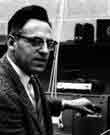
(1918 - 1998)
Frederick Reines was born on March
16, 1918, in Paterson, New
Jersey. He received undergraduate degree in engineering
in 1939 and a Master of Science degree in mathematical
physics in 1941 at Steven Institute of Technology. He
received his Ph.D. from New York University.
He first worked at Los Alamos National
Laboratory, confirming the existence of neutrinos while
there. In 1944, he was recruited as a staff member in
the Theoretical Division at the Los Alamos Scientific
Laboratory to work on the Manhattan Project. He then
became the head of the physics department of Case University
from 1959 to 1966. He subsequently became the founding
dean of the school of physical sciences at the newly
opened University of California, Irvine. He served as
Dean until 1974, when he stepped down to return to full
time teaching and research. He was appointed Distinguished
Professor of Physics at UCI in 1987 and became Professor
Emeritus in 1988.
He was awarded the 1995 Nobel
Prize in Physics, along with Martin
Perl , for his
detection of the neutrino in the neutrino
experiment.
He remained on UCI's faculty until
his death. Reines died on August 26, 1998.
Awards and Honors
· Fellow of the American Physical
Society, 1957
· Fellow, American Academy of Arts and Sciences,
1966
· Stevens Honor Award, 1971
· Fellow, American Association Advancement of
Science, 1979
· National Academy of Sciences, 1980
· J. Robert Oppenheimer Memorial Prize, 1981
· National Medal of Science, 1985
· Albert Einstein Memorial Lecturer, Israel Academy
of the Sciences and Humanities, Jerusalem, 1988
· Michelson-Morley Award, 1990
· Foreign Member, Russian Academy of Sciences,
1994
The following press release from the
Royal Swedish Academy of Sciences describes Reines'
work:
Mankind seeks his place
in nature. He endeavours to find answers
to philosophical and physical questions
alike. The home of mankind, the Universe,
was created in a Big Bang. “What
does this Universe consist of?” - "What
are the smallest constituents of the Universe
and what are their properties?"
- "What can they tell us of the history
of the Universe and of its future?" etc.
This year's laureates have in this search
made lasting contributions: They have discovered
two of nature's most remarkable subatomic
particles.
Frederick Reines made pioneering contributions
during the 1950s together with the late Clyde L. Cowan,
Jr., which led to their being able to demonstrate experimentally
the existence of the antineutrino of the electron.
Frederick Reines' and
Clyde L. Cowan's first observation of neutrinos
was a pioneering contribution that opened
the doors to the region of "impossible" neutrinoexperiments.
Nowadays we are attempting to capture neutrinos
in cosmic radiation that may originate
in the sun or in supernovas (exploding
stars). Because of the reluctance of neutrinos
to react with atomic nuclei and thus allow
themselves to be captured, very large detector
volumes are required for these experiments.
While Reines and Cowan in the 1950s managed
with about half a cubic metre of water
in their detector, large-scale experiments
in the 1990s use many thousand cubic metres.
Some experiments have even used surrounding
sea or ice as their detector volume.
Sources: Wikipedia,
Nobelprize.org,
Nobel
Prize Autobiography, Picture courtesy of Fermilab |