Hans Krebs
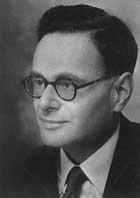
(1900 - 1981)
Hans Adolf Krebs was born on August 25, 1900, in Hildesheim, Germany. From 1918 to 1923,
Krebs studied medicine at the universities of Göttingen, Freiburg-im-Breisgau,
and Berlin. He obtained his Ph.D. from the University of Hamburg in
1925, then studied chemistry in Berlin for a year. It was in Berlin that Krebs became an assistant of Otto
Warburg (Nobel Prize recipient in 1931) at the Kaiser Wilhelm Institute
for Biology until 1930.
Because of his Jewish heritage, Krebs was barred from
practicing medicine in Germany and he immigrated to England in 1933. That year, he began working in the biochemistry department
at Cambridge. In 1935, he transferred to the University of Sheffield
where he was appointed Lecturer in Pharmacology. In 1945, Krebs became
Professor of Biochemistry at the University of Sheffield.
Kreb’s main area of interest was intermediary
metabolism. In 1932, he discovered the urea cycle (reactions in animal
organisms that produces urea from ammonia) and the citric acid cycle
(series of chemical reactions of central importance in all living cells
that utilize oxygen as part of cellular respiration) in 1937. Today,
the citric acid cycle is still often referred to as Krebs cycle.
Krebs was awarded the Nobel
Prize for Medicine in 1953, along with Fritz
Lipmann. In addition
to receiving the Nobel Prize, he was elected Foreign Member of the Royal
Society in London in 1947. For furthering the study of medicine, Krebs
was knighted in 1958. In 1979, Krebs was elected Honorary Fellow of
Girton College at Cambridge University.
Hans Krebs died on November 22, 1981, in Oxford, England.
Sources: Wikipedia;
Nobel
Prize |