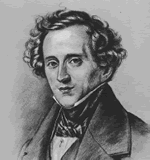
The grandson of Moses
Mendelssohn, a distinguished philosopher and spiritual leader of
German Jewry, wrote his inspired overture, A Midsummer Night's Dream, when only seventeen - eight years after his first public piano
recital. In the vibrant, cultivated atmosphere of an affluent
household, the young prodigy blossomed intellectually and musically.
Felix's father, Abraham, was a successful banker and businessman; his
mother, Leah Salomon, came from a prominent German Jewish
family of considerable means. When Felix was six, his parents baptized
him in the Lutheran church - they believed
that Judaism, with its history of torment, persecution and abuse,
was an antiquated and self-defeating form of religion, an obstacle to
their integration into the wider community. They also took the name Bartholdy. Felix was confirmed in the Lutheran church at
age fourteen.
Despite an exhausting schedule as a much
sought-after conductor, pianist and teacher, the prolific composer
completed five orchestral symphonies; the Reformation (1830-32),
Italian (1833) and Scottish (1842) are the best known and most
frequently performed. Within his body of music is the "Wedding
March" familiar to us all.
Mendelssohn earned considerable fame in his day.
His tours throughout the continent brought him often to England and into the personal favor of Queen Victoria who deeply admired his
genius. he also helped revive interest in the century-old works of
Bach, raised the quality of orchestral performance, and founded the
Leipzig Conservatory of Music which was then regarded as the finest
in the world.
Musicologists consider Mendelssohn's choral and
organ music as among the best the century produced. By the early
1840s he was the most acclaimed and popular composer in Central
Europe. And taking up the baton he conducted the first performances
of symphonies by his friend and colleague, Robert Schumann, and by
Franz Schubert.
Tragedy struck at age 38 when Mendelssohn's much
adored sister, Fanny (an accomplished pianist in her own right), died
suddenly. Physically depleted and in failing health, on of the most
gifted musicians of his day expired soon after his overwhelming
bereavement.
For the most part, Felix Mendelssohn lived and
died a Christian. At his Christian funeral, attended by multitudes of
admirers, a six-hundred voice sang: “Christ and the
Resurrection.” Felix was buried in the cemetery of Holy Cross
Church in Berlin. Today, a huge cross marks his grave.