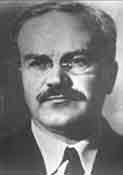
Vyacheslav Molotov, the son of middle-class parents,
was born in Kukarka, Russia, on February 25, 1890. He was sent to Kazan
to be educated and while there met a group of students who introduced
him to the ideas of Karl Marx.
In 1905 joined the Social Democratic Labour Party and
after the 1905 Revolution began to associate with the Bolshevik faction
of the party. Molotov was soon arrested and sent to Vologda province.
After his release Molotov left Russia to join other
Bolsheviks living in exile. He met Vladimir Lenin and it was agreed
that he should return to St. Petersburg to organize the distribution
of Zvezda, the party newspaper. Later Molotov was to become editorial
secretary of Pravda.
The Okhrana attempted to arrest Molotov in 1913 but
he managed to escape and went into hiding. Several times he came close
to being captured and so he moved to Moscow. However, several police
spies had joined the Bolsheviks in Moscow and Molotov was soon arrested
and deported to Irkutsk in Siberia.
In 1915 Molotov escaped from Siberia and managed to
get to Petrograd where he soon established himself as one of the leaders
of the Bolsheviks in the city. He worked closely with Alexander Shlyapnikov
and together they helped organize the strikes that resulted in the February
Revolution. Molotov also became a member of the Military Revolutionary
Committee that planned the October Revolution.
In 1921 Molotov was elected to the Central Committee
of the Communist Party and three years later became a member of the
Politburo. After the death of Vladimir Lenin in 1924 Molotov switched
his support to Joseph Stalin and played an important role in the launching of the Five Year Plan.
In 1930 Joseph Stalin appointed Molotov as his prime
minister. When the Jewish origins of Maxim Litvinov created problems
for Stalin during his negotiations with Germany in 1939, Molotov became
the new Commissar of Foreign Affairs. Soon afterwards Molotov signed
the the Nazi-Soviet Pact.
On September 25, 1940, the German foreign minister, Joachim von Ribbentrop sent a telegram to Molotov, informing him
that Germany, Italy and Japan were about to sign a military alliance.
Ribbentrop pointed out that the alliance was to be directed towards
the United States and not the Soviet Union. "Its exclusive purpose
is to bring the elements pressing for America's entry into the war to
their senses by conclusively demonstrating to them if they enter the
present struggle they will automatically have to deal with the three
great powers as adversaries."
Molotov already knew about the proposed German-Japanese
Pact. Richard Sorge, a German journalist working in Tokyo, was a Soviet
spy and had already told Molotov that Adolf
Hitler was involved in negotiations with Japan. In Sorge's view,
the pact was directed against the Soviet Union but it was not until
December 1940, that he was able to send Molotov full details of Operation
Barbarossa.
During the Second World War Molotov was at Stalin's
side during the conferences held at Teheran (1943), Yalta (1945) and
Potsdam (1945). He also attended the San Francisco Conference which
created the United Nations.
In 1949. Molotov lost his post when Joseph Stalin appointed
Andrei Vyshinsky as his Foreign Minister. After the death of Stalin
in 1953, Vyshinsky was sacked and Molotov returned to his old job.
In June 1956, Molotov joined the group that unsuccessfully
tried to oust Nikita Khrushchev as the new leader of the Soviet Union.
Khrushchev demoted him to the position of ambassador to Mongolia. He
was later denounced as being involved in the arrest and execution of
Lev Kamenev, Gregory Zinoviev, Nickolai Bukharin, Alexei Rykov and other
leading Bolsheviks of the 1930s. In 1964, Molotov was expelled from
the party.
Vyacheslav Molotov died in Moscow on November 8, 1986.