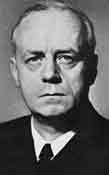
Joachim von Ribbentrop, the son of a German Army officer,
was born in Wesel, Germany,
on April 30, 1893. Educated at a boarding school at Switzerland he also
spent time in France and England as a child.
In 1911 he began working as clerk with a German importing
firm based in London before moving to Canada where he worked as a timekeeper
on the reconstruction of the Quebec Bridge and the Canadian Pacific
Railroad. This was followed by employment as a journalist in New York
City and Boston.
On the outbreak of the First World War, Ribbentrop
returned to Germany where he joined the German Army. While serving with
the 125th Hussar Regiment, he won the Iron Cross. After being seriously
wounded in 1917, Ribbentrop joined the War Ministry and was a member
of the German delegation that attended the Paris Peace Conference.
After leaving the German Army, Ribbentrop worked as
a salesman for the French firm of Pommerey in the Rhineland. He later
became a partner in a Berlin sales agency.
In May 1932, Ribbentrop joined the National
Socialist German Workers Party (NSDAP). He quickly moved up the
hierarchy and, in 1933, became Hitler's foreign affairs adviser. The following year he established the Ribbentrop
Bureau an organization that eventually had a staff of 300 people.
Adolf Hitler appointed Ribbentrop as the ambassador to London in August 1936. His
main objective was to persuade the British government not to get involved
in Germany territorial disputes and to work together against the the
communist government in the Soviet Union.
When Ribbentrop presented his credentials to George
VI on February 5, 1937, the British were outraged when he gave the Hitler
salute. He also upset the British government by posting Schutz
Staffeinel (SS) guards outside the German Embassy and by flying swastika flags on official
cars.
On February 4, 1938, Ribbentrop replaced Constantin
von Neurath as Germany's foreign minister. He worked closely with
Adolf Hitler in his negotiations with the British and French governments
and in August 1939 arranged the signing of the Nazi-Soviet Pact.
In 1940, Hitler once again began to consider invading
the Soviet Union and he sent Ribbentrop to negotiate a new treaty with
Japan. On September 25, 1940, Ribbentrop sent a telegram to Vyacheslav
Molotov, the Soviet foreign minister, informing him that Germany, Italy
and Japan were about to sign a military alliance. Ribbentrop pointed
out that the alliance was to be directed towards the United States and
not the Soviet Union.
Molotov already knew about the proposed German-Japanese
Pact. Richard Sorge, a German journalist working in Tokyo, was a Soviet
spy and had already told Molotov that Adolf Hitler was involved in negotiations
with Japan. In Sorge's view, the pact was directed against the Soviet
Union but it was not until December 1940, that he was able to send Molotov
full details of Operation Barbarossa.
Rippentrop became a background figure during the Second
World War but was arrested and charged with war crimes in June 1945.
Joachim von Ribbentrop denied knowledge of German concentration
camps and racial extermination policies, but was found guilty at
the Nuremberg War Crimes
Trial and was executed on October 16, 1946.